

Got Paid in Cash? Here’s Why IRCC Issues Procedural Fairness Letters And Potentially Refuse Your PR Application (And Exactly What to Do About It)
You did the work.
You earned the money.
You have the reference letter from your employer.
But suddenly, IRCC is questioning whether your work experience even exists, just because you were paid in cash.
If this sounds familiar, you’re not imagining things.
Something fundamental shifted at Immigration, Refugees and Citizenship Canada in 2025. And if you’re an Express Entry candidate or PR applicant whose employment was remunerated in cash, whether that’s Canadian work experience or foreign work experience, you need to understand this change RIGHT NOW.
The truth is: Cash payment is completely legal in Canada. But IRCC’s operational practices have evolved faster than the law, creating a new reality where cash-based employment is treated as “high-risk evidence” requiring extraordinary proof.
This isn’t a minor policy tweak. It’s affecting thousands of genuine applicants with legitimate work histories, especially in hospitality, construction, retail, cleaning services, and the skilled trades.
The best part? You can still overcome this scrutiny. But only if you understand exactly what IRCC now demands and build your evidence strategy accordingly.
Let me break down everything you need to know.
Key Takeaways: What You Need to Know Right Now
- IRCC has administratively reclassified cash-paid employment as high-risk evidence in 2025, not through law changes, but through operational practice driven by anti-fraud mandates
- A standard reference letter is NO LONGER sufficient for cash-paid work claims; you now need a multi-layered evidence package with government and financial institution records at the top
- The strongest proof hierarchy: Official tax documents and bank statements showing regular deposits > Employment contracts and pay stubs > Sworn affidavits and contextual explanations
- Procedural fairness violations are occurring, and many applicants are being refused WITHOUT receiving a Procedural Fairness Letter (PFL), which is legally vulnerable
- Misrepresentation vs. insufficient evidence matters: A finding of misrepresentation carries a 5-year ban; strategically, it may be better to withdraw weak claims than risk this outcome
- Judicial review at the Federal Court is your primary recourse if refused, particularly on grounds of procedural fairness breach or unreasonable decision-making
- This affects specific groups disproportionately: Workers from countries with large informal economies and Canadian workers in cash-heavy industries (hospitality, construction, retail)
What You’ll Find on This Page
1. What Changed in 2025: IRCC’s Unwritten Policy Shift on Cash Work
Here’s what happened.
For years, literally YEARS, Express Entry candidates and PR applicants successfully used well-drafted employer reference letters to prove their work experience. Even when wages were paid in cash.
IRCC was flexible. They understood that certain industries operate on cash. Restaurants. Construction. Retail. Freelance work. Small businesses.
As long as the reference letter was detailed and credible, most applications sailed through.
Then 2025 hit.
Immigration practitioners and lawyers across Canada started reporting the same pattern: Applications with cash-paid work experience were being refused at unprecedented rates.
Not because of suspicious documents. Not because of obvious fraud indicators.
Simply because the remuneration was in cash.
What Makes This So Frustrating
This isn’t a change to the Immigration and Refugee Protection Act (IRPA). It’s not in the Regulations. There’s no official Operational Bulletin announcing new requirements.
It’s an administrative shift in how officers assess evidence.
Cash-based employment claims now trigger what IRCC internally treats as “high-risk verification protocols”, the same level of scrutiny previously reserved for applications with clear red flags.
Think about that.
You worked. You were paid legally. Your employer can verify everything.
But because that payment happened in cash instead of via direct deposit, your entire work history is now presumed questionable until you prove otherwise.
The Reality on the Ground
Immigration officers are now specifically trained to identify potential fraud in cash-based claims. They’re contacting employers to verify reference letters. They’re cross-referencing dates and duties. They’re looking for any inconsistency as evidence of “manufactured employment.”
And here’s the kicker: Many genuine applicants are being caught in this net because they don’t realize the rules have changed.
They submit the same reference letter format that worked for thousands of applicants before them.
And they get refused.
2. Why This Is Happening: The Anti-Fraud Mandate Driving New Scrutiny
Let’s be clear: IRCC isn’t doing this to be mean.
They’re responding to a legitimate problem: immigration fraud.
The Fraud Challenge
Cash payments create a documentation gap. Unlike bank transfers or payroll deposits, which generate automatic third-party audit trails, cash transactions leave almost no traceable footprint.
This creates an opportunity for fraud:
- Fictitious employers issuing fake reference letters
- Real employers exaggerate duties or employment duration for a fee
- Complete fabrication of work experience to meet Express Entry eligibility
And this fraud undermines the integrity of Canada’s entire economic immigration system.
When people game the system with manufactured credentials, they’re not just breaking rules; they’re taking spots from genuine applicants who deserve them.
IRCC’s Response: The Verification Crackdown
To combat this, IRCC implemented department-wide “program integrity” initiatives. Officers now have:
- Specific anti-fraud training
- Protocols for verifying document authenticity
- Authority to contact employers and issuing authorities directly
- Internal guidance treating cash-based claims as inherently higher risk
The problem? This blunt-instrument approach doesn’t distinguish between:
- Fraudulent cash-paid claims (the actual target)
- Legitimate cash-paid employment with weak documentation (collateral damage)
- Legitimate cash-paid employment with STRONG documentation (what we’re building for you)
The Legal vs. Operational Reality
Here’s what the law actually says:
The IRPA defines “work” as any activity for which wages are paid or commission is earned. Period.
It does NOT specify a payment method.
Cash is as legally valid as direct deposit. Always has been.
But here’s where it gets tricky: The law gives immigration officers significant discretion in assessing evidence credibility. And officers are now exercising that discretion to create a de facto policy requiring electronic payment verification, even though no such requirement exists in law.
This is an administrative practice outpacing legislation.
And it creates a huge problem: The “rules” aren’t actually written down anywhere.
You can’t read an official document that says, “Here’s exactly what we need for cash-paid work.” You just… get refused, and then you’re supposed to figure it out.
That’s not fair. But it IS the current reality.
3. The Evidence Hierarchy: What IRCC Actually Wants to See
Let’s get tactical.
If IRCC now treats cash-paid work as high-risk, what evidence actually satisfies them?
Based on legal analysis of recent cases, practitioner reporting, and IRCC’s operational behavior, here’s the hierarchy:
TIER 1: Official Government and Financial Institution Records
(The Gold Standard: Highest Credibility)
These documents are at the top because they’re independently verifiable and nearly impossible to fabricate.
Tax Documents:
- For Canadian work: T4 slips (Statement of Remuneration Paid) and Notices of Assessment (NOA) from the Canada Revenue Agency
- For foreign work: Official tax filing documents from your country’s taxation authority
- Why they work: They prove you reported the income to a government body, which immediately counters suspicions of “under-the-table” work
Bank Statements:
- Official statements from a recognized financial institution showing consistent, regular deposits that match your claimed salary and pay frequency
- Critical requirement: The pattern must be logical. If you claim weekly $800 payments, statements should show weekly $800 deposits during your employment period
- Pro tip: Annotate your statements (highlight relevant deposits) and explain the correlation in a cover letter
The brutal truth: If you have ZERO tax records and ZERO bank statements showing income deposits, your application is in serious trouble.
TIER 2: Formal Employer-Generated and Third-Party Records
(High Credibility: But No Longer Sufficient Alone)
The Reference Letter (Still Mandatory, But Insufficient):
Your letter MUST include:
- Your full name and job title
- Detailed duties that align with the NOC code’s lead statement and main duties
- Exact start and end dates of employment
- Hours worked per week (to prove full-time or part-time status)
- Annual salary or hourly wage
- Explicit statement of payment method: “Employee was remunerated in cash on a [weekly/biweekly] basis”
- Supervisor’s name, title, signature, and verifiable contact information
Employment Contract or Letter of Appointment:
- A signed contract created BEFORE you started working is powerful corroborating evidence
- Shows the terms were established before immigration was even contemplated
Pay Slips/Pay Stubs:
- Even for cash payments, many jurisdictions legally require employers to provide pay slips
- Should itemize: gross pay, deductions (if any), net pay
- A complete series covering your employment period is extremely valuable
TIER 3: Ancillary and Contextual Evidence
(Supporting Credibility: Critical When Tier 1 Is Weak)
Sworn Affidavits:
- Notarized statements from supervisors, senior colleagues, or clients
- Made under oath, corroborating your job title, duties, dates, and the cash payment practice
- Recommendation: Get at least TWO: one from a supervisor, one from a colleague
Internal Company Records:
- Payroll ledgers
- Attendance logs
- Timesheets
- Staff shift rosters
Letter of Explanation:
- YOUR narrative explaining why the payment was in cash
- Cite industry norms (“Cash tips are standard in the restaurant industry”)
- Cite regional factors (“Banking infrastructure was limited in [region]”)
- Cite employer practice (“Small family business operating primarily in cash”)
Proof of Employer’s Legitimacy:
- Business registration documents
- Operating license
- Corporate filings
- Company website or social media presence
TIER 4: Applicant-Generated Explanations
(Low Individual Weight: But Essential for Context)
- Letter of Explanation (your detailed narrative)
- Annotated bank statements (highlighting relevant deposits)
- Personal work logs or journals (lowest credibility, use only to supplement)
4. Building Your Defense: The Multi-Layered Documentation Strategy
Here’s the framework that gives you the best chance of success.
Step 1: Adopt the “High-Risk” Mindset
From Day 1, treat ANY cash-paid work experience as high-risk.
Do NOT assume a reference letter is enough. That era is over.
Your goal: Provide so much credible, corroborating evidence that the officer has no reasonable basis to doubt your claim.
Step 2: Gather Tier 1 Evidence First
Tax documents and bank statements are non-negotiable.
If you have Canadian work experience:
- Request T4 slips from your employer (they’re required to provide them)
- Access your NOA from CRA through My Account
- Obtain bank statements for the full employment period, showing deposits
If you have foreign work experience:
- Identify your country’s equivalent of Canadian tax filing documents
- Request official copies from the taxation authority
- Ensure they’re translated by a certified translator if not in English/French
If you don’t have bank statements:
- Request historical statements from your bank (many banks retain records for several years)
- If deposits weren’t made, be prepared to explain why in your Letter of Explanation
Step 3: Build Your Tier 2 Foundation
Reference Letter Checklist:
- Printed on official company letterhead
- Includes ALL mandatory elements (name, title, duties, dates, hours, salary, payment method)
- Duties align specifically with your NOC code
- Supervisor information is complete and verifiable
- Explicitly states “paid in cash”
Additional Tier 2 Documents:
- Employment contract or appointment letter
- Complete set of pay stubs covering the employment period
- Any official employer documents referencing your role
Step 4: Strengthen With Tier 3 Evidence
Affidavit Strategy:
- Identify 2-3 people who can swear to your employment and duties
- Have statements notarized
- Include their relationship to you and how they can verify the information
Contextual Explanation:
- Draft a Letter of Explanation that tells a coherent story
- Explain industry norms, regional factors, or employer practices that made cash payment standard
- Link each piece of evidence to your narrative
Employer Legitimacy:
- Include business registration
- Include any licensing documents
- Include proof of ongoing operations (website, social media, business listings)
Step 5: The Consistency Check
Before you submit ANYTHING, do this:
Create a spreadsheet with columns for:
- Document type
- Job title listed
- Start date
- End date
- Salary amount
- Hours per week
- Duties described
Fill it out for EVERY document you’re submitting.
Then check: Do all the details match EXACTLY?
Any discrepancy, even minor, is a red flag. Fix it before submission.
The Evidence Package Structure
Organize your submission like this:
- Cover Letter / Letter of Explanation (your roadmap)
- Table of Contents (with page numbers)
- Tier 1 Evidence (tax and bank documents)
- Tier 2 Evidence (reference letter, contract, pay stubs)
- Tier 3 Evidence (affidavits, internal records, employer legitimacy proof)
- Supporting Explanations (your contextualized narrative)
Use tabs, clear labels, and page numbers. Make the officer’s job EASY.
5. Responding to a Procedural Fairness Letter About Cash Work
Getting a Procedural Fairness Letter (PFL) feels terrifying.
But here’s the reality: It’s an opportunity to save your application.
A PFL means the officer has concerns but is giving you a chance to respond before refusing. Many applicants don’t even get this courtesy (which is actually a procedural fairness violation, more on that later).
What a PFL Looks Like
The letter will outline specific concerns:
- “You have not provided sufficient proof of remuneration.”
- “The reference letter duties appear generic or copied from NOC descriptions.”
- “We have concerns about the genuineness of your employment.”
- “We were unable to verify your employer’s existence.”
You typically have 30 days to respond. This deadline is FIRM.
Your PFL Response Strategy
Step 1: Deconstruct Every Concern
Read the PFL multiple times. Highlight EVERY specific concern, question, or doubt the officer raised.
Create a numbered list of each point.
Step 2: Structure Your Response Document
Use this framework:
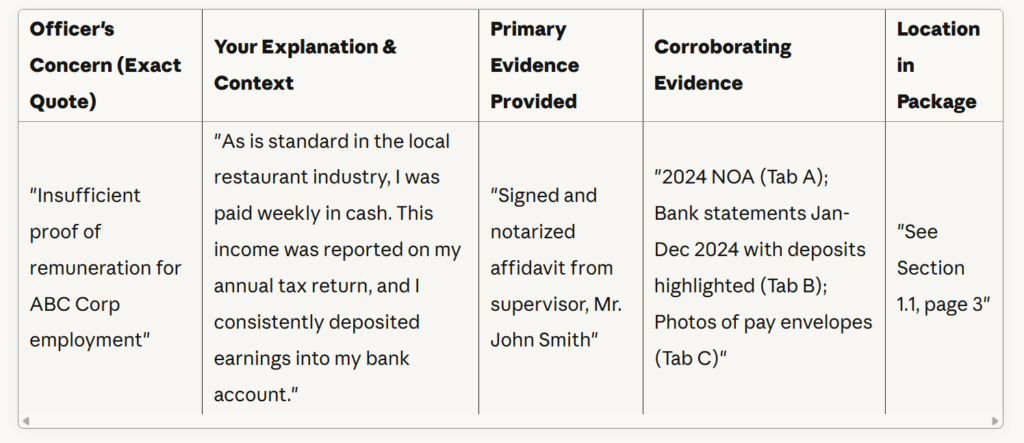
Step 3: Address Each Concern Directly
For EACH concern:
- Acknowledge it explicitly
- Provide a clear explanation with context
- Reference specific NEW evidence you’re including
- Link it back to your overall narrative
Step 4: Provide New Evidence
A PFL response is your chance to submit documents you didn’t include initially.
Prioritize:
- Any Tier 1 evidence you didn’t submit before
- Additional affidavits
- More detailed bank statements
- Internal company records
Step 5: Maintain a Respectful Tone
Do NOT argue with the officer. Do NOT use aggressive language.
Your tone should be: “I understand your concerns. Here is the clarification and additional evidence that addresses them.”
Common PFL Scenarios and How to Respond
Scenario 1: “Duties appear copied from NOC description”
Response strategy:
- Provide detailed project summaries showing specific work you did
- Include performance reviews referencing your duties
- Submit client emails or communications showing your responsibilities
- Have the supervisor provide an affidavit with MORE specific details about the unique aspects of your role
Scenario 2: “Unable to verify employer existence”
Response strategy:
- Provide business registration documents
- Include operating licenses
- Show proof of ongoing operations (website, social media, business listings)
- If the business is closed, provide documentation of when it operated
- Offer alternative verification methods (landlord confirmation, utility bills in the business name)
Scenario 3: “No proof of payment”
Response strategy:
- Submit tax returns showing reported income
- Provide bank statements with annotated deposits
- Include pay stubs or pay receipts if available
- Obtain an affidavit from the employer confirming the cash payment practice
- Explain industry or regional norms making cash standard
What NOT to Do in a PFL Response
❌ Ignore any of the concerns raised
❌ Submit the exact same documents again without additional evidence
❌ Use aggressive or accusatory language
❌ Miss the deadline
❌ Provide inconsistent information that contradicts your original application
❌ Fabricate or exaggerate evidence (this leads to misrepresentation of findings)
6. Your Legal Rights: When IRCC’s Decision Crosses the Line
Here’s something many applicants don’t realize:
IRCC officers are bound by legal duties. When they violate those duties, you have recourse.
The Duty of Procedural Fairness
Canadian administrative law requires decision-makers to follow “procedural fairness”, you have the right to:
- Know the case against you
- Respond to concerns before a decision is made
- Have your evidence considered fairly and reasonably
The PFL Requirement: When It’s Legally Mandatory
The Federal Court has consistently ruled that when an officer’s concern shifts from “sufficiency of evidence” to “credibility of evidence,” a PFL is legally required.
What does this mean?
Sufficiency concern: “You didn’t provide enough documents.”
- PFL may not be required (though it’s good practice)
Credibility concern: “We suspect these documents are fake or misleading.”
- PFL IS REQUIRED
For cash-paid work refusals, officers are almost always making credibility findings; they’re questioning whether the employment was genuine, whether documents are fabricated, whether it was “under-the-table” work.
That triggers the duty to issue a PFL.
The Alarming Trend: Refusals Without PFLs
Immigration lawyers are reporting a disturbing pattern: Many cash-paid work refusals are being issued WITHOUT a preceding PFL.
This is legally problematic.
The officer moves directly to refusal based on suspicions about credibility, without giving the applicant a chance to address those concerns.
This is a breach of procedural fairness—and it’s grounds for judicial review.
Challenging a Refusal: The Judicial Review (JR) Process
For Express Entry and most PR streams, there’s no appeal process. Your recourse is judicial review at the Federal Court of Canada.
What is judicial review?
- It’s NOT an appeal on the merits
- The court doesn’t substitute its own decision
- The court asks: “Was the decision-making process lawful, reasonable, and fair?”
Timeline:
- You typically have 30 days from receiving the refusal to file a leave application for JR
- This deadline is STRICT
Strong Legal Arguments for Cash-Work Refusals
1. Breach of Procedural Fairness
Argument: “I was refused based on credibility concerns about my cash-paid work, but IRCC never issued a PFL giving me a chance to address those concerns. This violates the duty of fairness established in cases like Taeb v Canada.”
This is often the strongest argument because procedural fairness violations are serious.
2. Unreasonable Decision
Argument: “The officer ignored substantial corroborating evidence (tax documents, bank statements, affidavits) and fixated solely on the absence of electronic payment records. This is unreasonable because the law doesn’t require any specific payment method. The decision is not justified, transparent, or intelligible.”
3. Error of Law
Argument: “The officer’s reasoning suggests they believe cash-paid work is inherently ineligible for PR purposes. This is an error of law, the IRPA does not prohibit cash remuneration.”
What Happens If You Win a Judicial Review
The court typically:
- Sets aside (cancels) the refusal decision
- Remits (sends back) your application to IRCC
- Orders a different officer to redetermine it
- Sometimes provides specific direction on how to assess the evidence
You get a second chance. With a clean slate. And IRCC knows the court found problems with their approach.
The Systemic Impact of JRs
Here’s the bigger picture:
Every time the Federal Court finds IRCC’s cash-work practices unreasonable or procedurally unfair, it creates legal precedent.
Enough successful challenges could force IRCC to:
- Formalize their guidance through an Operational Bulletin
- Train officers on proper procedural fairness application
- Adopt more balanced evidence assessment approaches
The judiciary may end up shaping the policy because IRCC hasn’t provided clear written guidance.
7. Risk Management: Misrepresentation vs. Insufficient Evidence
This is CRITICAL to understand.
There are two ways your application can fail:
- Insufficient Evidence: Officer isn’t satisfied you met program requirements
- Misrepresentation: Officer concludes you provided false or misleading information
The consequences are VASTLY different.
Insufficient Evidence
What it means: “We’re not convinced you have the required work experience.”
Consequences:
- The application is refused
- You can reapply immediately with stronger evidence
- No ban on entering Canada
- No permanent fraud record with IRCC
This is disappointing, but it’s NOT the end of the world.
Misrepresentation
What it means: “You lied or misled us, intentionally or not.”
Consequences:
- The application is refused
- 5-YEAR BAN from applying to come to Canada
- Permanent record in IRCC’s system, flagging you as having committed fraud
- Extremely difficult to overcome in future applications
This is DEVASTATING for your immigration prospects.
The Strategic Calculation
Here’s the uncomfortable truth:
If a particular period of employment is extremely weak and cannot be substantiated with credible Tier 1 or Tier 2 evidence, you may be better off NOT claiming it.
Why?
Because submitting questionable or potentially fabricated documents to “save” a weak claim creates misrepresentation risk.
It’s better to:
- Have your application refused for not meeting minimum work experience requirements (insufficient evidence)
- Reapply once you have additional work experience with proper documentation
- Preserve your long-term immigration eligibility
Than to:
- Submit weak or questionable evidence
- Risk a misrepresentation finding
- Face a 5-year ban and permanent fraud record
When to Consider Withdrawing a Claim
If you receive a PFL and realize:
- You genuinely don’t have strong evidence for a claimed period
- The evidence you submitted might be perceived as fabricated or exaggerated
- Responding might create inconsistencies that look like intentional deception
Consider:
- Admitting the evidence for that specific period is weak
- Offering to have that employment excluded from your work experience calculation
- Arguing that with it excluded, you may not meet program requirements, but at least you’re being honest
Sometimes the best strategy is honesty, even if it means refusal.
Protecting your long-term immigration record is more important than any single application.
When Misrepresentation Findings Happen
IRCC finds misrepresentation when:
- Documents are fake or altered
- Information is materially false
- Critical facts were concealed
- Even unintentional misrepresentation can result in a 5-year ban
If you’re unsure whether your evidence might be perceived this way, GET LEGAL ADVICE immediately.
8. Who This Affects Most (And Why That Matters)
This policy shift doesn’t impact everyone equally.
The groups hit hardest:
Workers from Countries with Large Informal Economies
Many of Canada’s top immigrant source countries have significant cash-based economies:
- Limited banking infrastructure in rural areas
- Cultural norms favoring cash transactions
- Small businesses operating informally
- Government tax systems that may not issue standardized documentation
If you’re from one of these countries, your legitimate skilled work experience might be extremely difficult to prove under IRCC’s new standards, even though the work was real and valuable.
Canadian Workers in Cash-Heavy Industries
Statistics Canada data show cash acceptance rates:
- Accommodation and food services: 91.3%
- Retail trade: 92.3%
Industries most affected:
- Restaurants and hospitality (servers, bartenders, cooks)
- Construction (especially subcontractors and laborers)
- Cleaning and janitorial services
- Day labor and temporary work
- Small retail operations
- Personal services (hair salons, etc.)
If you worked in these sectors in Canada, you’re facing the same scrutiny as foreign workers, despite having Canadian work experience.
Why This Creates a Policy Problem
Canada’s immigration system is designed to attract workers to fill labor market shortages.
Many of those shortages are in:
- Skilled trades
- Food services
- Healthcare support roles
- Agriculture
- Transportation
These are the EXACT industries where small businesses and cash payments are common.
The irony: IRCC’s verification approach may be filtering out the very workers Canada’s economy needs most.
The Express Entry Category-Based Selection Context
Canada recently introduced category-based selection for Express Entry, targeting workers in:
- Healthcare
- STEM
- Trades
- Transport
- Agriculture and agri-food
Many of these targeted occupations are found in small businesses and sectors with cash-based payment practices.
This creates a contradiction: Canada is prioritizing these workers through selection, but potentially rejecting them through verification.
9. What to Do Right Now: Your Action Plan
Okay. We’ve covered a LOT.
Here’s your actionable roadmap based on where you are in the process.
If You HAVEN’T Applied Yet and Have Cash-Paid Work Experience:
Step 1: Assess Your Evidence Strength
For EACH period of cash-paid employment, honestly evaluate:
- Do I have tax documents showing reported income?
- Do I have bank statements with regular deposit patterns?
- Can I get a detailed reference letter with verifiable supervisor contact?
- Do I have an employment contract or pay stubs?
- Can I obtain sworn affidavits from supervisors/colleagues?
Step 2: Determine Your Strategy
If you have strong Tier 1 evidence (tax + bank statements):
- ✅ Proceed with confidence
- Build a comprehensive multi-layered package
- Include detailed Letter of Explanation
If you have some Tier 1 evidence (either tax OR bank, but not both):
- ⚠️ Proceed with caution
- Compensate heavily with Tier 2 and Tier 3 evidence
- Consider getting professional legal review before submission
- Prepare for possible PFL
If you have NO Tier 1 evidence:
- 🛑 High risk
- Seriously consider whether claiming this experience is worth misrepresentation risk
- If you proceed, you MUST have exceptional Tier 2 and Tier 3 evidence
- Strongly recommended: Get legal advice before submitting
Step 3: Build Your Package Proactively
Don’t wait for an ADR or PFL. Submit everything upfront:
- Comprehensive Letter
Retry
A
Continue
of Explanation
- ALL Tier 1 evidence you can obtain
- Complete Tier 2 documentation
- Multiple Tier 3 corroborating documents
- Clear organization with tabs and index
Step 4: Consider Getting Professional Help
Given the high stakes and unclear standards, this is NOT the time to DIY if you’re uncertain.
A qualified immigration lawyer or consultant can:
- Assess your evidence objectively
- Identify gaps and suggest solutions
- Draft a compelling narrative
- Maximize your approval chances
- Protect you from misrepresentation risk
If You’ve ALREADY Applied and Are Worried:
Step 1: Review What You Submitted
Pull up your application and honestly assess:
- What evidence did you provide for cash-paid periods?
- How strong is it based on the hierarchy we discussed?
- Are there any inconsistencies or gaps?
Step 2: Prepare for Possible Contact
IRCC might:
- Issue an Additional Document Request (ADR)
- Issue a Procedural Fairness Letter (PFL)
- Contact your employer directly for verification
- Refuse without contact (procedurally unfair, but happening)
Step 3: Gather Additional Evidence NOW
Don’t wait for an ADR or PFL. Start collecting:
- Tax documents if you didn’t submit them
- Bank statements covering employment periods
- Affidavits from supervisors and colleagues
- Any additional employer documentation
Have these ready so you can respond quickly if needed.
Step 4: Monitor Your Application Closely
- Check your IRCC account daily
- Ensure all contact information is current
- Respond immediately to any communication
- Note all deadlines in your calendar with alerts
If You’ve RECEIVED a PFL:
You have 30 days. Use them strategically.
Week 1: Analysis and Planning
- Deconstruct every concern in the PFL
- Identify exactly what additional evidence you need
- Determine if you can obtain it within the deadline
- Consider whether legal representation is needed
Week 2-3: Evidence Gathering
- Request tax documents from CRA or foreign tax authority
- Obtain bank statements
- Arrange for affidavits to be drafted and notarized
- Collect any additional employer documentation
- Draft your response framework using the table template provided earlier
Week 4: Response Preparation and Submission
- Finalize your written response addressing each concern
- Organize all evidence with clear tabs and labels
- Have someone review for consistency and completeness
- Submit well before the deadline (don’t wait until the last day)
CRITICAL: If you realize you CAN’T substantiate a claim:
- Be honest about it in your response
- Explain what happened (employer out of business, records lost, etc.)
- Consider conceding that specific employment period
- Focus on protecting yourself from misrepresentation findings
If You’ve Been REFUSED:
Step 1: Understand the Reason
Read the refusal letter VERY carefully:
- Was it insufficient evidence?
- Was it a credibility/genuineness concern?
- Was there any mention of misrepresentation?
Step 2: Determine If PFL Was Required
Ask yourself:
- Did the officer question the credibility or genuineness of my evidence?
- Did I receive a PFL before the refusal?
If NO PFL was issued for a credibility-based refusal, you may have strong grounds for judicial review.
Step 3: Act FAST on Judicial Review Timeline
You typically have 30 DAYS from receiving the refusal to file for leave to apply for judicial review at Federal Court.
This deadline is STRICT. Missing it means you lose your right to challenge the decision.
Step 4: Get Legal Advice Immediately
Judicial review is a specialized legal process. You need:
- An immigration lawyer experienced in Federal Court litigation
- Someone who can assess if you have strong grounds
- Quick action to meet the filing deadline
Don’t try to DIY a judicial review. The procedural requirements are complex.
Step 5: Consider Your Misrepresentation Risk
If the refusal included ANY language about:
- False information
- Misleading documents
- Misrepresentation
This is SERIOUS. Get legal advice before doing ANYTHING else.
A misrepresentation finding means a 5-year ban. You need professional guidance on:
The Bottom Line: You Can Overcome This, But Strategy Matters
Let’s bring this home.
Yes, IRCC’s 2025 approach to cash-paid work is frustrating.
Yes, it feels unfair when you worked legitimately and are being questioned anyway.
Yes, the lack of clear written guidance creates uncertainty and anxiety.
But here’s the truth:
Cash-paid work experience CAN still be successfully used for Canadian PR.
You just need the right evidence strategy.
The days of submitting a reference letter and hoping for the best are over. IRCC wants proof. Multiple types of proof. From independent sources.
What this means for you:
✅ If you have tax records and bank statements showing your cash income, you’re in a strong position. Build a comprehensive package, provide a clear context, and you have excellent approval chances.
✅ If you have some gaps in Tier 1 evidence, you can still succeed by compensating with exceptional Tier 2 and Tier 3 documentation, but you need to be meticulous and strategic.
⚠️ If you have weak evidence overall, you need to make a hard decision: Is claiming this experience worth the misrepresentation risk? Sometimes honesty about limitations is the better long-term strategy.
The Bigger Picture
This verification standard shift reveals a fundamental tension in Canada’s immigration system:
Program integrity vs. Access for genuine workers in cash-based sectors
Right now, the pendulum has swung heavily toward integrity measures, perhaps too far, given the procedural fairness issues emerging.
The Federal Court may ultimately force a recalibration through consistent rulings that IRCC’s current practices are procedurally unfair or unreasonable.
But until that happens, you need to navigate the system as it exists today, not as it should be.
Your Most Important Takeaway
The method of payment doesn’t determine the legitimacy of your work experience.
But your ability to PROVE that work experience through credible, multi-layered documentation will determine whether IRCC accepts it.
Understanding this reality and preparing accordingly is the difference between refusal and approval.
Frequently Asked Questions
1. Is cash payment illegal in Canada?
No. It’s completely legal for employers to pay employees in cash in Canada.
BUT, both the employer and employee have legal obligations:
Employer must provide pay slips, remit taxes, EI, and CPP contributions
Employee must report ALL income to CRA, regardless of payment method
What’s illegal is “under-the-table” work where income is concealed from tax authorities. IRCC’s scrutiny targets that, not a legitimate cash payment.
2. Why is IRCC suddenly treating cash work as suspicious?
Because cash transactions don’t create the same audit trail as electronic payments. This makes them vulnerable to fraud, fictitious employment claims, with fake reference letters.
IRCC’s anti-fraud mandate has led to treating ALL cash-based claims as high-risk, requiring extraordinary proof to overcome that presumption.
3. Can I still use cash-paid work for Express Entry?
Yes. The law hasn’t changed; cash remuneration is valid.
But you need to prove it with much more comprehensive documentation than before. Without strong evidence (especially tax records and bank statements), your application faces a serious refusal risk.
4. What if my employer paid me cash but didn’t give me pay stubs or T4s?
This creates a difficult situation.
Options:
– Request T4s from employer (they’re legally required to provide them)
– Access your tax history through CRA My Account
– Obtain bank statements showing deposits
– Get sworn affidavits from the employer and colleagues
– Provide extensive contextual evidence
If the employer operated illegally (not remitting taxes), that’s “underground economy” work; IRCC won’t accept it, even if you performed legitimate duties.
5. I was paid partly in cash tips and partly through payroll. How do I prove the cash portion?
This is common in hospitality.
Strategy:
– T4 will show your base wage (payroll portion)
– Declare ALL income (including tips) on your tax return
– Bank statements should show deposits of cash tips
– The reference letter should specify “Base salary of $X plus cash tips averaging $Y per week.”
– An employer affidavit confirming tip income is helpful
The key: Show you reported ALL income to CRA, not just the payroll portion.
6. What if I worked in a country where banking infrastructure is limited?
This is a recognized challenge, but IRCC’s standards don’t make exceptions.
Your strategy:
– Focus heavily on official tax documents from your country
– Explain the banking limitations in your Letter of Explanation
– Provide whatever financial records exist (even if not traditional bank statements)
– Use multiple sworn affidavits from supervisors and colleagues
– Include extensive employer legitimacy documentation
Context matters; explain regional norms, but still provide maximum possible documentation.
7. Should I withdraw my application if I realize my cash work evidence is weak?
It depends on the stage and the weakness.
Before submission: Yes, consider whether claiming the experience is worth the risk.
After submission, before PFL: You can withdraw, but this may not be necessary; wait to see if concerns are raised.
After PFL: Evaluate carefully:
– If you can obtain additional strong evidence, respond to the PFL
– If you genuinely can’t substantiate the claim and risk misrepresentation, consider conceding that employment period in your response
After refusal: If it was insufficient evidence (not misrepresentation), you can reapply with stronger evidence or additional work experience.
8. What’s the difference between an ADR (Additional Document Request) and a PFL?
ADR (Additional Document Request):
– The officer needs more information to make a decision
– Not necessarily indicating negative concerns
– Neutral tone
– You provide the requested documents
PFL (Procedural Fairness Letter):
– The officer has specific concerns or doubts about your application
– Indicates potential refusal if concerns aren’t addressed
– More serious
– You must address each concern directly and provide compelling evidence
A PFL is more serious and requires a strategic, comprehensive response.
9. How long does IRCC keep a record if I’m found to have misrepresented?
Permanently.
A misrepresentation finding:
– Results in a 5-year ban from applying to Canada
– Creates a permanent flag in IRCC’s system
– Must be disclosed in ALL future applications
– Will be scrutinized in any subsequent applications, even after the ban expires
This is why protecting yourself from misrepresentation findings is critical, even if it means accepting a refusal for insufficient evidence instead.
10. Can I appeal if my Express Entry application is refused?
No. There’s no appeal process for Express Entry or most economic PR streams.
Your recourse is judicial review at the Federal Court, challenging the decision on the grounds of:
– Procedural fairness breach (no PFL when required)
– Unreasonableness (decision not justified by evidence)
– Error of law (officer misapplied legal requirements)
You have 30 days from refusal to file for leave to apply for judicial review.
11. If I get refused, can I just reapply immediately?
It depends on the refusal reason:
Insufficient evidence: Yes, you can reapply once you have:
– Additional work experience with better documentation, OR
– Stronger evidence for the previously claimed experience
Misrepresentation: No. You face a 5-year ban.
Before reapplying after any refusal, consider:
– What will be different in the new application?
– Have you addressed the deficiencies?
– Do you have genuinely stronger evidence?
Don’t just resubmit the same weak application; it will be refused again.
12. How much does it cost to challenge a refusal through judicial review?
Legal fees typically range from $5,000 to $15,000+, depending on:
– Complexity of the case
– Lawyer’s experience and location
– Whether it proceeds to a full hearing
Filing fees with the Federal Court are additional (currently around $50-$75).
This is why prevention is better than litigation; investing in proper application preparation is far more cost-effective than judicial review.
13. What if my employer went out of business and I can’t get a reference letter?
This is challenging but not impossible.
Alternative evidence strategies:
– Contact former supervisors directly for personal affidavits
– Locate former colleagues who can provide sworn statements
– Obtain proof of the employer’s past existence (archived business registrations, old websites via Wayback Machine)
– Use tax documents showing you reported employment with that employer
– Provide any employment contracts, pay stubs, or internal documents you retained
– Bank statements showing deposits during the employment period
Explain the situation clearly in your Letter of Explanation.
14. Will IRCC contact my current employer if I’m still working there?
Possibly. IRCC has the authority to verify information by contacting employers.
If you’re concerned about your current employer knowing you’re applying for PR:
– Some programs allow you to exclude current employment from your work experience claim (if you have sufficient other experience)
– Consider whether the risk of employer contact outweighs the benefit of claiming that experience
– Ensure your employer contact is someone supportive of your immigration plans
IRCC is supposed to be discreet, but verification calls do happen.
15. What should I do if I realize there’s an error in my submitted application?
Act immediately:
Minor errors (typo, wrong date format):
– Use the IRCC web form to submit a correction
– Explain that it was a clerical error
– Provide the correct information
Significant errors (wrong job title, incorrect salary, missing employment period):
– Contact IRCC immediately through the web form
– Provide a detailed explanation
– Submit corrected documents
– Be prepared that this might trigger additional scrutiny
DO NOT ignore errors, hoping they won’t be noticed; if discovered, they’ll look like intentional misrepresentation.
Being proactive and honest about mistakes protects you.
Take Action: Don’t Navigate This Alone
Here’s what we’ve established:
Cash-paid work experience is legitimate. But proving it in 2025 requires strategic, comprehensive documentation that most applicants don’t realize they need.
The stakes are high:
- Get it right: PR approval and your Canadian future
- Get it wrong: Refusal, potential 5-year ban, permanent fraud record
This isn’t a situation where “close enough” works.
You need precision. Strategy. Professional-grade documentation. And often, expert guidance.
Work With Someone Who Understands This System
If you’re preparing an application with cash-paid work experience, facing a PFL, or dealing with a refusal, Amir Ismail can help you navigate this complex landscape.
With extensive experience in Canadian immigration law and a deep understanding of IRCC’s evolving verification standards, Amir provides:
✅ Strategic application preparation that front-loads the right evidence from the start
✅ Honest assessment of your evidence strength and approval chances
✅ Comprehensive PFL response strategies that address officer concerns systematically
✅ Judicial review expertise when IRCC’s decisions cross legal boundaries
✅ Risk management guidance protecting you from misrepresentation findings
Book a consultation today to discuss your specific situation and develop a winning strategy.
Final Thoughts: Your Work Has Value, Prove It the Right Way
You worked hard. You earned that income. Your experience has value.
Don’t let IRCC’s verification shift rob you of your PR dreams.
But also don’t let frustration lead you to submit weak evidence or take shortcuts that create misrepresentation risk.
The path forward requires:
- Understanding what IRCC actually wants (not what the law says, but what officers demand)
- Building comprehensive, multi-layered evidence packages
- Providing a clear context that addresses suspicions proactively
- Knowing when to seek professional help
- Protecting your long-term immigration eligibility above all else
Cash payment doesn’t make your work experience less legitimate.
But insufficient documentation will make it impossible to prove.
Now you know what to do.
Build your case strategically. Document thoroughly. Respond professionally if challenged.
And get the expert guidance that maximizes your chances of success.
Your Canadian permanent residence is still achievable; you just need to prove your work experience the right way for 2025’s verification standards.
The rules changed. Your strategy needs to change, too.
Make it happen.
Partner with Amir Ismail & Associates
Navigating Canadian immigration and licensing can be complex. Amir Ismail & Associates offers expert guidance and personalized support to transform your aspiration into reality.
Tailored Immigration Strategies
Express Entry optimization, PNP navigation, documentation excellence.
Licensing & Settlement Support
Guidance on credential recognition, connections to resources, pre-arrival planning.
With over 30 years of experience and a proven track record, we are committed to helping you achieve your Canadian dream.
Amir Ismail, RCIC # R412319