
Your Best PNP Option Strategy Just Died. Here’s What Actually Works in 2025 and 2026.
Key Takeaways
The game changed completely in 2025. Here’s what you need to know right now:
- Canada slashed PNP allocations by 50%: from 110,000 spots to just 55,000, forcing provinces to completely restructure their programs
- Saskatchewan and Ontario paused their main “no job offer” streams and haven’t conducted a single draw since September 2024
- Alberta is your best bet if you work in tech, healthcare, construction, agriculture, or aviation; they’re still running targeted draws every few weeks
- PEI technically accepts applications without job offers, but 95% of selections go to people already working in the province
- The 600-point provincial nomination boost is still the fastest way to guarantee your Express Entry invitation, if you can get it
- Your occupation matters more than your CRS score for provincial selection in this new landscape
- Federal policy changes mean provinces now prioritize temporary residents already in Canada; 75% of nominations must go to people already here
What You’ll Find on This Page
Why Everything Changed in 2025
Let’s start with the truth.
If you researched PNPs in 2024, almost everything you learned is now outdated.
In late 2024, the Canadian government made a decision that completely restructured provincial immigration. They cut PNP allocations in half. Just like that.
The reason? Housing pressure. Healthcare strain. Infrastructure concerns.
The numbers tell the story:
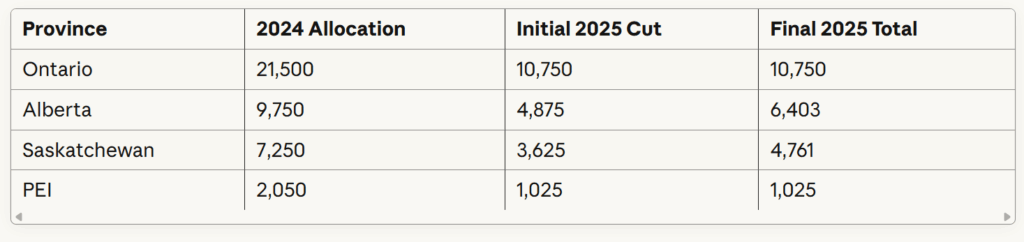
Alberta and Saskatchewan fought back and got partial increases. But the damage was done.
Here’s what happened next.
Provinces panicked. With half the nomination certificates, they couldn’t afford to gamble on overseas applicants who might not contribute immediately.
So they pivoted hard.
Saskatchewan and Ontario? They stopped inviting overseas applicants entirely through their main streams.
Alberta and PEI? They got hyper-focused on specific occupations and people already in the province.
But here’s the crucial part:
This isn’t necessarily permanent. Provincial allocations can change. Draws can resume. But you need to understand the current reality to make smart decisions right now.
The Provincial Nomination Game-Changer Explained
Before we dive into which provinces work, let’s talk about why provincial nomination matters so much.
The 600-point boost is magic.
Here’s the reality of Express Entry right now. Recent draws for candidates without provincial nominations require CRS scores in the high 400s to low 500s.
Let’s say you have:
- Master’s degree
- 5 years of skilled work experience
- IELTS 8777 (CLB 10)
- Age 29
Your CRS score? Around 475-480.
Strong profile. Still not enough.
You’re stuck. Indefinitely. Watching draw after draw pass you by.
Now add a provincial nomination.
Your score jumps to 1,075-1,080.
The next provincial nominee draw? You’re in. Guaranteed.
That’s the power we’re talking about.
This is why everyone wants a provincial nomination. This is why the competition for these spots is absolutely fierce right now.
The question isn’t whether provincial nomination helps.
The question is: How do you actually get one in 2025?
Alberta: Your Best Shot Right Now
Let’s be direct.
If you’re overseas without a job offer, Alberta is your most realistic option in 2025.
But there’s a catch. Actually, several catches.
How Alberta’s System Works
Alberta uses the Alberta Advantage Immigration Program (AAIP). The main pathway for overseas applicants is the Alberta Express Entry Stream.
Basic requirements:
- Active Express Entry profile
- Eligible for FSWP, FSTP, or CEC
- Minimum CRS of 300
That CRS requirement? It’s laughably low. Hundreds of thousands of people have 300+ scores.
So why isn’t everyone getting invited?
Because Alberta only invites specific occupations.
The Priority Sectors That Actually Get Invitations
Alberta runs targeted draws. Rarely general ones.
Look at the last six months of draws:
September – October 2025:
- Construction: 212 invitations across multiple draws
- Tech: 240+ invitations
- Healthcare: 196 invitations
- Agriculture: 71 invitations
- Law Enforcement: Less than 10
June – August 2025:
- Construction: 74 invitations
- Tech: 66 invitations
- Healthcare: 18 invitations
- Agriculture: 14 invitations
- Aviation: 40 invitations
Notice something? Zero general draws.
Every single draw targeted a specific sector.
Are You in a Priority Occupation?
This is the make-or-break question.
Tech occupations getting invitations:
- Software engineers
- Data scientists
- Cybersecurity specialists
- Web developers
- Database analysts
- IT system analysts
Healthcare occupations:
- Physicians (with Alberta job offers)
- Registered nurses
- Licensed practical nurses
- Medical technicians
Construction trades:
- Construction managers
- Electricians
- Plumbers
- Heavy equipment operators
- Carpenters
Agriculture roles:
- Farm supervisors
- Agricultural service contractors
- Specialized livestock workers
Aviation professionals:
- Pilots
- Aircraft maintenance engineers
- Air traffic controllers
Your Alberta Strategy
If your primary NOC code matches these sectors, here’s what you do:
1. Create your Express Entry profile
Make sure your profile lists the in-demand occupation as your PRIMARY work experience. Not secondary. Not additional. Primary.
2. Submit an Alberta EOI immediately
Don’t wait. Don’t overthink it. Alberta uses its own points grid that’s separate from your CRS score.
3. Optimize your Alberta points
The Alberta grid awards points for:
- Education level and location
- Work experience (total and Canada-specific)
- Language proficiency
- Family in Alberta (if applicable)
4. Monitor draws religiously
Alberta runs draws every 2-3 weeks. Check the AAIP website after each draw to see if your sector was targeted.
What If You’re Not in Priority Sectors?
Then Alberta isn’t your pathway right now.
I know that’s harsh. But I’d rather you spend energy on viable options than waste months hoping for a general draw that isn’t coming.
The data is clear. Occupation matters more than CRS score for Alberta selection in 2025.
Saskatchewan (SINP) and Ontario (OINP): Why They Went Silent
This section is shorter than it would’ve been in 2024.
Because there’s not much to say about programs that aren’t running.

Saskatchewan’s Indefinite Pause
Saskatchewan historically offered two popular pathways without job offers:
- Occupations In-Demand (OID) – Base stream
- Saskatchewan Express Entry – Enhanced stream
Both used the same EOI system. Both prioritized tech, finance, healthcare, and engineering roles.
Last draw: September 2024.
Draws since then: Zero.
It’s been over a year. The EOI pool is frozen. Applications aren’t moving.
Why the freeze?
Remember that 50% allocation cut? Saskatchewan went from 7,250 to 3,625 spots initially. They got 1,136 spots back, bringing them to 4,761.
But here’s the kicker: The federal government now requires 75% of provincial nominees to be temporary residents already in Canada.
Do the math. That leaves maybe 1,200 spots for overseas applicants. Total. For the entire year.
Saskatchewan’s response? Prioritize temporary residents through other streams. Pause overseas applicant invitations.
Ontario’s Strategic Pivot
Ontario operated three “no job offer” streams:
- Human Capital Priorities (HCP) – Express Entry aligned
- Masters Graduate Stream – For Ontario Master’s grads
- PhD Graduate Stream – For Ontario PhD grads
Draws in 2025: Zero across all three streams.
Last HCP draw: September 2024.
Last graduate draws: September 2024.
Ontario’s allocation dropped from 21,500 to 10,750. They made a strategic decision: Focus exclusively on Employer Job Offer streams.
Why? Risk management.
Every nomination certificate they issue to someone with a confirmed job offer is a guaranteed immediate economic contribution. No uncertainty. No risk of the person not coming or not finding work.
With half the spots, Ontario couldn’t afford to gamble.
Will These Programs Reopen?
Maybe. Eventually.
If federal allocations increase in 2026 or 2027, these streams could resume. The infrastructure still exists.
But for 2025 planning? Consider them closed.
What This Means for You
If Saskatchewan or Ontario were your strategy, you need a new plan.
Your options:
- Pivot to Alberta if your occupation matches their priorities
- Consider temporary residence first – Get into Canada through a work or study permit, then apply through provincial streams that prioritize people already here
- Expand your provincial research – Look at smaller provinces like Nova Scotia, New Brunswick, or Manitoba
- Improve your CRS score to compete in federal draws without a provincial nomination
- Wait strategically while monitoring for policy changes
The worst thing you can do? Keep refreshing Saskatchewan’s website, hoping for draws that aren’t coming.
PEI: The “Maybe” Option
Prince Edward Island is complicated.
Technically, PEI’s Express Entry stream doesn’t require a job offer.
Practically? It kind of does.
How PEI’s System Works
PEI runs monthly draws. Super predictable. They publish their draw schedule in advance.
Recent draw results:
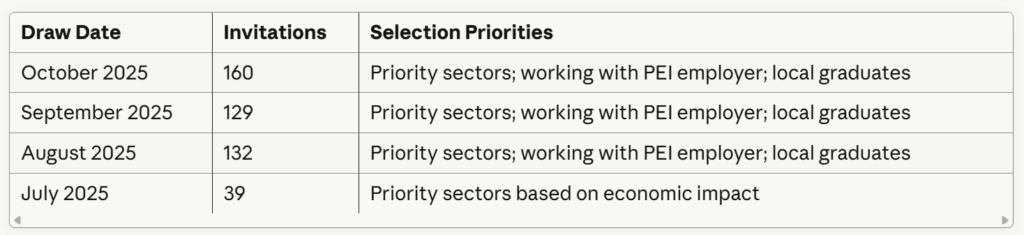
Notice the pattern?
Every single draw prioritizes “individuals working with a PEI Employer” and “local international graduates.”
The Catch-22
To get selected without a job offer, you basically need to be working in PEI.
To work in PEI, you need a work permit.
To get a work permit, you generally need… a job offer.
It’s circular.
Who Actually Gets PEI Nominations?
Based on selection patterns, successful candidates typically have:
- Current PEI employment (most important factor)
- PEI education credentials from UPEI or Holland College
- Work experience in priority sectors like healthcare, trades, or manufacturing
- At least 1 year of PEI work experience
The Strategic Use Case for PEI
PEI isn’t really a direct pathway from overseas.
It’s a second-step pathway.
The actual strategy:
- Get into PEI through a work permit or study program
- Work or study in the province for 6-12 months
- Build provincial connections and demonstrate commitment
- Apply through PEI’s Express Entry or Labour Impact streams
- Get prioritized in draws based on your provincial presence
This is a longer game. It requires initial temporary residence. But it works.
Should You Apply to PEI from Overseas?
You can. PEI won’t reject your application for being outside Canada.
But your chances of selection are very low unless you have exceptional adaptability factors like a close family in PEI.
Be realistic about this.
If PEI is your only strategy and you’re currently overseas, you’re probably setting yourself up for disappointment.
Which Province Matches Your Profile?
Let’s make this practical.
Here’s how to match your profile to viable pathways in the current landscape.
You Work in Tech
Best option: Alberta Accelerated Tech Pathway
Alternative: Monitor Ontario for potential future reopening (they heavily targeted tech in 2024)
Action: Create Alberta EOI immediately. Recent tech draws had minimum scores of 52-73 on the provincial grid.
You Work in Healthcare
Best option: Alberta Dedicated Healthcare Pathway (requires Alberta job offer for most roles)
Alternative: Look at smaller provinces like Nova Scotia or New Brunswick
Reality check: Healthcare has the most demand, but also requires licensing and job offers in most cases.
You Work in Construction Trades
Best option: Alberta Priority Sectors (Construction)
Why it works: Alberta ran the most construction draws in 2025, multiple draws per month with 15-121 invitations each.
Action: Ensure your NOC is correctly listed in your Express Entry profile.
You Work in Agriculture
Best option: Alberta Priority Sectors (Agriculture)
Draws: Less frequent than tech or construction, but consistent. 14-71 invitations per draw.
Consideration: Also, research Manitoba and Saskatchewan’s agriculture-specific streams for temporary residents.
You Work in Aviation
Best option: Alberta Priority Sectors (Aviation)
Pattern: Smaller draws (20 invitations) but specific targeting.
Who qualifies: Pilots, aircraft maintenance engineers, air traffic controllers.
You Work in Finance, HR, or Management
Current reality: Very limited options.
What happened: Saskatchewan and Ontario were the primary pathways for these occupations. Both are paused.
Your strategy:
- Maximize your CRS score for federal draws
- Consider pathways that start with temporary residence
- Research smaller provinces with less competition
- Be patient and monitor for policy changes
You’re a Recent Canadian Graduate
Current reality: Ontario’s graduate streams are paused.
Alternatives:
- Apply through the federal Express Entry if your CRS is competitive (500+)
- Look at provincial streams that prioritize Canadian education
- Consider Quebec if you’re bilingual
- Research Post-Graduation Work Permit strategies
You Have a Job Offer
You’re in a completely different category.
Most provinces prioritize, or exclusively select, candidates with job offers in 2025.
Your options: Ontario Employer Job Offer streams, Alberta’s various employer streams, or most other provinces’ job offer categories.
Your Action Plan for 2025-2026
Let’s bring this together.
Here’s what you actually need to do, step by step, based on everything we’ve covered.
Step 1: Occupational Assessment (This Week)
Action: Determine your primary NOC code and whether it aligns with Alberta’s priority sectors.
How:
- Review your work experience against Alberta’s targeted occupations
- Confirm your NOC code using Canada’s official NOC website
- Be honest about which occupation represents your PRIMARY experience
Decision point: If you’re in tech, construction, healthcare, agriculture, or aviation, continue to Step 2. If not, skip to Step 5.
Step 2: Express Entry Profile Creation (This Week)
Action: Create or update your Express Entry profile.
Critical details:
- Ensure your primary occupation is correctly listed
- Verify your educational credentials are properly assessed (ECA)
- Include your highest valid language test results (IELTS/CELPIP/TEF)
- Aim for a minimum CRS of 300 (higher is better, but not critical for Alberta)
Common mistake to avoid: Don’t list multiple occupations equally. Alberta’s system searches for candidates whose PRIMARY NOC matches their target.
Step 3: Alberta EOI Submission (This Week)
Action: Submit your Worker Expression of Interest to AAIP.
Focus areas:
- Maximize points for education (especially Canadian education)
- Document all relevant work experience
- Include any Alberta connections (family, previous work)
- Double-check language test results transfer correctly
Alberta points grid factors:
- Education level: Up to 10 points
- Location of education: Extra points for Canadian degrees
- Work experience: Up to 15 points
- Alberta work experience: Bonus points
- Language: Additional points for high proficiency
Step 4: Active Monitoring (Ongoing)
Action: Check AAIP draw results every 2-3 weeks.
What to track:
- Which sectors are getting invitations
- Minimum provincial scores for your sector
- Number of invitations issued
- Frequency of draws for your occupation
Where to find this: AAIP Updates page on Alberta’s official website.
Response strategy: If your sector gets drawn, evaluate your provincial score. If you weren’t invited but scores were close, look for ways to improve your Alberta EOI score.
Step 5: Backup Strategy Development (This Month)
If Alberta isn’t viable for you, create alternatives:
Option A: CRS Score Improvement
Focus on the federal Express Entry without provincial nomination:
- Retake language tests, aiming for CLB 10
- Complete additional education, a one-year Canadian diploma, adds significant points
- Gain additional work experience if under 3 years
- Consider spouse’s credentials if applicable
Target: Get your CRS above 500 for better federal draw chances.
Option B: Temporary Residence Pathway
Get into Canada first:
- Research work permit options (IEC, employer-specific permits)
- Investigate study programs under 2 years (maintains PR eligibility)
- Build provincial connections through temporary residence
- Apply to provincial streams after 6-12 months in Canada
Reality: This is longer but increasingly necessary given the 75% temporary resident priority.
Option C: Smaller Province Research
Expand beyond the “big four”:
- Nova Scotia (especially if you’re in healthcare)
- New Brunswick (entrepreneur and skilled worker streams)
- Manitoba (strong agriculture and manufacturing focus)
- Newfoundland (emerging tech sector)
Strategy: These provinces have smaller allocations but also less competition.
Step 6: Policy Monitoring (Monthly)
Action: Stay informed about policy changes that could reopen opportunities.
What to monitor:
- Federal PNP allocation announcements (usually announced annually)
- Provincial draw resumptions (especially Saskatchewan and Ontario)
- New targeted categories or pilot programs
- Changes to temporary resident prioritization rules
Resources:
- Official IRCC website
- Provincial immigration websites
Step 7: Professional Consultation Timing
When to consult an immigration professional:
Consult NOW if:
- You have a complex work history across multiple NOCs
- You’re unsure about your NOC classification
- You have previous Canadian immigration applications (refusals, withdrawals)
- You have admissibility concerns
- You’re over age 35 with declining age points
- You’re ready to invest in employer-based pathways
Consult LATER if:
- Your profile is straightforward
- You’re just starting research
- Your CRS score is below 400 (improve it first)
- You haven’t yet taken language tests
The Timeline Reality Check
Let’s be honest about timeframes.
If everything goes perfectly with Alberta:
- EOI submission: Week 1
- Draw invitation: 1-3 months (if your sector is targeted)
- Provincial nomination application: 2-3 months processing
- Express Entry ITA: Within days of provincial nomination
- PR application processing: 6-12 months
Total realistic timeline: 12-18 months from EOI to PR.
If you need temporary residence first:
- Work permit application: 2-6 months
- Time in Canada building profile: 6-12 months
- Provincial application: 2-4 months
- Express Entry: 6-12 months
Total realistic timeline: 2-3 years.
I’m not telling you this to discourage you.
I’m telling you so you can plan appropriately and set realistic expectations.
Frequently Asked Questions
Q: Can I submit EOIs to multiple provinces?
Yes. Absolutely. There’s no rule against this.
Smart strategy: Submit to every province where you might be eligible. Alberta, PEI, and any province that’s still running draws.
Important: Each province has its own separate EOI system. Your Alberta EOI doesn’t automatically go to PEI. You need to submit separately to each.
Q: If Saskatchewan and Ontario resume draws, will my old EOI still be active?
It depends.
Most provincial EOI profiles expire after 12 months of inactivity. If you submitted in late 2024, your profile may have expired.
What to do: Monitor official announcements.
Q: My CRS score is 440. Should I even bother with Alberta’s 300 minimum?
Your CRS score is separate from your Alberta provincial score.
Alberta doesn’t care that much about your CRS beyond the 300 minimum. They care about your provincial points based on their grid.
So yes, submit your Alberta EOI even if your CRS is “just” 440. If your occupation is targeted, you could get an invitation.
Q: I have 3 years of experience as a software engineer and 2 years as a project manager. Which should I list as my primary NOC?
List a software engineer as your primary.
Here’s why: Software engineers are explicitly targeted in Alberta’s Accelerated Tech Pathway. Project managers aren’t.
Your primary NOC determines which draws you’re visible in. Choose strategically based on provincial priorities.
Q: Can I apply for a work permit and provincial nomination at the same time?
Yes. These are completely separate processes.
In fact, it’s a smart strategy: Get a work permit to enter Canada while maintaining your provincial EOI. If you get a provincial nomination, great. If not, you’re building Canadian experience that helps with future applications.
Q: I applied to Saskatchewan in 2024 and never heard back. What do I do?
Your application is likely sitting in a frozen queue.
Your options:
– Leave it there and hope it draws a resume (costs nothing)
– Withdraw it and focus on active provinces (gives closure)
– Contact SINP to ask about status (may not get useful information)
My recommendation: Leave it, but don’t count on it. Build strategies around active provinces.
Q: Is the 75% temporary resident requirement permanent?
Unknown.
It was introduced in late 2024 as a response to specific policy concerns. It could change in 2026 or beyond if federal priorities shift.
What this means for you: Plan assuming current rules will continue for 2025-2026. Monitor for policy changes, but don’t bet your immigration plan on potential future changes.
Q: How quickly do I need to move to a province after getting a provincial nomination?
Important clarification: Provincial nomination doesn’t require you to move immediately.
The timeline:
1: Get provincial nomination
2: Receive Express Entry ITA (days later)
3: Submit PR application (60 days to submit)
4: Wait for PR approval (6-12 months)
5: Land in Canada as PR (usually have 12 months)
6: Live in the province of nomination (moral obligation, not legal for most provinces)
You generally have 12+ months from nomination to actually landing in Canada.
The Bottom Line
The PNP landscape in 2025 is fundamentally different than 2024.
What’s clear:
Alberta is the only major province consistently inviting overseas applicants without job offers, and only in specific sectors.
Saskatchewan and Ontario paused their main streams and show no signs of resuming soon.
PEI technically accepts overseas applicants but overwhelmingly prioritizes people already in the province.
What this means:
Your occupation matters more than your CRS score for PNP success.
Provincial nomination remains the most powerful Express Entry boost, if you can get it.
Many candidates will need temporary residence before permanent residence.
What you should do:
If you’re in Alberta’s priority sectors, act now. Submit your EOI this week.
If you’re not, develop a longer-term strategy that might include temporary residence or CRS score improvement.
Stay informed. Policies change. Allocations shift. New pathways emerge.
And most importantly:
Don’t put all your eggs in one basket. Have backup plans. Be flexible. Be strategic.
The path to Canadian PR isn’t easier in 2025. But it’s still possible.
You just need to know which doors are actually open.
Need Strategic Immigration Guidance?
Navigating Canada’s changing immigration landscape requires current information and strategic thinking.
For personalized guidance on provincial nominee strategies, alternative pathways, and realistic timeline planning based on your specific profile, contact Amir Ismail at www.amirismail.com/book-a-consultation.
With extensive experience in Canadian immigration law and a track record of helping clients navigate complex application strategies, Amir can help you:
- Assess which provincial pathways match your profile based on current draw patterns and priorities
- Develop backup strategies if your primary pathway isn’t viable
- Optimize your Express Entry and provincial profiles for maximum competitiveness
- Navigate temporary residence options as stepping stones to permanent residence
- Stay ahead of policy changes that create new opportunities
The immigration strategy that worked last year might not work this year. Make sure your plan matches current realities.
Book your consultation today to develop a strategic, data-driven approach to your Canadian immigration journey.
Explore More PNP and Express Entry Resources
Which Province Is Easiest to Get PR in Canada in 2026?
Which Province Is Easiest to Get PR in Canada in 2026? Last Updated: August 17,…

PGWP Refusal Rate Jumped to 21% in 2025: What Graduates Must Know
Last Updated: 16 August 2026 By Amir Ismail, RCIC #R412319 | Amir Ismail & Associates…
Express Entry Healthcare Draws 2026: Full CRS Breakdown
Express Entry Healthcare Draws 2026: Complete IRCC CRS Breakdown (169 to 475) Last Updated: September…

Practice-Ready Assessment Canada: Full IMG Guide 2026
Practice-Ready Assessment Canada: The Complete Pathway for International Medical Graduates, work permit and Permanent Residence…
IRCC’s proof of Canadian citizenship backlog tops 82,000 as Bill C-3 applications surge
IRCC’s proof of Canadian citizenship backlog tops 82,000 as Bill C-3 applications surge By Amir…

Latest Express Entry Healthcare Draw June 25, 2026: CRS 475 Explained (And What To Do Next)
Latest Express Entry Healthcare Draw June 25, 2026: CRS 475 Explained (And What To Do…
/patterns
Partner with Amir Ismail & Associates
Navigating Canadian immigration and licensing can be complex. Amir Ismail & Associates offers expert guidance and personalized support to transform your aspiration into reality.
Tailored Immigration Strategies
Express Entry optimization, PNP navigation, documentation excellence.
Licensing & Settlement Support
Guidance on credential recognition, connections to resources, pre-arrival planning.
With over 30 years of experience and a proven track record, we are committed to helping you achieve your Canadian dream.
Amir Ismail, RCIC # R412319