If your family has Canadian roots, stop right there. You may already be a Canadian citizen.
Not sure you qualify? Take our citizenship eligibility quiz or read the citizenship by descent guide.
Worried the law could be undone? Read our guide to Bill C-3 reversal risk.
The truth is, millions of Americans suddenly became eligible (or much closer to eligible) when Canada changed its law in December 2025.
The Canadian citizenship by descent law, known as Bill C‑3, is a 2025 reform that removed the “first‑generation limit” and expanded the ability of Canadians to pass citizenship to children and grandchildren born abroad.
Below is a simple, step‑by‑step checklist to help you:
- Spot your Canadian anchor ancestor (the first Canadian in your direct line).
- Understand whether you fall into Cohort 1 or Cohort 2 under Bill C‑3.
- See what documents you need as an American to prove your claim.
- Decide if it is worth applying now or getting professional help with a complex file.
Everything you want here exists on the other side of one decision: Are you willing to do the work to prove your Canadian roots?
Key Facts
If you were born before December 15, 2025, and have a Canadian parent, grandparent, or great‑grandparent, you may already be a Canadian citizen by law.
- If you were born on or after December 15, 2025, your Canadian parent needs at least 1,095 days of physical presence in Canada before your birth.
- Bill C‑3 removed the “first‑generation limit”, so you can now claim through grandparents and earlier generations.
- You prove your status by applying for a Proof of Citizenship (Form CIT 0001) with Immigration, Refugees and Citizenship Canada (IRCC).
For millions of Americans with Canadian heritage, the path to dual citizenship has never been more accessible. On December 15, 2025, the Canadian government enacted Bill C3, completely removing the restrictive “first generation limit” that previously blocked many Americans from claiming their ancestral rights.
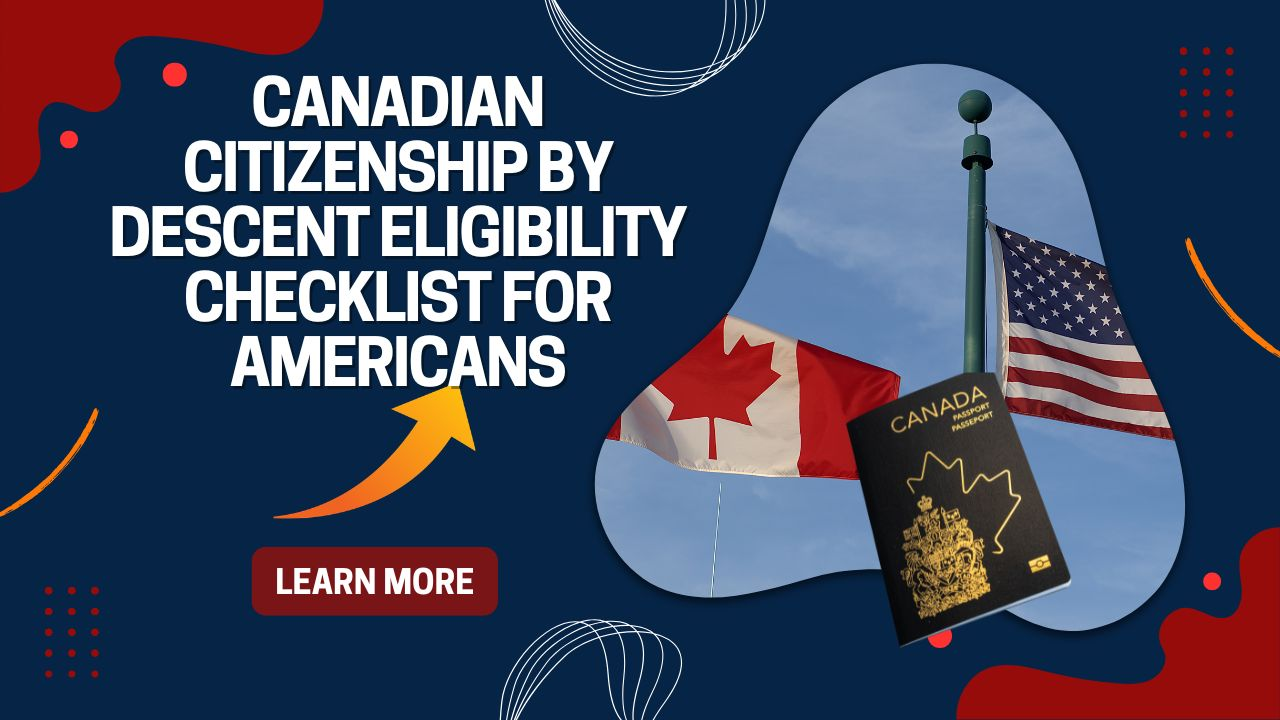
This comprehensive checklist will help you determine your eligibility based on the new rules, identify your Canadian “anchor ancestor“, and understand the exact requirements you need to secure your Proof of Citizenship.
What is the Canadian Citizenship by Descent Law (Bill C3)?
The Canadian citizenship by descent law (Bill C‑3) is the 2025 reform that removed the first‑generation limit and expanded the ability of Canadians to pass citizenship to children and grandchildren born abroad. It governs how nationality is passed down from a Canadian parent to a child born outside of Canada.
For Americans, this means that if any of your direct ancestors were Canadian citizens, there is now a much higher chance you qualify, even if you were born and raised in the United States.
Before December 2025, a strict law prevented Canadian citizens born abroad from passing their citizenship to their own children born abroad. This created “Lost Canadians” and fractured families. Following a major Supreme Court ruling, the government implemented Bill C3 to fix this inequality.
The new framework is entirely dependent on one specific date: December 15, 2025. Your eligibility rules change dramatically depending on whether you were born before or after this date. You can read a complete breakdown in our guide to Canadian citizenship by descent and Bill C3.
Who is Your Canadian Anchor Ancestor?
To begin your claim, you must identify your “anchor ancestor”. This is the original person in your family tree who was a recognized Canadian citizen.
You likely have an anchor ancestor if:
- One of them became a naturalized Canadian citizen at some point.
- Family records or stories mention a Canadian passport, Canadian military service, or living in Canada.
Example: If your grandmother was born in Toronto, your father was born in New York, and you were born in California before December 15, 2025, you may already be considered a Canadian citizen by descent.
You do not need to prove that this ancestor lived in Canada for a certain amount of time if you were born before the new legislation took effect. You only need to prove an unbroken chain of direct descent from this qualifying Canadian citizen down to yourself. It is also completely acceptable if your anchor ancestor held dual citizenship with the United States.
Which Eligibility Cohort Do You Belong To in Bill C-3?
Under the new Bill C3 rules, all applicants are divided into two distinct groups (cohorts). Finding your cohort is the most important step in your eligibility checklist.
Cohort 1: Born Before December 15, 2025 (Automatic Recognition)
Cohort 1 covers anyone born outside Canada before December 15, 2025, who can show a direct line of descent from a Canadian citizen.
If you were born outside of Canada before December 15, 2025, you are automatically recognized as a Canadian citizen by operation of law.
You do not need to demonstrate any physical presence or connection to Canada. You simply need to establish a continuous chain of descent from your Canadian anchor ancestor. Because your citizenship is automatic, you are technically not “applying” for citizenship. Instead, you are submitting an application for a Proof of Citizenship certificate to formally document the status you already hold.
Cohort 2: Born On or After December 15, 2025 (Substantial Connection Test)
Cohort 2 covers anyone born or adopted outside Canada on or after December 15, 2025; for these individuals, their Canadian parent must meet the Substantial Connection test.
If you were born or adopted outside of Canada on or after December 15, 2025, the rules are stricter. Citizenship transmission is no longer automatic.
To pass citizenship to you, your Canadian parent must pass the “Substantial Connection” test. This means your Canadian parent must prove they were physically present in Canada for a minimum of 1,095 days (approximately three years) at any point in their life before your birth.
Quick Comparison: Cohort 1 vs. Cohort 2
| Feature | Cohort 1 (Born before Dec 15, 2025) | Cohort 2 (Born on/after Dec 15, 2025) |
| Legal Status | Automatic recognition | Conditional upon parent’s connection |
| Physical Presence Required | None required | 1,095 days required (by the Canadian parent) |
| Ancestral Chain | Unbroken chain to Anchor Ancestor | Parent must prove the 1,095 days |
| Eligible ancestors | Parent, grandparent, great‑grandparent, and earlier in the direct line | Canadian parent only |
| Typical applicant | Adult American discovering Canadian roots later in life | Newborn or young child of a Canadian living in the US |
| Common refusal reason | Missing birth or marriage records to prove the chain | The parent cannot prove 1,095 days of presence in Canada |
| Main Challenge | Gathering historical vital records | Proving historical physical presence days |
Real-World Example for Americans
Imagine you were born in Chicago in 1992. Your father was born in New York, and your grandmother was born in Montreal. Under Cohort 1, you may already be a Canadian citizen by descent if you can prove the full chain from you to your Canadian anchor ancestor. In that case, you are not asking Canada to “grant” you citizenship; you are asking IRCC to issue Proof of Citizenship so your status is officially recognized.
Now, imagine your child was born in Texas in 2026. If you are a Canadian parent, your child may fall under Cohort 2, which means you must show at least 1,095 days of physical presence in Canada before the child’s birth. That is the difference between automatic recognition and a rule that requires proof of connection.
How Do I Calculate the Substantial Connection Test?
If you fall into Cohort 2, your Canadian parent must demonstrate 1,095 days of physical presence in Canada.
Unlike Canadian permanent residency, which requires days to be accumulated within a specific 5-year window, the Substantial Connection test has no such time limit. The 1,095 days can be accumulated at any point over your Canadian parents’ entire lifetime, as long as those days occurred before you were born.
A day counts if:
- It occurred before your child’s birth.
- You were not serving a criminal sentence in Canada on that day.
Applicants must use IRCC Form CIT 0555 to list each period of physical presence and calculate the total number of days in Canada. There is an exemption to this test if your Canadian parent was working abroad for the Canadian Armed Forces or public administration at the time of your birth.
What Documents Do Americans Need to Prove Citizenship?
Gathering evidence is the most rigorous part of the process. Because you must prove an unbroken chain, you need certified vital statistics records for every generation between you and your anchor ancestor.
A Proof of Citizenship certificate is an official document issued by Immigration, Refugees and Citizenship Canada (IRCC) confirming that you are a Canadian citizen under the law, even if you were born in the United States and have never lived in Canada.
For Americans, long‑form U.S. birth certificates and certified copies of U.S. naturalization records are usually required to prove the chain.
For each generation between you and your Canadian anchor ancestor, you should have:
- Marriage certificates where names changed.
- Your long-form birth certificate listing your parents
- Your parent’s birth certificates
- Your anchor ancestor’s birth certificate or naturalization record
- Proof of other nationalities acquired before 1977
Documents at a Glance for Americans
If your case involves complex generational tracing, read our comprehensive documents guide for Canadian citizenship by descent. If you need your documentation processed quickly due to an impending deadline, explore options for urgent processing of your Canadian citizenship certificate.
How to Assess Your Eligibility (Step-by-Step Checklist)
Answer these questions:
- Were you born outside Canada?
- Do you have a parent, grandparent, or great‑grandparent who was a Canadian citizen?
- Were you born before December 15, 2025?
- If you were born on or after December 15, 2025, did your Canadian parent spend at least 1,095 days in Canada before your birth?
- Can you collect birth and marriage records for each generation back to your Canadian ancestor?
If you answered “yes” to questions 1, 2, 3, and 5, you are very likely already a Canadian citizen by law and should apply for Proof of Citizenship (Form CIT 0001) to document your status officially.
If you answered “yes” to questions 1, 2, 4, and 5, and you were born on or after December 15, 2025, you may qualify through Cohort 2, provided your Canadian parent meets the Substantial Connection test.
- Locate your anchor ancestor. Identify the specific parent, grandparent, or great-grandparent who held Canadian citizenship.
- Determine your cohort date. Check your birth date. If you were born before December 15, 2025, move straight to step 4.
- Calculate the Substantial Connection (if applicable). If born on or after December 15, 2025, verify if your Canadian parent spent at least 1,095 days in Canada before your birth.
- Gather historical vital records. Secure certified long-form birth certificates (which explicitly list parentage) and marriage certificates for every single generation connecting you directly to your anchor ancestor.
- Submit Form CIT 0001. Prepare and submit the official Proof of Citizenship application to Immigration, Refugees and Citizenship Canada (IRCC).
- Decide if you need urgent processing.
- Plan next steps after receiving your certificate (passport, moving to Canada, sponsoring family).
In simple terms: If you were born before December 15, 2025, and you can prove your Canadian family line, you may already be a Canadian citizen. If you were born on or after that date, your Canadian parent must also prove 1,095 days of physical presence in Canada before your birth.
Not sure you qualify?
Take our Canadian citizenship eligibility quiz in about two minutes, read the Canadian citizenship guide, then Book a Strategy Consultation with Amir Ismail, RCIC R412319, to confirm your path.
Frequently Asked Questions (FAQs)
Do I have to pay Canadian taxes if I claim citizenship by descent?
Unlike the United States, Canada uses a residency-based taxation system rather than a citizenship-based taxation system. Generally, if you do not live in Canada or maintain significant residential ties there, you do not owe Canadian income tax on your global income simply by holding a passport.
How long does it take to get proof of Canadian citizenship?
As of 3 September 2026, IRCC shows a processing time of 33 months. However, Complex multigenerational claims that require extensive manual verification by IRCC officers are currently taking 25+ months due to the massive surge in applications from the United States.
Does claiming Canadian citizenship affect my American citizenship?
No. Both the United States and Canada legally recognize and permit dual citizenship. Claiming your ancestral Canadian citizenship will not cause you to lose your US passport or rights.
Can I get Canadian citizenship if my grandparent was born in Canada?
Yes. Under Bill C‑3, the first‑generation limit has been removed, so you can claim citizenship through a Canadian grandparent or great‑grandparent as long as you meet the cohort rules and can prove the family chain.
Is there a deadline to claim Canadian citizenship by descent under Bill C‑3?
No. There is currently no fixed deadline to claim Canadian citizenship by descent under Bill C‑3. As long as you meet the cohort rules and can prove your family chain to a Canadian anchor ancestor, you can apply for Proof of Citizenship at any time in the future. However, processing times may grow as more Americans discover their eligibility and file applications.
Can I pass Canadian citizenship to my children if I was born in the USA?
Yes. If you are recognized as a Canadian citizen by descent, you can generally pass your citizenship to children born outside Canada, but the rules depend on which cohort they fall under. Children born before December 15, 2025, are assessed under the Cohort 1 rules, while children born on or after that date must meet the Cohort 2 Substantial Connection test through you as their Canadian parent.
What if I do not qualify for Canadian citizenship by descent?
If you do not qualify for Canadian citizenship by descent, you may still have excellent options to live, work, or study in Canada through permanent residence or temporary status. Programs such as Express Entry, Provincial Nominee Programs, work permits, or study permits can offer you a pathway to eventually become a Canadian citizen, even without Canadian ancestry. It is often worth having your situation reviewed by a Regulated Canadian Immigration Consultant before you give up on your Canadian plans.
Disclaimer: The information provided in this article is for educational purposes only and does not constitute legal advice. Immigration policies are subject to change. For official government policy, please visit the IRCC homepage. Amir Ismail is a Regulated Canadian Immigration Consultant (RCIC #R412319).
If your case involves multiple generations or missing records, it is wise to work with a Regulated Canadian Immigration Consultant who understands Bill C‑3 in depth.
Access More Canadian Citizenship By Descent Resources

Section 8 Lost Canadians: Bill C-3 Gives Back Citizenship Lost at Age 28
Section 8 Lost Canadians: Bill C-3 Gives Back Citizenship Lost at Age 28 If you…

Bill C-3 Reversal Risk: Could You Lose Citizenship by Descent?
Bill C-3 Reversal Risk: Could You Lose Citizenship by Descent? By Amir Ismail, RCIC #R412319…
Proof of Canadian Citizenship Processing Time 2026 (33‑Month Wait and 136,000‑File Queue Explained)
Proof of Canadian Citizenship Processing Time 2026 (33-Month Wait and 136,000-File Queue Explained) By Amir…

Canadian Citizenship by Descent: Complete Document Guide (Bill C-3 2025)
Baptismal Records for Canadian Citizenship by Descent: 2026 Guide
Baptismal Records for Canadian Citizenship by Descent: A Complete Ordering Guide (2026) LAST UPDATED: AUGUST…
Six Wrong Reasons People Rule Themselves Out of Canadian Citizenship by Descent
Six Wrong Reasons People Rule Themselves Out of Canadian Citizenship by Descent By Amir Ismail,…

Married to a Brand-New Canadian Citizen? What Descent Does (and Does Not) Do for You
Married to a Brand-New Canadian Citizen? What Canadian Citizenship By Descent Does (and Does Not)…
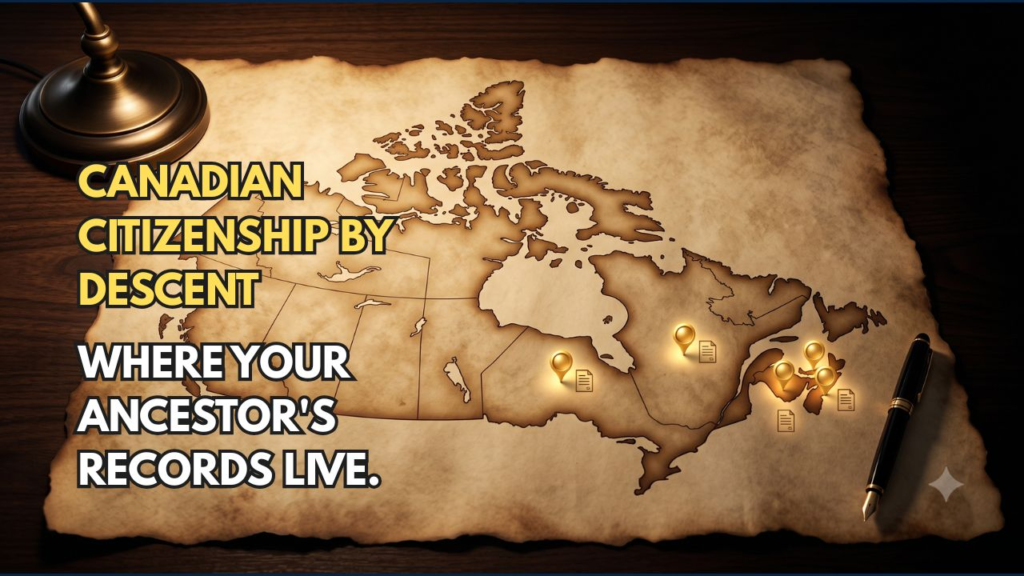
Canadian Vital Records for Citizenship by Descent: How to Find the Right Office in Every Province
Mandatory Vital Records for Canadian Citizenship by Descent (Canada‑Wide: Every Province, Every Office) By Amir…
Ancestor Birth Record Missing? IRCC Alternatives 2026
When the Birth Certificate Never Existed: Proving Your Canadian Ancestor’s Identity to IRCC By Amir…
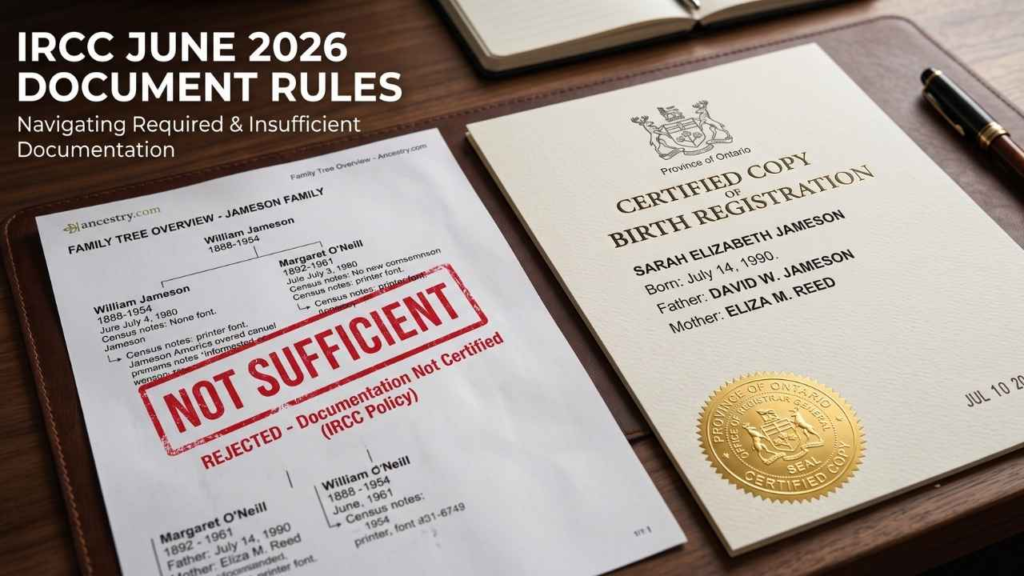
Ancestry Printouts Are Out: The Document Rules IRCC Rewrote for Citizenship by Descent in June 2026
Ancestry Printouts Are Out: The Document Rules IRCC Rewrote for Citizenship by Descent in June…
Canadian Citizenship by Descent Documents 2026: IRCC Rules to Avoid Refusal
Canadian Citizenship by Descent Documents 2026: New IRCC Rules You Must Follow By Amir Ismail…
Citizenship Certificate Surrender Notice Under Bill C‑3 (IRCC 2026): What It Means and What to Do
Citizenship Certificate Surrender Notice Under Bill C-3: What It Means and What to Do Last…
Search of Citizenship Records: How to Confirm Your Ancestor’s Canadian Citizenship
Search of Citizenship Records: How to Confirm Your Ancestor’s Canadian Citizenship By Amir Ismail, RCIC…

Canadian Citizenship by Descent for War Brides & Military Families (Bill C‑3, 2026)
Canadian Citizenship by Descent for War Brides & Military Families (Bill C‑3 Guide, 2026) LAST…