

PGWP Eligible Programs 2026: The Complete Guide to Avoiding Immigration Dead Ends

You’re planning to invest $50,000-$100,000 in a Canadian education.
You’re told that a study permit leads to a work permit. A work permit leads to permanent residence. Simple, right?
Not anymore.
Starting January 2026, Canada’s international student pathway has been completely restructured. The “open access” era is over. Thousands of programs that once led to Post-Graduation Work Permits (PGWP) now lead absolutely nowhere.
Choose wrong? You graduate, you leave. No work permit. No Canadian experience. No PR. Game over.
The truth is, Canada just eliminated the pathway for nearly half of all international students. Business diplomas? Gone. General management? Excluded. Hospitality programs? Dead end.
This isn’t a minor policy tweak. This is a complete reset.
Key Takeaways: What You Need to Know NOW
- Business and management diplomas at the college level are NO LONGER PGWP eligible starting November 2024 – if you’re enrolled in these programs, you won’t get a work permit after graduation
- Only university degrees (Bachelor’s, Master’s, PhD) are exempt from field restrictions – college diploma students MUST graduate from approved CIP code programs or face deportation
- Canada cut international student permits by 49% for 2026 (from 305,900 to 155,000) – getting approved is now exponentially harder
- Spousal open work permits eliminated for most students – only Master’s (16+ months), PhD, and specific professional degrees qualify
- Safe pathways exist in healthcare, trades, STEM engineering technology, and agriculture – these align with Canada’s 10-year labor shortage projections
What You’ll Find On This Page
What Changed With PGWP Eligible Programs in 2026?
The Post-Graduation Work Permit used to be simple: graduate from almost any program at a Designated Learning Institution, get an open work permit for 1-3 years.
That system is dead.
As of November 1, 2024, with full implementation in January 2026, PGWP eligibility now depends on what you study, not just where you study.
The New PGWP Rules
University degree graduates (Bachelor’s, Master’s, PhD): You’re safe. Any field of study qualifies for PGWP.
College diploma graduates: You MUST graduate from a program linked to an approved Classification of Instructional Programs (CIP) code on the government’s “eligible fields” list.
What’s a CIP code?
It’s a 6-digit number that classifies your program. For example:
- 51.3801 = Registered Nursing
- 46.0302 = Electrician
- 52.0201 = Business Administration (EXCLUDED)
If your college program’s CIP code isn’t on the approved list, you graduate with zero immigration options.
Why Did Canada Make These Changes?
The government’s Immigration Levels Plan 2026-2028 makes it clear: Canada is cutting temporary residents dramatically to stabilize population growth.
The data shows:
- International students admitted in 2026: 155,000 (down from 305,900 in 2025)
- That’s a 49% reduction in one year
- The goal: reduce the temporary resident population to below 5% of Canada’s total population by end of 2027
The message is blunt: Canada wants fewer students, but higher-quality students aligned with labor market needs.
Translation? Generic diploma mill programs are finished. Skills-based, shortage-aligned programs survive.
Which Programs Are Now Immigration Dead Ends?
Let me be direct: if you enroll in these programs at the college level, you’re walking into a trap.
The Red Zone: Programs That No Longer Lead to PGWP
1. Business and Management (Non-Degree)
This is the biggest casualty.
Excluded programs include:
- Business Administration
- International Business
- Human Resources Management
- Marketing
- Hospitality Management
- Tourism Management
- Supply Chain Management
- Event Management
The trap: Private and public colleges STILL market these programs aggressively. They’ll take your money. You’ll graduate in 2028 with a diploma and zero legal right to work in Canada.
Business programs used to account for 42% of all international student permits. Canada deliberately removed 178 fields to eliminate this volume.
Reality check: If you enroll in a 2-year Business Administration diploma at a Toronto college in 2026, you will graduate in 2028 with no PGWP. You cannot gain Canadian work experience. You cannot apply for permanent residence through the Canadian Experience Class. You must leave.
2. General Arts and Humanities (Non-Degree)
Excluded programs:
- General Arts and Science certificates
- Liberal Arts (if not leading to a university degree)
- Pre-Health certificates (if standalone)
The “pathway” lie: Many colleges sell these as “pathways” to university. If you don’t successfully transfer to a degree program, the standalone college certificate has ZERO immigration value.
Example: A “Pre-Health” certificate marketed as preparation for nursing. If you fail to get accepted into the competitive nursing degree program, you’re stuck with a useless certificate and no work permit.
3. Soft Tech and Design
Excluded programs:
- Digital Media Design (aesthetic focus)
- Web Design
- General IT Support
- Computer Systems (some programs under review)
The nuance: Not all “tech” is created equal. Generic web design and IT support roles are saturated. Even some “Computer Software and Systems Technology” programs may lose eligibility in future updates.
4. ALL Private Career College Programs
With very limited exceptions in Quebec, private career colleges remain completely ineligible for PGWP regardless of the subject.
Warning: Check the Designated Learning Institutions list carefully. Many private colleges have “University” or “College” in their name, but offer zero PGWP eligibility.
What Happens If You Choose Wrong?
The cascading failure looks like this:
Step 1: You graduate with your diploma (congratulations, you think)
Step 2: You apply for PGWP and get rejected (CIP code not eligible)
Step 3: You have 90 days after program completion to leave Canada
Step 4: No Canadian work experience = no Canadian Experience Class application possible
Step 5: No PGWP = no CRS points for Canadian education + work experience
Step 6: Forced departure. $50,000-$100,000 spent. Immigration dream over.
This isn’t theoretical. This is happening to thousands of students who enrolled in 2023-2024 before understanding these changes.
Which Programs Are Still PGWP Eligible and Safe?
The good news: clear pathways still exist. They just require strategic selection.
The Gold Standard: University Degrees
Bachelor’s degrees: Any field. History, English, and Business Administration at the university level, all eligible for PGWP.
Master’s and PhDs: Not only PGWP eligible, but:
- Exempt from study permit cap (Provincial Attestation Letter not required)
- Spouse eligible for open work permit (if 16+ months)
- Priority in Express Entry category-based draws
The insight: This creates a two-tiered system. University students buy immunity from CIP code restrictions. College students must navigate the approved list carefully.
PGWP-Eligible College Programs: The Safe List
These programs align with Canada’s 10-year labor shortage projections (Canadian Occupational Projections System 2024-2033).
Healthcare and Social Services
Status: HIGHLY SECURE
Eligible programs:
- Practical Nursing (LPN/RPN) – CIP 51.3801
- Pharmacy Technician
- Early Childhood Education (ECE)
- Medical Laboratory Technology
- Dental Hygiene
- Respiratory Therapy
- Paramedic
Why safe? Canada faces a severe healthcare worker shortage. 34 healthcare occupations are projected to be in deficit through 2033. These programs were explicitly protected and expanded in July 2025, with 119 new eligible fields added.
Critical detail: Your program must lead to licensure/registration. A “Healthcare Administration” diploma (business focus) is excluded. A “Nursing” diploma (clinical focus) is included.
Skilled Trades and Construction
Status: HIGHLY SECURE
Eligible programs:
- Electrician – CIP 46.0302
- Plumbing
- Welding – CIP 48.0508
- Carpentry
- HVAC
- Heavy Duty Equipment Technician
- Automotive Service Technician
Why safe? 28 trade occupations are in short supply. Infrastructure projects and housing construction drive continuous demand. The “Skilled Trades” Express Entry stream prioritizes these workers.
Example pathway:
- 2026: Enroll in Heavy Duty Equipment Technician at SAIT (Alberta)
- 2028: Graduate, get PGWP
- 2029: Work as an apprentice, validate TEER 2 experience
- 2030: Invited to apply for PR under Trades Category-Based Selection
STEM Engineering Technology
Status: SECURE
Eligible programs:
- Civil Engineering Technology – CIP 15.0201
- Mechanical Engineering Technician
- Electrical Engineering Technology – CIP 15.0303
- Chemical Technology
- Electro-mechanical Instrumentation
Why safe? These technologist/technician roles are the backbone of Canada’s industrial strategy. They’re less saturated than entry-level software development roles.
Warning: Be specific. “General Computer Science” at the college level may face scrutiny. “Civil Engineering Technology” is rock solid.
Agriculture and Agri-Food
Status: SECURE NICHE
Eligible programs:
- Sustainable Agriculture – CIP 1.0000 series
- Agricultural Technician
- Crop Production
- Horticulture
Why safe? Chronic labor shortages that domestic supply cannot fill. Food security is a national priority. These programs remain on the eligible list due to strategic importance.
Language Proficiency Requirements
Starting November 1, 2024, ALL PGWP applicants must prove language ability:
University graduates: CLB 7 (English) or NCLC 7 (French)
College graduates: CLB 5 (English) or NCLC 5 (French)
The trap: You might pass your courses but fail the CLB requirement for PGWP. A student with weak English who graduates from a lenient college program could be denied the work permit for failing CLB 5.
This makes language ability non-negotiable. Start preparing for IELTS/CELPIP/TEF now, not after graduation.
How Does the 2026 Study Permit Cap Affect Your Application?
Getting accepted to a college is no longer enough. You now need to fit within a drastically reduced national cap.
The Numbers
2026 international student cap: 408,000 total study permits (including new arrivals + extensions)
New arrivals only: 155,000 permits
Breakdown:
- Master’s/PhD (exempt from Provincial Attestation Letter): 49,000
- College/Undergraduate (PAL required): 180,000 allocated to provinces
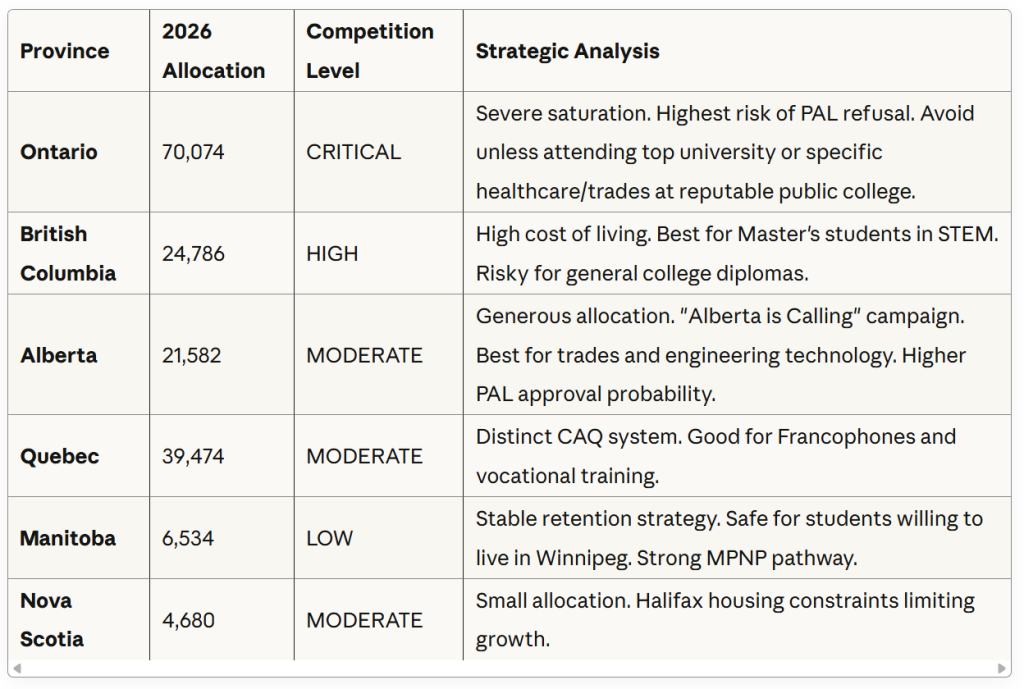
Provincial Allocations: Where Competition Is Fierce
The provinces with the highest historical volumes got the biggest cuts. Province 2026 Allocation Competition Level
What This Means For You
If you’re applying to Ontario, you’re competing for one of 70,074 spots in the province with the most DLIs. Unless you’re attending UofT, Waterloo, or a high-demand program at a reputable public college, your PAL approval odds are low.
If you’re applying to Alberta, you’re in a better position. Alberta’s allocation is generous relative to demand. Their immigration campaign prioritizes attracting students and skilled workers.
Strategy: Don’t just chase “brand name” provinces. Consider where your specific program has the best approval probability.
What About Spousal Work Permits?
This is where the 2026 changes devastate mature students and families.
The New Spousal Open Work Permit Rules (Effective January 21, 2025)
Spousal open work permits are now ONLY available if the primary student is in:
1. Master’s degree (16+ months duration)
2. Doctoral degree (PhD)
3. Specific professional degrees:
- Doctor of Medicine (MD)
- Doctor of Dental Surgery (DDS)
- Doctor of Optometry (OD)
- Doctor of Veterinary Medicine (DVM)
- Bachelor of Laws / JD
- Bachelor of Engineering (B.Eng)
- Bachelor of Science in Nursing (BScN)
- Bachelor of Education (B.Ed)
- Doctor of Pharmacy (PharmD)
What’s Excluded?
Undergraduate students: No spousal work permit (except professional degrees listed above)
College diploma students: No spousal work permit (even if PGWP-eligible program)
Master’s programs under 16 months: No spousal work permit
The Financial Trap
Scenario: You enroll in a 2-year Civil Engineering Technology diploma at a public college.
Student status: PGWP eligible (good program choice)
Spouse status: NOT eligible for an open work permit during your studies
Reality: Your family loses a potential second income for 2 years. You’re supporting yourself, your spouse, and possibly your children on savings alone. Financial strain becomes crushing.
Many families cannot afford this. The spouse must either:
- Get their own study permit
- Secure an employer-specific LMIA work permit (nearly impossible)
- Return to the home country
The Duration Trap for Master’s Students
Many accelerated MBA programs and Master of Data Science programs are 12-14 months.
If your Master’s is less than 16 months, your spouse CANNOT work.
You must specifically choose 16+ month programs to unlock spousal work rights.
After Graduation: SOWP for PGWP Holders
Once you graduate and get your PGWP, your spouse’s eligibility changes again.
Effective January 2026, spouses of PGWP holders only get a work permit if they’re working in:
- TEER 0 or 1 (Management/Professional), OR
- TEER 2 or 3 occupations on the labor shortage list
Translation: If you graduate and get a retail job (TEER 4/5) or a general admin job (TEER 3, not on the shortage list), your spouse cannot extend their stay as a worker.
Your family’s ability to remain in Canada depends on YOU securing a high-quality job immediately after graduation.
Which Province Should You Apply To?
The “one Canada” strategy is dead. You need a province-specific approach.
Ontario: The High-Risk Zone
Cap: 70,074 (severe restriction)
PGWP impact: Massive. Most affected by CIP exclusions.
PR pathway: OINP is oversaturated. The Ontario Immigrant Nominee Program suspended its Skilled Trades stream in late 2025 due to volume.
Verdict: Only viable for:
- University degree students at top institutions (UofT, Waterloo, McMaster, Queen’s)
- Healthcare/Trades at reputable public colleges (Algonquin, Seneca, George Brown)
Avoid: Private colleges entirely. Generic business/IT programs even at public colleges.
British Columbia: The Tech & Health Fortress
Cap: 24,786 (high restriction)
PGWP: BC has its own list for BC PNP Tech eligibility.
PR pathway: The BC PNP International Post-Graduate stream for Master’s in Science/Health/Engineering offers direct PR without a job offer. This is a SUPER GREEN pathway.
Verdict:
- Excellent for Master’s students in STEM
- UBC, SFU, UVic = premium options
- High risk for college diploma students (extreme cost of living + competition)
Alberta: The Opportunity Frontier
Cap: 21,582 (generous relative to population)
PGWP: Strong alignment with Trades and Engineering Technology programs.
PR pathway: Alberta Advantage Immigration Program (AAIP) is aggressive. The Dedicated Healthcare Pathway and Skilled Worker streams are active.
Verdict: BEST province for:
- Trades students (NAIT, SAIT)
- Engineering Technology students
- Healthcare workers willing to work in Calgary/Edmonton
The “Alberta is Calling” campaign is real. They want you.
Manitoba & Saskatchewan: The Retention Leaders
Cap: Stable allocations (MB: 6,534 / SK: similar)
PGWP: Programs align with local needs (Agriculture, Logistics, Trades)
PR pathway: The Manitoba Provincial Nominee Program (MPNP) and Saskatchewan Immigrant Nominee Program (SINP) rely on retention. Graduated, worked 6 months in the province, got nominated.
Verdict: The “safety school” option for PR.
If you’re willing to live in Winnipeg or Regina, your odds of PR are significantly higher than in Toronto or Vancouver.
The cost of living is lower. Competition is lower. Pathway is clearer.
Atlantic Canada: The Demographic Play
Cap: Small allocations (NS: 4,680 / NB: 3,726)
PR pathway: Atlantic Immigration Program (AIP) offers employer-driven PR.
Verdict:
- Good for university students (Dalhousie, Memorial University)
- Limited college capacity
- Excellent if you secure a job offer aligned with AIP
How Do You Ensure Your Program Leads to PR?
Getting a PGWP is halfway there. Permanent residency is the finish line.
The New PR Reality: Category-Based Selection
The Immigration Levels Plan 2026-2028 makes it clear: PR is no longer a volume game; it’s a strategic selection game.
General Express Entry draws (based only on CRS score) will likely have cutoffs of 530+. That’s out of reach for most college graduates without foreign work experience or French fluency.
The “general” draw is effectively a dead end for average students.
The 2026 PR Priority Categories
Canada’s category-based selection focuses on:
1. French-language proficiency (HIGHEST PRIORITY)
- Target: 9% of admissions in 2026, rising to 10.5% in 2028
- Golden ticket: Achieve NCLC 7 in French, bypass most other restrictions
2. Healthcare
- Continued acute need across all roles
3. STEM
- Science, Technology, Engineering, Math
4. Skilled Trades
- Construction and technical trades
5. Agriculture & Agri-Food
6. Transport
7. Potential new categories:
- Leadership/Senior Management
- Innovation
- Applied Science
The 10-Year Labor Market Forecast
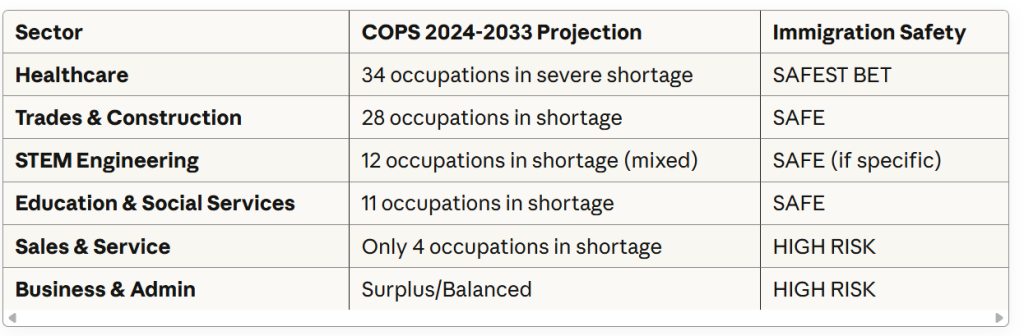
This data confirms: the exclusion of business and administrative programs isn’t temporary. It’s a 10-year structural realignment.
Students hoping for business diplomas “to come back” are betting against Canada’s own economic forecast.
The French Language Hack
Here’s the most powerful strategy:
Start learning French NOW.
Achieving NCLC 7 in French is the ultimate insurance policy against all other regulatory changes.
A student with:
- College diploma in ANY eligible field
- PGWP
- 1 year of Canadian work experience
- NCLC 7 French
…will get priority invitations over someone with a Master’s degree and zero French.
French proficiency is worth more than any credential.
Real-World Scenarios: Success vs. Failure
Let’s make this concrete.
Scenario A: The Business Diploma Trap
Profile: 23-year-old student from India
Choice: 2-year diploma in International Business at a private college in Brampton, Ontario
Timeline:
- 2026: Struggles to get Provincial Attestation Letter (Ontario cap + private college)
- Let’s say they get approved (unlikely)
- 2028: Graduates with a diploma
- 2028: Applies for PGWP → REJECTED (Business CIP code excluded)
- 2028: Must leave Canada within 90 days
Financial loss: $60,000+ in tuition + living costs
Immigration result: FAILURE. Zero pathway to PR.
Scenario B: The Trades Pivot
Profile: 25-year-old student from the Philippines
Choice: 2-year diploma in Heavy Duty Equipment Technician at SAIT (Alberta)
Timeline:
- 2026: Gets PAL (Alberta generous allocation)
- 2026: Approved for study permit
- 2028: Graduates from PGWP-eligible program
- 2028: Gets 3-year PGWP (program longer than 2 years)
- 2029: Works as an apprentice, gains TEER 2 experience
- 2030: Invited to apply for PR under Trades Category-Based Selection
- 2031: Permanent Resident
Financial result: Tuition investment recovered through work
Immigration result: SUCCESS
Scenario C: The University Degree (Safe but Expensive)
Profile: 19-year-old student from Nigeria
Choice: 4-year Bachelor of Arts in Psychology at the University of Alberta
Timeline:
- 2026: Study permit approved (university = lower refusal rate)
- 2030: Graduates with a Bachelor’s degree
- 2030: Gets 3-year PGWP (degree exemption from field restrictions)
- 2031: Works in social services (TEER 2), gains Canadian experience
- 2032: Applies for PR through Canadian Experience Class or PNP
- 2033: Permanent Resident
Financial result: Higher tuition ($120,000+) but guaranteed PGWP
Immigration result: SUCCESS (expensive but secure pathway)
Scenario D: The Master’s Power Couple
Profile: 28-year-old student from Brazil (married)
Choice: 2-year Master of Engineering at the University of British Columbia
Timeline:
- 2026: Primary applicant admitted to Master’s (16+ months)
- 2026: Spouse gets an open work permit
- 2026-2028: Spouse works full-time, supports family
- 2028: Primary applicant graduates
- 2028: Gets 3-year PGWP
- 2028: Works in TEER 0/1 role (professional engineer)
- 2029: Spouse continues working (primary in TEER 0/1 allows spousal renewal)
- 2029: Applies for BC PNP International Post-Graduate stream
- 2030: BOTH become Permanent Residents
Financial result: Spouse’s income offsets tuition costs
Immigration result: SUCCESS (family unit strategy)
Your Action Plan: What To Do Right Now
If You Haven’t Applied Yet
Step 1: Verify PGWP Eligibility
Use this decision tree:
Is it a university degree (Bachelor’s/Master’s/PhD)?
→ YES: You’re safe. Any field qualifies for PGWP.
→ NO: Continue to Step 2.
Is it a college program?
→ Check the CIP code on the IRCC field of study requirement page
→ If Business/Arts/Hospitality/Generic Management: DEAD END – DO NOT ENROLL
→ If Healthcare/Trades/STEM Engineering Tech/Agriculture: Proceed
Step 2: Verify SOWP Eligibility (If You’re Married)
Is it a Master’s degree, 16+ months, or a PhD?
→ YES: Your spouse can work
→ NO: Continue
Is it a professional degree (MD, Law, Engineering, Nursing, Pharmacy)?
→ YES: Your spouse can work
→ NO: Your spouse CANNOT work during your studies. Assess if this is financially viable.
Step 3: Choose Your Province Strategically
For College Diplomas:
- Avoid: Ontario, BC (cap saturation)
- Consider: Alberta (best odds), Manitoba, Saskatchewan
For University Degrees:
- More flexibility
- Consider a Master’s in BC for the International Post-Graduate stream (direct PR, no job offer needed)
Step 4: Start French Language Training
Regardless of your program, begin learning French NOW.
Target: NCLC 7 (equivalent to IELTS 6.0 in French)
This gives you the ultimate competitive advantage in Express Entry.
If You’re Already Studying
If you’re in a PGWP-eligible program:
- Continue
- Start building language skills (CLB 7 for university / CLB 5 for college)
- Research PR pathways for your field NOW, don’t wait until graduation
- Consider French training to open category-based selection doors
If you’re in a non-eligible program (Business, General Arts, excluded field):
You have three options:
Option 1: Transfer to an eligible program
- Check if you can transfer credits to a PGWP-eligible program
- This may extend your studies, but it saves your immigration pathway
Option 2: Pursue a university degree
- If you complete a degree, you bypass field restrictions
- Consider switching from a college diploma to a degree transfer program
Option 3: Finish program, return home, apply through a different pathway
- This is the harsh reality
- If you’re 1+ years into a non-eligible diploma, the money is spent
- Complete your credentials for the educational value
- Return home and apply for PR through other streams (Federal Skilled Worker if you have foreign experience)
The Bottom Line: What Canada Really Wants
The 2026-2028 policy changes send a clear message:
Canada wants fewer, higher-skilled temporary residents who fill specific labor shortages.
The era of volume-based international education is over.
The winners in this new system:
- University degree students (any field)
- College students in healthcare, trades, engineering technology, and agriculture
- French speakers
- Students willing to live in prairie provinces
- Families where the primary applicant pursues a Master’s/PhD
The losers:
- Generic business diploma seekers
- Students choosing programs based on “easy admission.”
- Families where the spouse needs to work but the student is in undergrad/college
- Students applying to saturated provinces (Ontario, BC) with low-demand programs
The cost of choosing wrong has never been higher: tens of thousands of dollars and years of lost time.
But the opportunity for those who choose strategically has never been clearer.
Canada is publishing the exact blueprint of what they want. They’re telling you which programs lead to work permits, which provinces have space, and which fields have a shortage.
Your job is to listen and act accordingly.
Get Strategic Guidance On Your Specific Situation
Choosing the right program isn’t just about education; it’s about securing your immigration future.
The difference between a PGWP-eligible program and a dead-end credential is the difference between building a life in Canada and forced departure with a useless diploma.
This decision is too important to guess.
For personalized analysis of your specific situation, including program evaluation, provincial strategy, SOWP considerations, and PR pathway planning, contact Amir Ismail at www.amirismail.com/book-a-consultation.
With extensive experience in Canadian immigration law and deep knowledge of the 2026-2028 policy framework, Amir can help you navigate these complex changes and build a strategy that actually works.
Book your consultation today. Your immigration future depends on the decisions you make right now.
Frequently Asked Questions – PGWP Eligible Programs 2026
Can I still get a PGWP if I’m enrolled in a business diploma program right now?
If you enrolled in a business diploma program before November 1, 2024, you may be grandfathered under the old rules (check your specific situation with IRCC). If you enroll after November 1, 2024, business diplomas at the college level do NOT qualify for PGWP. You will not get a work permit after graduation.
How do I find my program’s CIP code?
Ask your college’s international student office for the CIP code of your program. Then check the IRCC “Field of study requirement for post-graduation work permits” page to see if your specific code is on the eligible list. Do this BEFORE paying tuition.
Is a Bachelor’s degree in business PGWP eligible?
Yes. University Bachelor’s degrees are exempt from field of study restrictions. A Bachelor of Business Administration from a university qualifies for PGWP. A Business Administration diploma from a college does not.
Can I transfer from a non-eligible program to an eligible one?
Possibly. Some colleges allow program transfers. If you’re early in a non-eligible program, investigate transferring to an eligible program or to a university degree program. Each institution has different policies. Act fast; the longer you wait, the more tuition you lose.
Will the CIP code eligibility list change again?
Yes. IRCC has already updated the list multiple times (July 2025 added 119 fields, removed 178). They will continue updating based on labor market data. However, healthcare, trades, and STEM engineering technology are extremely unlikely to be removed; they’re based on 10-year shortage projections. Business and administrative fields are extremely unlikely to be added back.
My Master’s program is 15 months. Will my spouse get a work permit?
No. The spouse of a Master’s student only gets an open work permit if the program is 16+ months. A 15-month program does not qualify. You must specifically choose programs that are 16 months or longer to unlock spousal work rights.
What if I can’t achieve CLB 5 for the PGWP language requirement?
If you cannot achieve CLB 5 (college) or CLB 7 (university) by the time you graduate, you will be refused the PGWP even if your program is eligible. This makes language training during your studies non-negotiable. Start IELTS/CELPIP/TEF preparation immediately, not after graduation.
Are online programs PGWP eligible?
Generally no. PGWP requires in-person study at a DLI in Canada. Some hybrid programs may qualify, but 100% online programs do not. Verify with your institution and IRCC before enrolling.
How competitive is getting a Provincial Attestation Letter (PAL)?
Extremely competitive in Ontario and BC due to severe cap restrictions. In Alberta, Manitoba, and Saskatchewan, odds are better due to more generous allocations relative to demand. Your PAL approval depends on: your province, your institution’s allocation, and the quality of your application. Many students will be refused simply because the cap is full.
Can I apply for PR without a PGWP?
Theoretically, yes, but practically very difficult. Most pathways for international students (Canadian Experience Class, many PNP streams) require Canadian work experience, which you gain through a PGWP. Without a PGWP, you have limited options unless you have significant foreign work experience to qualify for a Federal Skilled Worker, or you marry a Canadian citizen/PR.
Last Updated: November 2025
Based on: Immigration Levels Plan 2026-2028, IRCC Policy Updates November 2024-January 2026, Canadian Occupational Projections System 2024-2033
Disclaimer: Immigration policy changes frequently. While this guide is based on the most current information available as of November 2025, always verify specific requirements with IRCC and licensed immigration professionals before making final decisions.
Partner with Amir Ismail & Associates
Navigating Canadian immigration and licensing can be complex. Amir Ismail & Associates offers expert guidance and personalized support to transform your aspiration into reality.
Tailored Immigration Strategies
Express Entry optimization, PNP navigation, documentation excellence.
Licensing & Settlement Support
Guidance on credential recognition, connections to resources, pre-arrival planning.
With over 30 years of experience and a proven track record, we are committed to helping you achieve your Canadian dream.
Amir Ismail, RCIC # R412319
Access More Study Abroad Resources

IRCC FREEZES PGWP-ELIGIBLE FIELDS OF STUDY FOR 2026
IRCC FREEZES PGWP-ELIGIBLE FIELDS OF STUDY FOR 2026 Last updated: January 21, 2026Based on: IRCC…

Why Study a Master’s in Canada 2026 – 2027: Your Exemption-Proof Pathway to PR
Why Study a Master’s in Canada (2026-2027): Your Exemption-Proof Pathway to PR Why study a…

Best Programs for PR in Canada: A Strategic Guide for International Students
A Strategic Guide for International Students Best Study Programs for Canadian Permanent Residence The clearest…

Canada Temporary Resident Numbers 2025: What the Latest Data Means for Students and Workers
Canada Temporary Resident Numbers 2025: What the Latest Data Means for Students and Workers Official…

Canada 2026 Study Permit Cap Exemption That Changes Everything
Canada Just Gave Graduate Students a Golden Ticket (And Nobody’s Talking About It) The Canada…