

Canada Temporary Resident Numbers 2025: What the Latest Data Means for Students and Workers
Official IRCC data confirms a 58% drop in temporary resident arrivals for the first half of 2025 compared to 2024.
214,520 fewer people received study or work permits between January and June.
This isn’t a rumor. This isn’t speculation. This is the documented result of Canada’s systematic restriction strategy.
And if you’re planning to study or work in Canada, or you’re already here trying to figure out your next move, you need to understand exactly what’s happening.
Let me show you the breakdown of who’s still getting approved, who’s getting refused, and most importantly, how to position yourself in this restricted environment.
Data Currency Note: This analysis covers official IRCC data through June 30, 2025 (Q1 & Q2). As of November 2025, Q3 data (July-September) may be released soon. The trends documented here, dramatic declines in study and work permit approvals, are expected to intensify in Q3 releases based on the timing of policy implementation.
Key Takeaways: What You Need to Know NOW about Canada Temporary Resident Numbers 2025
- 214,520 fewer temporary residents arrived in the first half of 2025 compared to 2024; the restrictions are working exactly as intended
- Study permit approvals dropped 88,617 (down 76%) between Jan-Jun 2024 and Jan-Jun 2025; the international student “boom” is over
- Work permit approvals fell 125,903 (down 55%) in the same period; temporary foreign worker hiring is being aggressively restricted
- The total temporary resident population is starting to decline; peak numbers were in October 2024, and inventory is now shrinking
- The hidden opportunity: 50% of new permanent residents in early 2025 were former temporary residents; Canada is prioritizing people already here over new arrivals
What You’ll Find on This Page
The Big Picture: How Many Temporary Residents Are Really Coming to Canada?
Let’s start with the headline number: 214,520 fewer arrivals in the first six months of 2025 compared to 2024.
That’s not a rounding error. That’s a complete policy reversal.
Here’s the breakdown:
January to June 2024:
- Study permits issued: 124,034
- Work permits issued: 245,137
- Total: 369,171 new temporary residents
January to June 2025:
- Study permits issued: 35,417
- Work permits issued: 119,234
- Total: 154,651 new temporary residents
The drop? 58% fewer temporary residents in the first half of 2025.
This isn’t accidental. This is Canada actively hitting the brakes.
Why the Government Is Publicizing These Numbers
IRCC doesn’t usually release month-by-month data like this. Why now?
The truth is, this is a political communication strategy. The government is committed to reducing Canada’s temporary resident population to below 5% of the total population. They’re under pressure to prove the restrictions are working.
So they’re publishing the data to show: “Look, we’re doing what we said we’d do.”
What does that mean for you?
These restrictions aren’t going away anytime soon. This is the new normal. At least through 2026 and likely 2027.
Breaking Down the Student Permit Drop: What Changed and Why
The international student numbers are where you see the most dramatic decline.
Study Permit Arrivals by Month
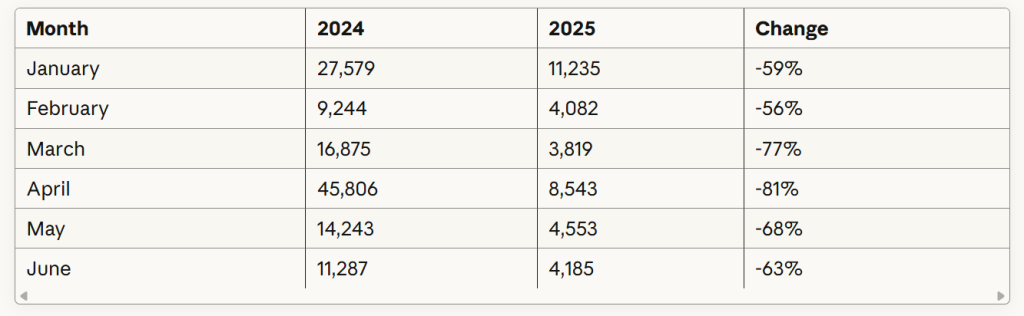
Notice what’s happening: Every single month shows a 55-80% reduction.
The steepest drop is in April (81% reduction). That’s when the spring intake would normally process. Instead? Only 8,543 approvals compared to 45,806 the year before.
What’s Driving the Student Permit Decline?
Three major policy changes hit at once:
1. The Annual Cap (2024-2025)
Canada introduced a hard cap on study permits:
- 2024: Approximately 360,000 permits
- 2025: 10% reduction from 2024 levels
This is distributed by province. So, even qualified applicants get refused because the provincial allocation runs out.
2. Increased Financial Requirements (December 2023)
Students now need to prove $20,635 CAD (plus tuition) instead of $10,000. This immediately disqualified thousands of applicants who met the old threshold but couldn’t meet the new one.
3. Enhanced Fraud Review (October 2023)
IRCC started aggressively reviewing college acceptance letters for fraud. Legitimate applicants face longer processing times. Questionable colleges lost their ability to sponsor international students.
Who’s Still Getting Study Permits Approved?
The data doesn’t break down approvals by category, but based on the policy framework, here’s who has the best chance:
✅ Graduate-level students at universities (not affected by the cap in many cases)
✅ Students applying to designated learning institutions in provinces with remaining allocation
✅ Applicants with strong financial profiles (well above the $20,635 threshold)
✅ Students in “aligned fields of study” (related to labor market needs; think healthcare, skilled trades, STEM)
Who’s facing the steepest barriers?
❌ Undergraduate college students (hit hardest by the cap)
❌ Students from high-fraud jurisdictions (India, Nigeria, Ghana face enhanced scrutiny.)
❌ Applicants to private career colleges (many lost eligibility entirely)
❌ Students applying late in the provincial allocation cycle (first-come, first-served in many provinces)
Understanding the Work Permit Restrictions: Who Can Still Get Approved?
Work permits show a different pattern than study permits, but the trend is just as dramatic.
Work Permit Arrivals by Month
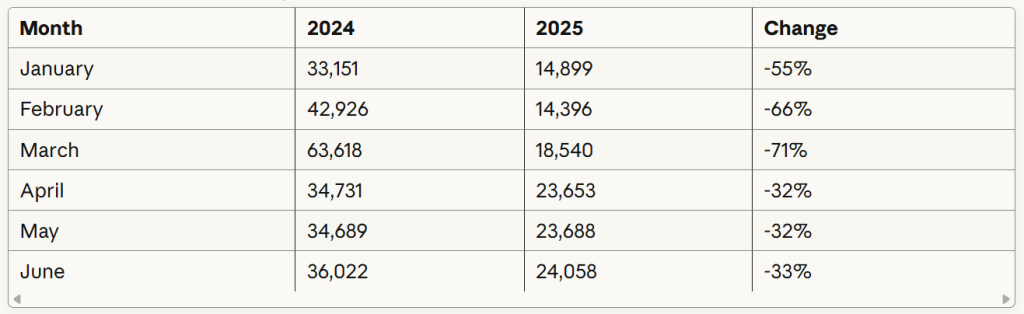
Notice the pattern: January-March show 55-71% drops. April-June stabilized around 32-33% drops.
What’s happening?
The September 2024 Temporary Foreign Worker Program (TFWP) restrictions took several months to flow through the system. Applications submitted before September under the old rules continued processing. By early 2025, the new rules will dominate.
Then approvals stabilize at a lower “new normal.”
What’s Driving the Work Permit Decline?
1. The 10% Low-Wage Hiring Cap (September 2024)
Employers can only fill 10% of their workforce with low-wage temporary foreign workers (20% in sectors with proven shortages like healthcare, construction, and food processing).
This immediately cut demand. Employers who were at 15-20% temporary foreign workers? They can’t submit new applications until attrition brings them under 10%.
2. Refusal-to-Process Policy in High-Unemployment Areas
If a region has unemployment at or above 6%, IRCC refuses to process TFWP applications in that area. Period.
This locked out applications from:
- Toronto
- Montreal
- Calgary
- Most major urban centers
3. Higher Wage Threshold for High-Wage Stream (November 2024)
The threshold increased, which pushed more positions into the low-wage stream (subject to the 10% cap). This further restricted employer options.
4. PGWP Tightening (September 2024)
Post-Graduation Work Permits became harder to get. Only graduates from:
- Programs aligned with labor market needs
- Institutions meeting new quality standards
- Fields of study in demand
Fewer PGWP holders = fewer work permits in the data.
5. Spousal Work Permit Restrictions
Spouses of international students and temporary foreign workers lost automatic work permit eligibility. Only spouses of:
- Master’s/PhD students
- Workers in TEER 0, 1, 2, 3 occupations
This cut a huge category of work permit holders.
Who’s Still Getting Work Permits Approved?
✅ Workers in TEER 0, 1, 2 occupations (managerial, professional, technical roles)
✅ Employees in remote/rural areas (not subject to refusal-to-process policies)
✅ Seasonal agricultural workers (exempt from caps, not even counted in this data)
✅ Workers in sectors with 20% cap exceptions (healthcare, construction, food processing in designated shortage areas)
✅ PGWP holders from aligned programs (graduates with in-demand skills)
✅ Intra-company transfers (not subject to TFWP restrictions)
Who’s blocked?
❌ Low-wage workers in urban centers (hit hardest by the 10% cap and refusal-to-process policy)
❌ Spouses of students/workers (no longer automatically eligible)
❌ PGWP applicants from non-aligned programs (career colleges, non-priority fields)
❌ Employers at/above the 10% cap (can’t submit new applications)
The Total Population Shift: What the Inventory Numbers Really Mean
Here’s where it gets interesting.
The arrival numbers show dramatic drops. But what about the total number of temporary residents already in Canada?
That’s the inventory. And it’s starting to decline, but slowly.
Total Students in Canada (Study Permit Holders Only)
- December 2023: 674,131
- Peak: September 2024: 627,062
- June 2025: 546,562
Drop from peak: 80,500 students (12.8% decline in 9 months)
Total Workers in Canada (Work Permit Holders Only)
- December 2023: 1,230,230
- Peak: November 2024: 1,458,886
- June 2025: 1,504,573
Wait, that number went up?
Yes. Work permit holders increased by 45,687 between November 2024 and June 2025.
Why?
Processing backlog from pre-restriction applications. Applications submitted before September 2024 under the old rules continued processing through early 2025. So even though new arrivals dropped, the inventory kept growing temporarily.
But look at the trend: May 2025 (1,507,381) to June 2025 (1,504,573) = first month-over-month decline.
The inventory is turning. The restrictions are working.
What This Means for You
If you’re already in Canada as a temporary resident, you’re in a fundamentally different position than someone trying to enter.
The government is trying to reduce the population of temporary residents from ~2.4 million to under 5% of Canada’s total population (approximately 2 million).
But they’re doing it through:
- Restricting new arrivals (working, as the data shows)
- Not extending everyone’s status (extensions are getting harder)
- Transitioning people to permanent residence (this is the strategic opportunity)
Which brings us to the most important section…
Strategic Positioning: Should You Still Apply in This Environment?
This is the question everyone’s asking: “Should I still try to come to Canada?”
The answer isn’t yes or no. It’s situational.
Let me give you a framework.
Decision Tree: Study Permit Applicants
Question 1: Are you applying to a graduate program (Master’s/PhD) at a university?
- YES → You’re in a much better position. Graduate students aren’t subject to the cap in most provinces. PROCEED, but expect rigorous financial scrutiny.
- NO → Go to Question 2.
Question 2: Is the provincial allocation for your province still available?
- UNKNOWN/LIMITED → Your chances are low. The cap means even qualified applicants get refused when the allocation runs out. RISK: HIGH. Consider deferring to 2026 when allocations reset.
- AVAILABLE → Go to Question 3.
Question 3: Can you prove financial capacity well above $20,635 CAD?
- NO → Your application will likely be refused. This isn’t negotiable. DO NOT APPLY until you meet the financial threshold.
- YES → Go to Question 4.
Question 4: Is your program in a field aligned with labor market needs (healthcare, skilled trades, STEM)?
- YES → PROCEED. You’re in the strongest position possible in this restricted environment. Apply early, document meticulously, and expect processing delays.
- NO → PROCEED WITH CAUTION. You can still succeed, but your approval isn’t guaranteed even if you meet all requirements. Have a Plan B.
Decision Tree: Work Permit Applicants
Question 1: What’s the TEER level of your job offer?
- TEER 0, 1, 2 → You’re in the high-wage stream. Not subject to the 10% cap. PROCEED.
- TEER 3 or below → Go to Question 2.
Question 2: Is the job location in an area with unemployment below 6%?
- ABOVE 6% → IRCC refuses to process. Your application is DOA. DO NOT APPLY.
- BELOW 6% → Go to Question 3.
Question 3: Is your employer currently at or above the 10% temporary foreign worker cap?
- YES → They can’t submit new applications. DO NOT APPLY.
- NO or EXEMPT SECTOR → Go to Question 4.
Question 4: Is this a position in healthcare, construction, or food processing in a designated shortage area?
- YES → Your employer gets a 20% cap instead of 10%. Much better odds. PROCEED.
- NO → PROCEED WITH CAUTION. Even if you meet all criteria, processing is slower and scrutiny is higher. Ensure your employer has strong documentation of recruitment efforts.
Special Category: Are You Already in Canada?
If you’re currently in Canada as a temporary resident, your strategic positioning is completely different.
You’re not fighting to get in. You’re fighting to stay and transition.
This is where the data reveals the hidden opportunity…
The Temporary-to-Permanent Advantage: Why Being Here Matters More Than Ever
Here’s the number that changes everything:
From January to June 2025, over 100,000 former temporary residents became permanent residents. This group accounted for about 50% of new permanent residents during that time.
Read that again.
Half of all new permanent residents in early 2025 were people who were already in Canada as temporary residents.
This isn’t an accident. This is strategic policy design.
Why Canada Prefers Temporary-to-Permanent Transitions
Think about it from the government’s perspective:
They want to reduce temporary resident arrivals. But they still need permanent resident arrivals to meet economic and demographic goals.
Solution? Prioritize transitions of people already here.
Why?
✅ Already integrated (Canadian education, work experience, language skills)
✅ Less housing/infrastructure impact (already using services, not new demand)
✅ Lower risk (proven track record in Canada)
✅ Faster processing (already in system, documents verified)
The Programs Driving Temporary-to-Permanent Transitions
If you have:
- Canadian work experience
- Canadian education
- Strong language scores
- Work experience in an in-demand occupation
You’re competitive in Express Entry even with moderate CRS scores. Category-based selection rounds specifically target people with Canadian experience.
Provincial Nominee Programs (PNPs)
Most PNPs prioritize applicants with:
- Work experience in the province
- Employer support
- Education credentials from provincial institutions
If you’re working in a province, you have a massive advantage over offshore applicants.
Canadian Experience Class (CEC)
Designed specifically for temporary residents with Canadian work experience. If you’ve worked full-time in a skilled occupation for 12 months while on a valid work permit, you’re eligible.
Strategic Positioning for Current Temporary Residents
If you’re already in Canada, your strategy should be:
1. Maximize Canadian Experience
Every month of work experience increases your CRS score and PNP eligibility. Don’t leave until you’ve maximized your Canadian experience.
2. Build Language Scores
Take IELTS/CELPIP or TEF. A CLB 9 in all categories can add 100+ CRS points. This is the easiest controllable variable.
3. Pursue Canadian Education (If Strategic)
Only if:
- You’re eligible for a PGWP after (aligned program.)
- It increases your CRS score significantly
- You have a clear permanent residence pathway after
Don’t do more education just to extend status. Do it if it positions you for permanent residence.
4. Target Provincial Programs
Research PNPs in your province. Many have:
- Dedicated streams for international graduates
- Employer-driven streams for current workers
- Lower CRS cutoffs than the federal Express Entry
5. Monitor Express Entry Category-Based Draws
If you’re in healthcare, STEM, Education, or have French language ability, category-based draws give you an advantage over the general pool.
The Timeline: How Long Do You Need?
Most temporary-to-permanent pathways require:
- Minimum 12 months of skilled Canadian work experience
- Language test results (CLB 7 minimum, CLB 9+ competitive)
- Educational credential assessment
- Valid status throughout the process
If you’re a current temporary resident, you need 2-3 years from arrival to permanent residence in most pathways.
Plan accordingly. Don’t assume you can stay indefinitely without a transition strategy.
Frequently Asked Questions
Will study permit and work permit numbers go back up?
Not anytime soon. Canada is committed to reducing temporary resident numbers through at least 2027 as part of the Immigration Levels Plan. The restrictions are working (as the data proves), so there’s no policy reason to reverse course.
Earliest likely increase: 2028, and only if housing supply catches up to demand.
If I apply now, will my application be processed under the new rules?
Yes. IRCC processes applications under the rules in place at the time of processing, not at submission. If you submit today and it’s processed in 6 months, you’re subject to whatever rules exist in 6 months.
The only exception: applications with positive eligibility assessments before a rule change may be grandfathered (but don’t count on it).
Are they still processing applications from 2024?
Yes. The inventory of pending applications is still being processed. This is why the total temporary resident population didn’t drop immediately when restrictions were announced.
But the backlog is clearing. By late 2025, most pending applications from pre-restriction submissions will be resolved.
Does the data include asylum claimants?
No. Asylum claimants are explicitly excluded from these statistics. This data only covers:
Study permit holders
Work permit holders (excluding seasonal agricultural workers and workers in Canada for less than 270 days in the same calendar year)
The total temporary resident population in Canada is higher than these numbers suggest because asylum claimants add another layer.
What if I’m in Canada but my status is expiring soon?
You need to either:
– Apply for an extension (but scrutiny is higher, approvals aren’t guaranteed)
– Apply for a different status (e.g., study permit to PGWP, PGWP to Express Entry)
– Leave Canada before your status expires (overstaying destroys future admissibility)
The key: Don’t wait until the last minute. Applications can take months, and an implied status while waiting doesn’t guarantee approval.
Can I still bring my spouse to Canada if I’m a student or worker?
Only if you meet the new criteria:
– Students: Your spouse gets an open work permit ONLY if you’re in a Master’s or PhD program.
– Workers: Your spouse gets an open work permit ONLY if your job is TEER 0, 1, 2, or 3.
If you don’t meet these criteria, your spouse needs their own pathway (separate study permit, job offer, etc.).
Should I hire a lawyer or an immigration consultant?
In this restricted environment? More than ever.
The margin for error is zero. Applications that would have been approved under the old system now get refused for minor documentation gaps.
If your situation involves:
– Complex employment history
– Prior refusals
– Unclear documentation
– Borderline eligibility
Professional guidance isn’t optional. It’s essential.
What This All Means: Your Next Move
Let me be blunt.
Canada’s temporary resident restrictions aren’t going away. The data proves the government is hitting its targets. This is the new reality.
But here’s the truth most people miss:
The restrictions aren’t designed to stop everyone. They’re designed to filter.
Canada still needs:
- Graduate students in universities
- High-skilled workers in critical occupations
- Temporary residents who transition to permanent status
If you’re in one of those categories, your pathway still exists. You just need to be strategic, precise, and well-documented.
If you’re not in one of those categories, trying to force your way in under the old assumptions will waste your time and money.
So what should you do?
If you’re planning to come to Canada:
- Assess your profile honestly against the decision trees above
- Don’t apply unless you meet the strengthened criteria
- If you’re borderline, defer and strengthen your application
- If you’re strong, apply early with meticulous documentation
If you’re already in Canada:
- Treat your temporary status as exactly that – temporary
- Build a permanent residence strategy from day one
- Maximize Canadian work experience and language scores
- Monitor Express Entry and PNP pathways constantly
- Don’t overstay, hoping for policy changes
If you’re unsure where you fit:
That’s what I do. I help people look at the data, assess their specific situation, and build a strategy that actually works in this restricted environment.
Not everyone needs a consultant. But in a system where the approval rates dropped 76% for students and 55% for workers in one year? The cost of getting it wrong is too high to guess.
Need Strategic Guidance? Let’s Talk
The 2026 Immigration Levels Plan is expected to maintain, or even tighten, these caps. Waiting to apply could mean facing stricter quotas, lower provincial allocations, and even more aggressive refusal-to-process policies next year.
If you’re trying to navigate Canada’s restricted temporary resident environment, whether you’re planning to apply, currently in Canada, or facing a status decision, I can help you understand your real options and build a strategy that works.
Book a consultation with Amir Ismail at www.amirismail.com/book-a-consultation.
With extensive experience in Canadian immigration law, I help clients understand not just the rules, but the strategic positioning that separates approvals from refusals in this environment.
The data shows the window is narrowing. Let’s build a plan based on facts, not hope.
Partner with Amir Ismail & Associates
Navigating Canadian immigration and licensing can be complex. Amir Ismail & Associates offers expert guidance and personalized support to transform your aspiration into reality.
Tailored Immigration Strategies
Express Entry optimization, PNP navigation, documentation excellence.
Licensing & Settlement Support
Guidance on credential recognition, connections to resources, pre-arrival planning.
With over 30 years of experience and a proven track record, we are committed to helping you achieve your Canadian dream.
Amir Ismail, RCIC # R412319
Read More Immigration Updates By Amir Ismail

Express Entry Transport Category 2026: Who Qualifies & How to Apply
Express Entry Transport Category 2026: Who Qualifies and How to Apply Last Updated: February 28,…
Canada 2026 Express Entry New Categories: Doctors, Researchers & Military | Amir Ismail
🚨 BREAKING — February 20, 2026 Canada’s New 2026 Express Entry Categories: Doctors, Researchers, Senior…

What to do when you receive an Express Entry ITA?
What to Do When You Receive an Express Entry ITA You just received your Invitation…

EXPRESS ENTRY DRAW 396 ANALYSIS – The CRS 508 Reality Check
EXPRESS ENTRY DRAW 396 ANALYSIS and What It Means for Your 2026 Immigration Strategy On…

How to Immigrate to Canada as a Dentist Without a Job Offer or licensure(2026 Guide)
How to Immigrate to Canada as a Dentist Without a Job Offer of Licensure (2026…

OINP 2026: Ontario Confirms 14,119 Nominations — Here’s How to Win
OINP nominations for 2026: Ontario Confirms 14,119 Nominations — Here’s How to Win Published: February…