

E-2 Visa for Canadians: Your Complete 2026 Guide to Moving Your Business to the U.S.
You’re tired of paying 53% tax rates.
You’re sick of bureaucratic red tape strangling your business growth.
You’ve watched friends move to Florida or Texas and wondered: Could I actually do that?
The answer is yes. And it might be easier than you think.
Over 126,000 Canadians moved to the U.S. in 2022 alone, a 70% increase from a decade ago. They’re not just visiting. They’re relocating permanently, building businesses, and keeping more of what they earn.
The E-2 visa is how many of them are doing it.
Here’s everything you need to know.
Key Takeaways
- The E-2 visa lets Canadian entrepreneurs start, buy, or transfer a business to the U.S., no green card needed
- You need a minimum investment of around $80,000-$100,000 USD (though higher investments strengthen your case)
- The approval process takes 4-8 months for most business types, with a 95% approval rate when done correctly
- Your spouse can work in the U.S., and your kids under 21 can attend school
- The visa renews indefinitely as long as your business operates successfully
- Popular routes include: buying a franchise, transferring your existing Canadian business, or starting from scratch
- Top destinations: Florida, Texas, and North Carolina (all have no or low state income tax)
What You’ll Find on This Page
Table of Contents
Why Canadians Are Leaving (And Where They’re Going)
Let’s be honest.
Canada is a great country. But if you’re an entrepreneur or high earner, you’re getting crushed.
The math is brutal:
- Federal tax rates up to 33%
- Provincial tax rates up to 25.75%
- Combined marginal rates exceeding 53% in some provinces
You work hard. You take risks. And then the government takes more than half.
Meanwhile, down south?
Florida: Zero state income tax. Thriving business environment. Sunshine 300 days a year.
Texas: Zero state income tax. Booming tech and healthcare sectors. Low cost of living.
North Carolina: Corporate tax rate of just 2.25%. Growing small business scene.
It’s not just about taxes, though.
It’s about freedom.
Freedom to grow your business without drowning in regulations.
Freedom to hire without navigating impossible employment laws.
Freedom to keep more of what you build.
And the numbers prove it: approximately 828,000 Canadian-born immigrants now live in the U.S.
That’s not a coincidence.
What Exactly Is the E-2 Visa?
Think of the E-2 visa as your business owner’s pass to the United States.
It’s NOT a green card. It’s a non-immigrant visa.
But here’s what makes it powerful:
You can:
- Start a new business in the U.S.
- Buy an existing business or franchise
- Transfer your Canadian business operations
- Live and work in the U.S. full-time
- Bring your spouse and children under 21
- Renew indefinitely (as long as your business operates)
Your spouse can:
- Work for ANY employer in the U.S. (huge benefit)
- Build their own career independently
Your kids can:
- Attend U.S. schools
- Access to in-state tuition rates at many universities
The E-2 visa is perfect if you want to test the waters before committing to permanent residency.
Or if you just want flexibility without the hassle of a green card application.
The best part?
There’s no annual quota. Unlike H-1B visas, which have a lottery system, E-2 visas are processed as long as you meet the requirements.
And Canada has been an E-2 treaty country since January 1, 1994.
You’re already eligible just by being Canadian.
Free instant E-2 visa Eligibility
-> DOWNLOAD COMPLETE USA E-2 VISA GUIDEThe Three Business Paths: Transfer, Franchise, or Start Fresh
You have three main routes to an E-2 visa. Each has different timelines, investment levels, and risk profiles.
Let’s break them down.
Option 1: Transfer Your Existing Canadian Business
Best for: Established business owners with existing operations
Investment required: $100,000-$200,000+ (varies by business type)
Timeline: Approximately 4 months
How it works:
You’re not abandoning your Canadian business. You’re expanding it.
You open a U.S. branch or subsidiary, transfer operations, and demonstrate that your Canadian success will translate south of the border.
The government wants to see:
- Proven business model
- Financial stability
- Clear expansion plan
- Job creation potential
Real Example:
Siva Sam ran companies in Canada for 20+ years before relocating to Houston. He invested $180,000 to expand his business, now operates 3 companies with 100+ employees globally, and serves U.S. clients in the oil and gas sector.
His advice? “Having a business established there really helped my case. especially with the E-2.”
Advantages:
✅ You already understand the business
✅ Existing cash flow and financial history
✅ Lower risk than starting fresh
✅ Demonstrates business acumen to immigration officials
Challenges:
❌ Requires existing business in good standing
❌ Need to show true expansion (not just relocation)
❌ More complex documentation
Option 2: Buy a Franchise
Best for: Entrepreneurs who want a proven system with support
Investment required: $80,000-$200,000+
Timeline: 4-8 months
Work hours: 30-50+ hours per week (potentially less after 18 months)
How it works:
You purchase a franchise in a system that’s already successful. McDonald’s, The Maids, dog hotels, insurance agencies, and hundreds of other options exist.
The franchise provides:
- Proven business model
- Training and ongoing support
- Brand recognition
- Marketing systems
- Technology and best practices
Here’s what most people don’t know:
Only 2% of businesses pass rigorous due diligence filters for E-2 visa success.
Working with experts who understand which franchises work (and which don’t) is critical.
Real Example:
Fabian Montoya left his executive role at Royal Bank of Canada and moved from Saskatchewan to Florida. He invested $70,000 in franchise setup plus $35,000 in working capital for his E-2 visa.
He launched The Maids franchise in Boca Raton.
Broke even in 3 months.
Now preparing his second crew and on track to surpass $300,000 in year one.
Real Example #2:
John Orsini, an architect from Ottawa, became a property management franchisee in Los Angeles. He now manages over 1,000+ rental properties in LA County.
He initially faced E-2 rejection, but with proper guidance, got approved and later transitioned to an EB-2 green card through his wife’s employer.
Advantages:
✅ Lower risk than starting from scratch
✅ Built-in support system
✅ Faster path to profitability
✅ Immigration authorities favor established brands
Challenges:
❌ Franchise fees and royalties reduce profit margins
❌ Less creative control
❌ Some franchises require hands-on daily management
Option 3: Start or Buy an Independent Business
Best for: Experienced entrepreneurs with specific business ideas
Investment required: $100,000-$200,000+
Timeline: 4-24 months (depending on whether you’re starting new or buying existing)
How it works:
You either launch a completely new venture or purchase an existing independent business (non-franchise).
This gives you maximum flexibility but requires the most business savvy.
Real Example:
James Hesling, originally from England, moved to Las Vegas after getting married there. With a background in health, wellness, and executive coaching, he applied under an E-2 essential employee structure with a $52,000 initial investment (plus another $20,000 at interview).
He works with local managers to run day-to-day operations remotely.
Real Example #2:
Loris Mazloum started with home appliance distribution, then pivoted to scalable drop-shipping. He built a patented mobile app recognized by Facebook and covered by media outlets.
He eventually transitioned to an EB-1A green card by highlighting his tech innovation.
Advantages:
✅ Complete control over business decisions
✅ No franchise fees or restrictions
✅ Can be more profitable long-term
✅ Flexibility to pivot as needed
Challenges:
❌ Higher risk of failure
❌ Lack of local market knowledge
❌ Language and cultural barriers
❌ Staffing and logistical difficulties
❌ Longer timeline for buying existing businesses
E-2 Visa Requirements Explained (In Plain English)
Let’s cut through the legal jargon.
Here’s what you actually need:
1. You Must Be Canadian
Easy enough. Canada has been an E-2 treaty country since 1994.
If you hold Canadian citizenship, you’re eligible.
2. You Must Own At Least 50% of the Business
The government wants to ensure YOU control the business.
Not a silent partner. Not a minority investor.
You’re the one making decisions.
3. You Must Make a “Substantial Investment”
What’s “substantial”?
Generally $100,000 USD or more.
But here’s the thing: there’s no official minimum written in stone.
Smaller investments CAN work if:
- The business type justifies it (service businesses often require less capital)
- You can show that the investment is substantial relative to the total cost
- The business will create jobs
Higher investments = stronger applications.
If you’re investing $180,000+ like many successful applicants, your case is much more solid.
4. Your Business Must Be Active and For-Profit
No passive investments.
No real estate holdings where you just collect rent.
You need to be actively developing and directing the business.
Think: franchise operations, consulting firms, retail stores, service businesses, restaurants, tech companies.
5. The Business Cannot Be “Marginal”
“Marginal” means it only generates enough income to support you and your family.
The government wants businesses that:
- Create jobs for Americans
- Contribute to the U.S. economy
- Have growth potential
Translation: Show them you’re going to hire people.
Even if it’s just 2-3 employees initially, demonstrate a plan to grow.
6. You Must Direct and Develop the Business
You’re not buying a business to sit on a beach.
You need to show you’ll be involved in:
- Strategic decision-making
- Business operations
- Growth and development
That said, you CAN hire managers for day-to-day operations (absentee ownership models DO work).
You just need to demonstrate executive control.
7. Your Investment Funds Must Be Lawful
Immigration will want to see a clear paper trail:
- Bank statements
- Sale of assets
- Business income
- Loans (though these are tricky, investment must be “at risk”)
No sketchy sources. Everything documented.
8. Your Investment Must Be “At Risk”
This means your money is truly committed to the business.
Not sitting in a bank account. Not held in escrow indefinitely.
The funds must be irrevocably committed, invested in:
- Equipment
- Inventory
- Lease deposits
- Working capital
- Franchise fees
If the business fails, you lose that money. That’s “at risk.”
How Long Does the Process Actually Take?
Let’s talk timelines.
Because this matters when you’re planning your life.
Starting a New Business for E-2:
4-5 months typically
Buying a Franchise for E-2:
4-8 months on average
Buying an Existing Business for E-2:
9-24 months (heavily dependent on finding and evaluating the right business)
Transferring Your Canadian Business:
Around 4 months
Some people get approved in under 3 months with everything perfectly organized.
But plan for 4-6 months as a realistic expectation.
Here’s what impacts timing:
- How quickly can you finalize your business investment
- How organized your documentation is
- The complexity of your business model
- The current processing times at U.S. consulates
Pro tip: Once you’re approved, renewal is straightforward. Many Canadians get 5-year visa stamps and renew indefinitely as long as the business operates.
Success Stories from Canadians Who Made the Move
Numbers are great. But stories are better.
Want to see exactly how real Canadians made this work? Read 10 detailed success stories →
The Numbers: E-2 Visa Approvals Are Surging
Let’s look at the data.
Because trends tell a story.
Total E-2 Visas Issued Worldwide:
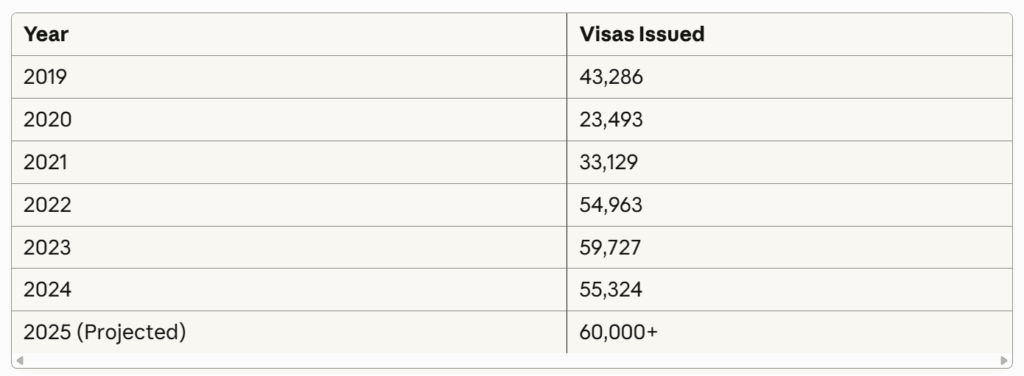
After a COVID dip in 2020, numbers rebounded sharply, reaching record highs in 2023-2024.
This reflects renewed confidence and rising global interest.
E-2 Visas Issued to Canadians:
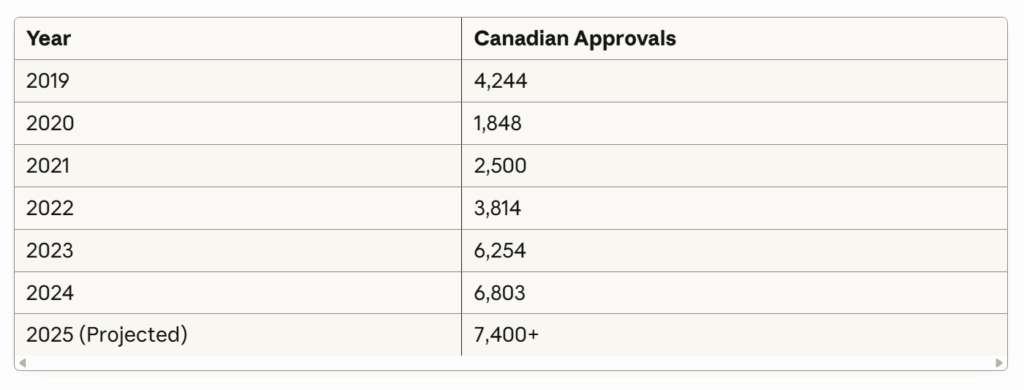
E-2 visa approvals for Canadians have STEADILY RISEN since 2021.
Over 6,800 Canadians received E-2 visas in 2024.
That number is expected to hit at least 7,400 in 2025.
What does this tell us?
More Canadians than ever are making the move.
The path is proven. The process works.
And the current U.S. administration (2025-2028) supports immigration via enterprise, focusing on job creation and attracting investors.
While labor visas like H-1B face new restrictions (including new $100,000 fees), investor pathways like E-2 receive favorable attention.
You’re entering at the right time.
From E-2 to Green Card: Your Long-Term Path
Here’s the truth:
The E-2 visa is amazing for flexibility.
But it’s NOT a green card.
So what happens if you decide you want permanent residency?
Good news: there are multiple paths.
EB-1A (Extraordinary Ability)
Best for: Founders and innovators who achieve national or international recognition
What you need: Press coverage, patents, awards, and significant contributions to your field
Timeline: Can be faster than other green card paths
Real Example: Loris Mazloum transitioned from E-2 to EB-1A by highlighting his tech innovation and patented mobile app recognized by Facebook.
EB-1C (Multinational Executive)
Best for: Executives managing a U.S. branch of an international business
What you need: Qualify for the L-1A visa first, then demonstrate an executive role in U.S. operations
Why it works: Direct path from business owner to permanent resident
EB-2/EB-3 (Employer Sponsorship)
Best for: Situations where your spouse secures a job with green card sponsorship, or you’re offered a qualifying role
What you need: A Job offer from a U.S. employer willing to sponsor
Timeline: Several years typically
Real Example: John Orsini transitioned to an EB-2 green card through his wife’s employer sponsorship.
EB-5 (Investor Visa)
Best for: High-net-worth individuals willing to make large investments
What you need: $800,000+ investment in a new business that creates at least 10 U.S. jobs
Timeline: Several years, but leads directly to a green card
Alternative Visas Worth Considering
The E-2 isn’t your only option.
Depending on your situation, these might work better:
L-1A Visa (Intracompany Transfer)
Who it’s for: Executives or managers of international companies expanding into the U.S.
Key benefits:
- Allows you to open or transfer to a U.S. office
- Direct path to green card (EB-1C)
- No investment amount required
Requirements:
- Must have worked at least 1 year (in the last 3) in a qualifying role abroad
- The U.S. company must have a qualifying relationship with a foreign company (parent, subsidiary, affiliate, etc.)
O-1A Visa (Extraordinary Ability)
Who it’s for: Individuals with extraordinary ability in business, science, education, or athletics
Key benefits:
- High flexibility (ideal for founders, consultants, thought leaders)
- No minimum investment
- Eligible for EB-1 green card later
Requirements:
- Must prove extraordinary ability through awards, media coverage, innovation, or leadership
- U.S. work must be related to demonstrated ability
E-1 Visa (Treaty Trader)
Who it’s for: Entrepreneurs from treaty countries engaged in substantial international trade with the U.S.
Key benefits:
- Renewable indefinitely
- Suitable for import/export and cross-border service businesses
Requirements:
- Must be a national of a treaty country (Canada qualifies)
- The majority of international business must involve trade between the U.S. and the home country
- Trade must be continuous and substantial
Which U.S. Visa Is Right for You?
Answer 7 quick questions to discover your best path to the U.S.
What Happens Next: Your Action Plan
Alright.
You’ve read this far.
You’re serious about this.
So what do you actually DO next?
Step 1: Choose Your Business Path
Decide which route makes sense:
- Transfer existing business
- Buy a franchise
- Start or buy an independent business
Step 2: Research Target States
Where do you want to live?
- Florida (no state income tax, booming)
- Texas (no state income tax, diverse economy)
- North Carolina (low corporate tax at 2.25%)
Consider:
- Business environment in your industry
- Cost of living
- Climate and lifestyle
- Proximity to clients/suppliers
Step 3: Secure Professional Guidance
This is NOT a DIY project.
You need experts who understand:
- Immigration law
- Business structuring
- Financial documentation
- Due diligence processes
Why?
Because only 2% of businesses pass rigorous due diligence for E-2 visa success.
One mistake can cost months of delays or outright rejection.
Step 4: Organize Your Finances
Start gathering:
- Bank statements (minimum 6 months)
- Proof of funds
- Source of investment capital documentation
- Tax returns
- Business financial statements (if transferring an existing business)
Step 5: Develop Your Business Plan
You’ll need a comprehensive plan that shows:
- Market analysis
- Financial projections
- Job creation timeline
- Growth strategy
This isn’t busy work. Immigration officials scrutinize this.
Step 6: Execute Your Investment
Once your business is identified and vetted:
- Finalize purchase or setup
- Commit funds irrevocably
- Document everything
Step 7: File Your Visa Application
With proper guidance, your application will include:
- Business plan
- Financial documentation
- Proof of investment
- Personal background information
- Job creation evidence
Step 8: Attend Your Visa Interview
Be prepared to discuss:
- Your business model
- Your investment
- Your plans for growth
- Your qualifications
Timeline reminder: Most people complete this process in 4-8 months.
The Truth Nobody Tells You
Here it is:
The hardest part isn’t the visa process.
The hardest part is making the DECISION.
Because once you decide, truly decide, the path becomes clear.
You’ll find the investment capital.
You’ll choose the right business.
You’ll navigate the paperwork.
But you have to decide first.
Are you staying in Canada, watching your tax rate climb while regulations strangle your growth?
Or are you taking control of your financial future?
Over 126,000 Canadians moved to the U.S. in 2022.
Over 6,800 Canadians got E-2 visas in 2024 alone.
They’re not smarter than you.
They’re not luckier.
They just decided.
Everything you want exists on the other side of fear.
The sunshine in Florida.
The business freedom in Texas.
The lower taxes in North Carolina.
It’s all there. Waiting.
You just have to reach for it.
Frequently Asked Questions
How much money do I really need for an E-2 visa?
While there’s no official minimum, most successful applications involve investments of $80,000-$100,000 USD minimum. Higher investments ($150,000-$200,000+) significantly strengthen your case. The key is that the investment must be “substantial” relative to the total cost of the business.
Can my spouse work in the U.S. with an E-2 visa?
Yes! This is one of the biggest benefits. Your spouse can work for ANY employer in the U.S., not just your E-2 business. They can build their own independent career.
What happens to my Canadian business if I get an E-2 visa?
You don’t have to close it. Many entrepreneurs maintain their Canadian operations while expanding to the U.S. The E-2 visa is about demonstrating U.S. business expansion, not abandoning Canada entirely.
Can I renew my E-2 visa indefinitely?
Yes. As long as your business continues to operate successfully and meets E-2 requirements, you can renew indefinitely. Many Canadians receive 5-year visa stamps and simply renew when needed.
Do I have to be physically present in the U.S. full-time?
You need to demonstrate that you’re actively directing and developing the business. But that doesn’t mean 60-hour work weeks on-site. With proper management structures, you can operate somewhat remotely. However, you can’t be an absentee owner who never visits.
What if my E-2 visa gets denied?
With proper preparation and expert guidance, approval rates are very high (95%+). If denied, you can typically reapply after addressing the specific concerns raised by immigration officials. This is why working with experienced professionals matters; they help you avoid common pitfalls.
Can I apply for a green card while on an E-2 visa?
Absolutely. The E-2 visa itself doesn’t provide a direct path to a green card, but you can pursue other green card pathways while maintaining E-2 status (EB-1A, EB-1C, EB-2, EB-3, or EB-5).
What happens if my business fails?
If your E-2 business closes or no longer meets visa requirements, you’ll need to leave the U.S., transition to another visa status, or start a new qualifying business. This is why choosing a viable business with proper due diligence is crucial.
Can I buy a business with my spouse and both of us obtain E-2 visas?
Yes, as long as you each own at least 50% and can demonstrate you’re both actively involved in directing the business.
Do my kids need their own visas?
Your unmarried children under the age of 21 can be included as E-2 dependents. They can attend school in the U.S. However, they cannot work in the U.S., and their visa status expires when they turn 21 or marry.
Ready to Make Your Move?
The opportunity is real.
The path is proven.
The timing is right.
But you need expert guidance to navigate this successfully.
With extensive experience in Canadian entrepreneur immigration to the U.S., Amir can help you evaluate your options, structure your business investment properly, and navigate the E-2 visa process with confidence.
Your future is waiting.
It’s time to claim it.
Free instant E-2 visa Eligibility
Why Choose Amir Ismail?
Your dedicated Global Immigration Adviser.
Your Immigration Journey with an Expert
Navigating USA immigration can be complex, but with a seasoned consultant by your side, you gain a significant advantage. Amir Ismail is dedicated to providing clear, ethical, and personalized immigration solutions.
- Expert Guidance: Benefit from in-depth knowledge of immigration laws and policies.
- Personalized Strategy: Receive a tailored plan that maximizes your E-2 visa chances of success.
- Application Accuracy: Avoid common pitfalls and ensure your application is complete and error-free.
- Timely Updates: Stay informed about the latest E-2 visa policy changes.
- Peace of Mind: Trust your application is in professional and capable hands.
Your USA dream is within reach. Let’s make it a reality together.
Sources: USCIS
-> DOWNLOAD COMPLETE USA E-2 VISA GUIDE
Get an Instant Free E-2 Visa Eligibility Assessment
Get an Instant Free E-2 Visa Eligibility Assessment Are you considering an E-2 investor visa…

E-2 visa Substantiality Calculator | Find If you are Eligible
Free E-2 visa Substantiality Calculator | By Amir Ismail Debunking the $100,000 Myth: What “Substantial…

Escape 53% Tax? Why 6,800+ Canadians Use the E-2 Visa
The E-2 Visa for Canadians: Why 6,800+ Canadians Use the E-2 Visa -> DOWNLOAD COMPLETE…

E-2 Visa Success Stories: 10 Real Canadians Who Built Thriving Businesses in the U.S.
E-2 Visa Success Stories: 10 Real Canadians Who Built Thriving Businesses in the U.S. You’ve…

6 E-2 Visa Mistakes: The 6 Traps That Lead to Denial (And How to Fix Them)
E-2 Visa Mistakes: The 6 Traps That Lead to Denial (And How to Fix Them)…

E-2 Visa for Pakistani Citizens | Your Complete Guide
E-2 Visa for Pakistani Citizens | Your Complete Guide | Amir Ismail Written by Amir…