
What Is a Good CRS Score for Canada PR in 2026? The Full Category Breakdown
You’ve checked your CRS score calculator again this week.
Here’s the direct answer: there’s no single good CRS score in 2026. It ranges from 382 for French speakers to 523+ for the Canadian Experience Class, and where you land depends entirely on which of 10 active categories you fit.
475. Maybe 490. Master’s degree. IELTS at CLB 9. Three years of work experience. You did everything right.
Then you check the latest Express Entry draw. The Canadian Experience Class cutoff was 523.
And you’re still waiting.
Here’s what nobody tells you: your score isn’t the problem. You’re competing in the wrong category.
Canada’s Express Entry system now runs 10 active categories, not the five or six most guides still describe. The question “what’s a good CRS score?” doesn’t have one answer anymore. It has ten, and your best move depends entirely on which one fits you.
Let me show you exactly where your score stands, and what to do before your profile expires.
Key Takeaways: What You Need to Know Now
The blunt truth about 2026 Express Entry:
- CEC sits at 507-523, not 531+. The August 18 draw hit 523, the highest of the year. It’s still tighter than most candidates expect, but not the wall it was in late 2025.
- French is still the cheapest ticket in. The August 19 draw invited 5,000 people at CRS 382, a 2026 low. That’s a 141-point gap below the same week’s CEC cutoff.
- Five new categories exist that most guides ignore. Physicians, Senior Managers, Researchers, Transport, and Skilled Military Recruits all launched between December 2025 and February 2026.
- The 12-month rule catches people off guard. Every 2026 category draw now requires 12 months of qualifying Canadian experience, double the 6-month rule from 2025.
- The 451-500 band is still crowded. 73,563 candidates, about a third of the entire pool, sit here with no category eligibility to fall back on.
Bottom line: A score that felt safe in 2024 or even late 2025 may not clear a single 2026 draw. Category fit decides more than your raw number ever will.
The Express Entry Pool in 2026: Where Does Your Score Actually Rank?
As of August 30, 2026, there were 226,673 active candidate profiles in the Express Entry pool. (IRCC, Aug 2026)
That’s down from 246,656 last November, but the crowding at the middle of the pool hasn’t eased.
Express Entry Pool Distribution (August 2026)
| CRS Score Range | Number of Candidates | Your Reality |
|---|---|---|
| 700+ | Small, nominated group | You have a provincial nomination. You’re getting invited. |
| 501-600 | Elite bottleneck | Competitive for CEC, but still waiting behind thousands of higher scorers. |
| 451-500 | 73,563 (largest band) | The squeeze zone. No category eligibility here means an indefinite wait. |
| 401-450 | 66,952 | Category-dependent. French, Healthcare, or Senior Manager eligibility changes everything. |
| Below 400 | Remainder of pool | Non-competitive without French or a provincial nomination. |
The number that matters most: 73,563 candidates sit in the 451-500 band. That’s nearly one in three people in the entire pool, all stuck below the CEC line with nothing else to fall back on.
Where You Actually Stand
If your score is 520: You clear most CEC draws, but you’re still behind thousands of people with identical or higher scores. Profile accuracy and timing matter as much as the number itself.
If your score is 470: CEC won’t reach you. Your path runs through Healthcare, Senior Managers, or French, not general draws.
If your score is 420: You need French, a qualifying category occupation, or a provincial nomination. Direct CEC invitation isn’t realistic at this score.
The pool tells you one thing clearly: Canada has more qualified applicants than spots. Selection is about fit now, not just merit.
What CRS Score Do You Need in 2026? The 10-Category Verdict Table
There is no single good CRS score in 2026. Your score is only “good” relative to the category you qualify for, and 2026 has ten of them, not the five most guides still list. Here’s where every category stood as of August 19, 2026. (Source: IRCC Ministerial Instructions, via AIA’s live 2026 draw tracker)
2026 CRS Cutoffs by Category
| Category | 2026 CRS Range | Latest Draw | Experience Needed |
|---|---|---|---|
| Canadian Experience Class | 507-523 | Aug 18, CRS 523 | 12 months, Canada |
| French Language Proficiency | 382-420 | Aug 19, CRS 382 | 12 months, Canada or abroad |
| Healthcare & Social Services | 462-510 | June 25, CRS 475 | 12 months, Canada or abroad |
| Trades Occupations | ~477 | Apr 2, CRS 477 | 12 months, Canada or abroad |
| Senior Managers | 392-429 | July 10, CRS 392 | 12 months, Canada only |
| Physicians | 169-223 | June 24, CRS 223 | 12 months, Canada only |
| Transport Occupations | 470 | Aug 7, CRS 470 | 12 months, Canada or abroad |
| Skilled Military Recruits | 368 | July 23, CRS 368 | CAF job offer required |
| Provincial Nominee Program | 708-805 (incl. +600 bonus) | Aug 17, CRS 760 | Varies by province |
| Education Occupations | No confirmed 2026 draw yet | N/A | 12 months, Canada or abroad |
| STEM Occupations | Dormant since Apr 2024 | None in 27+ months | N/A |
| Researchers | Category active, no confirmed draw data yet | N/A | 12 months, Canada only |
A quick honesty note on the last three rows: Education and Researchers are active categories with no confirmed 2026 draw in the record as of this writing, and STEM has been dormant for over two years. If you’re counting on any of these three, you need a backup plan, not a waiting game.
What CRS Score Do You Need for the Canadian Experience Class in 2026?
A safe CEC score in 2026 sits at 523 or higher, based on the highest 2026 cutoff recorded so far (Aug 18 draw). Anything from 507 to 522 is workable but draw-dependent, since CEC cutoffs moved between 507 and 523 across 49 draws this year. If you’re below 507, CEC alone won’t get you an ITA in the near term.
What CRS Score Do You Need for a Provincial Nomination in 2026?
Your pre-nomination CRS barely matters, since a nomination adds a flat +600 points, pushing almost every nominee over 700. What matters instead is qualifying for the province’s stream in the first place, which depends on occupation, connections, or a job offer, not your raw CRS number.
The 12-Month Rule Nobody’s Talking About
Every 2026 Express Entry category draw now requires 12 months of qualifying Canadian or (for some categories) foreign work experience, double the 6-month threshold that applied in 2025. This single change has quietly disqualified candidates who built a strategy around last year’s rules. If your experience calculation still assumes 6 months, you may not qualify for the draw you’re counting on.
Here’s where this catches people:
- Recent graduates on a PGWP who assumed 6 months of post-grad work would open Healthcare or Trades eligibility. It won’t, not anymore.
- Candidates who switched employers mid-year, breaking continuous experience and falling short of the 12-month mark.
- Physicians and Senior Managers specifically, where the rules require the 12 months to be in Canada only, not abroad. Foreign experience doesn’t count for these two categories at all.
Before you build a 2026 strategy around any category, confirm your NOC code and your experience timeline actually clear 12 months. A wrong assumption here wastes months you don’t have.
For personalized guidance on which categories you qualify for right now, and which ones you’re 60 days away from, Book Your Strategy Assessment with Amir Ismail, RCIC #R412319.
Is 450 a Good CRS Score in 2026? It Depends on This One Thing
A score of 450 is excellent for one pathway and unusable for most others, and the difference comes down entirely to category fit. French language proficiency turns 450 into an immediate ITA candidate. Without French or a provincial nomination, that same 450 sits in the crowded 451-500 band with no clear route forward.
Score Analysis: 450 CRS by Pathway
| Category | Verdict | Why |
|---|---|---|
| Canadian Experience Class | ❌ Not competitive | CEC cutoffs run 507-523. You’re 57+ points short. |
| French Language Proficiency | ✅ Excellent | French draws run 382-420. You clear the range with room to spare. |
| Healthcare & Social Services | ❌ Below threshold | Healthcare cutoffs run 462-510. You’re short by 12+ points. |
| Trades Occupations | ❌ Not competitive | Trades ran at 477. You’re short by 27 points. |
| Senior Managers | ✅ Competitive | Senior Manager draws ran 392-429. You clear this range comfortably. |
| Provincial Nominee Program | ⚠ Maybe | Base score doesn’t matter much; nomination eligibility does. |
Decision path for a CRS score around 450
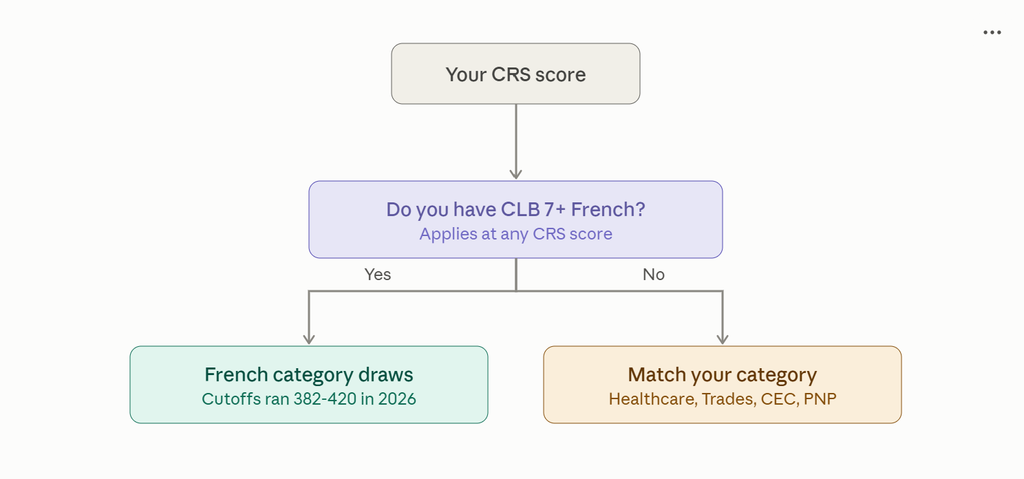
French fluency is the single biggest lever in this decision. At CLB 7, a 450 score clears French draws immediately. Without it, that same 450 sits in the crowded 451-500 band with no direct route in 2026.
What to do at 450, ranked by ROI:
- Learn French to CLB 7 (6-12 months, $500-$2,000): highest ROI, opens the lowest-cutoff pathway in the system
- Target PNP aggressively (Saskatchewan, BC tech streams, Ontario, Alberta): 2-6 months to nomination, then near-guaranteed ITA
- Boost core score to 480-490 through language retesting or additional education: slower and more expensive than French, but useful if you’re already close to a category threshold
A score of 450 puts you ahead of roughly 60% of the pool. But being above average doesn’t get you invited in a system built around category fit, not general ranking.
Not sure which category actually fits your profile? Book Your Strategy Assessment with Amir Ismail, RCIC #R412319, and get a category-by-category verdict instead of guessing.
French Language Proficiency: Still the Lowest-Scoring Pathway in 2026
French language proficiency remains the most accessible Express Entry pathway in 2026, with cutoffs running 382-420 across the year’s draws. The August 19 draw invited 5,000 people at CRS 382, a 2026 low, just one day after a CEC round cut off at 523. That’s a 141-point gap for the same skill set, minus fluent French.
You don’t need fluency. The minimum requirement is CLB 7 (NCLC 7) across reading, writing, listening, and speaking, functional intermediate French, not conversational mastery.
2026 French Draw Snapshot
| Draw Date | Invitations | CRS Cutoff |
|---|---|---|
| Aug 19, 2026 | 5,000 | 382 (2026 low) |
| Aug 6, 2026 | 5,000 | 391 |
| May 28, 2026 | 4,500 | 409 |
| Feb 6, 2026 | 8,500 | 400 |
French points stack with English points. If you already have strong English (CLB 9+) and add French at CLB 7, you gain category eligibility without losing your existing language score.
How Long Does It Take to Learn French to CLB 7?
Most candidates reach CLB 7 in 8-12 months of dedicated study, faster with prior exposure to a Romance language like Spanish or Italian. Intensive courses (20+ hours a week) can compress this to 6-8 months, while self-study with a tutor typically takes 12-18 months.
Recommended path: Alliance Française or equivalent structured courses, daily practice through apps like Duolingo or Frantastique as a supplement, and TEF Canada prep in the final two months before testing.
New in 2026: Physicians, Senior Managers, Researchers, Transport, and Military Categories
IRCC added five new Express Entry categories between December 2025 and February 2026, bringing the total to 10 active categories. Most CRS guides published before this year still describe the old system of five. If your research is even a few months old, you’re missing a third of your options.
- Physicians (added Dec 8, 2025): requires 12 months of Canadian clinical experience. The first draw hit a record-low CRS of 169.
- Senior Managers (Feb 18, 2026): NOC 00 codes only, 12 months Canadian experience required. Two draws so far, ranging 392-429.
- Researchers (Feb 18, 2026): 12 months Canadian experience required. No confirmed 2026 draw in the record as of this writing.
- Transport Occupations (Feb 18, 2026): 12 months experience, Canada or abroad. Latest draw (Aug 7) cut off at 470.
- Skilled Military Recruits (Feb 18, 2026): requires a job offer from the Canadian Armed Forces, not prior Canadian experience. A small category by design; the July 23 draw issued just 4 ITAs at CRS 368.
Note also what disappeared: the Agriculture and Agri-food category was retired for 2026. If you were counting on it, you need a new plan.
For full eligibility breakdowns on Physicians and Senior Managers, including specific NOC codes and documentation requirements, see AIA’s 2026 Express Entry category guide.
How to Strategically Improve Your CRS Score for 2026
Before optimizing, know where your points actually come from. Core human capital, education, language, age, and work experience, caps around 600 points. Additional points from a provincial nomination, Canadian education, or French proficiency can add several hundred more.
CRS Point Sources at a Glance
- Core Human Capital (max ~600): age, education, first-language ability, work experience
- Spouse/Partner factors (max ~40): education, language, work experience
- Skills Transferability (max 100): combinations of education, language, and experience
- Additional Points (max 600): provincial nomination (+600), Canadian education (+15 to +30), Canadian work experience (+40 to +50), French proficiency (+25 to +50), sibling in Canada (+15)
Optimization by Current Score Range
At 400-450: French to CLB 7 is your highest-ROI move, worth category eligibility, not just points. Improving English from CLB 8 to CLB 9 adds 10-20 points as a secondary lever.
At 450-490: French remains the priority. A Canadian postgraduate diploma adds 15-30 points if you can invest 12-14 months and $5,000-$15,000.
At 490-510: You’re close to CEC range. Pushing language to CLB 10 typically adds 10-15 points, enough to cross into competitive territory.
Timeline reality check: Moving from CLB 9 to CLB 10 usually takes 4-8 months of focused study and may require two or three test attempts to hit all four skills at the top band.
Your Express Entry 2026 Questions Answered
Is 480 a good CRS score for Canada PR in 2026?
It depends entirely on category. A 480 clears French draws (382-420) and Senior Manager draws (392-429) comfortably, but falls short of CEC (507-523) and most Healthcare draws. Without category eligibility, 480 sits in a competitive but not guaranteed position.
Is 400 a good CRS score for Canada PR in 2026?
Yes, if you have French at CLB 7 or higher. French draws ran as low as 382 in 2026, putting a 400 score comfortably within range. Without French, 400 is not competitive for CEC, Healthcare, Trades, or PNP without a provincial connection.
Can I get PR with a CRS score of 450 in 2026?
Yes, primarily through French language draws or a provincial nomination. Direct federal invitation at 450 through CEC, Healthcare, or Trades is not realistic given current cutoffs of 462 and above for those categories.
What CRS score do I need for Express Entry in 2026?
There’s no single number. CEC needs 507-523, French needs 382-420, Healthcare needs 462-510, Senior Managers need 392-429, and PNP is essentially guaranteed once nominated, since the +600 bonus pushes almost everyone over 700.
What happens if my Express Entry profile expires before I get invited?
Profiles expire after 12 months, and a new profile loses your original “time in pool” timestamp. If you’re close to a category threshold, update and maintain your profile. If you’re not competitive for any current category, letting it lapse while you build French proficiency or Canadian experience may be the better move.
Which provinces are easiest for PNP in 2026?
Saskatchewan’s SINP covers 60+ occupations with direct application. BC runs weekly tech-focused draws. Ontario has the largest allocation but is also the most competitive. The right province depends on your occupation and existing ties.
The Bottom Line: Category Beats Score in 2026
Here’s what to remember. Express Entry in 2026 runs on 10 active categories, not the five most guides still describe. A candidate with 382 CRS and French proficiency gets invited. A candidate with 500 CRS and no category fit waits.
Your score still matters. But category alignment decides whether that score ever gets tested against a draw at all.
If you’ve read this far, you understand the 2026 system better than most applicants checking their score calculator today. The next step is matching your specific profile, NOC code, and timeline to the category that fits.
For a full breakdown of your CRS score, category eligibility, and fastest path to an ITA, Book Your Strategy Assessment with Amir Ismail, RCIC #R412319.
Read More Express Entry Updates By Amir Ismail

Express Entry Police Certificate Requirements: Every Country You Lived In
The Express Entry police certificate requirements are simple to state and easy to get wrong….

CEC Draws 2026 (Feb to Sep): 15 Rounds, 41,250 Invitations, Cut-off 518
CEC draws 2026 got smaller and the cut-off got higher. The Express Entry rounds data…

Category Based Express Entry Strategy: What to Do When Your Draw Stalls
If your category has gone quiet, do not wait on it alone. A category based…

Express Entry Incomplete Application: Why IRCC Rejects Files and What It Costs
An Express Entry incomplete application is one Immigration, Refugees and Citizenship Canada (IRCC) rejects before…

Express Entry Category Draw Chances: Eligible Is Not Invited
Being eligible for an Express Entry category does not mean you will get an invitation….

Reuse Immigration Medical Exam Results for Express Entry: Who Qualifies
Yes, in many cases. If you live in Canada and had an immigration medical exam…