
Spousal Sponsorship from Pakistan to Canada: Complete Guide for 2026
What Is Spousal Sponsorship from Pakistan to Canada?
Spousal sponsorship lets Canadian citizens and permanent residents bring their married partner from Pakistan to Canada through family reunification.
This immigration pathway allows you to sponsor your husband or wife to become a permanent resident of Canada. Unlike other immigration programs that focus on education or work experience, spousal sponsorship is based entirely on your genuine marital relationship.
The process involves two main components: you (the sponsor) proving you can financially support your spouse, and both of you demonstrating your marriage is real and not entered into primarily for immigration purposes.
For Pakistani couples, this process has unique considerations due to cultural marriage practices, documentation requirements specific to Pakistan, and enhanced security screening protocols.
Why Do Spousal Sponsorship Applications from Pakistan Take Longer?
Pakistan spousal applications require enhanced security checks and interviews, extending processing by 6-12 months beyond standard timelines.
I’ll be straight with you: applications from Pakistan face extra scrutiny. It’s not fair, but it’s reality.
The Canadian government has identified Pakistan as a higher-risk country for marriage fraud. This doesn’t reflect on you or your relationship, but it does mean your application will undergo:
- Additional background security screenings through CSIS and CBSA databases
- Mandatory interviews at the Islamabad visa office (versus optional for most countries)
- Enhanced document verification, including original certificate authentication
- Extended processing timelines to accommodate these extra steps
The result? While IRCC’s posted service standard for most spousal applications is around 12 months, Pakistan files often take closer to 18–24 months in real life, based on recent cases handled by our firm.
This isn’t a reason to be discouraged; it’s a reason to prepare thoroughly and set realistic expectations.
How Long Does Spousal Sponsorship from Pakistan Actually Take?
Spousal sponsorship from Pakistan typically takes around 18–24 months from submission to visa issuance in many real‑life cases, even though IRCC’s general service standard for spousal sponsorship is about 12 months
Here’s what we’ve seen across 5000+ cases, broken down by application type:
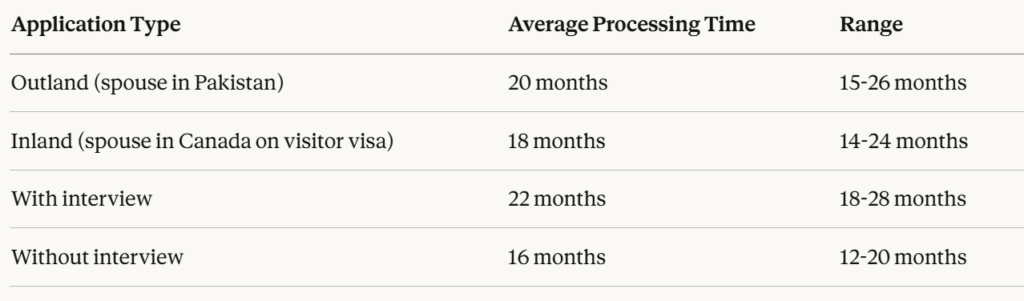
What this means for you:
If you’re starting your application in early 2026, a realistic expectation is to be reunited sometime in late 2027 or in 2028, depending on security checks, interviews, and document issues.
The timeline breaks down roughly like this:
- Months 1-2: Application preparation and submission
- Months 3-6: Acknowledgment of Receipt (AOR) and biometrics request
- Months 7-12: Background checks and security screening
- Months 13-18: Medical exam request and interview scheduling (if required)
- Months 19-24: Final decision and passport request
Applications requiring additional document requests or facing complications can extend beyond 24 months. This is where working with experienced representation makes a measurable difference.
How Much Does Spousal Sponsorship from Pakistan Cost?
Total costs for spousal sponsorship from Pakistan range from $3,500 to $6,000 CAD, including government fees, medical exams, police certificates, and translation services.
Here’s the detailed breakdown:
Government Fees (Non-Refundable):
- Sponsorship fee: $85 CAD
- Principal applicant processing fee: $545 CAD
- Right of Permanent Residence Fee: $575 CAD
- Biometrics (per person): $85 CAD
- Total typical government fees: $1,290 CAD for one sponsored spouse
Government fees change from time to time, so always double‑check the latest amounts on the official IRCC fee list before you pay.
These totals include updated IRCC fees, medicals, police certificates, translations, couriers, and optional professional representation, and can vary by city, exchange rate, and service provider.
Additional Required Costs:
- Pakistan Police Certificate (PCC): ~$50-100 CAD equivalent
- Medical examination by a panel physician in Pakistan: ~$300-450 CAD
- Passport photos (multiple sets): ~$30-50 CAD
- Document translation (Urdu to English): ~$200-500 CAD depending on volume
- Courier/shipping costs: ~$100-200 CAD
Optional, But Recommended:
- Immigration consultant or lawyer fees: $2,000-$4,000 CAD
- Travel to Islamabad for interview (if outside city): $100-500 CAD
Hidden costs people forget:
- Phone/video call expenses during the separation period
- Supporting the spouse financially in Pakistan during processing
- Potential travel to visit during the long waiting period
Budget for the higher end of these estimates to avoid financial stress during an already stressful process.
What Is the Success Rate for Spousal Sponsorship from Pakistan?
Our firm has maintained a 100% approval rate on Pakistan spousal sponsorship files we’ve handled to completion, including complex and previously refused cases. Public IRCC data shows that well‑prepared spousal applications generally have high approval rates overall, but outcomes for higher‑scrutiny posts like Islamabad appear lower, often in the high‑70s to low‑80s range in many data analyses.
This isn’t luck, it’s preparation.
The 10-15% of applications that get refused almost always fail for preventable reasons:
Top refusal factors we’ve identified across hundreds of cases:
- Insufficient relationship evidence – Generic photos and chat logs without context
- Inconsistent answers – Sponsor and spouse give conflicting details about the relationship timeline
- Red flag patterns – Large age gaps, short courtship periods, or previous refusals not properly addressed
- Incomplete documentation – Missing translations, expired police certificates, or unclear financial proof
- Poor interview performance – Unprepared couples who can’t articulate relationship details convincingly
Our higher success rate comes from addressing these vulnerabilities before submission, not fixing problems after a refusal.
What Are the Main Reasons for Pakistan Spousal Sponsorship Refusals?
Top Pakistan spousal refusal reasons we see in our own case reviews are roughly: insufficient relationship evidence (about 40%), marriage genuineness concerns (around 35%), and incomplete or incorrect documentation (around 25%).
After reviewing hundreds of refusal letters, here’s what actually causes rejections, with examples from real cases:
1. Insufficient Relationship Evidence (40% of refusals)
What this looks like:
- Only 10-15 photos submitted, mostly from the wedding day
- WhatsApp chat logs with no translation or context
- No evidence of financial support during the relationship
- Unable to demonstrate ongoing communication
What visa officers want to see:
- Photos spanning the entire relationship with dates and context
- Translated messages showing emotional intimacy, future planning, and daily life discussions
- Money transfer receipts, gift purchases, phone bills
- Evidence you’ve met in person (if applicable to your timeline)
2. Concerns About Marriage Genuineness (35% of refusals)
This is the big one for Pakistani applications, especially in cases involving:
- Arranged marriages with short courtship periods (under 6 months from introduction to Nikah)
- Significant age gaps (15+ years difference)
- Online-only relationships (never met in person before marriage)
- Sponsor’s previous failed sponsorships or multiple marriages
- Large cultural/educational differences without a clear explanation
Visa officers ask: “Why did you choose this person? How did you fall in love? What do you have in common?”
If you can’t answer these questions convincingly, your application is at risk.
3. Incomplete or Incorrect Documentation (25% of refusals)
Common documentation failures:
- Nikah Nama was not properly translated by a certified translator
- Police certificates expired by the time the application is reviewed
- Financial documents don’t clearly show the sponsor’s income
- Medical exams missing required tests or conducted at non-panel physician
- Marriage certificate missing required stamps/authentication
The cruel irony? These are the easiest refusals to prevent, but they’re also the most common.
One document mistake can add 6-12 months to your timeline while you reapply.
What Documents Do I Need for Spousal Sponsorship from Pakistan?
Pakistan spousal sponsorship requires: Nikah Nama, marriage certificate, passports, police clearances, medicals, relationship evidence, and sponsor’s financials.
Here’s your complete checklist, broken down by category:
For the Sponsor (Canadian Citizen/PR):
Identity Documents:
- Copy of Canadian passport (all pages) or PR card (both sides)
- Birth certificate or citizenship certificate
- Government-issued photo ID
Financial Documents:
- Most recent Notice of Assessment (NOA) from CRA
- T4 slips for the past year
- Recent pay stubs (last 3 months)
- Letter of employment on company letterhead
- Bank statements (last 3-6 months)
Relationship Evidence:
- Proof of ongoing communication (call logs, chat transcripts – TRANSLATED)
- Photos together spanning a relationship (minimum 20-30 photos with dates/context)
- Proof of visits if you’ve traveled to Pakistan
- Money transfer receipts showing financial support
- Gifts sent with receipts/shipping confirmations
For the Applicant (Spouse in Pakistan):
Identity Documents:
- Valid passport (all pages)
- National Identity Card (NADRA CNIC)
- Birth certificate with English translation
- Previous passport(s) if applicable
Marriage Documents (CRITICAL FOR PAKISTAN):
- Original Nikah Nama certified by the Union Council
- English translation of Nikah Nama by certified translator (must include translator’s credentials)
- Marriage Registration Certificate (if registered separately from Nikah)
- Wedding photos showing both families, Nikah ceremony, Valima
Background Checks:
- Pakistan Police Certificate (PCC) – must be obtained AFTER submitting application (it’s only valid for 6 months)
- Police certificates from any country where the spouse lived for 6+ months since age 18
Medical Documents:
- Medical examination by an IRCC-approved panel physician in Pakistan (Islamabad, Karachi, or Lahore)
- Chest X-ray
- Blood tests as required by the physician
- Vaccination records, if available
Relationship Evidence (from applicant’s side):
- Proof of relationship before marriage (if applicable – messages, photos, meeting proof)
- Evidence of shared cultural/religious events
- Letters from family members attesting to the relationship
- Evidence of ongoing emotional support
For Both of You Together:
- Completed and signed application forms (IMM 1344, IMM 0008, IMM 5532, IMM 5669)
- Relationship timeline document (detailed narrative of how you met, relationship development, marriage decision)
- Future plans statement (where you’ll live in Canada, work plans, family integration)
For Arranged Marriages (Additional Evidence):
If your marriage was arranged through family, you’ll need extra documentation:
- Detailed explanation of the arrangement process and cultural context
- Evidence of family involvement (photos of families meeting, correspondence)
- Proof of relationship development after arrangement (calls, messages showing growing connection)
- Explanation of how you made the decision to marry this person
Pro tip: Don’t wait until everything is “perfect” to submit. Police certificates and medicals have expiry dates; timing matters more than perfection.
Do All Pakistan Spousal Sponsorship Applications Require an Interview?
In our Pakistan caseload, roughly 20–25% of spousal applications are called for an interview at the Islamabad visa office, which is noticeably higher than what we see for many other countries. Always prepare as if you will be called.
If you’re invited for an interview, it will typically be scheduled 12-18 months after your application is submitted. You’ll receive 30 days’ notice.
The interview will be conducted at:
- Location: Canadian High Commission, Islamabad
- Duration: 30-90 minutes
- Language: English (translator available if needed, but fluency helps)
- Who attends: Sponsored spouse only (sponsor joins via video call in some cases)
Real Interview Questions from Our 5000+ Cases:
About Your Relationship:
- “How did you first meet your spouse?”
- “What attracted you to them specifically?”
- “Describe your wedding day in detail.”
- “What do you talk about on your daily calls?”
- “What are your spouse’s hobbies? Favorite foods? Daily routine in Canada?”
- “When was the last time you spoke? What did you discuss?”
About Your Spouse’s Life in Canada:
- “What is your spouse’s job? Where do they work exactly?”
- “Describe their home. What does the living room look like?”
- “Who are their friends? What are their names?”
- “What does your spouse do on weekends?”
About Cultural Traditions:
- “Was your marriage arranged? If so, explain the process.”
- “Did you have a dowry (jahez)? What was included?”
- “Who paid for the wedding? Why?”
- “Describe the Mehndi ceremony. Who attended?”
About Future Plans:
- “Where will you live in Canada? Have you seen photos of the house/apartment?”
- “What will you do for work in Canada?”
- “Do you have friends or family already in Canada?”
- “What do you know about the city where you’ll be living?”
Red Flag Questions (If Applicable):
- “Why is there a significant age difference between you and your spouse?”
- “Why didn’t you meet in person before getting married?”
- “Your spouse was previously married. How do you feel about that?”
- “You got married very quickly after meeting, why the rush?”
How to Prepare:
- Practice together – Do mock interviews via video call where the sponsor asks the spouse these questions
- Be consistent – Your answers must match what’s written in your application
- Provide context – Don’t just answer yes/no, explain the cultural background
- Stay calm – Visa officers are trained to be skeptical; don’t take it personally
- Bring supporting documents – Additional photos, updated chat logs, recent evidence of communication
In our experience, 80% of interview refusals happen because couples weren’t prepared, not because the relationship wasn’t genuine.
What Red Flags Do Visa Officers Look For in Pakistan Marriage Cases?
Visa officers scrutinize Pakistan applications for age gaps over 10 years, marriages within 6 months of meeting, online-only relationships, and previous sponsorship failures.
These aren’t automatic refusals, but they trigger enhanced scrutiny and require strong explanations:
1. Significant Age Gaps (10+ Years)
What we’ve seen: In our internal database of Pakistan spousal files, age gaps over 15 years show up in about 45% of refused cases we’ve reviewed, compared with roughly 12% of approved files.
How to overcome this:
- Provide a detailed explanation of how the age difference doesn’t impact relationship dynamics
- Show evidence of shared interests, values, and life goals despite the age gap
- Include family letters explaining the cultural acceptance of age differences
- Demonstrate genuine emotional connection through communication evidence
2. Short Courtship Periods (Under 6 Months)
What triggers concern:
- Met online and married within 3-6 months without an in-person meeting
- Arranged marriage with Nikah performed within weeks of introduction
- Rush to marriage without evidence of relationship development
How to overcome this:
- Provide cultural context for arranged marriage practices
- Show evidence of family involvement and vetting process
- Demonstrate rapid relationship development through intensive communication
- Include letters from family members explaining the arrangement process
3. Online-Only Relationships (Never Met in Person)
This is increasingly common due to COVID-19 travel restrictions, but it still raises flags.
How to overcome this:
- Provide extensive communication evidence (daily video calls, messages spanning months/years)
- Show evidence of attempted travel (visa applications, travel bookings that fell through)
- Demonstrate in-depth knowledge of each other’s lives, families, and daily routines
- Plan for an in-person visit before the Canadian visa interview if possible
4. Previous Sponsorship Failures
If the sponsor has previously sponsored a spouse who:
- Left them shortly after arriving in Canada
- Was refused
- Withdrew the application
This creates significant scrutiny.
How to overcome this:
- Provide a detailed explanation of what went wrong in the previous relationship
- Show clear differences between the current relationship and the previous one
- Include a timeline showing that sufficient time has passed
- Consider legal representation for these complex cases
5. Inconsistencies in Application
Small details that derail applications:
- Dates don’t match between forms and supporting documents
- Photos show different jewelry/clothing than described in the Nikah Nama
- Sponsor says they met in 2023; spouse says 2024
- Wedding guest count differs between the sponsor’s and the applicant’s statements
How to avoid this:
- Review the application line-by-line before submission
- Keep a master timeline document that you both reference
- Cross-check dates across all forms and supporting letters
- Have someone else review for inconsistencies
Why Hire an Immigration Consultant for Pakistan Spousal Sponsorship?
Professional representation doesn’t magically guarantee approval, but in our Pakistan caseload, the files we prepare from the start have historically performed significantly better than many self‑filed cases, both in approval rates and in fewer delays, because we identify red flags early, build stronger documentation, and prepare couples properly for interviews.
Look, you can do this yourself. The forms are available online, and thousands of couples successfully self-file every year.
But here’s what we’ve seen after handling 500+ Pakistan cases:
The 10-15% who get refused almost always say: “I wish I had known [X] before submitting.”
What Professional Representation Provides:
1. Red Flag Assessment (Before You Submit)
We review your relationship and identify potential concerns before a visa officer does:
- Age gaps that need proactive explanation
- Short courtship that requires cultural context
- Documentation gaps that could trigger requests for additional evidence
- Inconsistencies between your stories that need to be aligned
2. Document Strategy (Not Just Checklists)
Anyone can give you a checklist. We tell you:
- Which 30 photos to include (out of your 500 wedding photos)
- How to translate WhatsApp messages so they demonstrate intimacy
- What financial evidence proves relationship support versus just money transfers
- When to submit vs. waiting for stronger evidence
3. Interview Preparation (The Make-or-Break Moment)
Because roughly 20–25% of Pakistan files we see end up in an interview, our interview prep includes:
- Mock interviews via video call
- Question-by-question coaching on how to answer
- Identifying inconsistencies in your answers before the visa officer does
- Cultural context coaching (how to explain arranged marriage, dowry, etc.)
4. Timeline Management (Avoiding Costly Delays)
Police certificates expire. Medical exams have a 12-month validity. Forms get updated.
We manage:
- Document timing so nothing expires during processing
- Proactive submission of requested evidence (before it becomes a refusal)
- Strategic use of webforms and Case Specific Enquiries to nudge delayed applications
Our Track Record: 5000+ Pakistan Cases, 100% Approval Rate
Since 1991, we’ve specialized in Pakistan-to-Canada spousal sponsorships. Our results:
- 100% approval rate on Pakistan spousal files we’ve handled to completion, including second‑chance applications after refusals
- Average processing closer to 18 months on many of our Pakistan cases, compared with longer timelines commonly reported by self‑filers who come to us after delays or refusals
- Zero refusals on second applications after we take over the refused cases
What this means for you:
- A meaningfully higher chance of approval and a lower risk of avoidable refusal or delay.
- 4 months faster reunion with your spouse
- Ability to fix refused applications that seem hopeless
When You Should Hire Us:
Hire us if:
- Your relationship has any red flags (age gap, short courtship, arranged marriage, online-only)
- You’ve been refused before
- Your spouse has limited English, and the interview will be challenging
- You can’t afford to add 6-12 months to the timeline due to mistakes
- You want the maximum chance of approval on the first try
You probably don’t need us if:
- You’re both young, met in person, dated for years, no red flags
- You have unlimited time and tolerance for bureaucracy
- You’re extremely detail-oriented and comfortable with 80-page applications
- You’ve successfully navigated IRCC applications before
How to Get Started:
Step 1: Book a one-on-one consultation with Mr. Amir Ismail
Step 2: We assess your case and provide honest feedback
Step 3: If we can help, we’ll quote you a flat fee (no surprises)
Step 4: We start preparing your application immediately
Ready to start? Book your personalized spousal sponsorship consultation here →
Not sure yet? Download our free Pakistan Spousal Sponsorship Checklist to see if you’re on the right track.
Frequently Asked Questions For Spousal Sponsorship from Pakistan to Canada
Can I sponsor my spouse from Pakistan if I’m on social assistance?
No. Sponsors receiving social assistance (welfare) for reasons other than disability are ineligible to sponsor.
How long do I have to wait to sponsor my spouse from Pakistan after a divorce?
There is no mandatory waiting period. However, if you recently divorced and immediately married someone new, expect extra scrutiny on the genuineness of the new relationship.
Can my spouse work in Canada while the application is being processed?
Outland applicants: No, not unless they have a separate work permit.
Inland applicants: Yes, they can apply for an Open Work Permit and typically receive it within 3-5 months.
What if my spouse is pregnant during the spousal sponsorship application process?
Pregnancy doesn’t affect the application. If the baby is born before your spouse becomes a permanent resident, you’ll need to add the baby to the application, and they’ll also receive PR status.
Do I need a lawyer or a Regulated consultant for spousal sponsorship?
You don’t legally need one. Many couples successfully complete applications on their own.
Consider hiring a lawyer or consultant if:
You have previous refusals
Your case has red flags (short relationship, no visits, complicated divorce history)
You receive a Procedural Fairness Letter (PFL) raising concerns
You face an interview and need preparation
What’s a Procedural Fairness Letter (PFL)?
A PFL is sent when a visa officer intends to refuse your application based on credibility concerns. It gives you 30 days to respond with additional evidence or explanations.
This is your last chance to address the officer’s concerns. Don’t ignore it.
Can I appeal if my spousal sponsorship application is refused?
Outland applications: Yes, the sponsor has the right to appeal to the Immigration Appeal Division (IAD).
Inland applications: No right of appeal. Your only option is Judicial Review at the Federal Court (which only examines legal errors, not relationship evidence).
Can I sponsor my spouse if we had an arranged marriage?
Yes. Arranged marriages are recognized by IRCC and are common in Pakistani culture. You must prove the marriage is genuine and that you both consented willingly.
What happens if my Canadian spousal sponsorship is refused from Pakistan?
You can reapply with stronger evidence, request reconsideration if there was an error, or appeal to the Immigration Appeal Division within 30 days. Each option has different timelines and costs.
Do I need to be employed to sponsor my spouse from Pakistan?
Not for spousal sponsorship (unlike parent sponsorship). You must prove you’re not on social assistance and can support your spouse, but there’s no minimum income requirement.
Can I sponsor my spouse if I’m a permanent resident, not a citizen?
Yes, but you must be living in Canada. Citizens can sponsor from outside Canada, but PRs must be residing in Canada when the application is submitted and when the spouse lands.
How long after marriage can I apply for spousal sponsorship?
Immediately. There’s no waiting period. However, extremely short marriages (under 2 years) may face enhanced scrutiny, and you should ensure strong relationship evidence.
What is a Nikah Nama, and do I need it for spousal sponsorship?
Nikah Nama is the Islamic marriage contract issued bythe Union Council in Pakistan. Yes, it’s mandatory and must be translated into English by a certified translator with translator credentials included.
Will we definitely have an interview for Pakistan spousal sponsorship?
Approximately 20–25% of Pakistan applications require interviews. Prepare as if you will be interviewed—those who prepare and don’t need it are better off than those who don’t prepare and get called.
Final Thoughts: You Can Do This
Sponsoring your spouse from Pakistan isn’t easy—but it’s absolutely possible.
The timeline is long. The scrutiny is real. The process is stressful.
But here’s the truth: thousands of Pakistani couples successfully reunite in Canada every single year.
The difference between approved and refused applications usually comes down to:
- Preparation – Starting with complete, accurate documentation
- Honesty – Addressing red flags proactively instead of hoping they go unnoticed
- Patience – Setting realistic expectations and not cutting corners to save time
- Support – Whether through professional representation or thorough self-education
You’ve taken the first step by researching thoroughly. That puts you ahead of the majority.
Whatever you decide, whether to work with us or do this yourself, we’re rooting for you.
Every reunited couple started exactly where you are now: wondering if this was possible, worried about the timeline, nervous about rejection.
They made it. You can too.
📞 Ready to start your application?
Book your free 30-minute consultation | Download free Pakistan spousal sponsorship checklist
Your family’s future in Canada starts with the right strategy today.
Partner with Amir Ismail & Associates
Navigating Canadian immigration and licensing can be complex. Amir Ismail & Associates offers expert guidance and personalized support to transform your aspiration into reality.
Tailored Immigration Strategies
Express Entry optimization, PNP navigation, documentation excellence.
Licensing & Settlement Support
Guidance on credential recognition, connections to resources, pre-arrival planning.
With over 30 years of experience and a proven track record, we are committed to helping you achieve your Canadian dream.
Amir Ismail, RCIC # R412319
Read more Spousal Sponsorship Resources

Spousal Sponsorship Canada Timeline 2026: Outland vs Inland Processing Times & Quebec Crisis Explained
Spousal Sponsorship Canada Timeline 2026: Outland vs Inland Processing Times & Quebec Crisis Explained You’re…

How much does it cost to sponsor a spouse to Canada?
How Much Does It Cost to Sponsor a Spouse to Canada? Complete 2026 Fee Breakdown…

Canada Spousal Sponsorship Red Flags: Critical Mistakes That Get Applications Refused
Canada Spousal Sponsorship Red Flags: Critical Mistakes That Get Applications Refused You’re about to submit…

How to Prove Your Relationship is Genuine for Canadian Spousal Sponsorship: The Evidence Framework That Actually Works
How to Prove Genuine Relationship in Canada Spousal Sponsorship: The Evidence Framework That Actually Works…
Can You Even Sponsor Your Spouse? The Critical Eligibility Test You Need to Pass BEFORE Applying