
Canada Just Held Its Second CEC Draw in Two Weeks – Here’s What Changed (November 2025)
Something interesting just happened in Canada’s Express Entry system.
And if you’re working in Canada right now, hoping to get your PR, you need to know about this.
IRCC just held a Canadian Experience Class – CEC draw on November 12, 2025.
That’s the second CEC draw in just over two weeks.
But here’s what matters more: Canada just announced massive changes for 2026.
Let me tell you what this really means for you.
Key Takeaways
- 1,000 invitations issued in the November 12 CEC draw with a CRS cutoff of 533
- Two draws in two weeks: The Previous CEC draw was on October 28 (though this pattern also occurred in June-July 2025)
- Tie-breaker jumped dramatically: From March 2025 to October 17, 2025—showing intense competition
- Provincial Nominee Program rebounds: 55,000 in 2025, but jumping to 91,500 in 2026 (66% increase)
- 82,980 spots allocated for in-Canada candidates in 2025 (includes CEC and PNP space)
- Processing time: 6-7 months average from ITA to permanent residence for CEC (as of November 2025)
- Job offer points removed: As of March 25, 2025, job offers no longer provide CRS points
What You’ll Find on This Page
The November 12 Express Entry Draw Details
Here’s what happened on November 12, 2025:
Draw Type: Canadian Experience Class (program-specific)
Invitations Issued: 1,000 ITAs
CRS Cutoff Score: 533
Tie-Breaker Date: October 17, 2025, at 3:39 AM UTC
What does this mean?
If you had a CRS score of 533 or higher AND created your Express Entry profile before October 17, you got an invitation.
If you had 533 but created your profile after October 17? You’re still in the pool waiting.
That’s how tie-breakers work.
What’s Different About Recent Draws
Let’s look at what’s actually happening with CEC draws in 2025.
The recent pattern shows smaller, more selective draws:
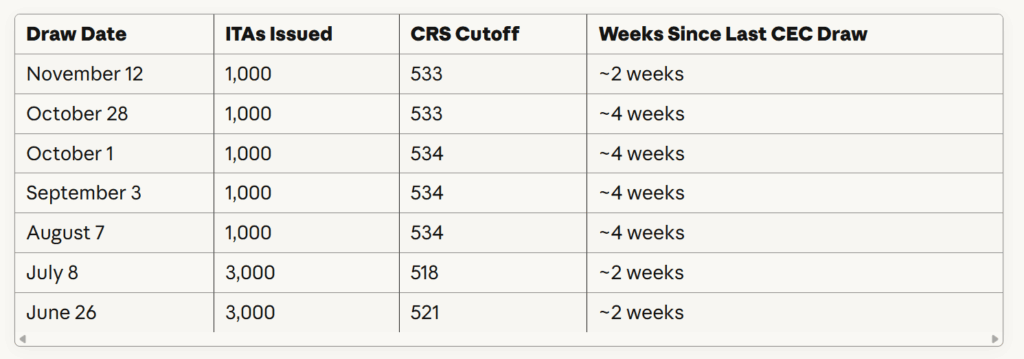
Here’s what the data shows:
June-July 2025: High-frequency draws (every 2 weeks) with 3,000 ITAs each. CRS scores ranged from 518-529.
August-October 2025: Draw frequency slowed to roughly every 4 weeks, but draw size dropped to 1,000 ITAs. CRS scores jumped to 533-534.
November 2025: Frequency increased again (2 weeks between draws), but size remained at 1,000 ITAs, and CRS stayed at 533.
The real story here isn’t about “breaking patterns.”
It’s about IRCC‘s multi-objective selection strategy.
Look at what happened between the October 28 and November 12 CEC draws:
- October 29: 6,000 French-language proficiency candidates invited with CRS cutoff of just 416
- November 10: 714 Provincial Nominee Program candidates invited with CRS cutoff of 738
IRCC is simultaneously:
- Inviting small numbers of high-CRS in-Canada candidates (CEC at 533)
- Inviting large numbers of French-speaking candidates (6,000 at CRS 416)
- Inviting provincial nominees who already have job offers and community connections
This is a complex selection system with multiple priorities, not a simple “pattern.”
The Tie-Breaker Rule Explained
Let’s talk about something that reveals intense competition.
The tie-breaker date.
On October 28, the tie-breaker date was in March 2025.
On November 12, it jumped to October 17, 2025.
That’s a massive leap forward—seven months.
What does this tell us?
Hundreds of people are sitting at exactly CRS 533.
Think about it.
IRCC had to go through everyone from March to October 17 who scored 533 just to find 1,000 people to invite.
That’s seven months of profiles.
All tied at the same score.
All are competing for those invitations.
The competition at 533 is fierce.
Big News: 2026-2028 Immigration Levels Plan
Here’s the most important information that just came out in early November 2025.
Canada released its new 2026-2028 Immigration Levels Plan.
And it changes the game for Provincial Nominee Programs.
The PNP Rebound
2025: 55,000 PNP spots (this was seen as a major cut)
2026: 91,500 PNP spots (66% increase)
2027: 92,500 PNP spots
2028: 92,500 PNP spots
The 55,000 target for 2025 was a one-year correction, not a permanent change.
Starting in 2026, the PNP is expanding dramatically.
What This Means for You
If you’re working in Canada right now, Provincial Nominee Programs should be your primary strategy for 2026 and beyond.
Why?
A provincial nomination gives you +600 CRS points.
That means guaranteed invitation in the next Express Entry draw.
With PNP targets increasing by 66%, provinces will be nominating significantly more candidates in 2026.
If you’ve been working in:
- Ontario
- British Columbia
- Alberta
- Manitoba
- Saskatchewan
Check your province’s PNP streams immediately.
The 2026 expansion represents your best opportunity.
2026 Express Entry Targets
The new plan also shows continued strong support for in-Canada candidates:
Federal High Skilled (Express Entry): 109,000 admissions in 2026
In-Canada Focus: Continues to prioritize temporary residents transitioning to PR
The government’s commitment is clear: people already working and studying in Canada remain the priority.
What CRS 533 Actually Requires
Let me be completely honest with you about what it takes to hit 533 points.
Because reaching this score is harder than many people realize.
What DOESN’T Get You to 533
Let’s start with what doesn’t work.
Profile Example 1:
- Age: 29 years old
- Education: Bachelor’s degree (with ECA)
- Language: CLB 9 in all abilities
- Canadian Work Experience: 2 years
Actual CRS Score: 457 points (76 points short of 533)
Profile Example 2:
- Age: 32 years old
- Education: Master’s degree
- Language: CLB 10 in all abilities (near-perfect IELTS)
- Work Experience: 3 years foreign + 1 year Canadian
Actual CRS Score: 496 points (37 points short of 533)
Even with a Master’s degree and perfect language scores, you’re still short.
What DOES Get You to 533
To reach CRS 533, you typically need one or more of these additional factors:
Option 1: Canadian Education Credential
A Canadian post-secondary credential (in addition to your foreign degree) adds:
- 1-2 year program: +15 points
- 3+ year program: +30 points
So Profile Example 2 (496 points) + a Canadian 3-year credential = 526 points (still 7 points short)
Option 2: French Language Proficiency
This is the game-changer most people miss.
If you have:
- CLB 7 or higher in English (all four abilities)
- AND NCLC 7 or higher in French (all four abilities)
You receive a +50 point bonus for strong French proficiency.
So Profile Example 2 (496 points) + French bonus (50 points) = 546 points ✓
Option 3: Combination Strategy
- Master’s degree (or higher)
- CLB 10 in English
- 2+ years of Canadian work experience
- Canadian education credential
- Younger age (under 30)
The truth is this:
CRS 533 is not a “typical” profile.
It requires exceptional credentials:
- Bilingualism (English + French), OR
- Multiple post-secondary credentials, including Canadian education, OR
- Perfect optimization of age, language, education, and work experience
If you’re sitting below 533, you need to understand what actually moves the needle.
Your Next Steps
Okay, so what do you do with this information?
If Your Score is Below 533
Priority Strategy: Provincial Nomination
With PNP spots jumping to 91,500 in 2026, this should be your primary focus.
A provincial nomination gives you +600 points = guaranteed ITA at any score.
Research your province’s streams NOW for 2026:
Ontario (OINP)
- Human Capital Priorities Stream
- French-Speaking Skilled Worker Stream
- Skilled Trades Stream
British Columbia (BC PNP)
- Skilled Worker Stream
- International Graduate Stream
Alberta (AAIP)
- Alberta Opportunity Stream
- Alberta Express Entry Stream
Manitoba (MPNP)
- Skilled Worker in Manitoba Stream
Saskatchewan (SINP)
- International Skilled Worker: Saskatchewan Express Entry
Most provinces prioritize candidates already working or studying in their province.
Alternative: Improve Your CRS Score
If PNP isn’t an option, focus on score optimization:
Language: Retake IELTS/CELPIP and aim for CLB 10 in all abilities (adds significant points)
French: If you have any French ability, develop it to NCLC 7+ for the 50-point bonus
Canadian Education: Enroll in a Canadian post-secondary program (adds 15-30 points)
Work Experience: Gain additional Canadian work experience (1 year vs 2 years vs 3+ years matters)
Spouse Factors: If applying with a partner, improve their language scores and credentials
If Your Score is 533 or Higher
Step 1: Verify Your Profile is Complete
Double-check:
- Language test results are current (valid for 2 years)
- Work experience letters have all the required details
- Educational credentials are up to date
- All personal details are accurate
Step 2: Prepare Documents NOW (Don’t Wait for ITA)
When you get your ITA, you have 60 days to submit your complete application.
Start gathering now:
Week 1 Actions:
- Book a medical exam with an IRCC-approved panel physician
- Request police certificates from all countries where you lived 6+ months since age 18
- Request detailed employment reference letters from all employers
- Gather educational transcripts and certificates
Week 2-3 Actions:
- Complete medical exam
- Follow up on police certificate requests
- Organize proof of funds (if applicable to your program)
- Compile all supporting documents
The medical exam and police certificates take the longest.
Start these immediately—don’t wait for your ITA.
If You Just Received Your ITA
Congratulations. You have 60 days.
Here’s your timeline:
Immediately:
- Read the ITA requirements carefully
- Create a checklist of all required documents
- Book a medical exam if not done already
Weeks 1-2:
- Complete medical exam
- Submit police certificate applications
- Request employment reference letters
- Upload education documents and ECA
Weeks 3-4:
- Gather all family documents (marriage certificate, birth certificates)
- Prepare statutory declarations if needed
- Complete all forms accurately
Week 5:
- Final document review
- Pay fees:
- Primary applicant: $1,525
- Spouse: $1,525
- Dependent child: $260 per child
- Submit a complete application
After Submission:
Processing time: 6-7 months average for CEC applications (as of November 2025)
You’ll receive updates through your IRCC online account.
CEC applications typically process faster than other Express Entry programs because you’re already in Canada and your work experience is easier to verify.
Understanding the 2025 Targets
Let’s clear up some confusion about the 82,980 “In-Canada Focus” target.
This number represents admissions (people landing as permanent residents), not ITAs (invitations).
Key distinction:
An ITA issued in November 2025 results in an admission in mid-2026 (due to the 6-7 month processing time).
That admission counts toward the 2026 target, not 2025.
Also important:
The 82,980 “In-Canada Focus” target is not exclusively for CEC.
Official documents state this target is for “CEC incl. PNP space.”
This means it includes in-Canada provincial nominees who go through Express Entry.
The point is: Canada is committed to transitioning temporary residents to permanent status.
Over 40% of 2025 permanent resident admissions are expected to be people already in Canada as students or workers.
If you’re working in Canada now, you’re in the priority group.
Frequently Asked Questions About Canada Experience Class
Can I apply for CEC if I’m no longer in Canada?
Yes. You can apply for CEC even if you’ve returned to your home country.
The requirement is that you have gained at least 12 months of skilled Canadian work experience in the past three years. Where you are when you apply doesn’t matter.
Where you worked matters.
What if my work permit is expiring soon?
If you receive an ITA but your work permit is expiring in the next 4 months, you can apply for a Bridging Open Work Permit (BOWP). This allows you to keep working in Canada while your PR application is being processed. Critical: You can only apply for the BOWP after you’ve submitted your PR application.
Do I need to show proof of funds for CEC?
No. Unlike the Federal Skilled Worker Program, CEC applicants do not need to show proof of settlement funds. This is because you’ve already been living and working in Canada. IRCC assumes you have the financial means to support yourself.
Can self-employment count toward CEC work experience?
No. Self-employment does not count for CEC.
The work experience must be:
– Paid employment (wages or commission)
– Full-time or part-time totaling 1,560 hours minimum
– In a skilled occupation (NOC TEER 0, 1, 2, or 3)
– Gained while on a valid work permit
– Volunteer work and unpaid internships also don’t count.
What happens if my language test expires while I’m in the pool?
Your Express Entry profile will become ineligible. Language test results are valid for two years from the test date. If your results expire while you’re in the pool, you’ll need to:
– Retake the language test
– Update your Express Entry profile with new test results
– Your profile will be re-ranked with your new scores
Important: Updating your profile doesn’t change your profile creation date for tie-breaker purposes.
Can I improve my score after creating my profile?
Yes. You can and should update your Express Entry profile if your circumstances change.
Examples:
– You retake your language test and get higher scores
– You gain more Canadian work experience
– You complete a new degree or diploma
– You get a provincial nomination
– Your spouse improves their language scores
– Each time you update, the system recalculates your CRS score.
But: your original profile creation date stays the same for tie-breaker purposes.
How long does it take to get a PR after receiving an ITA?
From ITA to permanent residence: 6-7 months on average for CEC applications as of November 2025. Here’s the breakdown:
– 60 days: To submit your complete application after ITA
– 6-7 months: IRCC processing time from submission to decision
Total: 8-9 months from ITA to becoming a permanent resident
CEC applications tend to process faster than other Express Entry categories because:
– You’re already in Canada
– Your work experience is Canadian (easier to verify)
– No proof of funds needed
– Fewer documents required overall
Should I focus on CEC or PNP for 2026?
Based on the new 2026-2028 Immigration Levels Plan, Provincial Nominee Programs should be your primary strategy. Here’s why:
PNP Benefits:
– +600 CRS points = guaranteed ITA
– 91,500 spots in 2026 (66% increase from 2025)
– Most provinces prioritize candidates already in their province
– Lower CRS score requirements than the general CEC draws
CEC Reality:
– CRS 533 requires exceptional credentials
– Tie-breaker competition is intense
– Draw sizes remain small (1,000 ITAs)
If you’re working in a Canadian province right now, research that province’s PNP streams immediately. The 2026 expansion represents a massive opportunity.
The Bottom Line
Here’s what matters from the November 12 draw:
The competition at CRS 533 is fierce. The tie-breaker date, jumping seven months forward, shows hundreds of candidates tied at this exact score.
The big news isn’t the draw; it’s the 2026-2028 plan. PNP spots are expanding by 66% starting in 2026. This is your opportunity.
CRS 533 requires exceptional credentials. Bilingualism (English + French) or multiple post-secondary credentials, including Canadian education, are typically necessary.
Job offers don’t give CRS points anymore. This policy changed in March 2025. Don’t waste money on LMIAs expecting score boosts.
Processing takes 6-7 months. Plan accordingly. An ITA in late 2025 becomes an admission in mid-2026.
If you’re working in Canada right now, you’re in the priority group.
But reaching CRS 533 through Express Entry alone is extremely difficult.
Your strategic advantage for 2026: Provincial nomination.
Research your province’s streams now.
Position yourself for the PNP expansion.
And if you’re at 533 or above, keep your profile current and documents ready.
Your time is coming.
For personalized guidance on Express Entry, CRS score optimization, and Provincial Nominee Program strategies, contact Amir Ismail at www.amirismail.com/book-a-consultation.
With 34+ years of experience across Canadian, American, Australian, and global immigration systems, Amir and his team have helped over 25,000 clients successfully navigate Express Entry and achieve permanent residence in Canada.
With offices in Toronto, Dubai, and Karachi, we serve clients worldwide, whether you’re already working in Canada or planning your move from abroad.
Related Articles

How to Immigrate to Canada as a Doctor in 2026
You can immigrate to Canada as a doctor through two main routes. If you have…

Canada PR Admissions by Country 2026: India, Pakistan, UAE
India led Canada PR admissions by country from January to July 2026, with 53,320 of…

French Express Entry Draw October 16, 2026: 5,000 Invited at CRS 435
The French Express Entry draw on October 16, 2026 invited 5,000 candidates at a cut-off…

October 15 CEC Draw: 2,500 Invited at CRS 519
The October 15 CEC draw of 2026 invited 2,500 Canadian Experience Class candidates at a…

PNP Express Entry Draw October 13, 2026: 752 Nominees Invited at CRS 772
The PNP Express Entry draw on October 13, 2026 invited 752 provincial nominees at a…

Express Entry Draws October 2026: French Cut-off Hits 435 as 8,252 Are Invited in One Week
Express Entry draws October 2026 update: Immigration, Refugees and Citizenship Canada (IRCC) invited 8,252 candidates…
Partner with Amir Ismail & Associates
Navigating Canadian immigration and licensing can be complex. Amir Ismail & Associates offers expert guidance and personalized support to transform your aspiration into reality.
Tailored Immigration Strategies
Express Entry optimization, PNP navigation, documentation excellence.
Licensing & Settlement Support
Guidance on credential recognition, connections to resources, pre-arrival planning.
With over 30 years of experience and a proven track record, we are committed to helping you achieve your Canadian dream.
Amir Ismail, RCIC # R412319