
What is a Good CRS Score for Canada PR in 2026? The Category-Based Reality
You’ve checked your CRS score calculator for the hundredth time.
You’ve got 475 points. Maybe 490. You’ve done everything right, Master’s degree. IELTS scores at CLB 9. Three years of work experience.
But when you check the latest Express Entry draw, the cutoff is 531 for the Canadian Experience Class.
And you’re still waiting.
Here’s what nobody is telling you: Your score isn’t the problem. You’re competing in the wrong category.
Canada’s Express Entry system underwent a fundamental transformation in 2025 that most applicants still don’t understand. The question “What is a good CRS score?” no longer has a single answer. It has six different answers depending on which category you qualify for.
And if you’re waiting for “general draws” to resume? They’re not coming back.
Let me show you exactly where you stand and what you need to do before your profile expires.
Key Takeaways: What You Need to Know NOW
The brutal truth about 2026 Express Entry:
- General draws are dead. IRCC hasn’t conducted a true “all-program” draw since early 2025. If you’re not CEC, PNP, or category-eligible, you’re invisible to the system.
- CEC is stuck at 531-534. The Canadian Experience Class draws maintained rigid cutoffs throughout Q4 2025 despite frequent rounds. This isn’t changing in 2026.
- French speakers own Express Entry. Three draws in late 2025 issued 18,500 invitations at scores as low as 379. That’s a 152-point advantage over CEC.
- Categories are volatile but predictable. Healthcare went from 445 to 472. Trades spiked to 505. Education established itself at 462-479. Know your category’s range.
- The 451-500 “squeeze zone” is a trap. Nearly 69,000 candidates scored in this range. Without category eligibility, they’re statistically invisible.
Bottom line: Your 2024 strategy won’t work in 2026. Category alignment beats raw score every single time.
What you’ll find on this page
Why Your “Good” CRS Score From 2024 Doesn’t Work in 2026
Let’s start with the hard data.
In 2024, a CRS score of 480 was competitive. Not guaranteed, but competitive.
In late 2025? That same 480 score means you’re in the “squeezed middle”, a statistical dead zone where 68,875 other candidates sit with you, watching draw after draw pass them by.
The Three Policy Shifts That Broke Everything
1. The Death of General Draws
IRCC hasn’t conducted a true “all-program” draw since early 2025. The last major general draw happened in 2024.
What replaced them? Category-based selection and program-specific rounds (CEC, PNP).
The truth is, Canada decided that who you are matters more than how many points you have.
2. The Arranged Employment Point Removal (March 25, 2025)
IRCC eliminated CRS points for job offers, thinking this would “level the playing field.”
It didn’t.
Scores stayed high because the pool is now filled with candidates who have exceptional core human capital, Canadian master’s degrees, CLB 10 language scores, and multiple years of skilled experience.
The system removed one advantage, but the underlying competition got fiercer.
3. The PNP Allocation Slash
Provincial Nominee Program spots dropped from 110,000 in 2024 to just 55,000 in 2025.
That 600-point nomination bonus? Half as many people can get it now.
Provinces became pickier. Ontario’s Human Capital Priorities stream used to target candidates with 440+ scores. Now? You need 460-480 just to get a Notification of Interest.
What This Means for Your Score
Here’s the reality check:
A CRS score of 480 in 2026 is:
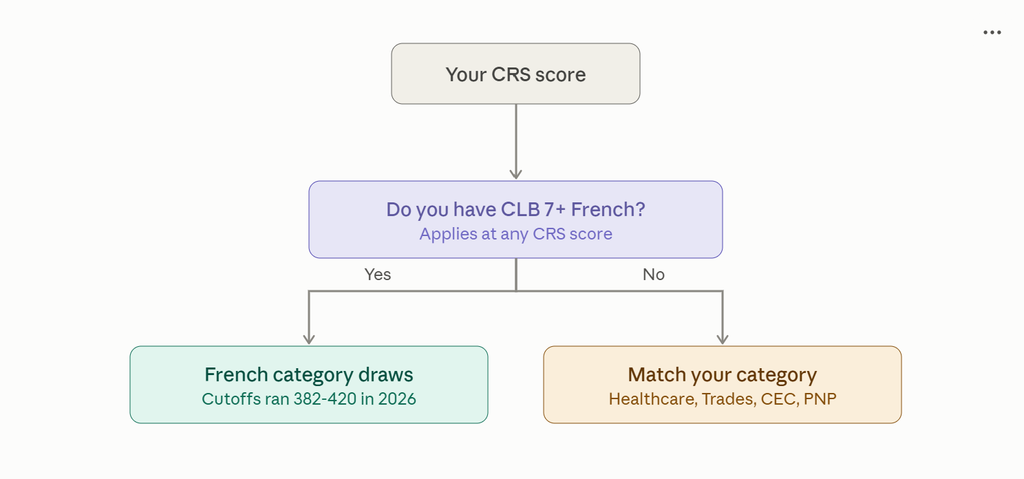
- Excellent if you have French language proficiency (CLB 7+)
- Competitive if you’re a healthcare professional (RN, dentist, pharmacist)
- Below average if you’re trying for Canadian Experience Class
- Insufficient if you’re hoping for a general draw (they don’t exist)
- Uncertain if you’re relying solely on Provincial Nominee interest
The number itself means nothing without category context.
The Express Entry Pool in 2026: Where Does Your Score Actually Rank?
As of November 24, 2025, there were 246,656 active candidate profiles in the Express Entry pool.
That’s a quarter million people competing for roughly 110,000 federal economic immigration spots (Express Entry + some PNP).
Here’s where those candidates fall:
Express Entry Pool Distribution (November 2025)
| CRS Score Range | Number of Candidates | % of Pool | Your Reality |
|---|---|---|---|
| 601-1200 | 779 | 0.32% | You have a provincial nomination. You’re getting invited. |
| 501-600 | 26,351 | 10.68% | The “elite bottleneck.” This group alone could fill 6-8 months of CEC draws. |
| 451-500 | 68,875 | 27.92% | The “squeezed middle.” Historically competitive, now structurally excluded without category eligibility. |
| 401-450 | 70,194 | 28.46% | Category-dependent. Viable only for French speakers or specific occupations. |
| 351-400 | 53,004 | 21.49% | Non-competitive federally. Requires extensive upskilling or provincial intervention. |
| 0-350 | 27,453 | 11.13% | Statistical noise. |
The most important number in this table: 26,351 candidates scoring 501-600.
In 2020-2022, a score of 501 virtually guaranteed an invitation.
In late 2025? It’s just the entry point to the waiting room.
CEC draws in Q4 2025 issued only 1,000 invitations per round. At that pace, it takes six months to clear the 501-600 cohort, and that’s if nobody new enters the pool (which isn’t happening).
Where You Actually Stand
If your score is 520:
You’re in the top 11% of the entire pool. But you’re competing against 26,351 people with higher scores for CEC rounds that issue 1,000 ITAs at a time.
If your score is 470:
You’re in the top 39% overall. But CEC and general draws don’t reach you. Your only federal paths are French-language draws or specific occupational categories.
If your score is 420:
You’re in the top 68%. You need either French proficiency, a healthcare occupation, or a provincial nomination. Direct federal invitation through Express Entry is not happening.
The pool distribution tells you this: Canada has more qualified applicants than it needs. The selection system is now about strategic fit, not just merit.
What CRS Score Do You Need for the Canadian Experience Class in 2026?
The Canadian Experience Class remains the primary pathway for temporary residents transitioning to permanent residence.
But the numbers are brutal.
CEC Draw Analysis: Q4 2025
Here’s every CEC draw from October through late November 2025:
| Draw Date | Invitations Issued | CRS Cutoff | What This Means |
|---|---|---|---|
| Nov 26, 2025 | 1,000 | 531 | Micro-draws maintain high pressure |
| Nov 12, 2025 | 1,000 | 533 | Negligible movement despite back-to-back rounds |
| Oct 28, 2025 | 1,000 | 533 | Stability indicates deep replenishment of high-scoring candidates |
| Oct 1, 2025 | 1,000 | 534 | Q4 begins with a high benchmark |
See the pattern?
Small draw size (1,000 ITAs) = high cutoff (531-534).
But here’s what happened earlier in 2025 when IRCC conducted a larger draw:
- June 26, 2025: 3,000 invitations issued, cutoff dropped to 521
The system is volume-sensitive.
When IRCC issues 1,000 ITAs, they’re skimming the absolute top of the pool, the candidates with near-perfect scores.
When they issue 3,000 ITAs, they have to reach deeper, and scores drop by 10-13 points.
Why CEC Scores Won’t Drop in 2026
You might be thinking: “Okay, so scores drop with higher volume. Won’t 2026 have higher volume?”
Maybe. But here’s the problem:
The pool keeps replenishing with high scorers.
Who are these people?
- International students graduating from Canadian master’s programs (extra education points)
- PGWP holders who’ve accumulated 2+ years of Canadian experience (maximum experience points)
- Candidates with CLB 10 English scores (maximum language points)
- Younger candidates (ages 20-29) who get maximum age points
These candidates are entering the pool with baseline scores of 480-500 before any additional factors.
Add a Canadian master’s degree (+15 points), CLB 10 in all abilities (+30-40 points compared to CLB 9), and 3 years of Canadian experience, and you’re at 530+.
The system has become a victim of its own success. Canada’s immigration marketing works so well that it attracts exceptional candidates who create intense competition.
2026 CEC Score Projections
Based on pool composition and historical draw patterns, here are the realistic CEC score ranges for 2026:
Scenario A: Status Quo (1,000 ITA draws)
- Score Range: 530-535
- Probability: 70%
- Rationale: IRCC maintains small, frequent draws to keep quality high
Scenario B: Volume Increase (3,000+ ITA draws)
- Score Range: 520-525
- Probability: 20%
- Rationale: Political pressure to increase admissions might force larger rounds
Scenario C: Category Priority Shift
- Score Range: 540+
- Probability: 10%
- Rationale: If category-based draws increase, CEC rounds become rarer and more selective
What This Means for You
If your CRS score is 525-530:
You’re on the bubble. Your profile needs to be 100% optimized, with perfect job title/NOC code alignment, a complete work history, and no red flags. Consider the “time in pool” advantage: enter now to establish seniority at your score level.
If your CRS score is 510-525:
You’re in the “danger zone.” Current trends don’t favor you. Your best move: pivot to category eligibility (add French) or aggressively target PNP streams.
If your CRS score is below 510:
CEC invitation is statistically unlikely in 2026. Focus entirely on alternative pathways: French language category, occupational categories, or provincial nomination.
The bottom line for CEC: A “good” score for Canadian Experience Class in 2026 is 535. A “safe” score is 540.
Anything below 520 requires a backup strategy.
French Language Proficiency: The Lowest CRS Pathway (379-420 Range)
Let me show you the most dramatic advantage in Express Entry.
French Language Draws: 2025 Performance
In 2025, French language proficiency drew 18,500 invitations, more than any other category.
Here are the numbers:
| Draw Date | Invitations | CRS Cutoff | Context |
|---|---|---|---|
| Mar 21, 2025 | 7,500 | 379 | Lowest cutoff of the entire year |
| Feb 19, 2025 | 6,500 | 428 | High-volume, mid-range |
| Mar 6, 2025 | 4,500 | 410 | Consistent accessibility |
| Aug 8, 2025 | 2,500 | 481 | Pool temporarily depleted |
| Nov 28, 2025 | 6,000 | 408 | Return to high volume, crashing scores |
Let’s break down what happened:
Q1 2025: High volume, low scores. IRCC aggressively pursued Francophone candidates, driving cutoffs down to 379, a 152-point advantage over CEC.
Q3 2025 (August): Score spiked to 481. Why? The pool of “ready” Francophone candidates had been temporarily depleted. IRCC had to reach higher to fill the draw.
Q4 2025 (November): Massive 12,000 invitations across two draws (October + November) crashed the score back to 408. New candidates completed language testing and entered the pool.
What “French Language Proficiency” Actually Means
To qualify for French language draws, you need:
Minimum requirement: CLB 7 in French (NCLC 7)
That translates to:
- Reading: NCLC 7 (scores vary by test)
- Writing: NCLC 7
- Listening: NCLC 7
- Speaking: NCLC 7
You don’t need to be fluent. You need functional intermediate French.
Here’s the strategy most applicants miss: French points stack with English points.
If you have:
- English at CLB 9 (strong)
- French at CLB 7 (intermediate)
You get:
- Maximum first official language points (English)
- Bonus second official language points (French)
- Eligibility for the French language category draws
This is how candidates with “low” CRS scores (390-420) suddenly become competitive.
2026 French Draw Projections
Canada has legislative mandates to increase Francophone immigration outside Quebec.
The targets are clear: 6% of French-speaking immigrants outside Quebec by 2026, rising to 10% by 2028.
This means French draws will not only continue, but they’ll likely increase in frequency.
Projected 2026 French Score Range: 400-420
Why this range:
- Low end (400): Large draws (5,000+ ITAs) when IRCC has quotas to meet
- Mid-range (410-415): Standard draws (3,000-4,000 ITAs)
- High end (420-430): Smaller draws or when the pool is temporarily depleted
The Francophone Advantage in Numbers:
A candidate with 405 CRS + French proficiency gets invited.
A candidate with 534 CRS without French proficiency waits indefinitely for CEC.
That’s a 129-point difference.
Should You Learn French?
Here’s the honest calculation:
If your current CRS score is 380-450:
Learning French to CLB 7 is the single highest-ROI move you can make. It transforms you from “non-competitive” to “highly competitive.”
Time investment: 6-12 months of dedicated study to reach CLB 7 from zero.
If your current CRS score is 451-510:
You’re in the “squeezed middle” for CEC but perfect for French draws. Add French = instant category eligibility.
If your current CRS score is 520+:
You don’t need French for CEC, but it’s insurance. If CEC scores spike to 540, your French proficiency gives you a 400-level backup pathway.
The French Reality Check
Learning a new language is hard.
But compare the alternatives:
- Wait 12-18 months, hoping CEC scores drop (they won’t)
- Spend $10,000-$15,000 on a Canadian diploma for +15-30 CRS points (marginal gain)
- Apply to 47 PNP streams and hope for a Notification of Interest (low probability)
- Spend 6-12 months learning French to CLB 7 (guaranteed category eligibility)
The truth is, French proficiency is currently the most accessible Express Entry pathway for candidates scoring below 500.
Healthcare Workers: What CRS Score Gets You Invited in 2026?
Canada’s healthcare system is in crisis.
Physician shortages. Nursing shortages. Long wait times.
IRCC responded with dedicated healthcare category draws throughout 2025.
But here’s what the data actually shows:
Healthcare Draw Trends: 2025
| Draw Date | Invitations | CRS Cutoff | Analysis |
|---|---|---|---|
| Nov 14, 2025 | 3,500 | 462 | Largest draw, moderate score |
| Oct 15, 2025 | 2,500 | 472 | A very small draw spiked the score |
| Aug 19, 2025 | 2,500 | 470 | Q3 consistency |
| July 5, 2025 | 3,750 | 445 | Early year low point |
| May 2, 2025 | 500 | 510 | Very small draw spiked the score |
The trend: Healthcare scores crept upward from 445 (July) to 472 (October), then settled at 462 (November).
This tells us the “low-hanging fruit” of the healthcare pool has been picked.
Unlike French draws that can dip into the 300s, healthcare draws require a solid human capital foundation.
Who Qualifies for Healthcare Draws?
Eligible occupations include:
Physicians and Specialists:
- NOC 31100: Specialists in clinical and laboratory medicine
- NOC 31101: Specialists in surgery
- NOC 31102: General practitioners and family physicians
Nursing Professionals:
- NOC 31300: Nursing coordinators and supervisors
- NOC 31301: Registered nurses and registered psychiatric nurses
- NOC 31302: Nurse practitioners
- NOC 32101: Licensed practical nurses
Allied Health:
- NOC 31303: Physician assistants, midwives, and allied health professionals
- NOC 32102: Paramedical occupations
- NOC 32103: Respiratory therapists, clinical perfusionists, and cardiopulmonary technologists
- NOC 32104: Animal health technologists and veterinary technicians
Support and Social Services:
- NOC 42200: Social and community service workers
- NOC 31200: Psychologists
- NOC 31202: Physiotherapists
- NOC 31203: Occupational therapists
Dentistry:
- NOC 31110: Dentists
- NOC 32111: Dental hygienists and dental therapists
- NOC 33100: Dental assistants and dental laboratory assistants
Pharmacy:
- NOC 31120: Pharmacists
- NOC 32124: Pharmacy technicians
Why Healthcare Scores Are Rising
You’d think that with Canada’s healthcare crisis, scores would be lower.
The opposite is happening.
Three reasons:
1. Healthcare professionals are highly educated.
Most registered nurses have bachelor’s degrees (minimum). Many have master’s degrees in nursing.
This gives them high education points before even considering experience.
2. Healthcare professionals often have strong English.
Clinical work requires excellent communication. Most healthcare workers score CLB 8-9 naturally, which is near the maximum language points.
3. Healthcare workers with Canadian experience compete in CEC first.
The most competitive healthcare candidates (those with Canadian nursing licenses, Canadian experience) qualify for CEC draws at 531-534.
What’s left for healthcare-specific draws? International healthcare professionals or those with less Canadian experience need to compensate with higher core human capital scores.
2026 Healthcare Score Projections
Projected Range: 460-475
Good score: 460-465
Competitive score: 465-470
Safe score: 475+
Why we predict modest increases:
- Canada’s 2026 immigration targets include specific healthcare allocations
- The healthcare category will remain active (likely 3-4 draws per quarter)
- Pool composition suggests consistent scores in the 460-470 range
Healthcare Reality Check
If you’re a registered nurse with a CRS score of 450:
You’re close but not quite there. Focus on boosting your score through:
- Language testing improvement (CLB 9 → CLB 10 adds significant points)
- Education Credential Assessment for any additional qualifications
- Spousal points, if applicable
If you’re a healthcare worker with 480+ CRS:
You’re in excellent shape. You qualify for both healthcare-specific draws (462-472) and are close to the CEC range (531+).
If you’re a healthcare worker with under 440:
The healthcare category alone won’t work. Consider:
- French language proficiency (adds points + opens French category)
- Provincial nomination (BC, Ontario, and Saskatchewan all have healthcare streams)
- Additional Canadian credentials (PG diploma adds 15-30 points)
Trades Occupations: Why Scores Jumped to 505 in 2025
This is where 2025 delivered the biggest shock.
Historical data suggested trade draws would have cutoffs around 430-436.
Then September 2025 happened.
The Trades Category Spike
September 18, 2025: 1,250 invitations issued at CRS 505
That’s a 69-point increase from historical norms.
Let me explain what happened.
Why Trades Scores Aren’t “Low”
The assumption was: “Tradespeople have a high school education, so scores will be low.”
That assumption is wrong.
The tradespeople who succeed in Express Entry have:
- Certificates of Qualification: Worth +50 CRS points
- Canadian work experience: Many have 2-3 years on a work permit
- Strong English scores: Trades require communication on job sites (CLB 7-8)
- Post-secondary education: Many modern trades programs require college diplomas
Add it up:
- Base human capital: 350-400
- Certificate of Qualification: +50
- Canadian experience: +40-50
- Additional education: +15-30
Total: 455-530
The September 2025 draw at 505 wasn’t an anomaly; it was reality.
Which Trades Qualify?
Eligible occupations (expanded list for 2025-2026):
Construction Trades:
- NOC 72010: Contractors and supervisors, machining, metal forming, shaping, and erecting trades
- NOC 72011: Contractors and supervisors, electrical trades and telecommunications occupations
- NOC 72012: Contractors and supervisors, pipefitting trades
- NOC 72013: Contractors and supervisors, carpentry trades
- NOC 72014: Contractors and supervisors, other construction trades
- NOC 72020: Contractors and supervisors, mechanic trades
- NOC 72021: Contractors and supervisors, heavy equipment operator crews
- NOC 72100: Machinists and machining and tooling inspectors
- NOC 72101: Tool and die makers
- NOC 72102: Sheet metal workers
- NOC 72103: Boilermakers
- NOC 72104: Structural metal and platework fabricators and fitters
- NOC 72105: Ironworkers
- NOC 72106: Welders and related machine operators
- NOC 72200: Electricians (except industrial and power system)
- NOC 72201: Industrial electricians
Industrial and Manufacturing:
- NOC 72300: Plumbers
- NOC 72301: Steamfitters, pipefitters, and sprinkler system installers
- NOC 72302: Gas fitters
- NOC 72310: Carpenters
- NOC 72311: Cabinetmakers
- NOC 72320: Bricklayers
- NOC 72321: Plasterers, drywall installers and finishers, and lathers
Maintenance and Equipment:
- NOC 72400: Construction millwrights and industrial mechanics
- NOC 72401: Heavy-duty equipment mechanics
- NOC 72402: Heating, refrigeration, and air conditioning mechanics
- NOC 72403: Railway carmen/women
- NOC 72404: Aircraft mechanics and aircraft inspectors
- NOC 72405: Machine fitters
- NOC 72410: Automotive service technicians, truck and bus mechanics, and mechanical repairers
- NOC 72411: Auto body collision, refinishing, and glass technicians and damage repair estimators
- NOC 72500: Crane operators
- NOC 72600: Air pilots, flight engineers, and flying instructors
2026 Trades Score Projections
Projected Range: 490-510
Good score: 490-495
Competitive score: 495-505
Safe score: 510+
Why these projections:
- September 2025 established 505 as the new baseline
- Trades professionals are increasingly educated and qualified
- Certificate of Qualification holders dominate the eligible pool
Trades Category Strategy
If you’re a tradesperson with 470-490 CRS:
You’re borderline. Maximize every possible point:
- Get your Certificate of Qualification assessment done (adds 50 points if you don’t have it calculated)
- Improve English to CLB 8+ if you’re at CLB 7
- Consider a short-term Canadian credential (college certificate in your trade)
If you’re a tradesperson with 500+ CRS:
You’re competitive for trades, draws, and approaching the CEC range. Maintain your profile and monitor both draw types.
If you’re under 460:
The trades category alone won’t work. Focus on:
- French language proficiency (opens a different category)
- Provincial nomination through trades-specific streams (BC, Saskatchewan, Atlantic provinces)
- Gaining Canadian experience to boost CRS
Critical point: Don’t assume “trades = easy pathway.” The 2025 data shows that trades are now as competitive as education and healthcare.
Education Occupations: Canada’s Newest Priority Category
Education is the newest category, launched in 2025.
Limited data means higher uncertainty, but here’s what we know.
Education Draw Performance: 2025
May 1, 2025: 1,000 invitations issued at CRS 479
That’s the only major education-specific draw we have clear data for in the research.
But we can extract additional insights:
- The November 2025 data references education draws ranging from 462-479
- This suggests multiple smaller rounds occurred throughout the year
Who Qualifies for Education Draws?
Eligible occupations include:
University and College Faculty:
- NOC 41200: University professors and lecturers
- NOC 41210: College and other vocational instructors
School Teachers:
- NOC 41220: Elementary school and kindergarten teachers
- NOC 41221: Secondary school teachers
- NOC 41222: Elementary and secondary school teacher assistants
Early Childhood Educators:
- NOC 42200: Early childhood educators and assistants
Specialized Education:
- NOC 41301: Therapists in counselling and related specialized therapies
- NOC 41310: Police investigators and other investigative occupations
- NOC 41311: Investigators and security advisors
- NOC 41300: Social workers
Education Administration:
- NOC 40020: School principals and administrators of elementary and secondary education
- NOC 40021: Administrators – post-secondary education and vocational training
Why Education Scores Are Mid-Range
Education professionals typically have:
Higher education credentials: Master’s degrees are common (MEd, MA in Education)
Strong English proficiency: Teaching requires excellent communication (CLB 8-9 naturally)
Variable work experience: Some have Canadian teaching experience (high CRS), others have only international experience (lower CRS)
Provincial certification challenges: Canadian provinces require specific teaching certifications, which means many international teachers are working in education-adjacent roles
This creates a pool with solid but not exceptional CRS scores, hence the 462-479 range.
2026 Education Score Projections
Projected Range: 470-490
Good score: 470-475
Competitive score: 475-485
Safe score: 490+
Why we expect modest increases:
- Canada faces teacher shortages in many provinces (especially in French immersion and STEM subjects)
- The education category will likely see 2-3 draws per quarter
- Pool composition suggests scores in the high 400s
Education Category Strategy
If you’re a teacher with 460-470 CRS:
You’re on the edge. Boost your score through:
- French language proficiency (especially valuable, French immersion teachers are in massive demand)
- Additional credentials (PG diploma in Education)
- Provincial teacher certification (some provinces count this toward qualifications)
If you’re a teacher with 480+ CRS:
You’re highly competitive for education draws and approaching the CEC range. Consider applying to both pathways simultaneously.
If you’re under 450:
The education category alone is insufficient. Focus on:
- French language (opens French category + is highly valued for education roles)
- Provincial nomination (BC, Ontario, and Saskatchewan have education streams)
- Early childhood education roles often have lower score requirements through the PNP.
Critical advantage: Teachers with French language proficiency qualify for BOTH French language draws (400-420 cutoff) AND education draws (470-490 cutoff). This dramatically increases invitation probability.
Is 450 a Good CRS Score in 2026? It Depends on This One Thing
Let’s address the question everyone asks.
Many candidates hover around 450-460. They’re anxious. They’re confused.
“Is my score good enough?”
Here’s the answer:
450 is simultaneously excellent and insufficient, depending entirely on category eligibility.
Let me break this down by category:
Score Analysis: 450 CRS by Pathway
| For Canadian Experience Class: | ❌ Not competitive. | CEC cutoffs are 531-534. You’re 81 points short. |
| For French Language Proficiency: | ✅ Excellent. | French draws range from 379-428. You’re 22 points above the high end. |
| For Healthcare Occupations: | ❌ Below threshold. | Healthcare draws are 462-472. You’re 12-22 points short. |
| For Trades Occupations: | ❌ Not competitive. | Trades draws are at 490-510. You’re 40-60 points short. |
| For Education Occupations: | ❌ Below threshold. | Education draws are 462-479. You’re 12-29 points short. |
| For Provincial Nominee Programs: | ⚠️ Maybe. | Your base score of 450 means you need a provincial nomination (+600 points). Some provinces issue Notifications of Interest to candidates with 440-460 scores in specific streams. |
The Single Factor That Changes Everything
French language proficiency.
If you have 450 CRS + French CLB 7:
- You qualify for French draws (cutoff: 379-428)
- You’re invited to the next large French round
- Your PR application moves forward
If you have 450 CRS without French:
- You don’t qualify for any regular Express Entry draw
- You’re dependent on provincial nomination
- You’re in the “squeezed middle” with 68,875 other candidates
That’s the difference.
What to Do if You’re at 450
Option 1: Learn French (Highest ROI)
Time investment: 6-12 months to CLB 7 Cost: $500-$2,000 for courses and testing Result: Guaranteed category eligibility
Option 2: Target PNP Aggressively
Focus provinces:
- Saskatchewan: Has entrepreneur and skilled worker streams that issue NOIs at 440-470
- Manitoba: Skilled Worker Overseas stream for candidates with provincial connections
- Atlantic provinces: Specific occupations get priority
Option 3: Gain Canadian Experience
If you’re on a work permit:
- Accumulate 12 months of skilled Canadian experience
- Enter the CEC pool
- Realize you now need 531-534 CRS (you’ve solved one problem but created another)
Option 4: Boost Core Score to 480-490
How:
- Improve language scores (IELTS/CELPIP): CLB 9 → CLB 10 adds 10-20 points
- Additional education: Canadian PG diploma adds 15-30 points
- Spousal factors: Optimize spouse’s education/language for additional points
The Harsh Truth About 450
A score of 450 puts you in the 61st percentile of all Express Entry candidates.
You’re better than 60% of applicants.
But being “above average” doesn’t get you invited in a system that only selects the top 5-10% or specific categories.
The 2026 Express Entry system is not a meritocracy based on pure human capital.
It’s a targeted selection mechanism that prioritizes specific attributes (French language, occupational need, Canadian integration) over general qualifications.
Your action plan at 450: Identify which category you can qualify for within 6-12 months, then invest every resource toward that eligibility.
Provincial Nominee Programs: Your Alternative When Federal Scores Are Too High
When the federal Express Entry doesn’t work, PNPs often do.
Canada initially cut the Provincial Nominee Program (PNP) quota significantly for 2025, but has since reversed parts of that decision with increases for 2026. A 50% cut to the PNP allocation was announced in October 2024 for 2025, reducing the target from around 110,000 to 55,000 nominations. However, the federal government later increased allocations for most provinces, and the 2026 target has been set much higher at 91,500, a 66% increase from the 2025 figure.
What this means:
- Provinces became more selective
- Notification of Interest (NOI) thresholds increased
- Processing times extended
- Competition for provincial nominations intensified
Despite this, PNP remains the single most reliable pathway for candidates with CRS scores under 500.
How PNP Changes Your CRS Reality
The 600-point bonus is absolute.
If a province nominates you, you receive +600 CRS points.
Example:
Your base CRS: 420
After provincial nomination: 420 + 600 = 1020
The next PNP-specific Express Entry draw invites everyone above 700.
You’re invited. Guaranteed.
Express Entry-Aligned PNP Draws: 2025 Data
Here’s what PNP-specific Express Entry draws looked like in 2025:
| Draw Date | CRS Cutoff | Implied Base Score (minus 600) |
|---|---|---|
| Nov 25, 2025 | 699 | ~99 |
| Nov 10, 2025 | 738 | ~138 |
| Oct 27, 2025 | 761 | ~161 |
| Sept 29, 2025 | 855 | ~255 |
What these numbers mean:
The PNP draw cutoff is irrelevant to you as a candidate. Once you have a provincial nomination (+600 points), you’re virtually guaranteed an ITA.
The variance (699 vs. 855) reflects the composition of the nominated pool in that particular draw, not your competitive threshold.
The real question: How do you get the provincial nomination in the first place?
Province-by-Province Strategy: Where to Focus
Ontario Immigrant Nominee Program (OINP)
Best for: Tech workers, healthcare professionals, skilled trades
Key streams:
- Human Capital Priorities Stream: Issues Notifications of Interest to Express Entry candidates
- Employer Job Offer Stream: Requires a valid job offer in Ontario
2025 Reality: NOI thresholds for Human Capital Priorities increased to 460-480 (up from 440-460 in 2024)
2026 Outlook: Ontario will likely prioritize tech (NOC 21xxx) and healthcare (NOC 31xxx, 32xxx) occupations
British Columbia Provincial Nominee Program (BC PNP)
Best for: Tech workers, healthcare professionals, early childhood educators
Key streams:
- Skills Immigration Stream: For candidates with BC job offers
- Express Entry BC: For candidates already in the Express Entry pool with a BC connection
2025 Reality: BC conducts weekly draws with occupation-specific targeting (tech, healthcare, construction)
2026 Outlook: Tech workers (especially software developers, NOC 21232) will continue to see regular invitations at 440-470 base scores
Alberta Advantage Immigration Program (AAIP)
Best for: Tech workers, healthcare professionals, hospitality
Key streams:
- Express Entry Stream: Targets Express Entry candidates with Alberta connections or priority occupations
2025 Reality: Alberta prioritized candidates with Alberta work experience or job offers
2026 Outlook: Moderate activity; focus on candidates with existing Alberta ties
Saskatchewan Immigrant Nominee Program (SINP)
Best for: In-demand occupations (wide range), candidates without Canadian experience
Key streams:
- Express Entry Sub-category: For Express Entry candidates in targeted occupations
- Occupations In-Demand: Does not require an Express Entry profile
2025 Reality: SINP conducted regular draws targeting 60+ occupations
2026 Outlook: Saskatchewan remains one of the most accessible provinces for candidates with 400-450 CRS scores in eligible occupations
Manitoba Provincial Nominee Program (MPNP)
Best for: Candidates with Manitoba connections (family, past work/study experience)
Key streams:
- Skilled Worker in Manitoba Stream: For candidates currently working in Manitoba
- Skilled Worker Overseas Stream: For candidates with family/friend connections or past Manitoba experience
2025 Reality: Manitoba heavily prioritizes candidates with provincial connections
2026 Outlook: Difficult to access without existing Manitoba ties, but valuable for those who have them
Atlantic Immigration Program (AIP)
Best for: Candidates with job offers from Atlantic provinces (New Brunswick, Nova Scotia, Prince Edward Island, Newfoundland and Labrador)
Key feature: Not technically PNP, but functions similarly; requires employer designation and job offer
2025 Reality: One of the most accessible pathways for candidates with lower CRS scores (300-400), IF they can secure a designated employer job offer
2026 Outlook: Continues to be valuable for candidates willing to relocate to Atlantic Canada
PNP Strategy for 2026
If your CRS is 400-450:
Focus on:
- Saskatchewan SINP: Check in-demand occupation list; if eligible, apply directly
- BC PNP Tech: If you’re in a tech occupation, monitor BC Tech draws (happen weekly)
- Ontario Human Capital Priorities: Maintain Express Entry profile; hope for NOI
If your CRS is 450-490:
You’re competitive for many PNP streams:
- Ontario: Strong chance of NOI for tech/healthcare occupations
- BC: Regular invitations for priority occupations
- Saskatchewan: Excellent probability if the occupation is eligible
If your CRS is 490+:
You’re in hybrid territory:
- High enough for PNP (guaranteed)
- Close enough to category draws (healthcare, education) to be competitive
- Strategy: Apply to both PNP and maintain an Express Entry profile for category draws
The PNP Timing Consideration
Critical fact: PNP processing takes time.
From application to nomination: 2-6 months (varies by province)
From nomination to Express Entry ITA: 0-30 days (next PNP draw)
From ITA to PR approval: 6-12 months
Total timeline: 8-18 months
Comparison: Federal Express Entry (if invited directly): 6-12 months total
PNP adds 2-6 months to your overall process, but it’s often the only viable pathway for candidates under 500 CRS.
How to Strategically Improve Your CRS Score for 2026
You’ve seen the benchmarks.
Maybe your score isn’t where it needs to be.
Here’s how to improve it, strategically.
The CRS Point Breakdown
Before you optimize, understand where points come from:
Core Human Capital (Maximum ~600 points):
- Age (max 110 points): Peak at ages 20-29
- Education (max 150 points): Doctoral degree
- Language (max 160 points): First official language at CLB 10 in all abilities
- Work experience (max 80 points): 3+ years skilled foreign experience
Spouse/Partner (Maximum ~40 points if applicable):
- Spouse education (max 10 points)
- Spouse language (max 20 points)
- Spouse work experience (max 10 points)
Skills Transferability (Maximum 100 points):
- Combinations of education + work experience, + language
Additional Points (Maximum 600 points):
- Provincial nomination (+600)
- Canadian education (degree: +30; diploma: +15)
- Canadian work experience (1 year: +40; 2+ years: +50)
- Sibling in Canada (+15)
- French language proficiency (bonus points: +25-50 depending on level)
- Certificate of Qualification for trades (+50)
Optimization Strategy by Current Score Range
If You’re at 400-430:
Best moves:
- French to CLB 7 → +25-50 points + category eligibility
- Improve English CLB 8 → CLB 9 → +10-20 points
- Spouse language optimization → +5-20 points
Time investment: 6-12 months
Cost: $1,000-$3,000
Result: 435-500 CRS + French category eligibility
If You’re at 430-470:
Best moves:
- French to CLB 7 → +25-50 points + category eligibility (PRIORITY)
- Canadian PG Diploma → +15-30 points + Canadian education credential
- Improve English CLB 9 → CLB 10 → +10-15 points
Time investment: 8-14 months
Cost: $5,000-$15,000 (if pursuing Canadian education)
Result: 455-520 CRS
If You’re at 470-510:
Best moves:
- French to CLB 7 → Opens French category (379-428 cutoff) as backup pathway
- Language improvement to CLB 10 → +10-15 points (brings you close to CEC range)
- Optimize spouse contributions → +5-20 points if not maximized
Time investment: 6-12 months
Cost: $500-$2,000
Result: 480-530 CRS + category eligibility
If You’re at 510-525:
You’re in the “CEC bubble”, close but not quite there.
Best moves:
- Language to CLB 10 → +10-15 points (pushes you to 525-540)
- French to CLB 7 → Insurance policy if CEC scores spike
- Additional Canadian education → +15-30 points
Time investment: 3-8 months
Cost: $1,000-$10,000
Result: 520-540 CRS (CEC competitive)
The French Language Investment Analysis
Let me break down the ROI of learning French:
Scenario: Candidate with 450 CRS, no French
Option A: Do Nothing
- Current competitiveness: Non-viable for any federal draw
- Path to PR: PNP-dependent
- Timeline: 12-24 months (if provincial nomination)
Option B: Canadian PG Diploma (+$15,000, 12-14 months)
- New CRS: ~475
- Current competitiveness: Still below healthcare (462), trades (490), education (470)
- Path to PR: Marginal improvement; still PNP-dependent
- Timeline: 12-14 months (education) + 12-24 months (PNP)
Option C: French to CLB 7 (+$1,500, 8-12 months)
- New CRS: ~475-500 (with French points)
- Current competitiveness: Qualifies for French draws (cutoff: 379-428)
- Path to PR: Direct Express Entry invitation
- Timeline: 8-12 months (language study) + 0-6 months (next French draw) + 6-12 months (PR processing)
Winner: French language.
Fastest path to invitation, lowest cost, highest certainty.
Language Improvement: English/French Testing Strategy
Moving from CLB 8 to CLB 9:
Worth: 10-20 CRS points
Strategy:
- Focus on the weakest skill first (usually writing or speaking)
- Use official practice materials (IELTS/CELPIP prep courses)
- Book a test when scoring consistently at the target level in practice
Timeline: 2-4 months of focused study
Moving from CLB 9 to CLB 10:
Worth: 10-15 CRS points
Strategy:
- CLB 10 requires near-native proficiency
- Intensive conversation practice for speaking
- Academic writing courses for the writing section
- May require 2-3 test attempts to hit all four skills at CLB 10
Timeline: 4-8 months
French from Zero to CLB 7:
Worth: Category eligibility (more valuable than points)
Strategy:
- Intensive courses (20+ hours/week): 6-8 months
- Standard courses (10 hours/week): 10-12 months
- Self-study with tutor: 12-18 months
Recommended path:
- Alliance Française courses (if available in your city)
- Online platforms (Frantastique, Babbel, Duolingo for foundation)
- TEF Canada preparation courses in the final 2 months
Timeline: 8-12 months to CLB 7
The “Time in Pool” Factor
Here’s something most applicants don’t know:
Profile timestamp matters.
When 5,000 candidates all have a CRS score of 408 (as in the November 28, 2025, French draw), IRCC uses a tie-breaking rule based on profile submission date.
November 28, 2025, French Draw:
- Cutoff: 408
- Tie-breaking date: May 26, 2025, at 12:28:38 UTC
What this means:
A candidate with 408 CRS who submitted their profile on May 27, 2025, was rejected, despite having the qualifying score.
They missed by 24 hours of profile age.
Strategic implication: Enter the pool NOW, even if your score isn’t optimal yet.
Establish your timestamp. If you improve your score later, you maintain seniority at that new score level.
2026 Express Entry Predictions: Which Categories Will Dominate?
Let’s look ahead.
Based on 2025 trends and Canada’s stated immigration priorities, here’s what 2026 will look like.
Category Activity Forecast
French Language Proficiency
- Predicted draws: 8-12 draws
- Total invitations: 30,000-40,000
- Score range: 400-420
- Volatility: Moderate (scores swing based on pool composition)
- Confidence: HIGH, legislative mandates require increased Francophone immigration
Canadian Experience Class
- Predicted draws: 12-18 draws
- Total invitations: 12,000-18,000 (assuming 1,000 per draw)
- Score range: 530-535
- Volatility: Low (rigid due to pool composition)
- Confidence: HIGH, transitioning temporary residents remains a priority
Healthcare Occupations
- Predicted draws: 8-10 draws
- Total invitations: 20,000-30,000
- Score range: 465-475
- Volatility: Low to Moderate
- Confidence: HIGH, healthcare shortages continue
Trades Occupations
- Predicted draws: 4-6 draws
- Total invitations: 5,000-8,000
- Score range: 490-510
- Volatility: Moderate (scores dependent on Certificate of Qualification holders in the pool)
- Confidence: MODERATE, construction/trades demand is regional
Education Occupations
- Predicted draws: 4-6 draws
- Total invitations: 4,000-6,000
- Score range: 475-490
- Volatility: Moderate (new category, still establishing baseline)
- Confidence: MODERATE, teacher shortages exist but vary by province
STEM Occupations
- Predicted draws: 2-4 draws
- Total invitations: 3,000-6,000
- Score range: 490-515
- Volatility: High (STEM professionals often absorbed into CEC draws)
- Confidence: LOW, IRCC hasn’t prioritized STEM-specific draws in late 2025
Provincial Nominee Program
- Predicted draws: 24-36 draws (every 1-2 weeks)
- Total invitations: 91,000 (allocation limit)
- Score range: N/A (depends on base score; guaranteed invitation with nomination)
- Volatility: N/A
- Confidence: HIGH, PNP allocations are legislated
The Absent Category: General/FSW Draws
Will general draws return in 2026?
Short answer: Probably not.
Why:
- Policy intent: IRCC deliberately moved to category-based selection in 2023-2024. This wasn’t a temporary measure; it’s the new system design.
- Pool composition: With 246,656 candidates in the pool, general draws would require massive invitation volumes (20,000+) to make a meaningful dent. IRCC prefers targeted, smaller draws.
- Political messaging: Category-based selection allows the government to say “we’re selecting immigrants based on labor market needs,” which is more politically defensible than “we’re taking the highest scorers.”
Possible exception:
If Canada increases immigration targets in late 2026 (unlikely given 2025 trends), IRCC might conduct 1-2 large general draws to meet quotas.
Projected probability of general draw in 2026: 15-20%
2026 Score Predictions: Summary Table
| Category | 2024 Average | 2025 Actual (Q4) | 2026 Projection | Trend |
|---|---|---|---|---|
| General/FSW | 525-549 | N/A (no draws) | 545+ (if draws resume) | ⬆️ Extreme increase |
| CEC | 507-539 | 531-534 | 535 | ➡️ Stagnation |
| French | 336-400 | 379-481 | 400-420 | ↕️ High volatility |
| Healthcare | 422-445 | 445-472 | 465-475 | ↗️ Gradual increase |
| Trades | 433-436 | 505 | 490-510 | ⬆️ Structural shift |
| Education | N/A (new) | 462-479 | 475-490 | 🆕 Establishing |
| STEM | ~491 | N/A (low activity) | 490-515 | ⬆️ Stealth increase |
Political and Economic Factors to Watch
Federal Election Timing
Canada’s next federal election is expected in October 2025 or early 2026.
Implications:
- Pre-election: Government may increase draws to appear “immigrant-friendly.”
- Post-election: New government could adjust targets up or down
Labor Market Feedback
If Canada enters a recession in 2026:
- Draw volumes may decrease
- Score thresholds may increase
- Category focus may shift toward “essential” occupations only
If labor shortages intensify:
- Draw volumes may increase
- Score thresholds may soften
- New categories may emerge (e.g., agriculture, transportation)
Provincial Political Dynamics
Several provinces have signaled they want more control over immigration:
- Quebec: Operating entirely separate system; no impact on Express Entry
- Ontario: Requested higher PNP allocations (unlikely to receive them)
- Alberta: May increase Express Entry activity if oil sector recovers
Your 2026 Action Plan by Category
If you qualify for French language draws:
Timeline: Passive (wait for next draw)
Action: Maintain profile; retake language test before expiry
Probability of invitation: 85-95% within 6 months at 400+ CRS
If you qualify for Healthcare:
Timeline: Passive to Moderate (draws every 1-2 months)
Action: Optimize score to 465+; verify NOC code accuracy
Probability of invitation: 70-80% within 6 months at 465+ CRS
If you’re CEC-eligible:
Timeline: Active (need 535+ score)
Action: Maximize every point; enter pool immediately for timestamp advantage
Probability of invitation: 60-70% within 6 months at 535+ CRS
If you’re none of the above:
Timeline: Active (pursue PNP or category pivot)
Action: Apply to PNP streams + consider French language study
Probability of invitation: 40-60% within 12 months (PNP-dependent)
Final Recommendations: Your 2026 Express Entry Strategy
We’ve covered 11,000+ words of data, projections, and analysis.
Let me distill this into concrete action steps.
If Your CRS Score is 380-450
Primary Strategy: French Language Proficiency
Action Plan:
- Enroll in French courses immediately (goal: CLB 7 in 8-12 months)
- Take TEF Canada as soon as you reach CLB 6-7 in practice tests
- Update Express Entry profile with French results
- Wait for next French draw (happens 2-3x per quarter)
Backup Strategy: PNP targeting (Saskatchewan, Atlantic provinces)
Timeline to ITA: 10-16 months
Probability of success: 80-90%
If Your CRS Score is 451-490
Primary Strategy: Category Alignment
Action Plan:
- Identify eligible categories (Healthcare? Education? Trades?)
- If eligible: Optimize score to category threshold (465 healthcare, 490 trades, 475 education)
- If not eligible: Learn French to CLB 7 (makes you competitive for French draws at 379-428)
Backup Strategy: PNP targeting (Ontario, BC, Saskatchewan)
Timeline to ITA: 6-12 months
Probability of success: 70-80% (category) or 85-95% (French)
If Your CRS Score is 491-525
Primary Strategy: CEC Optimization or Category Dual-Track
Action Plan:
- If CEC-eligible: Push score to 535+ through language improvement (CLB 10)
- If not CEC-eligible: Target healthcare/education/trades categories (you’re already competitive)
- Regardless: Add French CLB 7 as an insurance policy
Backup Strategy: Wait for potential CEC draw volume increase (would drop scores to 520-525)
Timeline to ITA: 3-9 months
Probability of success: 60-75% (CEC) or 70-80% (category)
If Your CRS Score is 526+
Primary Strategy: Passive Waiting (CEC)
Action Plan:
- Maintain profile accuracy (job title, NOC code, employment dates)
- Ensure language tests don’t expire
- Enter the pool immediately for the timestamp advantage
- Wait for the next CEC draw
Backup Strategy: None needed (you’re competitive)
Timeline to ITA: 0-4 months
Probability of success: 90-95%
Universal Recommendations for All Score Ranges
1. Enter the Pool Immediately
Even if your score isn’t optimal, create your Express Entry profile NOW.
The “time in pool” tie-breaker means profile age matters when scores are tied.
Incorrect NOC codes are the #1 reason for ITA rejections.
Use IRCC’s NOC finder tool. Match your job duties to the lead statement and main duties.
3. Don’t Wait for General Draws
They’re not coming back in 2026. Stop waiting. Start strategizing.
4. French is a Superpower
Even moderate French proficiency (CLB 7) opens the lowest-scoring Express Entry pathway (379-428).
The ROI is unmatched.
5. PNP is Not a Backup; It’s a Primary Strategy
For candidates under 500 CRS without category eligibility, PNP should be your main focus, not your fallback.
6. Monitor Official Sources
- IRCC Express Entry draw updates (published every 1-2 weeks)
- Ministerial Instructions (published with each draw)
- Immigration Levels Plan updates (annual, usually November)
7. Professional Consultation for Complex Cases
If you have:
- Multiple nationalities
- Complex work history
- Education from multiple countries
- Previous visa refusals
- Inadmissibility concerns
Don’t DIY your application. The stakes are too high.
Your Express Entry 2026 Questions Answered
Can I get PR with a CRS score of 450 in 2026?
Yes, but only if you qualify for French language draws or receive a provincial nomination.
Direct federal invitation at 450 is not possible through CEC, healthcare, trades, or education categories; their cutoffs range from 462-535.
Should I wait for CRS scores to drop in 2026?
No. Scores aren’t dropping in 2026. CEC has been stable at 531-534 for six months. Category-specific draws have their own thresholds.
Instead of waiting, pivot: add French proficiency or pursue PNP.
How long does it take to learn French to CLB 7?
8-12 months of dedicated study (15-20 hours per week) from zero to CLB 7. Faster if you have previous French exposure or other Romance language background (Spanish, Italian).
Is it worth doing a Canadian PG diploma to boost my CRS score?
It depends on your current score and pathway.
Worth it if:
You’re at 510-520 and need to reach 535 for CEC (diploma adds 15-30 points)
You want a Canadian education credential for PNP streams
You can afford 12-14 months and $10,000-$15,000
Not worth it if:
You’re at 450-480 (doesn’t make you competitive for any category)
You can learn French instead (better ROI, faster timeline)
You’re already above 530 (unnecessary)
Which provinces are easiest for PNP in 2026?
Easiest access: Saskatchewan SINP (60+ eligible occupations, direct application)
Most nominations: Ontario (largest allocation, but also most competitive)
Best for tech: British Columbia (weekly tech draws)
Best for healthcare: BC, Ontario, Saskatchewan (all prioritize healthcare)
Best for trades: Saskatchewan, Alberta, BC
Can I improve my CRS score after creating my profile?
Yes. You can update your Express Entry profile anytime.
Common updates:
– Language test results (retake IELTS/TEF for higher scores)
– Additional work experience (after gaining 1 more year)
– Additional education (after completing a diploma/degree)
– Marital status change (marriage/divorce changes score calculation)
– Your profile timestamp updates when you make major changes, so enter the pool early to establish seniority.
What happens if my profile expires before I get invited?
Express Entry profiles expire after 12 months.
If your profile expires, you can create a new profile immediately, but you lose your “time in pool” timestamp.
Strategy: If you’re close to expiring and not competitive, let it expire and rebuild your score before re-entering.
If you’re competitive for your category, maintain and update the profile.
Are STEM draws coming back in 2026?
Uncertain.
STEM occupations saw minimal dedicated draw activity in late 2025. Most STEM professionals were invited through CEC or PNP rather than STEM-specific rounds.
Prediction: 2-4 STEM draws maximum in 2026, with cutoffs around 490-515.
STEM candidates should target CEC, PNP, or French language pathways rather than waiting for STEM draws.
The Bottom Line: Category Beats Score in 2026
Here’s what you need to remember:
Canada’s Express Entry system changed fundamentally in 2025.
The old rule: Get the highest CRS score possible and wait for a draw.
The new rule: Align with a targeted category, French, Healthcare, Trades, Education, and you’ll be invited at much lower scores than CEC or general pools.
A candidate with 408 CRS + French proficiency gets invited.
A candidate with 530 CRS without category alignment waits months or years.
That’s the 2026 reality.
Your score matters. But category eligibility matters more.
If your current strategy is “wait and hope,” you’re in trouble.
If your strategy is “identify eligible category and optimize toward it,” you’re positioned for success.
The data is clear. The projections are clear.
Now it’s time to act.
Ready to Build Your Category-Aligned Strategy?
Express Entry in 2026 isn’t about luck.
It’s about strategy. Data. Understanding the system’s structural realities.
If you’ve read this far, you now understand the 2026 landscape better than 95% of applicants.
But understanding isn’t enough; you need execution.
For personalized guidance on optimizing your CRS score and identifying your strongest Express Entry pathway, contact Amir Ismail at www.amirismail.com/book-a-consultation.
With 34+ years of experience guiding skilled workers through Canada’s economic immigration programs, Amir can help you:
✓ Identify which categories you qualify for (or can qualify for within 6-12 months)
✓ Develop a concrete timeline and action plan to maximize your invitation probability
✓ Assess whether French language study, PNP targeting, or score optimization is your best path
✓ Navigate complex situations (multiple NOC codes, international credentials, previous visa issues)
Don’t let another draw pass you by while you’re stuck in the wrong strategy.
The 2026 Express Entry landscape is unforgiving to passive applicants, but incredibly accessible to those who understand the category-based reality and position themselves strategically.
Your Canadian permanent residence is achievable. But only if you’re competing in the right category.
Partner with Amir Ismail & Associates
Navigating Canadian immigration and licensing can be complex. Amir Ismail & Associates offers expert guidance and personalized support to transform your aspiration into reality.
Tailored Immigration Strategies
Express Entry optimization, PNP navigation, documentation excellence.
Licensing & Settlement Support
Guidance on credential recognition, connections to resources, pre-arrival planning.
With over 30 years of experience and a proven track record, we are committed to helping you achieve your Canadian dream.
Amir Ismail, RCIC # R412319
Explore More Immigration News and Resources By Amir Ismail
Top Immigrant Source Countries for Canada: 2026 Data Update
The 2026 Canadian Immigration Source Country Report: Demographic Trends, PR Approval Rates, and Policy Shifts…
How Canada’s proposed Express Entry reforms will change your CRS score
CEC Express Entry CRS score hits 515: what it means for your profile in 2026
CEC Express Entry Pool April 2026: CRS Scores Explained
CEC Express Entry Pool April 2026: CRS Scores Explained Express Entry · April 2026 Update…