

Can Physiotherapists Get PR in Canada? (2026 Expert Guide)
Yes, physiotherapists can absolutely get Permanent Residency in Canada.
And the truth is, you’re in one of the best positions among healthcare professionals.
Canada’s aging population means demand for rehabilitation services is exploding. Hospitals need you. Clinics need you. Long-term care facilities need you.
As a Licensed Immigration Consultant who has guided over 500 physiotherapists to Canadian PR since 1991, I’ve watched this pathway work repeatedly, even for applicants who thought their CRS scores were “too low.”
This guide breaks down everything: eligibility, NOC codes, CRS realities, licensing myths, and the exact programs selecting physiotherapists right now.
Key Takeaways: What You Need to Know NOW
Here’s the blunt truth about physiotherapist PR in Canada:
- Physiotherapists ARE eligible for Canadian PR through Express Entry, category-based health draws, and Provincial Nominee Programs
- NOC 31202 is your classification; it’s a TEER 1 skilled occupation that qualifies for all major PR programs
- You do NOT need a Canadian physiotherapy license to apply for PR; licensing and immigration are separate processes
- Category-based health draws select physiotherapists with CRS scores 20-30 points lower than general draws
- Provincial nominations (OINP, AAIP) add 600 CRS points, essentially guaranteeing PR even with mid-range scores
- Ontario and Alberta are actively nominating physiotherapists through streams that don’t require job offers
What You’ll Find on This Page
- What NOC Code Do Physiotherapists Use for Canada PR?
- Are Physiotherapists Eligible for Canadian PR?
- Why Canada Desperately Needs Physiotherapists in 2025
- What CRS Score Do Physiotherapists Actually Need?
- Best PR Programs for Physiotherapists (Ranked by Success Rate)
- Do Physiotherapists Need a License Before Applying for PR?
- Which Canadian Provinces Are Hiring Physiotherapists?
- What Mistakes Cost Physiotherapists Their PR Applications?
- Real Success Stories: CRS 425 to PR Approval
What NOC Code Do Physiotherapists Use for Canada PR?
Physiotherapists use NOC 31202.
(Previously NOC 3142 under the old system; if you’re reading older guides, that’s the same occupation.)
Why this matters:
NOC 31202 is classified as TEER Category 1 (Training, Education, Experience, and Responsibilities). This is the highest skill category in Canada’s immigration system.
TEER 1 occupations qualify for:
- Federal Skilled Worker Program (FSWP) through Express Entry
- Category-based Express Entry draws
- Provincial Nominee Programs
- Atlantic Immigration Program
The truth is, your NOC code is your golden ticket. But only if you use it correctly on your application.
Are Physiotherapists Eligible for Canadian PR?
Yes, multiple pathways are open to you.
Physiotherapists qualify for PR through:
1. Express Entry (Federal Skilled Worker Program)
The main federal immigration system. You create an Express Entry profile, receive a Comprehensive Ranking System (CRS) score, and wait for an Invitation to Apply (ITA).
2. Category-Based Express Entry Draws (Healthcare)
These are game-changing. IRCC now holds targeted draws specifically for healthcare occupations, including physiotherapists.
The benefit? Lower CRS cutoffs. Way lower.
3. Provincial Nominee Programs (PNPs)
Provinces can nominate you directly if they need physiotherapists. A nomination adds 600 CRS points to your Express Entry profile, essentially guaranteeing an ITA.
Top PNPs for physiotherapists:
- Ontario Immigrant Nominee Program (OINP) – Human Capital Priorities Stream
- Alberta Advantage Immigration Program (AAIP) – Alberta Express Entry Stream
- British Columbia PNP (BC PNP) – Healthcare Professional Category
4. Atlantic Immigration Program (AIP)
If you have a job offer from an employer in Nova Scotia, New Brunswick, Prince Edward Island, or Newfoundland and Labrador, this pathway is fast and reliable.
The bottom line? Physiotherapists have more pathways than most other occupations.
Why Canada Desperately Needs Physiotherapists in 2025
The demand isn’t theoretical, it’s structural.
Here’s what’s driving the shortage:
Canada’s population is aging rapidly. By 2030, one in four Canadians will be over 65. That means exponentially more people needing rehabilitation, mobility support, chronic pain management, and post-surgery recovery.
Chronic illness rates are climbing. Diabetes, arthritis, cardiovascular disease, and neurological conditions all require ongoing physiotherapy intervention.
Rural and remote communities are underserved. Small towns across Canada have clinics but no physiotherapists to staff them.
Existing physiotherapists are retiring. The workforce is aging out, and domestic training programs can’t fill the gap fast enough.
What this means for you: Immigration authorities know physiotherapists are essential. That’s why you’re seeing targeted draws, provincial nominations, and faster processing.
This isn’t charity. It’s a strategy.
Canada needs you to make the healthcare system work.
What CRS Score Do Physiotherapists Actually Need?
This is where the category-based system changes everything.
Before category-based draws existed, physiotherapists competed in general Express Entry rounds where CRS cutoffs sat between 480 and 540.
Those general draws are gone.
IRCC stopped conducting general Express Entry draws in 2024, and they’re not coming back in 2026 or beyond.
What replaced them?
Category-based draws that target specific occupations, including healthcare professionals.
And the CRS requirements are significantly lower.
Let me show you the real data:
Healthcare Category-Based Draws (2023-2025)
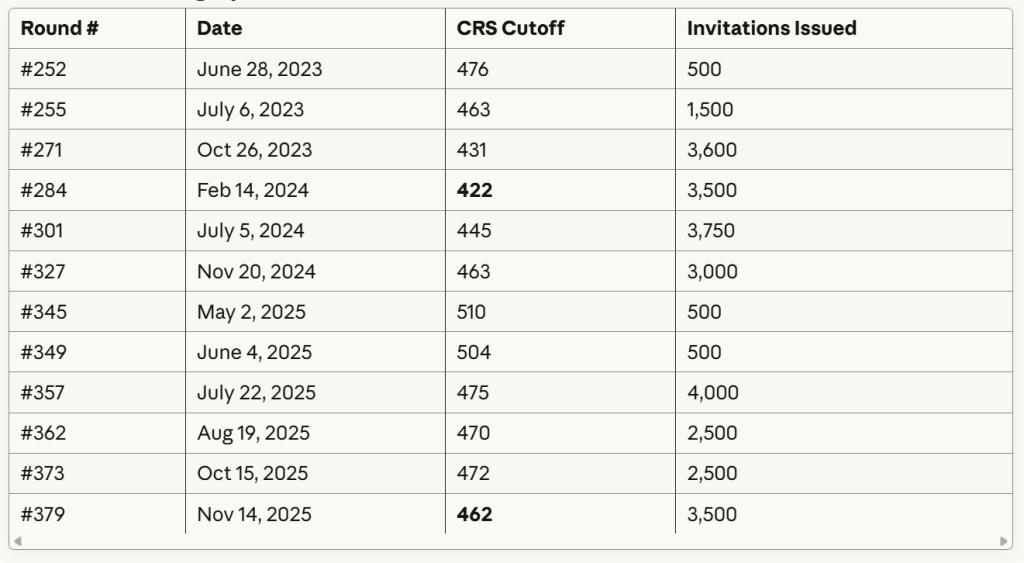
What this data tells you:
The lowest CRS cutoff ever for healthcare professionals was 422 (February 2024, Round #284).
Recent 2025 draws have stabilized between 462-475 for most rounds.
The May-June 2025 spike (504-510) was an outlier with much smaller invitation volumes (500 each). Once IRCC increased invitation volumes back to 2,500-4,000, scores dropped back to the 460s-470s.
What this really means for you:
If you’re a physiotherapist with a CRS score between 460-480, you’re in the competitive range for healthcare draws happening every 4-8 weeks.
Compare that to the old system: Before category-based draws, you would have needed 500+ to compete in general rounds.
The category-based system dropped the barrier by 40-80 points for healthcare professionals.
That’s the difference between waiting years (or never qualifying) and receiving an ITA within months.
Best PR Programs for Physiotherapists (Ranked by Success Rate)
Based on 34+ years of practice, here’s what works:
1. Category-Based Express Entry Draws (Healthcare)
Why it’s #1: Lower CRS requirements + frequent draws + fast processing.
Who it’s for: Physiotherapists with 2-10 years of experience and CRS scores between 420-480.
Timeline: 4-8 months from profile creation to PR approval.
How to qualify:
- Create an Express Entry profile
- Ensure your NOC code is correctly listed as 31202
- Have at least 1 year of full-time work experience as a physiotherapist
- Meet language requirements (CLB 7 minimum, but CLB 9+ dramatically improves your score)
2. Ontario Immigrant Nominee Program (OINP) – Human Capital Priorities
Why it works: Ontario regularly issues Notifications of Interest (NOIs) to physiotherapists, even with mid-range CRS scores.
Who it’s for: Physiotherapists with CRS scores between 400-470 who haven’t received an ITA yet.
Timeline: 6-12 months from NOI to provincial nomination.
How to qualify:
- Have an active Express Entry profile
- Score at least 400 CRS points
- Have work experience in NOC 31202
- Wait for a Notification of Interest from Ontario (you can’t apply directly)
The payoff? A provincial nomination adds 600 CRS points. That takes you from 450 to 1,050, guaranteeing an ITA in the next federal draw.
3. Alberta Advantage Immigration Program (AAIP)
Why it’s underrated: Alberta has aggressive immigration targets and actively searches Express Entry pools for physiotherapists.
Who it’s for: Physiotherapists with ties to Alberta (past work, study, or family) or strong CRS profiles.
Timeline: 3-6 months from Expression of Interest (EOI) to nomination.
How to qualify:
- Submit an EOI to Alberta
- Demonstrate connection to the province (not always mandatory, but it helps)
- Work experience in NOC 31202
- Active Express Entry profile
4. British Columbia PNP – Healthcare Professional Category
Why it’s effective: BC has dedicated streams for healthcare workers with job offers.
Who it’s for: Physiotherapists with confirmed employment in British Columbia.
Timeline: 6-10 months.
How to qualify:
- Secure a permanent, full-time job offer from a BC employer
- Meet registration requirements with the College of Physical Therapists of BC (for work purposes, not PR)
Do Physiotherapists Need a License Before Applying for PR?
No. Absolutely not.
This is the biggest myth I hear from physiotherapists, and it stops qualified people from applying.
Here’s the truth:
Immigration and professional licensing are completely separate processes.
You do NOT need:
- Registration with a provincial physiotherapy college
- Completion of the Physiotherapy Competency Examination (PCE)
- Proof of Canadian work authorization
To apply for Permanent Residency.
What you DO need:
- Proof of your foreign education (physiotherapy degree)
- Credential assessment (Educational Credential Assessment through WES or ICAS)
- Work experience letters documenting your physiotherapy practice
- Language test results (IELTS or CELPIP)
When do you need a license?
After you land in Canada, and want to work as a physiotherapist.
Each province has its own regulatory college:
- Ontario: College of Physiotherapists of Ontario (CPO)
- Alberta: Physiotherapy Alberta College + Association (PACA)
- British Columbia: College of Physical Therapists of BC
You’ll complete the licensing process after you arrive as a Permanent Resident.
Which Canadian Provinces Are Hiring Physiotherapists?
Not all provinces are equal when it comes to physiotherapist demand.
Based on immigration data, job postings, and successful client placements, here are the top provinces:
1. Ontario
Why it’s #1: Largest population + aging demographics + highest number of physiotherapy job openings.
Where the jobs are: Toronto, Ottawa, Hamilton, London, Mississauga.
PNP opportunity: OINP Human Capital Priorities regularly selects physiotherapists.
2. Alberta
Why it’s strong: Growing population + expanding healthcare infrastructure + fewer applicants than Ontario.
Where the jobs are: Calgary, Edmonton, Red Deer, and Lethbridge.
PNP opportunity: AAIP actively nominates healthcare professionals through the Express Entry Stream.
3. British Columbia
Why it’s attractive: High quality of life + competitive salaries + strong healthcare system.
Where the jobs are: Vancouver, Surrey, Victoria, Kelowna.
PNP opportunity: BC PNP Healthcare Professional Category requires a job offer, but processes quickly.
4. Manitoba
Why it’s underrated: Lower competition + strong provincial support + affordable cost of living.
Where the jobs are: Winnipeg, Brandon.
PNP opportunity: The Manitoba Provincial Nominee Program (MPNP) invites healthcare workers regularly.
What Mistakes Cost Physiotherapists Their PR Applications?
I’ve seen these errors destroy otherwise strong applications:
Mistake #1: Using the Wrong NOC Code
Some physiotherapists mistakenly classify themselves under:
- NOC 32109 (Other technical occupations in therapy)
- NOC 31303 (Physician assistants)
Why this matters: If your NOC code is wrong, you’re ineligible for healthcare draws and may not qualify for FSWP at all.
How to avoid it: Double-check that your duties match NOC 31202 exactly. Your reference letters must describe physiotherapy-specific responsibilities.
Mistake #2: Ignoring Provincial Nomination Programs
Too many physiotherapists focus exclusively on Express Entry general draws and miss provincial opportunities.
The truth is, a provincial nomination is often faster and more reliable than waiting for your CRS score to hit 500+.
Mistake #3: Thinking You Need a License to Apply
This myth delays applications by 12-18 months unnecessarily.
Apply for PR first. Complete licensing after landing.
Mistake #4: Weak Reference Letters
Your work experience letters must include:
- Your job title (Physiotherapist)
- Employment dates
- Number of hours worked per week
- Detailed description of duties matching NOC 31202
- Supervisor’s name, title, and contact information
Generic letters get rejected.
Mistake #5: Not Improving Language Scores
A CLB 7 qualifies you. But a CLB 9 or 10 adds 30-50 extra CRS points.
That difference can mean the gap between waiting years and receiving an ITA in months.
Real Success Stories
These are actual clients I’ve represented.
Case Study #1: CRS 422 → Healthcare Draw #284 → PR Approved
Client profile:
- Male, 34 years old
- 6 years of physiotherapy experience in India
- Bachelor’s degree in Physiotherapy
- IELTS: Overall 7.5 (CLB 9)
- CRS score: 422
What happened:
He thought his score was too low. Most online forums said 480+ was the minimum.
But we knew healthcare draws were targeting physiotherapists specifically.
Draw #284 happened on February 14, 2024, with a cutoff of 422 exactly.
He received his ITA. Application submitted within 45 days. PR approved in 6 months.
He’s now practicing in Toronto.
Case Study #2: CRS 463 → Healthcare Draw #327 → PR Approved
Client profile:
- Female, 29 years old
- 4 years of physiotherapy experience in the Philippines
- Master’s degree in Physical Therapy
- IELTS: Overall 8.0 (CLB 9+)
- CRS score: 463
What happened:
She created her Express Entry profile in mid-2024 with a CRS of 465.
Healthcare draw #327 on November 20, 2024, had a cutoff of 463.
She received her ITA that day. Application submitted, approved in 5 months.
She’s now working in a rehabilitation clinic in Calgary.
Case Study #3: CRS 470 → Healthcare Draw #362 → PR Approved
Client profile:
- Male, 31 years old
- 5 years of physiotherapy experience in Nigeria
- Bachelor’s degree in Physiotherapy
- IELTS: Overall 8.5 (CLB 10)
- CRS score: 470
What happened:
His score of 471 positioned him well for healthcare draws throughout 2025.
Healthcare draw #362 on August 19, 2025, had a cutoff of 470.
He received his ITA and submitted his application within 60 days. PR approved in 7 months.
He’s now settled in Edmonton, Alberta.
FAQ: Everything Else Physiotherapists Ask
Can physiotherapists with less than 3 years of experience get PR?
Yes. The minimum requirement for Express Entry (FSWP) is 1 year of full-time work experience (or equivalent part-time). Category-based healthcare draws don’t specify minimum years, just that you qualify under NOC 31202.
Do I need a job offer to apply for PR as a physiotherapist?
No, not for Express Entry or most PNPs. OINP and AAIP do not require job offers. However, some streams (like BC PNP Healthcare) do require employment.
Can I bring my family with my PR application?
Yes. You can include your spouse or common-law partner and dependent children. They’ll receive PR at the same time you do.
How long does the entire PR process take for physiotherapists?
4-12 months on average from receiving your ITA to PR approval, depending on the program and application complexity.
Will my foreign physiotherapy degree be accepted?
Yes, but you need an Educational Credential Assessment (ECA). This verifies that your foreign degree is equivalent to a Canadian credential. Use WES (World Education Services) or ICAS (International Credential Assessment Service).
What if I’m already in Canada on a work permit?
Even better. Canadian work experience adds CRS points. You can still apply through Express Entry while working in Canada.
Can I apply for PR if I’m over 40?
Yes. Age affects your CRS score (you lose points after 30), but physiotherapists with strong language scores, education, and work experience can still qualify, especially through category-based draws and PNPs.
Conclusion: Your Pathway to Canadian PR as a Physiotherapist
Here’s what you need to remember:
Physiotherapists are in demand. The pathways are open. The CRS scores are lower than you think.
If your CRS is between 420-480, target category-based healthcare draws.
If your CRS is between 400-450, explore OINP or AAIP for a provincial nomination.
If you have a job offer, look at the BC PNP or the Atlantic Immigration Program.
The mistake most physiotherapists make? Waiting too long to start. Waiting for the “perfect” CRS score. Waiting for more experience.
Don’t wait.
Start now. Build your Express Entry profile. Improve your language scores. Watch for healthcare draws.
Your Canadian PR is closer than you think.
About Amir Ismail
I’m a Licensed Immigration Consultant (RCIC) based in Toronto with 34+ years of experience guiding healthcare professionals to Canadian Permanent Residency.
Since 1991, I’ve helped over 25,000 people immigrate to Canada, including more than 500 physiotherapists, through Express Entry, Provincial Nominee Programs, and category-based healthcare draws.
If you want expert guidance on your physiotherapy PR journey, book a consultation at www.amirismail.com/book-a-consultation.
I’ll review your profile, calculate your exact CRS score, identify the fastest pathway for your situation, and guide you through every step of the application process.
Your Canadian future is waiting.
Partner with Amir Ismail & Associates
Navigating Canadian immigration and licensing can be complex. Amir Ismail & Associates offers expert guidance and personalized support to transform your aspiration into reality.
Tailored Immigration Strategies
Express Entry optimization, PNP navigation, documentation excellence.
Licensing & Settlement Support
Guidance on credential recognition, connections to resources, pre-arrival planning.
With over 30 years of experience and a proven track record, we are committed to helping you achieve your Canadian dream.
Amir Ismail, RCIC # R412319
Explore More Express Entry News

Express Entry Transport Category 2026: Who Qualifies & How to Apply
Express Entry Transport Category 2026: Who Qualifies and How to Apply Last Updated: February 28,…
Canada 2026 Express Entry New Categories: Doctors, Researchers & Military | Amir Ismail
🚨 BREAKING — February 20, 2026 Canada’s New 2026 Express Entry Categories: Doctors, Researchers, Senior…

What to do when you receive an Express Entry ITA?
What to Do When You Receive an Express Entry ITA You just received your Invitation…

EXPRESS ENTRY DRAW 396 ANALYSIS – The CRS 508 Reality Check
EXPRESS ENTRY DRAW 396 ANALYSIS and What It Means for Your 2026 Immigration Strategy On…

How to Immigrate to Canada as a Dentist Without a Job Offer or licensure(2026 Guide)
How to Immigrate to Canada as a Dentist Without a Job Offer of Licensure (2026…

How to Immigrate to Canada as a Doctor Without a Job Offer or Canadian License (2026 Guide)
How to Immigrate to Canada as a Doctor Without a Job Offer or Canadian License…