
Study Options For International Students
Study in Canada
Navigate New Canada Study Permit Caps, PGWP Language Requirements & Provincial Attestation Letter Complexity With Strategic Planning That Turns Canadian Education Into Permanent Residence

Trusted by 25K+ clients across the world
What Is This Page About?
This page explains how to choose the right Canadian program, secure your study permit under the 2026–2027 rules, and plan your path to work and permanent residence with the guidance of a licensed RCIC.
Studying in Canada opens doors to world-class education, legal work experience, and often a direct path to permanent residence, but only if you navigate the constantly evolving process correctly.
The reality? In 2024, Canada’s overall study permit approval rate was approximately 48%, meaning roughly 52% of applications were refused. In 2025, early data show approval rates have fallen to around 31% (meaning a 69% refusal rate), with countries like India experiencing refusal rates as high as 74-80%. The Canadian government has fundamentally tightened international student admission, making strategic preparation more critical than ever.
Canada Study Permit Reality Check
- Overall approval rate: ~31% (69% refused)
- India: 20-26% approval rate (74-80% refused)
- Nigeria, Pakistan, Bangladesh: 60-80% refusal rates
- Even strong profiles face unprecedented scrutiny
- 2026 study permit caps: 309,670 (29% fewer than 2025)
The Canadian government has rolled out major policy changes since 2024 that are still hitting hard in 2026, including tighter study‑permit levels (from a 437,000 overall target in 2025 to a 2026 system built around a 309,670 application cap), higher financial requirements for students (at least 22,895 CAD in living expenses for a single applicant as of September 2025, on top of tuition and travel), mandatory language tests for most new PGWP applicants, and field‑of‑study limits on who can actually get a PGWP. These changes have fundamentally reshaped the international student landscape.
At Amir Ismail & Associates (RCIC R412319), you work directly with a licensed immigration professional (Amir Ismail) who has guided over 7,400 international students through Canadian admissions, study permit applications, PGWP transitions, and permanent residence pathways since 1991.
Our study permit approval rate has consistently exceeded 90% because we stay current with every policy change and build compelling cases that address the specific concerns that are causing the majority of applications to be refused in 2025.
Whether you’re exploring diploma programs at Canadian colleges, bachelor’s degrees at universities, or postgraduate options that lead to work permits and PR, you get honest assessment, strategic program selection aligned with 2025-2026 regulations, and expert application preparation from a regulated consultant, not a sales agent.
Why Our 90%+ Approval Rate Matters in 2026
When 69% of all study permit applications are being refused globally, and rates in some countries exceed 80%, having a licensed RCIC who understands exactly what visa officers are looking for isn’t just helpful, it’s the difference between approval and a $15,000 lost investment in tuition deposits.
We’ve maintained our 90%+ approval rate through the 2024-2025 policy tightening because we:
- Turn away applications we assess as unlikely to succeed (honesty over revenue)
- Verify every program recommendation meets the current PGWP eligibility rules under the November 2024 changes
- Address the specific refusal reasons causing the 2025 rejection surge (financial scrutiny, dual intent concerns, program mismatch)
- Build applications that proactively answer visa officer concerns rather than reacting after refusal
Best Study In Canada Visa Consultants
Amir Ismail & Associates Study abroad services
Guided Since 1991
Approval Rate Maintained for 3+ Decades
Trusted by 25K+ clients across the world
Toronto | Dubai | Karachi
Why Study in Canada? Education, Work Rights & Immigration Pathways
Canada remains one of the world’s top destinations for international students, despite recent policy tightening. You’re not just buying a degree; you’re investing in a future that combines quality education, practical work experience, and realistic immigration opportunities that few other countries offer.
However, it’s critical to understand the current landscape: Canada admitted over 800,000 international students in 2023, but has since implemented strict caps. For 2025, only 437,000 study permits will be issued (a 10% reduction from 2024), and this will further decrease to 309,670 in 2026, representing a 29% reduction from 2025 levels. Competition for spots has intensified dramatically, and visa officers are applying unprecedented scrutiny to every application.
If you’re still deciding between Canada and other destinations like USA, UK, Australia, Ireland or Germany, start with our Global Study overview page.
What Are The Benefits Of Studying in Canada
- World-Class Education from Recognized Institutions:
Canadian universities and colleges consistently rank in global top-tier lists. Whether you study engineering at the University of Toronto, business at Seneca College, or computer science at the University of British Columbia, your credential holds weight with employers worldwide. Programs are regulated by provincial education authorities, ensuring quality standards that are recognized internationally.
- Gain Work Experience with a Post-Graduation Work Permit (PGWP)
Graduates from eligible programs at Designated Learning Institutions (DLIs) can apply for a Post-Graduation Work Permit valid for up to three years. However, as of November 1, 2024, new eligibility requirements apply that fundamentally changed the PGWP landscape.
- Live in a Safe, Welcoming, and Multicultural Society
Canada is consistently ranked as one of the safest and most livable countries globally. Cities like Toronto, Vancouver, Montreal, Calgary, and Ottawa are truly multicultural, with established communities from virtually every country. You won’t feel isolated; you’ll find cultural organizations, religious institutions, and community groups that make Canada feel like home.
- Work Legally While You Study
Eligible study permit holders can work up to 24 hours per week during academic sessions and full-time during scheduled breaks (winter break, summer break, reading week). After graduation, the Post-Graduation Work Permit (subject to the new 2024-2025 requirements outlined above) allows you to gain Canadian work experience that counts toward most permanent residence applications.
Understand the current rules: Working While Studying in Canada: 2026 – 2027 Updated Guide →
- A Clear Pathway To Your Future
Research shows that approximately 54% of international students who graduate from Canadian institutions successfully transition to permanent residence within 10 years of first arriving. Programs like Canadian Experience Class, Provincial Nominee Programs, and various immigration streams specifically prioritize candidates with Canadian education and work experience.
Explore pathways: From Student Visa to Permanent Residence: Your 2026-2027 Roadmap →
- Spouse and Family Benefits
If you’re enrolled in certain eligible programs, specifically bachelor’s, master’s, or doctoral programs at public universities, your spouse may qualify for an open work permit, allowing them to work full-time for any Canadian employer while you study.
Canada vs. Other Study Destinations:
| Feature |
🇨🇦 Canada
|
🇺🇸 USA
|
🇬🇧 UK
|
🇦🇺 Australia
|
|---|---|---|---|---|
| Post-Study Work | 3 years (PGWP with restrictions) |
1-3 years (OPT - very limited) |
2 years (Graduate Route) |
2-4 years (depends on location) |
| PR Pathway |
⭐⭐⭐⭐⭐
Clear, accessible |
⭐⭐
Very difficult |
⭐⭐⭐
Challenging |
⭐⭐⭐⭐
Good |
| Avg Tuition/Year | $20-30K CAD | $30-50K USD | £15-30K | $20-45K AUD |
| Work During Studies | 24 hrs/week | Limited (on-campus primarily) |
20 hrs/week | 24 hrs/week |
| Safety Rating | ⭐⭐⭐⭐⭐ | ⭐⭐⭐ | ⭐⭐⭐⭐ | ⭐⭐⭐⭐ |
| Healthcare | Provincial (wait period) |
Private (expensive) |
NHS (free for students) |
Medicare (limited for students) |
💡 Information is approximate and subject to change. Always verify with official sources.
Compared to the USA (limited work permits, no clear PR pathway), UK (2-year post-study visa but difficult settlement routes), and Australia (good but more expensive), Canada still offers a strong combination of education quality, work rights, and permanent residence pathways, but the increased competition and stricter requirements mean strategic planning is more critical than ever before.
Before You Decide to Study in Canada – Honest Questions You Must Answer
Before you spend $35,000-$70,000 CAD on a Canadian education and invest 1-3 years of your life, you need honest answers to uncomfortable questions, especially given the significant policy changes in 2024-2025 and the reality that 69% of study permit applications are now being refused.
Why We Turn Away 15-20% of Initial Consultation Requests
At Amir Ismail & Associates, we decline to take on cases when:
- The applicant’s true goal is clearly just to enter Canada with no genuine study intent
- Financial documentation appears fabricated or unsustainable, or shows the sudden deposits that trigger automatic refusals
- The proposed program doesn’t meet new PGWP field-of-study requirements, and the student’s stated goal is immigration
- Previous visa refusals show patterns suggesting the current application would also fail without significant profile changes that aren’t achievable in the near term
- The person is being exploited by unscrupulous agents promising guaranteed results despite the policy changes
This honesty has earned us a 90%+ study permit approval rate over three decades, even through major policy changes. We’d rather tell you difficult truths during a consultation than have you spend $15,000 on tuition deposits and application fees for a permit that gets refused, which is what happens to 69% of applicants in 2025.
Critical Questions to Ask Yourself:
Can You Actually Meet Academic and Language Requirements?
Canadian institutions have minimum entry standards, and visa officers scrutinize whether you’re academically capable of succeeding. If your previous grades are poor, if you’ve failed courses, or if your English test scores barely meet minimum requirements, your study permit application faces higher scrutiny, particularly in the current environment where officers are looking for reasons to refuse applications, given the strict caps.
Typical admission requirements:
- College diplomas: High school completion with 55-65% minimum grades, IELTS 6.0-6.5 overall
- Bachelor’s degrees: High school completion with 65-75% minimum, IELTS 6.5-7.0 overall
- Postgraduate programs: Completed a bachelor’s degree in a related field, IELTS 6.5-7.5 overall
Important planning note: Even if you meet admission requirements, you’ll also need to prove language proficiency for your eventual PGWP application. University degree holders will need CLB 7 (IELTS 6.0 in all four skills), and college diploma holders will need CLB 5 (IELTS 5.0 in speaking/listening/writing, 4.0 in reading). Plan ahead; if your admission test scores are borderline, you may struggle to meet PGWP requirements later.
Do You Have Realistic Financial Resources, Including the New September 2025 Requirements?
As of September 1, 2025, Canadian study permit applications require significantly increased proof of funds. This is one of the areas where refusal rates have spiked dramatically in 2025, as visa officers are applying extreme scrutiny to financial documentation.
Minimum financial requirements (effective September 1, 2025):
- First year’s tuition (varies by program)
- $22,895 CAD for living expenses for 12 months (increased from $20,635 CAD in early 2024)
- $4,121 CAD for each accompanying family member
- Return transportation costs
For Quebec (separate requirements): $24,571 CAD for living expenses
These are minimums set by the government. Real costs often run significantly higher, especially in cities like Toronto, Vancouver, or Calgary. Total annual budget for most students typically ranges from $35,000-$70,000 CAD, depending on program and location.
Get clarity: What Does It Really Cost to Study in Canada? Complete 2026-2027 Budget Guide →
⚠️ Critical financial documentation requirement: You must show 4-6 months of consistent banking history. Sudden large deposits in the final 1-2 months before your application are major red flags that trigger immediate refusals. Visa officers are trained to spot “funds arranged for visa purposes” versus genuine, accessible financial resources.
Red flags causing financial refusals in 2026:
- Bank statements showing minimal balance for 4-5 months, then a sudden large deposit 2-4 weeks before application
- Income sources that don’t match claimed employment (e.g., a student claiming to have saved $30,000 CAD from part-time work)
- Incomplete sponsor documentation (parent claims to sponsor but doesn’t provide employment letters, tax returns, or business ownership proof)
- Bank balance showing exactly the minimum requirement with no buffer for emergencies
- Unexplained transfers between multiple accounts create confusion about the actual available funds
⚠️ Reality check: If you’re considering taking large loans, mortgaging family property, or liquidating retirement savings to fund Canadian studies, please reconsider carefully. Education is valuable, but not if it destroys your family’s financial stability or leaves you burdened with debt you cannot repay if the permit is refused, which happens to 69% of applicants.
Can You Secure a Provincial Attestation Letter (PAL)?
Since January 22, 2024, most international students need a Provincial Attestation Letter in addition to their Letter of Acceptance. This is a relatively new requirement that many prospective students don’t fully understand.
Current 2026 PAL requirements:
- Required for virtually all study permit applicants, master’s and PhD students are exempt.
- Issued by your educational institution from their provincial allocation (not something you apply for separately)
- Provincial caps are strict: 437,000 total study permits available for 2025, reducing to 309,670 in 2026
- Each province receives a specific allocation and distributes Provincial Attestation Letters to its designated learning institutions
Important change coming January 1, 2026: Master’s and PhD students at public universities will become PAL-exempt.
What this means practically: Getting accepted to a program doesn’t automatically guarantee you’ll receive a study permit. If your chosen institution has exhausted its PAL allocation from the province, you may receive admission but not be able to proceed with your study permit application. Some institutions are now operating waitlists or limiting international student admissions based on their PAL capacity.
Strategic consideration: When selecting programs, ask institutions directly about their PAL allocation status and whether they anticipate being able to provide PALs for your intended start term. This is a conversation many students aren’t having, leading to disappointment when they receive admission but cannot proceed.
Are Your Target Programs PGWP-Eligible Under New 2025-2026 Rules?
This is more complex than ever before and represents one of the most significant changes affecting international students. Not all programs lead to Post-Graduation Work Permits anymore, and the rules changed fundamentally on November 1, 2024.
New PGWP eligibility rules (effective November 1, 2024):
✅ Bachelor’s, master’s, and doctoral degrees at universities: All fields of study remain eligible for PGWP. There are no field-of-study restrictions for degree programs. Whether you study engineering, English literature, business, or fine arts at the university level, you qualify for PGWP.
⚠️ College diplomas and certificates: Must be in one of 920 eligible fields of study linked to labour shortages. These fields fall into five broad categories:
- Healthcare and social services: Practical nursing, personal support worker, medical laboratory technology, dental hygiene, respiratory therapy, medical imaging, pharmacy technician
- Skilled trades: Electrical techniques, plumbing, welding, HVAC technician, automotive service, heavy equipment operation, carpentry, construction technology
- STEM (Science, Technology, Engineering, Mathematics): Computer programming, network administration, software development, civil engineering technology, mechanical engineering technology, electronics engineering technology, data analytics
- Education: Early childhood education, education assistant programs, special needs support
- Agriculture, agri-food, and transportation: Agricultural technology, food processing, logistics, and supply chain
❌ Fields largely removed from PGWP eligibility for college programs:
- General business administration (many programs removed, though some specialized streams remain)
- Hospitality and tourism management (many programs removed)
- General liberal arts and humanities
- Media studies and communications (many programs removed)
- General office administration
- Marketing and advertising (many programs removed)
❌ Private college programs: Most programs at private colleges are no longer PGWP-eligible, with limited exceptions for specific fields at specific accredited private institutions. Public colleges are the safest bet for PGWP eligibility.
If you choose the wrong program, you might complete your studies only to discover you’re ineligible for PGWP, which closes virtually every Canadian immigration pathway, as most require Canadian skilled work experience that can only be obtained with a valid work permit.
Essential verification: Understanding PGWP Eligibility: 2024-2025 Field of Study & Language Requirements →
Compare options: College vs University in Canada: Which Should You Choose Under 2026 Rules? →
Our verification process: We cross-reference every program recommendation against IRCC’s current list of eligible fields (updated as recently as July 2025), checking not just whether the program is at a DLI, but whether it falls within the Classification of Instructional Programs (CIP) codes that qualify for PGWP. Many college recruitment agents are still recommending programs that became ineligible in November 2024 because they either don’t understand the new rules or are incentivized by institutional commissions to enroll students regardless of PGWP outcomes.
Does Your Program Choice Make Sense Given Your Background?
Your study plan, the written explanation you submit with your study permit application, must demonstrate a logical progression from your previous education and work experience to your chosen Canadian program. Visa officers are extensively trained to spot applications where students are clearly using education as an immigration backdoor rather than pursuing genuine academic objectives.
Red flags that trigger refusals based on program mismatch:
- 35-year-old civil engineer with 10 years of work experience, enrolling in a basic 2-year business administration diploma
- Master’s degree graduate in economics, enrolling in a 1-year general certificate program in office administration
- Complete field change with no explanation or logical connection (an accountant with 5 years of experience suddenly enrolling in culinary arts)
- Significantly downgrading academically from previous credentials (PhD holder enrolling in a 2-year college diploma)
- Choosing a non-PGWP-eligible program when your profile clearly indicates immigration intent (extensive research into Canadian immigration pathways, family already in Canada, no clear plan to return to home country)
How to present a logical progression: Your study plan must explain:
- Why does this specific program build on your previous education and work experience
- What specific skills or credentials will you gain that aren’t available in your home country
- How this Canadian credential advances your career—whether you return home OR pursue Canadian immigration pathways
- Why are you pursuing this education at this specific stage of your life (addressing age concerns if applicable)
- What research have you done on the Canadian education system, this institution, and this program specifically
Visa officers read hundreds of study plans. Generic, template-based explanations are immediately recognizable and trigger skepticism. The most successful study plans demonstrate specific, detailed research about the program and articulate a narrative that makes sense given the applicant’s life circumstances.
Are You Prepared for Canada's Climate and Cultural Adjustment?
If you’re from a tropical or warm climate, Canadian winters are a genuine physical and mental health challenge that shouldn’t be underestimated. Temperatures in cities like Toronto, Winnipeg, or Edmonton routinely drop to -20°C to -30°C from December through February, with wind chill making it feel even colder. You’ll need to budget $400-$900 for proper winter clothing (insulated jacket, boots, gloves, hat) and face seasonal affective disorder risks due to limited daylight hours in the winter months.
Cultural adjustment is equally significant. Canada operates on different social norms, academic expectations, and communication styles than many countries:
- Academic culture: Canadian universities and colleges expect active class participation, critical thinking, and challenging professors’ ideas respectfully—very different from hierarchical educational systems in many countries
- Direct communication: Canadians tend to communicate more directly than cultures with high-context communication styles
- Individual responsibility: Canadian academic culture emphasizes self-directed learning and personal responsibility for outcomes
- Time management: Punctuality is highly valued; being late is considered disrespectful
- Work-life integration: Part-time work while studying requires careful time management and prioritization
None of these challenges is insurmountable; thousands of international students adapt successfully every year, but you need to enter with realistic expectations rather than romanticized fantasies about an easy new life abroad.
When We Say "No" to Potential Clients
We’ve declined to take on cases when:
- The applicant’s true goal is clearly just to enter Canada with no genuine study intent, and their profile won’t withstand visa officer scrutiny given 2025’s heightened standards
- Financial documentation appears fabricated, shows suspicious patterns, or is clearly unsustainable for a multi-year program
- The proposed program makes no logical sense given the person’s background, and we cannot construct a credible study plan narrative (e.g., a 35-year-old engineer enrolling in a basic business diploma)
- The chosen program is not PGWP-eligible under the November 2024 rules, but the person’s stated goal is immigration, setting them up for certain disappointment
- Previous visa refusals show patterns (multiple refusals, misrepresentation allegations, overstays) that suggest the current application would face automatic denial without significant time passing and circumstances changing
- The person is clearly being exploited by unscrupulous agents promising “guaranteed approval” or “package deals” with colleges that involve kickbacks
This honesty has earned us a 90%+ study permit approval rate over three decades. We’d rather tell you difficult truths during a $300 consultation than have you spend $15,000 on tuition deposits, application fees, English tests, medical exams, and months of stress for a permit that gets refused, the fate of 69% of applicants in 2025.
Take Our 2-Minute Study in Canada Eligibility Assessment ->
Types of Study Programs in Canada – Which Path Fits Your Goals Under 2026-2027 Rules?
Canada’s education system offers diverse options for international students at different academic levels, budgets, and career stages. However, the November 2024 PGWP changes have fundamentally altered which programs make strategic sense for immigration-minded students. Understanding these distinctions is essential before investing time and money.
College Diplomas and Certificates (Career-Focused, Practical Programs)
What they are: Canadian colleges (often called “community colleges” in other countries) offer diploma and certificate programs ranging from 8 months to 3 years, focused on practical, industry-relevant skills rather than academic theory. These aren’t “lesser” than university degrees—they’re different, designed to produce job-ready graduates with hands-on technical expertise.
Who they suit:
- Students seeking faster, more affordable entry to Canadian education and potential immigration pathways
- Career-changers who want technical skills without spending 4 years on a bachelor’s degree
- Graduates who already have bachelor’s degrees but want Canadian credentials in a specific technical field
- Those who prefer hands-on, applied learning over academic research and theory
Popular PGWP-eligible fields under 2025 rules:
✅ Healthcare: Practical Nursing, Personal Support Worker, Medical Laboratory Technology, Dental Hygiene, Respiratory Therapy, Medical Imaging Technology, Pharmacy Technician
✅ Skilled Trades: Electrical Techniques, Plumbing, Welding, HVAC Technician, Automotive Service Technician, Heavy Equipment Operation, Carpentry, Construction Technology, Industrial Mechanic
✅ STEM: Computer Programming, Network Administration, Software Development, Web Development, Cybersecurity, Civil Engineering Technology, Mechanical Engineering Technology, Electronics Engineering Technology, Data Analytics
✅ Early Childhood Education: Programs that train educators for childcare centers and early learning environments
✅ Social Services: Programs in social work, community services, and related support fields
⚠️ Fields with limited or no PGWP eligibility (removed November 2024):
- General Business Administration (some specialized streams remain, but many have been removed)
- Hospitality and Tourism Management (many programs removed from the eligible list)
- General Arts and Liberal Studies programs
- Media Studies and Communications (many programs removed)
- Marketing and Advertising programs (many removed)
- Office Administration programs
Typical costs: $12,000-$22,000 CAD per year tuition
Duration: Most programs are 2-3 years for international students
PGWP eligibility (CRITICAL 2024-2025 CHANGES):
- ✅ 2-3 year programs in eligible fields of study at public colleges: Lead to 3-year PGWP
- ❌ Programs NOT in the 920 eligible fields: No PGWP regardless of program length or institution quality
- New language requirement: Must prove CLB 5 language proficiency (IELTS 5.0 in speaking/listening/writing, 4.0 in reading) when applying for PGWP
Immigration advantage: College graduates in eligible fields (healthcare, trades, STEM, early childhood education) often have easier PR pathways than university graduates because many Provincial Nominee Programs specifically target these occupations as in-demand. For example:
- Ontario’s Skilled Trades Stream
- Manitoba’s International Education Stream (very accessible for college graduates)
- BC’s Skills Immigration categories for healthcare and childcare workers
- Saskatchewan’s Occupations In-Demand category
- Atlantic Immigration Program streams
Strategic consideration for 2025-2026: If your primary goal is Canadian immigration rather than academic credentials for their own sake, a 2-year college diploma in an eligible field followed by PGWP and work experience may get you to permanent residence faster and cheaper than a 4-year bachelor’s degree—especially if you choose a province with accessible PNP pathways like Manitoba or Saskatchewan.
Verify before enrolling: Complete List of PGWP-Eligible College Programs 2026-2027 →
Compare strategically: College vs University: Which Path is Right Under New Rules? →
Bachelor's Degrees (Traditional 4-Year University Programs)
What they are: Undergraduate degrees from Canadian universities, typically requiring 4 years of full-time study (3 years in some provinces for certain programs). These provide comprehensive education combining breadth (general education requirements) and depth (major specialization) in arts, sciences, engineering, business, and professional fields.
Who they suit:
- Students coming directly from high school who want comprehensive academic education
- Those planning careers that explicitly require bachelor’s degrees as minimum qualification (engineering, law preparation, medicine preparation, teaching, regulated professions)
- Students who may pursue master’s or doctoral programs later and need the undergraduate foundation
- Those who want the traditional university campus experience, research opportunities, and academic environment
Popular fields: Computer Science, Engineering (Civil, Mechanical, Electrical, Software, Chemical, Aerospace), Business Administration and Commerce, Economics, Biology and Life Sciences, Psychology, Political Science, Communications, Mathematics, Physics
Typical costs: $20,000-$45,000 CAD per year tuition, depending on program and institution
Engineering, computer science, and business programs typically cost 30-50% more than arts and humanities programs
Duration: 4 years full-time (3 years in some provinces for some programs, particularly in Quebec and some arts programs)
PGWP eligibility under 2024-2025 rules:
- ✅ All bachelor’s degrees lead to 3-year Post-Graduation Work Permits regardless of field of study
- ✅ Completely exempt from field-of-study restrictions that apply to college programs
- New language requirement: Must prove CLB 7 language proficiency (IELTS 6.0 in all four skills) when applying for PGWP
Immigration advantages:
- Bachelor’s degrees earn 30 CRS points in Express Entry’s Comprehensive Ranking System, compared to 15 points for 1-2 year college diplomas
- Essential minimum requirement for regulated professions in Canada (engineering, accounting, teaching, most healthcare professions)
- Opens doors to master’s programs, which can add significant additional Express Entry points
- Access to university-specific Provincial Nominee streams (some PNPs have dedicated categories for university graduates)
- More credibility with some employers for professional-level positions
Consideration for immigration-focused students: Bachelor’s degrees take significantly longer and cost substantially more than diploma programs. Total investment for a 4-year bachelor’s degree ranges from $80,000-$180,000 CAD (tuition alone), compared to $24,000-$44,000 for a 2-year college diploma.
If your primary goal is Canadian immigration rather than the university experience itself, carefully evaluate whether the additional time, money, and effort required for a bachelor’s degree provides sufficient return on investment compared to a strategic 2-year college diploma in an in-demand field. The diploma path can get you to the same permanent residence outcome 2-3 years faster and $100,000+ cheaper—though with fewer CRS points along the way, requiring strategic province selection (Manitoba, Saskatchewan, Atlantic Canada) to compensate.
Strategic planning: Bachelor’s degrees make most sense when:
- You’re coming directly from high school and want comprehensive education
- Your career requires a degree as minimum qualification (engineering, regulated professions)
- You plan to pursue graduate studies (master’s/PhD)
- You’re willing to invest the additional time and money for the credential itself, not just for immigration purposes
- You’re targeting highly competitive immigration pathways where maximum CRS points matter
Explore field-specific guides: Study Engineering in Canada 2026-2027 → | Study Computer Science in Canada 2026-20275 → | Study Business in Canada 2026-2027 →
Postgraduate Diplomas and Master's Degrees
What they are: Programs for students who already have bachelor’s degrees and want specialization, career change, or advanced credentials.
Postgraduate Diplomas (1-2 years): Offered primarily by colleges, these programs target working professionals who want Canadian credentials in a new field or specialization without pursuing a full master’s degree. They’re shorter, more affordable, and more career-focused than master’s programs.
Examples: Postgraduate Certificate in Data Analytics, Project Management, Human Resources Management, Digital Marketing, Global Business Management, Supply Chain Management, Financial Planning, Web Development
Master’s Degrees (1-2 years): Academic or professional graduate programs at universities requiring coursework, research, and often a thesis or major project. These provide advanced theoretical knowledge and research skills in a specific field.
Examples: MBA (Master of Business Administration), Master of Engineering (MEng), Master of Computer Science (MCS), Master of Public Health (MPH), Master of Applied Science (MASc), Master of Education (MEd)
Who they suit:
- Working professionals with bachelor’s degrees seeking career advancement or complete career change
- Those who want maximum Express Entry CRS points for immigration (master’s degrees add the highest education points: 135 points)
- Students planning academic, research, or policy careers that require graduate-level credentials
- Professionals whose foreign credentials aren’t recognized in Canada and need Canadian qualifications to enter their field
- Those who can leverage existing undergraduate education to complete a shorter program (1-2 years) rather than starting from scratch
Typical costs:
- Postgraduate diplomas: $15,000-$25,000 CAD for the complete 1-2 year program
- Master’s degrees: $20,000-$60,000 CAD for the complete program, with significant variation:
- MBA programs at top schools (Rotman, Ivey, Schulich): $80,000-$120,000 CAD
- Professional master’s programs (MEng, MCS): $25,000-$50,000 CAD
- Research-based master’s programs (MASc, MA, MSc): $20,000-$35,000 CAD
- Some research-based programs offer funding through teaching/research assistantships
PGWP eligibility under current rules:
Postgraduate Diplomas:
- ⚠️ Subject to field-of-study restrictions (same as college diplomas—must be in one of the 920 eligible fields)
- Must be at public college or eligible private institution
- Language requirement: Must prove CLB 5 (IELTS 5.0 in speaking/listening/writing, 4.0 reading) when applying for PGWP
- 1-year programs: PGWP length matches program length (1 year)
- 2-year programs: 3-year PGWP
Master’s Degrees:
- ✅ All master’s programs eligible regardless of field of study
- ✅ Completely exempt from field-of-study restrictions (same as bachelor’s degrees)
- Language requirement: Must prove CLB 7 (IELTS 6.0 in all four skills) when applying for PGWP
- Most 1-2 year master’s programs: Lead to 3-year PGWP
Immigration advantages of master’s degrees:
Express Entry points: Master’s degrees provide the highest CRS points for education: 135 points total, compared to:
- 120 points for two or more post-secondary credentials (one being 3+ years)
- 112 points for bachelor’s degree of 3+ years
- 90-98 points for 1-2 year post-secondary credentials
This 35-point difference can be enormous in competitive Express Entry draws where cut-off scores often range from 470-510 points.
Provincial Nominee Programs: Many provinces have dedicated master’s graduate streams with significantly lower requirements or even no job offer requirements:
- Ontario Masters Graduate Stream: No job offer required, apply directly after graduation (though extremely competitive with limited spots)
- Ontario PhD Graduate Stream: No job offer required (more accessible than masters stream)
- British Columbia International Post-Graduate stream: For master’s/PhD graduates in natural, applied, or health sciences
- Many other PNPs give priority processing or additional points to master’s graduates
Spouse work permit advantage: If you’re enrolled in a master’s or doctoral program at a public university, your spouse automatically qualifies for an open work permit—a significant family benefit allowing them to:
- Work full-time for any Canadian employer in any occupation
- Gain their own Canadian work experience (which can contribute to family CRS score)
- Earn income to support family finances during your studies
- Build their own professional network in Canada
Consideration on timing: Some students complete a bachelor’s degree in Canada, then continue immediately to a master’s degree. Others complete bachelor’s degrees in their home country, work for several years, then pursue Canadian master’s degrees. The second path can be advantageous for:
- Building work experience that strengthens your study permit application narrative
- Saving money for tuition and living expenses
- Gaining professional maturity that helps with graduate studies
- Creating a clearer career narrative (working professional seeking specialized advanced training)
PAL requirement update for 2025-2026: Master’s and PhD students currently need Provincial Attestation Letters in 2025, but starting January 1, 2026, master’s and PhD students at public universities will become PAL-exempt. This exemption recognizes graduate students’ contributions to research and innovation and aims to maintain Canada’s competitiveness in attracting top graduate talent.
Explore postgraduate options: Master’s Programs for International Students: ROI Analysis →
Language and Pathway Programs
What they are: Programs designed to help students meet language proficiency or academic requirements before entering their main diploma or degree program. These include:
- English as a Second Language (ESL) programs
- English for Academic Purposes (EAP) programs
- Academic preparation and upgrading programs
- University/college pathway programs with conditional admission
Who they suit:
- Students whose English test scores fall slightly below direct entry requirements for their desired program
- Those who need academic upgrading in specific subjects (math, sciences) before qualifying for college or university admission
- Students who want to improve English language skills while adapting to Canadian educational systems and teaching styles
- Those who want to experience Canadian education before committing to a full program
⚠️ CRITICAL PGWP LIMITATIONS:
Language training programs alone do NOT lead to Post-Graduation Work Permits. This is a crucial point that many prospective students misunderstand.
If you complete a 6-month or 1-year English language pathway program, then transition into a full 2-year diploma or 4-year degree program, your PGWP eligibility and length is based only on the diploma/degree portion—the time spent in language training does not count toward PGWP length.
Example:
- Student A: Completes 1-year ESL program + 2-year college diploma = Eligible for 2-year PGWP (based only on the diploma)
- Student B: Completes 2-year college diploma directly = Eligible for 3-year PGWP
Student A spent 3 years total in Canada but receives a shorter PGWP because the ESL year doesn’t count.
Immigration consideration: Time spent in language training also doesn’t count toward Canadian Experience Class work experience requirements or most Provincial Nominee Program qualification periods. If your goal is immigration, there’s a strong incentive to minimize pathway program length and focus on meeting direct entry requirements through intensive IELTS/TOEFL preparation in your home country before applying.
Strategic recommendation: If your English scores are close to requirements (e.g., you have IELTS 5.5 overall but need 6.0, or you have 6.0 but need 6.5), invest in intensive English preparation and retake the test rather than enrolling in a 6-12 month pathway program that adds time and cost without contributing to PGWP or immigration timelines.
When pathway programs make sense:
- Your English is significantly below requirements (IELTS 4.5-5.0 when you need 6.5+) and you need structured learning environment
- You want to experience Canadian education and life before committing to a multi-year program
- You need academic upgrading in specific subjects that can’t be achieved through self-study
- You have time and budget flexibility and aren’t in a rush to complete your education and start working
Improve English efficiently: IELTS Preparation Guide for Canadian Study Permits →
How to Study in Canada – Our Proven 4-Step Process (Updated for 2025 Regulations)
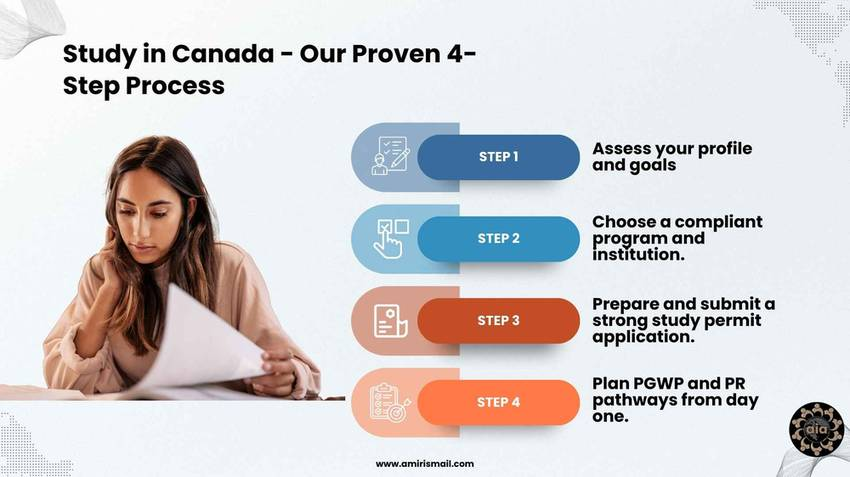
At Amir Ismail & Associates, we’ve refined a four-step process over 34 years that has helped over 7,400 international students navigate successfully through Canadian admissions, study permit applications, work permit transitions, and permanent residence pathways, including through the major 2024-2025 policy transformations that caught most education agents completely unprepared.
This isn’t a generic “apply to college and fill out forms” process. It’s strategic, multi-year planning that addresses immigration implications at every single decision point, accounts for constantly changing regulations, and builds cases that withstand the unprecedented scrutiny visa officers are applying in 2025 when 69% of applications are being refused.
Step 1: Personalized Canada Study Assessment (Week 1)
Your first consultation isn’t a sales pitch designed to get your signature on a retainer agreement. It’s a comprehensive diagnostic session where we determine whether studying in Canada genuinely makes sense for your situation, given current 2025-2026 policies, and if so, what specific pathway offers the highest probability of success.
What happens in the assessment:
We conduct a detailed review of:
✓ Academic history and qualifications: Complete transcripts, degrees, diplomas, certificates, and overall grades to assess your admission competitiveness at various institution types and program levels. We identify any gaps, academic weaknesses, or credential recognition issues that might affect applications or visa officer perceptions.
✓ Language proficiency assessment: Current IELTS, TOEFL, PTE, or other test scores and whether they meet realistic program admission requirements. Critically, we also assess whether your scores will meet future PGWP language requirements (CLB 7 for degrees, CLB 5 for diplomas) or whether you’ll need to retake tests before PGWP application 2-3 years from now.
✓ Financial capacity analysis: Current savings, family support availability, loan options, and honest assessment of whether funds can genuinely sustain 1-3 years in Canada. We calculate total program costs, including the new $22,895 CAD living expense requirement (September 2025), evaluate whether your financial documentation will withstand visa officer scrutiny, and identify potential red flags (sudden deposits, inconsistent income sources) that cause refusals.
✓ Work experience review: Employment history that might strengthen your study permit application narrative by demonstrating career progression and logical program choice. We also assess how any work experience might position you for future Canadian immigration programs.
✓ Long-term goals clarification: Whether you plan to return home after studies, seek Canadian work experience, or explicitly aim for Canadian permanent residence. Understanding your true goals allows us to recommend programs and provinces that align with those objectives rather than making generic recommendations.
✓ Age and family situation: Whether you’re a young student coming directly from high school, a mid-career professional in your 30s-40s, or bringing a spouse and children, each scenario has dramatically different implications for program choice, visa officer concerns, costs, and immigration pathways.
✓ PGWP eligibility verification (NEW for 2024-2025): For every program under consideration, we verify whether it meets the November 2024 field-of-study requirements if you’re pursuing a college diploma. We check the specific institution’s status as a Designated Learning Institution, confirm the program is at a public (not private) college if you’re pursuing a diploma, and verify the program’s Classification of Instructional Programs (CIP) code falls within the 920 eligible fields.
You receive in writing:
At the conclusion of the assessment (usually within 2-3 business days after the consultation), you receive a comprehensive written assessment that includes:
- Realistic admission chances at various institution types (community colleges, polytechnic institutes, universities) and program levels (diplomas, bachelor’s degrees, postgraduate certificates, master’s degrees)
- 3-5 specific program recommendations with detailed rationale explaining why each program suits your background, goals, budget, and immigration objectives
- Complete budget breakdown using September 2025 financial requirements ($22,895 CAD minimum living expenses), realistic tuition costs, and city-specific living expense estimates—not government minimums that underestimate reality
- Study permit approval probability assessment based on your specific profile, country of origin, current refusal rates for your demographic, and the strength of your academic/financial/ties narrative
- Provincial Attestation Letter (PAL) availability assessment for your target institutions and programs, including whether institutions have indicated PAL allocation constraints
- Alternative immigration options if studying in Canada isn’t the optimal path currently (e.g., if you’re better suited for skilled worker programs, you have insufficient funds for multi-year studies, or your profile suggests a very high refusal risk)
- Clear timeline for next steps if you decide to proceed, including application deadlines, document preparation requirements, and estimated total timeline from consultation to arrival in Canada
Why this assessment matters in 2026-2027:
Many education consultants and college recruitment agents are still operating with outdated information or simply don’t understand the November 2024 PGWP changes. We regularly encounter students who’ve been advised by other agents to pursue:
- College programs that are no longer PGWP-eligible under the field-of-study restrictions
- Private college programs that never qualified for PGWP
- Programs that technically qualify for PGWP but lead to occupations with very limited job prospects in Canada
- Study plans in provinces with highly competitive immigration pathways, where the student would qualify more easily in a different province
- Academic pathways that don’t align with the student’s actual background trigger the visa officer’s suspicion
These mistakes become apparent only after students have invested months and thousands of dollars in applications, tuition deposits, and study permit fees, then receive refusals that could have been prevented with proper upfront assessment.
Investment and value:
Initial assessment consultations start at $200 USD. This fee is fully credited toward our full representation retainer if you decide to proceed with our services for study permit application preparation.
Consider this modest investment against the alternative: the average refused study permit applicant loses $8,000-$15,000 in non-refundable tuition deposits, application fees, English test costs, medical examination fees, and wasted time, all of which could have been avoided with proper assessment identifying fatal flaws in the application strategy before proceeding.
Step 2: Strategic Program & Institution Selection (Weeks 2-4)
Once we’ve confirmed that Canadian studies align with your goals and that your profile has realistic approval prospects, we move to strategic program and institution selection. This goes far beyond simply choosing whatever program “sounds interesting” or accepting recommendations from agents with institutional commission arrangements.
Our comprehensive selection criteria under the 2025 rules:
PGWP Eligibility Verification (Enhanced Multi-Point Process)
We cross-reference every single program recommendation against current IRCC guidelines for Post-Graduation Work Permit eligibility, checking multiple verification points:
✓ Is the institution a Designated Learning Institution (DLI)? We verify the current DLI status, as institutions can lose this designation due to compliance failures.
✓ Is this specific program PGWP-eligible under the November 2024 rules? Not all programs at DLIs qualify for PGWP. We check:
- Program length (minimum 8 months required)
- Institution type (public vs private—private colleges face restrictions)
- For college/diploma programs: Whether the program falls within the 920 eligible fields of study using the Classification of Instructional Programs (CIP) code system
- Recent IRCC updates (the eligible fields list was updated as recently as July 2025, with 119 fields added and 178 removed)
✓ What language proficiency will you need for an eventual PGWP application? CLB 7 for university degree programs, CLB 5 for college diploma programs—we ensure you understand this requirement now, not when you’re surprised by it 2-3 years later when applying for PGWP.
✓ What’s the program length, and what PGWP length does it lead to?
- Programs 8 months to less than 2 years: PGWP length equals program length
- Programs 2 years or longer: 3-year PGWP
- Understanding this helps you choose strategically (2-year programs are optimal for PGWP length)
✓ Have there been recent policy changes affecting this program type? We track IRCC announcements, program delivery updates, and provincial changes that might affect PGWP eligibility or study permit processing.
Provincial Immigration Pathway Analysis
Where you study in Canada matters as much as what you study. Each province offers different advantages for job markets, living costs, and—critically—immigration pathways. We analyze:
Ontario (Toronto, Ottawa, Waterloo, Hamilton, London, Kingston):
- Advantages: Largest job market in Canada, most diverse economy, highest number of institutions and program options, excellent for the technology sector (Waterloo corridor), financial services (Toronto), government (Ottawa)
- Challenges: Most expensive living costs in Canada ($2,000-$3,000+ monthly in Toronto), most competitive Express Entry pool, OINP (Ontario Immigrant Nominee Program) has limited spots and very high competition
- Best for: Students targeting top-tier universities regardless of cost, those with family/community already in Ontario, technology and finance career tracks
- PNP pathways: Ontario Masters Graduate Stream (no job offer but extremely competitive), Ontario PhD Graduate Stream, Employer Job Offer streams (various categories)
British Columbia (Vancouver, Victoria, Burnaby, Surrey, Kelowna):
- Advantages: Mild climate (minimal winter compared to the rest of Canada), beautiful natural environment, strong technology sector (Vancouver is a growing tech hub), good for film/media industries
- Challenges: Second-highest living costs in Canada after Toronto (Vancouver rivals Toronto), very competitive rental housing market, and high competition for jobs
- Best for: Technology workers, those who prioritize climate/outdoor lifestyle, students in film/media/animation, and healthcare workers
- PNP pathways: BC PNP International Graduate stream (requires job offer in any skilled occupation), BC PNP Tech stream (priority processing, weekly draws for 35 specific technology occupations), Healthcare and childcare priority streams
Alberta (Calgary, Edmonton):
- Advantages: Strong economy based on energy sector, technology, engineering, significantly lower cost of living than Toronto/Vancouver, no provincial sales tax (saves ~5-7% on all purchases), growing technology sector in Calgary
- Challenges: Cold winters (-30°C common), the economy historically tied to the energy sector (though diversifying), and smaller international student communities than Ontario/BC
- Best for: Engineering students, computer science, business students, and those who want lower costs without sacrificing job market strength
- PNP pathways: Alberta Opportunity Stream (requires Alberta work experience + job offer), Express Entry stream for candidates already in the Express Entry pool, Rural Renewal Stream
Manitoba (Winnipeg):
- Advantages: Easiest Provincial Nominee Program pathway for college and university graduates, very affordable cost of living, welcoming community with strong newcomer support services, straightforward MPNP International Education Stream
- Challenges: Extremely cold winters (-30°C to -40°C common, colder than other provinces), smaller job market compared to Ontario/BC, limited institution options, less diverse economy
- Best for: Budget-conscious students prioritizing a guaranteed immigration pathway over prestige, those who don’t mind harsh winters, and students wanting straightforward PR with minimal competition
- PNP pathways: Manitoba Provincial Nominee Program International Education Stream (requires 1 year of Manitoba work experience after graduation, no job offer needed in many cases, very accessible scoring)
Saskatchewan (Saskatoon, Regina):
- Advantages: Low cost of living, straightforward Saskatchewan Immigrant Nominee Program (SINP) pathways similar to Manitoba, growing economy, and affordable housing
- Challenges: Very cold winters, smaller cities with limited cultural amenities compared to major metros, and fewer post-secondary institution options
- Best for: Students wanting affordable education combined with a clear PR pathway and lower competition than in Manitoba, and those comfortable in smaller cities
- PNP pathways: SINP International Skilled Worker – Saskatchewan Experience (requires 6-12 months work experience in Saskatchewan, relatively straightforward)
Atlantic Canada (Nova Scotia, New Brunswick, Prince Edward Island, Newfoundland and Labrador):
- Major cities: Halifax (Nova Scotia), Moncton (New Brunswick), St. John’s (Newfoundland), Charlottetown (PEI)
- Advantages: Affordable tuition and living costs, Atlantic Immigration Program offers PR pathways even for college diploma graduates with job offers, safe and friendly smaller communities, beautiful coastal environments, slower pace of life
- Challenges: Limited job opportunities compared to major provinces (smaller, resource-based economies), harsh winters (especially Newfoundland with extreme weather), smaller international student communities, brain drain (many locals move to Ontario/BC for work)
- Best for: Students wanting a quieter lifestyle, lower costs, and clear PR pathways through the Atlantic Immigration Program, those who appreciate maritime culture and coastal living
- Immigration pathways: Atlantic Immigration Program (requires a job offer from a designated employer in any of the four Atlantic provinces, includes an employer-supported settlement plan, relatively accessible for college graduates)
Quebec (Montreal, Quebec City, Gatineau):
- Advantages: Lower tuition at Quebec institutions compared to other provinces, affordable cost of living (especially Montreal), vibrant culture, bilingual environment, European feel, excellent food, and arts scenes
- Challenges: French language essential for most permanent residence pathways through the Quebec immigration system, Quebec has a separate immigration system (Quebec Skilled Worker Program, not aligned with federal programs), requires Quebec Acceptance Certificate (CAQ) before study permit application (additional step)
- Best for: French-speaking students or those willing to commit to learning French for immigration purposes, students interested in a bilingual environment, and European-influenced culture
- Immigration pathways: Quebec Experience Program (PEQ) requires French language proficiency, Quebec Skilled Worker Program has a separate point system from the federal Express Entry
Program-Career-Immigration Alignment Analysis
We ensure your chosen program makes logical sense as a coherent narrative connecting your past, present, and future:
✓ Does it build logically on your previous education and work experience? If you have a bachelor’s degree in engineering and 3 years of work experience as a civil engineer, pursuing a postgraduate diploma in construction project management makes perfect sense. Pursuing a certificate in hospitality management does not.
✓ Will it lead to jobs classified as NOC TEER 0, 1, 2, or 3? These are the skilled occupation categories that qualify for most Canadian immigration programs, including Canadian Experience Class and Provincial Nominee Programs. Programs leading to NOC TEER 4 or 5 occupations (lower-skilled work) generally don’t provide immigration pathways.
✓ Are you enrolling in a genuinely in-demand field, or a saturated one? Just because a field is PGWP-eligible doesn’t mean jobs are plentiful. We assess:
- Labor market demand in your target province
- Whether your field appears on the Provincial Nominee Program occupation lists
- Job posting volumes and competition levels
- Typical starting salaries and career progression potential
✓ Can you construct a credible explanation for a visa officer? Your study plan—the written narrative accompanying your study permit application—must explain why you’re taking this program at this stage of your life in a way that sounds genuine rather than fabricated for immigration purposes. We help you identify and articulate the authentic connections.
Provincial Attestation Letter (PAL) Availability Assessment
Given the strict provincial caps introduced in 2024-2025, this has become a critical selection factor that many students overlook:
✓ Verify the institution has a PAL allocation available for your intended intake term. Some popular institutions in Ontario and BC exhausted their 2025 PAL allocations early in the year.
✓ Confirm timeline for PAL issuance after you receive admission. Institutions have different processes—some issue PALs automatically with admission letters, others require additional steps.
✓ Understand the institution’s prioritization process if PAL allocation is limited. Some institutions prioritize applications by date received, others by program type, and others by country of origin.
✓ Plan application timing strategically to maximize your chances of receiving a PAL. For the Fall 2027 intake, applying in late 2026 rather than waiting until early 2027 may be critical.
Financial Feasibility Analysis
We match program costs to your demonstrated financial capacity using current September 2025 requirements ($22,895 CAD living expenses), ensuring you’re not stretching finances to a breaking point that could:
- Jeopardize your study permit application (insufficient funds = refusal)
- Force you to work excessive hours during studies (violating study permit conditions and risking cancellation)
- Cause you to withdraw from the program mid-way due to running out of money
- Create such financial stress that your academic performance suffers
You receive:
At the end of the program selection phase, you receive:
- Shortlist of 3-5 programs with detailed comparison showing tuition costs, total program costs, location and living expenses, admission requirements, PGWP eligibility status, and language requirements, and provincial immigration pathway analysis
- Application timeline showing specific deadlines for each program, required documents with lead times for obtaining them (transcripts can take weeks, English tests require scheduling, etc.), and recommended submission dates to maximize PAL access
- Draft study plan rationale for each program explaining why it makes sense given your background and goals—the foundation of your eventual Statement of Purpose for the study permit
- Direct institutional contact guidance where needed (we work directly with schools’ admissions offices, not through agent relationships, ensuring you get accurate information)
Compare provinces strategically: Where Should You Study in Canada? Complete 2026-2027 Province Guide →
Step 3: Study Permit Application Preparation & Submission (Weeks 5-10)
Once you’ve received your Letter of Acceptance from a Canadian institution (and Provincial Attestation Letter if required), we prepare your study permit application. This is the most critical step where most unrepresented applicants fail—particularly in 2025 when 69% of applications are being refused and visa officers are applying extreme scrutiny to every element.
Key documents we prepare with strategic attention:
📄 Letter of Acceptance (LOA) from your Canadian Designated Learning Institution
New requirement as of November 2024: Your institution must verify your Letter of Acceptance in IRCC’s system. Unverified Letters of Acceptance result in applications being returned unprocessed. We coordinate with institutions to ensure verification is completed before we submit your study permit application.
We verify:
- LOA is from a current Designated Learning Institution (DLI list changes as institutions gain/lose status)
- LOA specifies program name, duration, start date, and tuition fees clearly
- LOA has been verified by the institution in IRCC’s portal (we confirm verification status)
- LOA matches the program you’re actually planning to attend (sounds obvious, but we’ve seen cases where agents submitted LOAs for different programs)
📄 Provincial Attestation Letter (PAL)
Current 2025 requirement for most applicants: Nearly all study permit applicants need a PAL from the province where their institution is located.
We ensure:
- PAL has been issued by your institution from their provincial allocation
- PAL number is valid and not expired (PALs have validity periods)
- PAL matches your Letter of Acceptance (same institution, same general timeframe)
- PAL is uploaded in correct section of online application (different from LOA upload)
Note for 2026: Starting January 1, 2026, master’s and PhD students at public universities become PAL-exempt. But this exemption does NOT apply to Fall 2025 or Winter 2026 applicants who submit before January 1, 2026.
📄 Proof of Financial Support meeting September 2025 Requirements
This is where the majority of refusals occur in 2025. We prepare comprehensive financial documentation showing:
Minimum amounts (as of September 1, 2025):
- First year’s tuition paid or guaranteed through Guaranteed Investment Certificate (GIC) or bank draft
- $22,895 CAD for living expenses for 12 months (increased from $20,635 CAD earlier in 2024)
- $4,121 CAD for each accompanying family member
- Return transportation costs (typically $1,000-$3,000 CAD depending on country of origin)
For Quebec (separate requirements):
- First year’s tuition
- $24,571 CAD for living expenses for 12 months (Quebec sets higher amount than other provinces)
- $5,176 CAD for first accompanying family member
- $3,098 CAD for each additional family member
- Transportation costs
Acceptable forms of proof (we prepare complete packages including):
✓ Bank statements from the past 4-6 months showing consistent balance that meets or exceeds requirements. The key word is “consistent”—we ensure statements show steady financial activity over time, not sudden large deposits in the final month that trigger suspicion.
✓ Guaranteed Investment Certificate (GIC) of $22,895 CAD from participating Canadian financial institutions (Scotiabank, CIBC, ICICI Bank Canada, SBI Canada, etc.). GICs are particularly important for applicants from countries with high refusal rates (India, Pakistan, Philippines, Nigeria, Bangladesh, Ghana) as they demonstrate genuine commitment of funds.
✓ Bank drafts or cashier’s checks in Canadian dollars or easily convertible currencies
✓ Proof of tuition payment (receipts, wire transfer confirmations showing first year tuition paid to institution)
✓ Scholarship or funding letters from Canadian institutions or recognized international scholarship programs showing guaranteed funding for duration of studies
✓ Student loan approval letters from recognized financial institutions showing approved loan amounts, disbursement schedules, and terms
✓ Affidavit of support from parents or sponsors, accompanied by their complete financial documentation:
- Bank statements showing sufficient funds and income history
- Employment letters on company letterhead showing position, salary, and tenure
- Income tax returns for past 2-3 years demonstrating consistent income
- Business registration and ownership documents if self-employed
- Property ownership documents (property deeds, valuation assessments)
- Clear explanation of relationship to applicant and willingness/ability to provide stated support
What makes our financial documentation strategy different:
❌ Red flags we help you avoid that cause refusals:
- Bank statements showing minimal balance ($3,000-$5,000) for 4-5 months, then sudden deposit of $30,000-$40,000 in the month before application (obvious “funds arranged for visa”)
- Income sources that don’t match employment (student claiming to have saved $25,000 from part-time retail work over 2 years—mathematically implausible)
- Sponsor affidavits with impressive claimed income but minimal supporting documentation (no tax returns, vague employment letters, no property proof)
- Showing exactly $22,895 or $23,000 with no buffer for emergencies (suggests calculated minimum rather than genuine financial capacity)
- Multiple complicated transfers between different bank accounts creating confusion about whether funds are actually accessible
- Unexplained large gifts or transfers from multiple family members all timed suspiciously close to application
- Financial documents in poor quality (blurry photocopies, missing pages, altered-looking statements)
✓ Best practices we implement that increase approval odds:
- Demonstrating steady financial history over 6+ months minimum, ideally 12+ months
- Showing consistent income sources that align with claimed employment and make logical sense
- Providing complete sponsor documentation package (employment + income + assets + tax history + relationship proof) leaving no questions unanswered
- Budgeting and showing 30-40% above minimum requirements to demonstrate genuine capacity and buffer for unexpected expenses
- Using GICs when from high-refusal countries to demonstrate binding commitment of funds
- Organizing all financial documents with cover letters explaining source of funds clearly and proactively
- Addressing any unusual financial patterns with written explanations before visa officer has to ask
📄 Statement of Purpose (Study Plan) – The Narrative That Makes or Breaks Applications
This is the written document where you explain your study intentions, career goals, and plans. It’s arguably the most important document in your application because it addresses the visa officer’s core concern: “Is this person genuinely coming to study, or are they using education as a pretext to immigrate?”
What makes a study plan compelling vs. generic:
❌ Generic, template-based study plans that trigger immediate refusals:
- “Canada has world-class education and I want to get a quality degree”
- “This program will help me advance my career when I return to my home country”
- “I have always dreamed of studying abroad”
- No specific details about the program, institution, or courses
- No explanation of why this program versus programs in home country or other countries
- No logical connection between previous education/work and chosen program
- Copy-pasted language clearly taken from internet templates
- Grammatical errors and poor English (if studying in English medium)
✓ Compelling study plans we craft that address visa officer concerns:
Opening (strong hook): “As a civil engineer with 5 years of experience working on residential construction projects in Lagos, Nigeria, I have identified a critical skills gap in sustainable building practices and green construction technologies that are becoming mandatory in international building codes but remain limited in my home market. The 2-year Civil Engineering Technology – Construction Management diploma at Seneca College offers the specific technical training in LEED certification, sustainable materials, and green building systems that will position me to lead my employer’s expansion into environmentally certified projects upon my return.”
This opening:
- Demonstrates specific, detailed knowledge of the program
- Shows logical connection to previous work experience
- Explains concrete skill gaps the program will fill
- Mentions return to home country naturally
- Mentions employer (showing ties)
- Names specific courses/specializations (not generic)
Middle sections address:
- Why Canada specifically (beyond generic “quality education”)
- Canadian leadership in specific field (e.g., sustainable building, AI research, resource management)
- Specific faculty members or research centers at chosen institution
- Industry partnerships or co-op opportunities unique to Canada
- Credentials recognized internationally or valued in home country
- Why this specific program and institution
- Mention 3-5 specific required courses by course code and name
- Reference faculty members teaching those courses and their expertise
- Explain program’s unique features (co-op terms, industry certifications, facilities, teaching approach)
- Show understanding of program outcomes and career pathways
- How this program builds on your previous education and work experience
- Create narrative thread: previous degree → work experience → skills gaps identified → this program fills gaps → enhanced career trajectory
- Explain any field changes or apparent contradictions proactively
- Address any time gaps in education or employment
- Career goals after graduation (critical section)
- Describe specific, realistic job titles and roles (not generic “senior manager”)
- Explain how Canadian credential will be valued in home country market
- If planning to pursue PGWP and Canadian work experience: acknowledge this honestly while also presenting home country opportunities (“While I hope to gain 1-2 years of Canadian work experience through PGWP to enhance my credentials, I maintain strong ties to Nigeria through my family and career network, and see significant opportunity to apply these skills in Nigeria’s growing green building sector”)
- Provide concrete examples of companies or sectors you’d target
- Ties to home country (critical for visa officer concern about genuine temporary resident)
- Family ties: parents, siblings, spouse if not accompanying, children
- Property ownership or co-ownership
- Employment: letters from employers granting leave of absence rather than resignation, or clear path to re-employment
- Business interests or family business
- Cultural, religious, or community commitments
- Future plans requiring presence in home country
- Financial plan
- Explain source of funds clearly (family savings, scholarships, loans, combination)
- Show understanding of total costs (not just tuition)
- Explain plan for duration of program if multiple years
- Understanding of Canadian study permit conditions and commitment to compliance
- Acknowledge understanding of work restrictions (24 hours/week)
- Acknowledge PGWP requirements if planning to apply
- Commit to maintaining full-time enrollment and academic progress
Length: Typically 2-3 pages single-spaced, 800-1,200 words. Long enough to address all concerns thoroughly, short enough that visa officer will actually read it carefully.
Tone: Professional, specific, authentic. Not overly formal or using complicated vocabulary to impress. Clear and honest.
Our approach: We don’t use templates. We interview you extensively, then craft a study plan that tells your authentic story in the most compelling way possible while addressing every potential visa officer concern proactively.
📄 Language Test Results (IELTS, TOEFL, PTE Academic, CELPIP, Duolingo)
Official test results meeting your program’s minimum requirements. We ensure:
- Test results are from accepted testing organizations
- Results are within validity period (typically 2 years)
- Scores meet minimum requirements for admission
- You understand you’ll need to take test again for PGWP if current scores don’t meet CLB 7 (degrees) or CLB 5 (diplomas) requirements
📄 Educational Documents (Transcripts, Degrees, Diplomas)
- All transcripts from secondary school and any post-secondary education
- Degree/diploma certificates
- English translations by certified translators if original documents in other languages
- Educational Credential Assessment (ECA) if required by program or if helpful to clarify foreign credentials
📄 Medical Examination
Required if:
- Your program is longer than 6 months, OR
- You’ve resided in certain countries for 6+ months in the year before applying to Canada
Examination must be conducted by IRCC-approved panel physician. Results are valid for 12 months. We provide:
- List of panel physicians in your country
- Medical examination form with instructions
- Guidance on timing (don’t do medical too early as 12-month validity can expire)
📄 Police Certificates (Criminal Record Checks)
May be required if you’ve lived in certain countries for 6+ months since age 18. Usually requested by visa officer if deemed necessary, not always required upfront. We:
- Advise which police certificates you may need based on residence history
- Provide guidance on obtaining certificates from each country
- Ensure certificates are properly translated and certified if needed
📄 Quebec Acceptance Certificate (CAQ)
If studying in Quebec: You must first apply for and receive a Quebec Acceptance Certificate (CAQ) from the Quebec Ministry of Immigration (MIFI), THEN apply for federal study permit. This is a separate application with separate fees and processing time (typically 4-6 weeks). We:
- Prepare complete CAQ application
- Coordinate timing so CAQ arrives before study permit application
- Ensure Quebec-specific financial requirements are met ($24,571 vs $22,895)
📄 Family Information Form (IMM 5707, IMM 5645)
Complete listing of all family members including:
- Parents
- Siblings (even if not accompanying)
- Spouse (whether accompanying or not)
- Children (whether accompanying or not)
- Previous marriages or common-law relationships
This form must be complete and accurate. Omitting family members or providing incorrect information can be deemed misrepresentation.
📄 Custodianship Declaration (For Minor Students)
If you’re under age 17 (or under 19 in some provinces—British Columbia, New Brunswick, Newfoundland, Northwest Territories, Nova Scotia, Nunavut), you need notarized custodianship declaration from a Canadian citizen or permanent resident who will be responsible for you in Canada. We help:
- Identify appropriate custodian (often relative, family friend, or arranged through institution)
- Prepare custodianship documents meeting legal requirements
- Ensure notarization is proper
Application submission method and processing:
Online application (strongly preferred method):
- Faster processing times compared to paper applications
- Easier to upload additional documents if requested by visa officer
- Real-time status tracking through IRCC online account
- We submit through secure online portal with you as principal applicant and our firm as your authorized representative (using form IMM 5476 – Use of a Representative)
What happens after submission:
You’ll receive:
- Application acknowledgment confirming IRCC received your application
- Biometrics Instruction Letter (if applicable): If you haven’t provided biometrics in the past 10 years, you’ll need to visit a Visa Application Centre (VAC) within 30 days of receiving this letter. Cost: $85 CAD. We provide:
- List of VAC locations in your country
- Instructions for booking biometrics appointment
- What to bring to appointment
- Additional Document Requests (if needed): Sometimes visa officers request additional documentation or clarification. We monitor your application and respond promptly to any requests.
- Medical Examination Instructions: If you haven’t completed medical exam yet and it’s required for your country/program length, you’ll receive instructions.
- Final Decision:
- Approval: You receive “Port of Entry Letter of Introduction” (approval letter) along with message about when/where to travel. At Canadian airport/border, you present this letter and receive your actual study permit document.
- Refusal: You receive letter explaining reasons for refusal. We provide refusal analysis service to determine if reapplication is viable.
Processing timeline expectations (current as of December 2025):
- Most countries: 8-16 weeks from submission to decision
- India: 8-12 weeks
- Pakistan: 10-14 weeks
- Philippines: 10-16 weeks
- China: 8-14 weeks
- Nigeria: 12-18 weeks
- Vietnam: 10-14 weeks
Factors that add time:
- Biometrics requirement: Adds 2-4 weeks to timeline
- Additional document requests: Each request can add 4-8 weeks
- Peak processing periods: Applications for Fall semester (May-July submissions) face longer processing
- Security screenings: Certain countries or applicant backgrounds trigger additional security checks adding weeks or months
Our recommendation: Submit applications 3-4 months before intended program start date to account for processing time and potential delays.
⚠️ Important note on Student Direct Stream: The Student Direct Stream (SDS), which previously offered faster processing (20 business days) for applicants from certain countries who met specific requirements, was ended on November 8, 2024. All study permit applicants now use the regular processing stream regardless of country of origin.
Our guarantee on applications:
We cannot guarantee approval—no honest consultant can, as visa officers have discretion and we don’t work for IRCC. However, we guarantee that your application will be:
- Complete with all required documents in proper format
- Consistent across all documents with no contradictions
- Well-documented with strategic financial presentation
- Accompanied by compelling study plan addressing visa officer concerns
- Submitted in compliance with all current IRCC requirements and formatting guidelines
If refused despite our preparation (which happens in less than 10% of our cases), we provide complimentary GCMS notes review and honest assessment of whether reapplication is viable given the refusal reasons stated.
Get prepared: Complete 2026-2027 Study Permit Document Checklist →
Download Our Complete Study Permit Preparation Checklist ->
Step 4: Pre-Arrival Preparation, PGWP Planning & PR Strategy (Ongoing)
Your study permit approval is just the beginning of your Canadian journey. We provide comprehensive guidance for every stage that follows:
Pre-Arrival Preparation (After approval, before travel):
✓ Understanding your Port of Entry Letter of Introduction: What to expect when you land at a Canadian airport or border crossing, what documents to present, questions immigration officers typically ask, how to answer confidently
✓ Arranging temporary housing: Options for the first few weeks (campus residence if available, homestay programs, short-term Airbnb or hotel, temporary rentals) while you search for permanent accommodation
✓ Opening a Canadian bank account: Many banks allow international students to open accounts before arrival (Scotiabank, CIBC, TD, RBC all have international student programs). We provide:
- Bank comparison and recommendation
- Required documents list
- How to transfer money internationally cost-effectively
- Understanding Canadian banking products (chequing accounts, GICs, credit cards)
✓ Understanding your institution’s orientation, registration, and first-day expectations: What to do immediately upon arrival at your school, registration procedures, mandatory orientations, setting up student email and portals
✓ Health insurance enrollment: Most provinces require a 3-month wait period before you’re eligible for provincial health coverage (Ontario’s OHIP, BC’s MSP, Alberta’s AHCIP). You need private health insurance coverage for those first 3 months. We explain:
- Province-specific health insurance requirements
- How to obtain coverage (many institutions offer plans, or Guard.me, StudentGuard, etc.)
- What’s covered and not covered
- How to use Canadian healthcare system
✓ Understanding Canadian climate and what to bring: Packing recommendations, where to buy winter clothing affordably after arrival, how to dress for -20°C to -30°C weather
During Your Studies (Ongoing compliance and preparation):
✓ Maintaining study permit compliance:
- Full-time enrollment requirement: You must be enrolled as a full-time student throughout academic terms (typically 9-15 credits per semester, depending on institution). Part-time enrollment, even for one semester, can result in study permit cancellation.
- Academic progress requirement: You must be making satisfactory academic progress. Repeated course failures or being placed on academic probation can jeopardize your status.
- Reporting institution changes: If you change programs or institutions, you must update IRCC and may need to apply for a new study permit
- Authorized leave understanding: Up to 150 days of authorized leave is permitted in certain circumstances (medical, family emergency), but must be documented
✓ Understanding work restrictions and compliance:
- 24 hours per week maximum during academic sessions (September-April typically varies by institution)
- Full-time work allowed during scheduled breaks (winter break, summer break, reading week)
- No work allowed between study permit approval and program start date
- No work allowed during authorized leaves from studies
- Tracking your hours carefully to avoid violations (IRCC can audit your employment records through CRA/Service Canada)
✓ Co-op work permit applications if needed: If your program includes mandatory co-op placements or internships as part of the curriculum, these require separate co-op work permit applications. We assist with:
- Timing applications properly
- Preparing required documentation
- Understanding co-op work conditions
- Ensuring compliance during placements
✓ Building Canadian credit history: Establishing credit in Canada is important for future apartment rentals, phone plans without large deposits, car purchases, and other financial activities. We provide guidance on:
- Getting your first Canadian credit card (often secured cards for international students)
- How Canadian credit scores work
- Building positive credit history
- Avoiding common mistakes that damage credit
✓ Networking and professional development: Building a professional network while studying improves post-graduation job prospects significantly:
- Attending career fairs and networking events
- Joining professional associations’ student chapters
- LinkedIn optimization for the Canadian job market
- Informational interviews with professionals in your field
- Co-op and internship applications (if program includes these)
✓ Preparing for PGWP language test requirement (critical planning):
This is one of the most important things we help students plan for that other consultants often miss.
Remember: Starting November 1, 2024, all PGWP applicants must submit language test results proving CLB 7 (university degrees) or CLB 5 (college diplomas). Test results must be less than 2 years old when you apply for PGWP.
Strategic timing:
- If you’re in a 2-year program graduating in April 2027, you should take your PGWP language test in summer 2026 or winter 2027 (within 2 years before graduation)
- Don’t take test too early (more than 2 years before graduation) as results will expire
- Don’t wait until after graduation—have results ready so you can apply for PGWP immediately after completing program
Which test to take:
- IELTS General Training (most common)
- CELPIP General (popular within Canada)
- PTE Core (increasingly accepted)
- TEF Canada or TCF Canada (for French)
Target scores:
- CLB 7 (for university degrees) = IELTS General Training 6.0 in all four skills (listening, reading, writing, speaking)
- CLB 5 (for college diplomas) = IELTS General Training 5.0 in speaking/listening/writing, 4.0 in reading
We provide:
- Timeline reminders for test registration
- Test preparation resource recommendations
- Score requirements verification
- Test center locations and booking guidance
Post-Graduation Work Permit (PGWP) Application:
When you’re approaching graduation (final semester), we prepare your PGWP application:
✓ Eligibility confirmation based on actual program completion:
- Verify you completed a PGWP-eligible program at DLI
- Confirm program length (determines PGWP length)
- Verify you maintained full-time status throughout (except final semester, where part-time is often allowed)
- Check for any compliance issues during studies that might affect eligibility
✓ Language test submission:
- Confirm your language test results meet requirements (CLB 7 or CLB 5)
- Verify results are still valid (less than 2 years old)
- Upload test results in correct format
✓ Field of study verification (if college diploma):
- Verify your program’s CIP code falls within the 920 eligible fields
- Document this verification for your records
- Address any concerns if program eligibility is borderline
✓ Application submission within 180-day deadline:
Critical timing rule: You must apply for PGWP within 180 days of:
- Receiving written notification of program completion from your institution, OR
- Receiving your final grades/marks for the program
Whichever comes first.
We help you:
- Track when the 180-day clock starts
- Prepare the application before the deadline
- Avoid common timing mistakes that result in ineligibility
✓ Understanding PGWP length based on program duration:
- Programs 8 months to less than 2 years: PGWP length equals program length
- Programs 2 years or longer: 3-year PGWP
- Multiple programs can be combined if completed consecutively at the same level
✓ Bridging work permits if needed: If your study permit expires before PGWP is approved, you may need a bridging open work permit to maintain legal work authorization. We handle these applications.
Complete PGWP guide: Post-Graduation Work Permit: 2024-2025 Language, Field & Application Requirements →
Permanent Residence Pathway Planning:
Once you have PGWP and are working in Canada, we help plan your transition to permanent residence:
✓ Canadian Experience Class (CEC) through Express Entry:
- Understanding 1-year work experience requirement (1,560 hours skilled work)
- Ensuring your job qualifies as NOC TEER 0, 1, 2, or 3
- Tracking your hours and employer details carefully (you’ll need comprehensive records for PR application)
- Meeting language requirements (CLB 7 for NOC 0/1, CLB 5 for NOC 2/3)
- Building your Express Entry profile for maximum CRS points
✓ Provincial Nominee Programs (PNPs) for graduates:
Each province has different streams, requirements, and processing times:
- Ontario: Assessing Masters Graduate Stream eligibility, Employer Job Offer streams, targeted draws
- BC: International Post-Graduate categories, BC PNP Tech stream, Healthcare/Childcare priority streams
- Manitoba: International Education Stream requirements and application
- Saskatchewan: Saskatchewan Experience pathway for graduates
- Alberta: Alberta Advantage Immigration Program graduate streams
- Atlantic Canada: Atlantic Immigration Program with employer job offers
✓ Express Entry Comprehensive Ranking System (CRS) score optimization:
We help you maximize your CRS score through:
- Education: Ensuring you get maximum points for Canadian education
- Age: Understanding point decrease over age 30 and optimizing timing
- Work experience: Both Canadian and foreign work experience add points
- Language: Retaking IELTS/CELPIP to achieve CLB 10 (maximum points) vs CLB 9 can add 20-30+ points
- French language: Learning French adds massive bonus points (50+ points for CLB 7 French even with CLB 5 English)
- Spouse factors: If married, optimizing whose profile to use as principal applicant vs dependent
- Provincial nomination: Getting PNP adds 600 points, virtually guaranteeing Invitation to Apply (ITA)
- Siblings in Canada: If you have brother/sister who is Canadian citizen or PR, adds 15 points
✓ Timing applications strategically:
We help you understand:
- When to create Express Entry profile (after gaining required work experience)
- Whether to wait for CRS score improvements or apply immediately
- How to time applications to avoid work permit expiry issues
- Coordinating multiple pathways (applying to both CEC and PNP simultaneously in some cases)
Plan your permanent residence pathway: From Study to PR: Complete 2025-2026 Roadmap by Province & Program →
This comprehensive, long-term support is what differentiates us from college recruitment agents and visa application mills. We’re not interested in just getting you a study permit and moving on to the next commission. We’re invested in your successful navigation of the entire multi-year journey from study permit through PGWP to permanent residence, adapting to policy changes along the way and providing expert guidance at each transition point.
Our relationship doesn’t end when your study permit is approved—it continues throughout your Canadian education and immigration journey for as long as you need our support.
Canada Study Permit Requirements at a Glance (Updated January 2026)
Study permit requirements vary by program level, country of origin, and individual circumstances, but certain core criteria apply to virtually every international student application. Understanding these requirements thoroughly before you start your application prevents costly mistakes and delays. For current official requirements, see Canada’s study permit guide.
Academic Requirements
For College Diplomas and Bachelor’s Degrees:
- High school completion with official transcripts showing grades from all years of secondary education
- Minimum grade requirements: Vary by institution and program:
- Community colleges: Typically 55-65% overall average minimum
- Polytechnic institutes: Typically 60-70% overall average
- Universities: Typically 65-75% overall average for bachelor’s programs
- Competitive programs (engineering, business, computer science, health sciences): Often 75-85%+ required
- Specific prerequisite courses for certain programs:
- Engineering programs: Advanced mathematics (calculus, physics, chemistry typically required)
- Sciences: Specific science courses (biology, chemistry, physics depending on program)
- Business: Mathematics, sometimes economics
- English language proficiency meeting program minimums (see Language Proficiency section)
For Postgraduate Programs (Postgraduate Diplomas and Master’s Degrees):
- Completed bachelor’s degree from recognized institution
- Minimum GPA requirements:
- Postgraduate diplomas at colleges: Typically 2.5-3.0 GPA on 4.0 scale (equivalent to 60-70%)
- Master’s programs at universities: Typically 3.0-3.5 GPA on 4.0 scale (equivalent to 70-80%), with competitive programs requiring 3.5+
- Related field requirement: For master’s programs, your bachelor’s degree must usually be in the same or closely related field (exceptions exist for MBA and some professional master’s programs that accept diverse backgrounds)
- Additional requirements may include:
- Letters of recommendation (typically 2-3 for master’s programs)
- Statement of intent/personal statement
- Resume/CV showing relevant experience
- Portfolio for creative programs (art, design, architecture)
- GRE or GMAT scores (some MBA programs, though increasingly optional)
- Writing samples for some programs
Educational Credential Assessment (ECA):
Not always required for study permit applications, but increasingly recommended and sometimes mandatory for certain programs or when your credentials are from countries with education systems very different from Canada’s.
ECA from designated organizations translates your international credentials into Canadian equivalency:
- World Education Services (WES)
- International Credential Assessment Service of Canada (ICAS)
- International Qualifications Assessment Service (IQAS)
- Comparative Education Service – University of Toronto School of Continuing Studies (CES)
Cost: $200-$300 CAD
Processing time: 4-12 weeks depending on organization and origin country
Validity: Typically 5 years
Language Proficiency Requirements
For admission to programs:
Canadian institutions require proof of English or French language proficiency through standardized tests. Requirements vary by program level and institution prestige.
Accepted English tests:
- IELTS Academic: Most widely accepted by virtually all Canadian institutions
- TOEFL iBT: Accepted by most universities, fewer colleges
- PTE Academic: Increasingly accepted by Canadian institutions
- CELPIP (Canadian English Language Proficiency Index Program): Widely accepted, especially by institutions familiar with Canadian immigration requirements
- Duolingo English Test: Rapidly gaining acceptance, especially post-COVID, though some traditional institutions still don’t accept it
- Cambridge English exams: Accepted by some institutions
Typical minimum score requirements for admission:
College Diplomas:
- IELTS Academic: 6.0 overall with no band below 5.5
- TOEFL iBT: 78-80 overall
- Duolingo: 105-110
- PTE Academic: 50-53
Bachelor’s Degrees:
- IELTS Academic: 6.5 overall with no band below 6.0
- TOEFL iBT: 88-90 overall
- Duolingo: 120-125
- PTE Academic: 58-60
Master’s Programs:
- IELTS Academic: 6.5-7.0 overall with no band below 6.0-6.5
- TOEFL iBT: 90-100 overall (competitive programs often require 100+)
- Duolingo: 125-140
- PTE Academic: 60-65
Important notes:
- Competitive programs (engineering, business, law, medicine, competitive universities) often require higher scores than minimums listed
- Some programs have minimum scores for individual test components (e.g., minimum 6.5 in writing)
- Test scores must typically be taken within the past 2 years to be valid for admission
Language test exemptions:
You may be exempt from language testing if:
- You completed previous education (secondary school or post-secondary) in English or French as the language of instruction in Canada, USA, UK, Australia, New Zealand, Ireland, or other exempt countries
- You completed at least 3-4 years of full-time studies at an English-medium or French-medium institution (varies by institution—some require 3 years, others require 4)
- Some institutions offer their own English proficiency tests or pathway programs
For future Post-Graduation Work Permit (PGWP) – plan ahead:
Even if you meet admission requirements, remember you’ll need language proficiency for PGWP:
- University degree holders: Will need CLB 7 (IELTS General Training 6.0 in all four skills: listening, reading, writing, speaking)
- College diploma holders: Will need CLB 5 (IELTS General Training 5.0 in speaking/listening/writing, 4.0 in reading)
Strategic planning: If your current admission test scores are IELTS Academic 6.5 overall but you have 5.5 in one skill, you meet admission requirements for most universities—but you won’t meet CLB 7 for PGWP later. Plan to retake test during studies to achieve CLB 7 in all skills before graduation.
Test score validity for PGWP: Results must be less than 2 years old when you apply for PGWP. Don’t take PGWP language test too early (more than 2 years before graduation) as it will expire.
Financial Requirements (Effective September 1, 2025)
This is where the majority of study permit refusals occur in 2025. You must prove you have sufficient funds to cover tuition and living expenses without relying on unauthorized employment in Canada.
Minimum financial requirements updated September 1, 2025:
For applicants outside Quebec:
- First year’s tuition (amount varies by program—see Costs section)
- $22,895 CAD for living expenses for 12 months (increased from $20,635 CAD in early 2024)
- $4,121 CAD for each accompanying family member for 12 months
- Return transportation costs (typically $1,000-$3,000 CAD depending on country of origin)
For applicants to Quebec (separate requirements):
- First year’s tuition
- $24,571 CAD for living expenses for 12 months (Quebec sets higher amount than other provinces)
- $5,176 CAD for first accompanying family member for 12 months
- $3,098 CAD for each additional family member for 12 months
- Transportation costs
These are government minimums—real costs are typically higher. See Costs section for realistic budget requirements.
Acceptable forms of proof of funds:
✅ Canadian bank account in your name showing you’ve transferred money to Canada (with bank statements and transfer documentation)
✅ Guaranteed Investment Certificate (GIC) of minimum $22,895 CAD from participating Canadian financial institutions:
- Scotiabank International Student GIC Program
- CIBC International Student GIC
- ICICI Bank Canada
- RBC (Royal Bank of Canada) International Student GIC
- SBI Canada Bank
- Bank of Montreal (BMO) International Student Account
GICs are particularly important for applicants from countries with high refusal rates as they demonstrate genuine, binding commitment of funds.
✅ Bank statements from foreign financial institutions showing available funds:
- Must cover previous 4-6 months minimum
- Should show consistent balance, not sudden deposits
- Must be in easily convertible currency or Canadian dollars
- Should demonstrate income sources and financial activity, not just static balance
✅ Proof of tuition payment for first year:
- Receipt from institution showing tuition paid
- Wire transfer confirmation showing payment to institution
- Bank draft or certified check made payable to institution
✅ Scholarship or funding letters from Canadian institutions or recognized international organizations:
- Must show guaranteed funding amount
- Should specify duration of funding
- Must be official letters on institution/organization letterhead
✅ Student loan approval letters from recognized financial institutions:
- Must show approved loan amount sufficient to cover requirements
- Should include disbursement schedule
- Must be from established bank or financial institution (not personal loans from individuals)
✅ Affidavit of support from parents or sponsors accompanied by their complete financial documentation:
The sponsor must provide:
- Bank statements (4-6 months) showing sufficient funds and regular income
- Employment letter on company letterhead showing:
- Position title
- Salary
- Years of employment
- Employer contact information
- Income tax returns for past 2-3 years showing consistent declared income
- Business registration and ownership documents if self-employed
- Property ownership documents (deeds, property valuation reports)
- Clear written statement of willingness and ability to support you, explaining relationship
⚠️ Refusal triggers – financial documentation red flags:
These patterns cause immediate refusals:
- Bank statements showing $5,000-$8,000 balance for 4-5 months, then sudden deposit of $35,000 in the month before application (obvious “funds arranged for visa purposes”)
- Income sources that don’t match employment claims (student claiming to have saved $30,000 from part-time work over 18 months—mathematically implausible given typical wages)
- Sponsor claiming high income but providing minimal supporting documentation (vague employment letter, no tax returns, no property/business proof)
- Showing exactly $22,895 or exactly $23,000 with no buffer for emergencies (suggests calculated minimum rather than genuine financial capacity—visa officers want to see buffer)
- Multiple complicated transfers between different bank accounts creating confusion about whether funds are genuinely accessible vs just being moved around for appearance
- Unexplained large gifts or transfers from multiple family members all occurring suspiciously close to application date
- Financial documents of poor quality (blurry photocopies, missing pages, documents that appear altered or fabricated)
- Funds held in accounts that are frozen or have restrictions on withdrawal
Best practices for financial documentation:
✓ Demonstrate steady, consistent financial history over 6-12 months minimum, not last-minute arrangements
✓ Show funds in excess of minimum requirements (30-40% buffer demonstrates genuine capacity)
✓ Provide complete sponsor documentation package leaving no questions unanswered (employment + income history + tax returns + assets + relationship proof)
✓ Use GICs when from high-refusal countries to demonstrate binding commitment
✓ Organize documents logically with cover letter explaining source of all funds clearly
✓ Address any unusual patterns proactively with written explanations
✓ Ensure all amounts are clearly shown in CAD or with current exchange rates provided
Plan your budget realistically: What Does It Really Cost to Study in Canada? Complete 2026-2027 Budget Calculator →
Provincial Attestation Letter (PAL) Requirements
Current requirement for 2026:
Nearly all study permit applicants need a Provincial Attestation Letter from the province where their Designated Learning Institution is located. This requirement was introduced on January 22, 2024, as part of Canada’s efforts to manage international student numbers through provincial caps.
Who needs PAL in 2025:
- College diploma students ✅ Required
- Bachelor’s degree students ✅ Required
- Postgraduate certificate/diploma students ✅ Required
- Master’s degree students ✅ Required (2025 only)
- Doctoral students ✅ Required (2025 only)
- Elementary/secondary school students ⚠️ May be required depending on the province
Who is PAL-exempt in 2026-2027:
- Study permit extension applications (students already in Canada extending their permits)
- Students with study permits issued before January 22, 2024, who are extending
- Some primary and secondary school students (varies by province)
Important change for 2026:
Starting January 1, 2026, master’s and doctoral students at public universities will become PAL-exempt. However, this exemption does NOT apply to students applying before January 1, 2026, even if their program starts in 2026.
How PAL works:
- Each province receives an allocation of study permits from the federal government based on provincial caps (437,000 total for 2025, reducing to 309,670 for 2026)
- Provinces distribute Provincial Attestation Letters to their Designated Learning Institutions based on various factors (institution size, historical enrollment, program types, etc.)
- When you receive admission from an institution, the institution issues you a PAL from their provincial allocation
- You include the PAL with your study permit application to IRCC
You do NOT apply for PAL separately—your institution provides it as part of the admission process.
Strategic considerations:
⚠️ Getting admission ≠ guaranteed PAL: Some popular institutions exhausted their 2025 PAL allocations early in the year. Students received admission offers but couldn’t proceed with study permit applications because the institution had no PALs remaining.
When selecting programs, ask institutions directly:
- “Do you still have PAL allocation available for [intake term]?”
- “What is your process for issuing PALs to admitted students?”
- “Are you operating a waitlist for PALs if allocation is exhausted?”
- “When do you expect to receive your allocation for the next academic year?”
PAL validity: Provincial Attestation Letters typically have validity periods (often 6 months). Ensure you apply for your study permit before the PAL expires.
Additional Required Documents
Valid passport:
- Must have at least 6 months validity beyond your expected date of entry to Canada
- Must have blank pages for visa stamps
- If passport is expiring soon, renew before applying
Biometrics:
- Cost: $85 CAD (one-time fee, valid for 10 years)
- Who needs: Applicants from most countries (excluding US citizens, children under 14, applicants over 79)
- When: You receive Biometrics Instruction Letter after submitting study permit application
- Where: Visa Application Centres (VACs) in your country
- Timeline: Must complete within 30 days of receiving instruction letter
- What happens: Fingerprints and photograph taken at VAC, results sent directly to IRCC
Medical examination:
- Who needs: Applicants whose program is longer than 6 months, OR applicants who have resided in certain designated countries for 6+ months in the year before applying to Canada
- When: Before or after submitting study permit application (results valid 12 months)
- Where: IRCC-approved panel physicians in your country (list provided by IRCC)
- Cost: Varies by country, typically $150-$400 CAD
- What’s included: Physical examination, chest X-ray (if over age 11), blood tests if indicated
- Processing: Results sent directly from panel physician to IRCC electronically
Police certificates (criminal record checks):
- May be required if you’ve lived in certain countries for 6+ months since age 18
- Usually not required upfront—IRCC requests during processing if deemed necessary
- Must be issued by police or government authorities of each country
- Must cover period of residence in that country
- Must be original documents or certified copies
- If not in English or French, must be accompanied by certified translation
Statement of Purpose (Study Plan):
- Written explanation of your study intentions, career goals, and plans
- Typically 2-3 pages (800-1,200 words)
- Must address:
- Why you want to study in Canada specifically
- Why you chose this particular program and institution
- How this program relates to your previous education and work experience
- Your career goals after graduation
- Your ties to home country and intention to comply with study permit conditions
- Your understanding of costs and financial arrangements
- Your plan after program completion (whether returning home or pursuing PGWP and potential immigration)
See Step 3 in Our Process section for detailed guidance on crafting compelling study plans.
Digital photo:
- Must meet IRCC specifications (50mm x 70mm, white or light-colored background, neutral expression, no glasses, etc.)
- Uploaded as digital file for online applications
- Many photo studios familiar with Canadian passport/visa photo requirements
Family information forms:
- IMM 5707 (for applicants over 18): Complete information on all family members (parents, siblings, spouse, children)
- IMM 5645 (for applicants from certain countries): Additional family information form
- Must include all family members regardless of whether they’re accompanying you to Canada
- Omitting family members can be considered misrepresentation with serious consequences
Custodianship declaration (for minor students):
- Required if you’re under age 17 (or under 19 in British Columbia, New Brunswick, Newfoundland and Labrador, Northwest Territories, Nova Scotia, Nunavut)
- Must be completed by a Canadian citizen or permanent resident who will be responsible for you
- Must be notarized
- Often coordinated through educational institution if they have custodianship programs
Letter of Acceptance (LOA) from Designated Learning Institution:
- Must specify program name, duration, start date, tuition amount
- Must be from institution with current DLI status (check IRCC’s DLI list)
- New requirement as of November 2024: Institution must verify LOA in IRCC’s system
- Unverified LOAs result in applications being returned unprocessed
Quebec Acceptance Certificate (CAQ) – if studying in Quebec:
- Separate application to Quebec Ministry of Immigration (MIFI)
- Must be obtained BEFORE applying for federal study permit
- Processing time: 4-6 weeks typically
- Cost: $124 CAD
- Quebec has separate requirements including higher financial thresholds ($24,571 CAD vs $22,895 CAD for other provinces)
Processing Times (Current as of January 2026)
Study permit processing times vary significantly by country of origin, time of year, and application complexity. These are approximate timelines from application submission to final decision:
By country (regular processing):
- India: 8-12 weeks
- Pakistan: 10-14 weeks
- China: 8-14 weeks
- Philippines: 10-16 weeks
- Nigeria: 12-18 weeks
- Vietnam: 10-14 weeks
- Bangladesh: 10-16 weeks
- South Korea: 6-10 weeks
- Iran: 12-18 weeks
- Brazil: 8-12 weeks
- Most other countries: 8-16 weeks
Factors that add processing time:
⚠️ Biometrics requirement: Adds 2-4 weeks to overall timeline (waiting for appointment availability, biometrics to be processed and linked to application)
⚠️ Medical examination: If required and not done upfront, adds 3-6 weeks (waiting for panel physician appointment, exam results to be submitted and processed)
⚠️ Additional document requests: Each time IRCC requests additional documents or clarification, timeline can extend 4-8 weeks (time for you to receive request, gather documents, submit, and visa officer to review)
⚠️ Peak application periods: Applications submitted May-July (for September start) face longest processing times due to volume. Applications for January intake (October-December submissions) also see delays.
⚠️ Security screenings: Applicants from certain countries or with certain backgrounds (previous residence in countries with security concerns, military service, work in certain fields) may undergo additional security screenings adding weeks or months
⚠️ Incomplete applications: Missing documents, errors in forms, or inconsistencies between documents will delay processing significantly
Our recommendation: Submit applications 3-4 months before intended program start date to account for processing time, potential delays, and unexpected requests for additional information.
⚠️ Important note about Student Direct Stream (SDS):
The Student Direct Stream, which previously offered expedited processing (20 business days) for applicants from India, China, Philippines, Pakistan, Vietnam, Morocco, Senegal, and several other countries who met specific requirements, was permanently ended on November 8, 2024.
All study permit applicants now use regular processing regardless of country of origin, financial arrangements, or other factors. There is no longer a “fast track” option for study permits.
Get Your Complete Study Permit Checklist -> (2026-2027 Requirements)

Can You Meet the New 2026-2027 Canada Study Requirements?
Visa refusal rates remain high for 2026-2027 due to strict caps, higher financial requirements, and new PGWP rules. Take this free 2-minute assessment to see your "Traffic Light" status before you apply.
Title
Text
Financial Reality Check
Calculate Your Required Proof of Funds
Includes Avg Tuition + Realistic Living Costs (not just govt min) + Transport.
Do you have access to approximately this amount in liquid funds (bank savings, education loan) AND a plan for future years?
* Please select program and city first.
Analyzing Your Profile...
Checking against 2026-2027 IRCC guidelines
Regardless of the result, expert strategy is required to navigate PAL allocation and the new PGWP constraints.
✨ Our Strategic Analysis
Get a personalized strategy summary based on your specific profile.
Next Step: Professional Strategy
Don't guess with your future. Book a consultation with Mr. Amir Ismail to discuss your specific admission and study visa strategy.
Book a Consultation NowHonest advice. 90%+ historical approval rate.
What It Really Costs to Study in Canada
Understanding the true cost of Canadian education is essential for making informed decisions and preparing successful study permit applications. Many prospective students underestimate total costs, leading to financial stress during studies or study permit refusals due to insufficient proof of funds.
Tuition Fees by Program Type (Annual Costs - 2026-2027)
Tuition varies significantly based on program level, field of study, and institution prestige. These are typical ranges for international students:
College Diplomas and Certificates:
| Program Type | Annual Tuition Range |
|---|---|
| Business/Office Administration | $12,000 – $18,000 |
| Healthcare (Nursing, PSW, Medical Lab Tech) | $14,000 – $22,000 |
| Engineering Technology | $14,000 – $20,000 |
| Computer Programming/IT | $13,000 – $19,000 |
| Skilled Trades | $12,000 – $17,000 |
| Early Childhood Education | $12,000 – $16,000 |
| Hospitality/Culinary | $13,000 – $18,000 |
Bachelor’s Degrees:
| Program Type | Annual Tuition Range |
|---|---|
| Arts & Humanities | $20,000 – $28,000 |
| Social Sciences | $20,000 – $30,000 |
| Business & Commerce | $25,000 – $40,000 |
| Computer Science | $28,000 – $45,000 |
| Engineering (all streams) | $30,000 – $45,000 |
| Life Sciences/Biology | $25,000 – $35,000 |
| Mathematics/Statistics | $23,000 – $33,000 |
| Health Sciences | $25,000 – $40,000 |
Note: Top-tier universities (University of Toronto, UBC, McGill, Waterloo for engineering/CS) typically charge at the higher end of these ranges or above.
Postgraduate Diplomas:
| Program Type | Total Program Cost (1-2 years) |
|---|---|
| Business/Project Management | $15,000 – $25,000 |
| Data Analytics | $16,000 – $24,000 |
| Digital Marketing | $14,000 – $22,000 |
| Human Resources Management | $15,000 – $23,000 |
| Supply Chain Management | $15,000 – $24,000 |
| Web Development/Programming | $16,000 – $25,000 |
Master’s Degrees:
| Program Type | Total Program Cost (1-2 years) |
|---|---|
| MBA (top schools – Rotman, Ivey, Schulich) | $80,000 – $120,000 |
| MBA (mid-tier schools) | $35,000 – $65,000 |
| Master of Engineering (MEng) | $25,000 – $50,000 |
| Master of Computer Science (MCS) | $30,000 – $55,000 |
| Master of Applied Science (MASc – research) | $20,000 – $40,000 |
| Master of Public Health (MPH) | $25,000 – $45,000 |
| Master of Education (MEd) | $20,000 – $38,000 |
| MA/MSc (Arts/Sciences – research-based) | $18,000 – $35,000 |
Note: Research-based master’s programs (MASc, MA, MSc with thesis) often offer funding through teaching or research assistantships that can partially or fully offset tuition costs. Professional master’s programs (MEng, MCS professional stream, MBA) typically do not offer funding.
Living Expenses by City (Monthly & Annual Budgets - 2026 - 2027)
Government minimum (September 2025): $22,895 CAD annually = $1,908/month
However, this is a bare minimum that assumes extremely frugal living. Realistic monthly budgets are significantly higher, particularly in major cities.
Realistic Monthly Living Expense Budgets by City Tier:
Tier 1 Cities (Highest Cost): Toronto, Vancouver
| Expense Category | Monthly Cost Range |
|---|---|
| Rent (shared apartment/room) | $800 – $1,400 |
| Rent (studio/1-bedroom) | $1,500 – $2,500 |
| Food & Groceries | $300 – $500 |
| Transportation (public transit pass) | $120 – $156 |
| Phone & Internet | $60 – $120 |
| Utilities (if not included in rent) | $50 – $100 |
| Personal expenses (clothing, entertainment, etc.) | $150 – $300 |
| Health insurance | $50 – $75 |
| Books & supplies | $50 – $100 (averaged) |
| TOTAL (shared housing) | $1,700 – $3,000/month |
| TOTAL (own apartment) | $2,400 – $3,900/month |
Annual budget: $20,400 – $36,000 (shared) or $28,800 – $46,800 (own apartment)
Tier 2 Cities (Moderate-High Cost): Calgary, Edmonton, Ottawa, Waterloo
| Expense Category | Monthly Cost Range |
|---|---|
| Rent (shared apartment/room) | $600 – $1,000 |
| Rent (studio/1-bedroom) | $1,100 – $1,800 |
| Food & Groceries | $280 – $450 |
| Transportation (public transit pass) | $100 – $125 |
| Phone & Internet | $60 – $110 |
| Utilities (if not included) | $50 – $90 |
| Personal expenses | $120 – $250 |
| Health insurance | $50 – $75 |
| Books & supplies | $50 – $100 (averaged) |
| TOTAL (shared housing) | $1,500 – $2,400/month |
| TOTAL (own apartment) | $2,000 – $3,000/month |
Annual budget: $18,000 – $28,800 (shared) or $24,000 – $36,000 (own apartment)
Tier 3 Cities (Moderate Cost): Winnipeg, Halifax, London (ON), Kitchener, Victoria, Saskatoon, Regina
| Expense Category | Monthly Cost Range |
|---|---|
| Rent (shared apartment/room) | $450 – $800 |
| Rent (studio/1-bedroom) | $900 – $1,400 |
| Food & Groceries | $250 – $400 |
| Transportation (public transit pass) | $80 – $110 |
| Phone & Internet | $55 – $100 |
| Utilities (if not included) | $40 – $80 |
| Personal expenses | $100 – $220 |
| Health insurance | $50 – $75 |
| Books & supplies | $50 – $100 (averaged) |
| TOTAL (shared housing) | $1,300 – $2,000/month |
| TOTAL (own apartment) | $1,750 – $2,600/month |
Annual budget: $15,600 – $24,000 (shared) or $21,000 – $31,200 (own apartment)
Tier 4 Cities (Lower Cost): Smaller cities and towns, Atlantic Canada cities (St. John’s, Moncton, Charlottetown)
| Expense Category | Monthly Cost Range |
|---|---|
| Rent (shared apartment/room) | $400 – $650 |
| Rent (studio/1-bedroom) | $800 – $1,200 |
| Food & Groceries | $230 – $380 |
| Transportation (public transit or car) | $70 – $150 |
| Phone & Internet | $55 – $95 |
| Utilities (if not included) | $40 – $75 |
| Personal expenses | $90 – $200 |
| Health insurance | $50 – $75 |
| Books & supplies | $50 – $100 (averaged) |
| TOTAL (shared housing) | $1,200 – $1,800/month |
| TOTAL (own apartment) | $1,600 – $2,400/month |
Annual budget: $14,400 – $21,600 (shared) or $19,200 – $28,800 (own apartment)
Total Investment Examples (Complete Program Costs)
Understanding total program costs helps you plan realistically and prepare adequate financial documentation for study permit applications.
Example 1: 2-Year College Diploma in Ontario (Toronto)
| Cost Component | Amount |
|---|---|
| Tuition (2 years @ $17,000/year) | $34,000 |
| Living expenses (24 months @ $2,200/month avg) | $52,800 |
| Books & supplies (2 years @ $1,000/year) | $2,000 |
| Health insurance (2 years @ $750/year) | $1,500 |
| Initial settlement (first month, furniture, winter clothes) | $2,500 |
| Return travel | $2,000 |
| Miscellaneous | $3,000 |
| TOTAL 2-YEAR INVESTMENT | $97,800 CAD |
Realistic range: $80,000 – $110,000 CAD depending on lifestyle and accommodation choices
Example 2: 4-Year Bachelor’s Degree in British Columbia (Vancouver)
| Cost Component | Amount |
|---|---|
| Tuition (4 years @ $32,000/year avg) | $128,000 |
| Living expenses (48 months @ $2,400/month avg) | $115,200 |
| Books & supplies (4 years @ $1,200/year) | $4,800 |
| Health insurance (4 years @ $900/year) | $3,600 |
| Initial settlement | $3,000 |
| Return travel (visits home + final return) | $6,000 |
| Miscellaneous | $8,000 |
| TOTAL 4-YEAR INVESTMENT | $268,600 CAD |
Realistic range: $220,000 – $320,000 CAD depending on program, lifestyle, and accommodation
Example 3: 1-Year Postgraduate Diploma in Alberta (Calgary)
| Cost Component | Amount |
|---|---|
| Tuition (complete program) | $19,000 |
| Living expenses (12 months @ $1,900/month avg) | $22,800 |
| Books & supplies | $1,000 |
| Health insurance | $750 |
| Initial settlement | $2,000 |
| Return travel | $2,000 |
| Miscellaneous | $2,000 |
| TOTAL 1-YEAR INVESTMENT | $49,550 CAD |
Realistic range: $42,000 – $58,000 CAD
Example 4: 2-Year Master’s Degree in Ontario (Ottawa)
| Cost Component | Amount |
|---|---|
| Tuition (complete program) | $45,000 |
| Living expenses (24 months @ $2,100/month avg) | $50,400 |
| Books & supplies (2 years) | $2,000 |
| Health insurance (2 years) | $1,800 |
| Conference travel (academic conferences) | $2,500 |
| Research expenses | $1,500 |
| Initial settlement | $2,500 |
| Return travel | $2,500 |
| Miscellaneous | $4,000 |
| TOTAL 2-YEAR INVESTMENT | $112,200 CAD |
Realistic range: $95,000 – $140,000 CAD, depending on funding availability
What You Must Prove for Study Permit Application
Understanding the difference between “total program cost” and “what you must prove” is important for application planning.
Study permit financial requirement (first year only):
You must prove you have sufficient funds for:
- First year’s tuition (not total program tuition)
- Living expenses: $22,895 CAD (outside Quebec) or $24,571 CAD (Quebec)
- Each family member: $4,121 CAD per person
- Transportation: $1,000 – $3,000 CAD
Single applicant example (Ontario college program):
- Tuition (first year): $17,000
- Living expenses: $22,895
- Transportation: $2,000
- Total proof required: $41,895 CAD
Applicant with spouse (Ontario bachelor’s program):
- Tuition (first year): $32,000
- Living expenses (principal): $22,895
- Spouse living expenses: $4,121
- Transportation (both): $3,000
- Total proof required: $62,016 CAD
Applicant with spouse and one child (Manitoba college program):
- Tuition (first year): $15,000
- Living expenses (principal): $22,895
- Spouse: $4,121
- Child: $4,121
- Transportation (all three): $4,000
- Total proof required: $50,137 CAD
⚠️ Critical note: While you only need to prove first-year funds for the study permit application, you should have realistic plans for funding subsequent years. Visa officers sometimes ask about multi-year funding plans during interviews or in additional document requests.
Part-Time Work Income (Supplemental Only)
As an international student with valid study permit, you can work up to 24 hours per week during academic sessions and full-time during scheduled breaks.
Realistic earnings from part-time work:
Typical wage range for student jobs:
- Minimum wage jobs (retail, food service, campus jobs): $15.50 – $17.00/hour (varies by province)
- Skilled positions (tutoring, office work, tech support): $17.00 – $22.00/hour
- Co-op placements (if program includes them): $18.00 – $30.00/hour depending on field
Monthly income calculation (24 hours/week):
- At $16/hour × 24 hours/week × 4.33 weeks/month = $1,663/month (during academic terms)
- At $17/hour × 24 hours/week × 4.33 weeks/month = $1,766/month (during academic terms)
Full-time during breaks (summer – 4 months):
- At $16/hour × 40 hours/week × 4.33 weeks/month = $2,771/month
- Total for 4-month summer break: $11,084
Annual earnings potential:
- During academic terms (8 months @ 24 hrs/week): $13,304 – $14,128
- During summer break (4 months full-time): $11,084
- Total potential annual earnings: $24,388 – $25,212 CAD
However:
⚠️ Part-time work income cannot be your primary financial source for study permit purposes. Visa officers will not approve applications where the financial plan relies primarily on working in Canada.
⚠️ You cannot count on finding employment immediately. Job competition exists, especially for entry-level positions. Budget assuming you may not find work for the first 3-6 months.
⚠️ Working excessive hours impacts academic performance. Many students who work maximum permitted hours struggle academically, leading to poor grades, course failures, or even academic probation that can jeopardize study permit status.
Strategic approach: View part-time work as supplemental income that can cover:
- Entertainment and social activities
- Travel within Canada during breaks
- Building buffer for emergencies
- Reducing reliance on family support for day-to-day spending
Do NOT budget part-time work income as essential for covering tuition or rent—this creates dangerous financial vulnerability.
Download Our Interactive Canada Study Budget Calculator (Excel) ->
🇨🇦 Canada Study Cost Calculator (2026/27)
Calculate the "Proof of Funds" (Visa Requirements) vs. Real World Costs based on the latest IRCC regulations.
Step 1: IRCC Proof of Funds
Step 2: Real World Cost
Annual EstimatePart-Time Work Simulator
Can You Work While Studying in Canada? (2026 Updated Rules & PGWP Requirements)
One of Canada’s major advantages for international students is the legal ability to work during studies and after graduation, but these privileges come with specific rules and recent changes that you must understand and comply with carefully. Rules can change, so always verify with the latest IRCC guidance on working during studies
Work eligibility conditions:
If you meet ALL of the following criteria, you can work in Canada without a separate work permit:
✅ You have a valid study permit
✅ You’re enrolled full-time at a Designated Learning Institution (DLI)
✅ Your program is at least 6 months in length
✅ Your program leads to a degree, diploma, or certificate
Current work limits (updated 2024):
- During academic sessions (fall/winter terms): Up to 24 hours per week maximum
- During scheduled breaks (winter break, summer break, reading week): Full-time work allowed (no weekly hour restrictions)
⚠️ Previous limit: Until recently, students could work only 20 hours per week during academic sessions. The limit was increased to 24 hours/week to help students with rising costs of living.
Important clarifications:
“Academic session” means the period when classes are in session and you’re required to be actively studying. Typically September-April for most programs, but varies by institution.
“Scheduled breaks” means breaks scheduled by your institution in the academic calendar:
- Winter break (typically 2-3 weeks in December-January)
- Summer break (typically May-August for 8-month academic year programs)
- Reading week or study break (typically 1 week in February or March)
“Full-time” during breaks means you can work 40+ hours per week if you wish (and can find employment offering those hours).
When you CANNOT work:
❌ Between receiving study permit approval and the start date of your program (you must wait until program officially begins)
❌ During authorized leaves from your studies (medical leave, compassionate leave, etc.—even though study permit remains valid, work authorization is suspended)
❌ After completing your program but before receiving Post-Graduation Work Permit (there’s a gap period where you cannot work while PGWP application is processing, unless you apply for bridging open work permit)
❌ If you switch from full-time to part-time enrollment (dropping to part-time status immediately suspends work authorization)
Where you can work:
Both on-campus and off-campus work are permitted. No restrictions on type of employer or industry (retail, food service, office work, campus positions, etc.) as long as you comply with hour limits.
On-campus work means work at your own institution:
- Campus restaurants, cafeterias, coffee shops
- Campus bookstores
- Library positions
- Research assistant positions
- Teaching assistant positions (if qualified)
- Administrative and office positions
- Campus recreation facilities
Off-campus work means any work not at your institution:
- Retail stores
- Restaurants and food service
- Offices and businesses
- Tutoring or freelance work
- Any legal employment
Compliance and tracking hours:
⚠️ Critical responsibility: YOU are responsible for tracking and ensuring you don’t exceed 24 hours per week during academic sessions. IRCC can audit your employment records through Canada Revenue Agency and Service Canada data. If found to be exceeding limits:
- Your study permit can be cancelled immediately
- You can be required to leave Canada
- Future applications for Canadian visas can be refused due to non-compliance history
How to track hours carefully:
- Maintain your own spreadsheet or calendar tracking all work hours weekly
- If you have multiple part-time jobs, total hours from all jobs combined must not exceed 24/week
- Account for all hours worked, including training, meetings, travel time if compensated
- Be conservative—if you’re approaching 24 hours in a week, stop before exceeding
- Remember that many employers schedule slightly over contracted hours due to shift coverage needs
Typical student jobs and earnings:
Common on-campus positions:
- Campus food services: $15.50-$17/hour
- Library assistant: $16-$18/hour
- Research assistant: $17-$25/hour (varies significantly by department and role)
- Teaching assistant: $20-$30/hour (usually limited to graduate students)
- Campus recreation: $15.50-$17/hour
- Administrative assistant: $17-$22/hour
Common off-campus positions:
- Retail sales: $15.50-$17/hour
- Food service (server, barista, cook): $15.50-$18/hour + tips
- Customer service representative: $16-$20/hour
- Tutor (if qualified in high-demand subjects): $25-$50/hour
- Freelance work (writing, graphic design, programming if skilled): $20-$50/hour
- Warehouse/delivery: $16-$19/hour
Essential reading: Working While Studying: Student Work Permit Conditions & Compliance Guide →
If your program includes mandatory work placement, internship, or co-op terms as part of the curriculum (not optional), you need a separate Co-op Work Permit in addition to your study permit.
Co-op work permit requirements:
- Your co-op/internship must be essential to your program (not optional)
- Work placement must constitute 50% or less of total program
- You must apply for co-op work permit (separate application, separate fee)
- Processing time: Typically 4-8 weeks
Cost: $155 CAD processing fee
When to apply: After receiving Letter of Acceptance showing co-op component, ideally 2-3 months before co-op term begins
Co-op earnings:
Co-op placements typically pay significantly better than regular part-time student work:
- Engineering co-ops: $20-$35/hour ($40,000-$70,000 annualized)
- Computer science/IT co-ops: $22-$40/hour ($45,000-$80,000 annualized)
- Business co-ops: $18-$28/hour ($36,000-$56,000 annualized)
- Science/research co-ops: $17-$25/hour ($34,000-$50,000 annualized)
Many students use co-op earnings to significantly offset subsequent year’s tuition and living expenses.
The Post-Graduation Work Permit is the bridge between completing your Canadian studies and pursuing Canadian permanent residence. It’s an open work permit (you can work for any employer in any occupation) valid for up to 3 years.
However, PGWP eligibility rules changed fundamentally on November 1, 2024, creating new requirements that many prospective students don’t yet understand.
Basic PGWP eligibility (applies to everyone):
✅ You graduated from a program at a Designated Learning Institution
✅ Your program was at least 8 months in length
✅ You maintained full-time student status throughout the program (except final semester where part-time is allowed)
✅ You apply within 180 days of:
- Receiving written notification from your institution that you’ve completed your program, OR
- Receiving your final marks/grades
(Whichever comes first)
✅ Your study permit was still valid when you applied for PGWP (or you applied for restoration within 90 days of expiry)
NEW Requirements effective November 1, 2024:
1. Mandatory Language Testing
All PGWP applicants must submit language test results:
For university degree graduates (bachelor’s, master’s, doctoral):
- Must prove CLB 7 language proficiency
- IELTS General Training: 6.0 in all four skills (listening, reading, writing, speaking)
- CELPIP General: 7 in all four skills
- PTE Core: 60 in all four skills
- TEF Canada or TCF Canada: Corresponding French levels
For college diploma and certificate graduates:
- Must prove CLB 5 language proficiency
- IELTS General Training: 5.0 in speaking/listening/writing, 4.0 in reading
- CELPIP General: 5 in speaking/listening/writing, 4 in reading
- PTE Core: 42 in speaking/listening/writing, 33 in reading
- TEF Canada or TCF Canada: Corresponding French levels
Critical details:
⚠️ Test results must be less than 2 years old when you apply for PGWP
⚠️ You must take the test even if:
- You studied entirely in English or French
- Your previous credentials were from English or French-medium institutions
- You achieved high scores on admission tests
- You speak English or French fluently
The test is mandatory. There are no exemptions.
Strategic timing:
If you’re in a 2-year program graduating in April 2027, you should take your PGWP language test between:
- Earliest: May 2025 (2 years before graduation)
- Optimal: Winter 2026 or Fall 2026 (1-1.5 years before graduation, giving time for retake if needed)
- Latest: February 2027 (2 months before graduation, cutting it close)
Don’t take test too early (it will expire before you apply for PGWP) or too late (creates unnecessary stress near graduation when you’re busy with final projects, exams, etc.).
2. Field of Study Requirement (College/Diploma Programs Only)
For college diplomas and certificates ONLY:
If you applied for your study permit on or after November 1, 2024, and you’re completing a non-degree program (diploma or certificate) at the college level, your program must be in an eligible field of study to qualify for PGWP.
As of July 2025, there are 920 eligible programs across five broad categories:
Eligible fields:
✅ Healthcare and social services:
- Practical nursing, personal support worker
- Medical laboratory technology, medical imaging
- Dental hygiene, dental assistant
- Respiratory therapy, cardiology technology
- Pharmacy technician
- Social work, community services
- Addictions counseling
✅ Skilled trades:
- Electrical techniques and systems
- Plumbing, pipefitting, steamfitting
- Welding and metal fabrication
- HVAC technician
- Automotive service technician
- Heavy equipment operation and maintenance
- Carpentry and renovation
- Construction management and technology
- Industrial mechanic, millwright
✅ STEM (Science, Technology, Engineering, Mathematics):
- Computer programming, software development
- Network administration, cybersecurity
- Web development and design
- Civil engineering technology
- Mechanical engineering technology
- Electronics engineering technology
- Data analytics, database administration
- Biotechnology
✅ Education:
- Early childhood education
- Education assistant programs
- Special education support
✅ Agriculture, agri-food, transportation:
- Agricultural technology and management
- Food processing technology
- Supply chain and logistics
- Transportation and traffic management
Fields with limited or no eligibility (many removed November 2024):
❌ General business administration (many programs removed, though some specialized streams remain eligible)
❌ Hospitality and tourism management (many programs removed)
❌ General arts and liberal studies programs
❌ Media studies and communications (many programs removed)
❌ Marketing and advertising programs (many programs removed)
❌ Office administration programs
❌ General graphic design (many programs removed)
How to verify if your program is eligible:
Programs are classified using the Classification of Instructional Programs (CIP) code system. Each program has a 6-digit CIP code. IRCC maintains a list of eligible CIP codes for PGWP.
- Contact your institution’s international student office or admissions office
- Ask: “What is the CIP code for [specific program name]?”
- Cross-reference against IRCC’s list of eligible fields (updated periodically—most recently July 2025 with 119 additions and 178 removals)
⚠️ Important: Just because a program is PGWP-eligible doesn’t mean it leads to good job prospects or immigration success. Some eligible programs lead to occupations with very limited job opportunities in Canada. Verify both PGWP eligibility AND career outcomes before enrolling.
Exemptions from field-of-study requirements:
✅ Bachelor’s degrees: ALL fields of study eligible (no restrictions)
✅ Master’s degrees: ALL fields of study eligible (no restrictions)
✅ Doctoral degrees: ALL fields of study eligible (no restrictions)
✅ College programs for students who applied for study permits before November 1, 2024: Grandfathered under old rules (no field restrictions)
Grandfathering provision:
If you applied for your study permit before November 1, 2024, you are exempt from field-of-study restrictions even if you’re completing a college diploma. The date your study permit application was submitted determines whether field restrictions apply.
PGWP length based on program duration:
- Programs 8 months to less than 2 years: PGWP length equals program length (e.g., 1-year program = 1-year PGWP)
- Programs 2 years or longer: 3-year PGWP (maximum)
- Multiple programs: If you complete multiple programs consecutively at same institution or level, can combine lengths (subject to maximum 3 years)
⚠️ CRITICAL: One PGWP per lifetime
You can only receive ONE Post-Graduation Work Permit in your entire life. If you use your PGWP after completing a 1-year program (receiving 1-year work permit), you cannot get another PGWP after completing a subsequent 2-year program.
Strategic consideration: If you’re planning to complete multiple Canadian credentials, complete them consecutively BEFORE applying for PGWP to maximize your work permit length. For example:
- Complete 2-year diploma + 1-year postgraduate certificate = Combine for 3-year PGWP (if you apply after completing both)
- Complete 2-year diploma, apply for PGWP (get 3 years), work, then return for 1-year certificate = No PGWP after certificate (already used your one lifetime PGWP)
When PGWP applications are typically refused:
❌ Program wasn’t at a Designated Learning Institution (DLI status was revoked during your studies)
❌ Program was primarily distance/online learning completed outside Canada
❌ Program at private college that doesn’t meet strict eligibility criteria
❌ You didn’t maintain full-time status (took too many part-time semesters)
❌ Applied after 180-day deadline
❌ Study permit had already expired and you didn’t apply for restoration in time
❌ NEW: Didn’t meet language test requirement (CLB 7 or CLB 5)
❌ NEW: College program not in eligible field of study (if submitted study permit application after November 1, 2024)
Essential guide: Complete PGWP Guide: Language Requirements, Field Restrictions & Application Process 2026-2027 →
From Study Permit to PR in Canada
Is this realistic in 2026-2027? Yes, but success requires strategic planning from the very beginning, not just after you arrive in Canada.
Research shows that approximately 54% of international graduates transition to permanent residence within 10 years of first arriving in Canada. However, this average conceals significant variation:
- Graduates from in-demand fields (healthcare, engineering, computer science) with strategic province selection: 70-85% PR success within 5-7 years
- Graduates from less in-demand fields without strategic planning: 20-35% PR success
The difference? Strategic program selection + province choice + understanding immigration pathways before enrolling, not discovering them after graduating.
The Optimal Timeline (2-Year College Diploma Example)
Year 1-2: Complete 2-Year Program
↓
Graduation: Prepare PGWP Language Test
Submit IELTS/CELPIP within final semester showing CLB 5 (diplomas) or CLB 7 (degrees)
↓
Within 180 Days of Graduation: Apply for PGWP
Submit application with language test results, program completion documentation
Processing: 4-8 weeks typically
↓
Receive 3-Year Post-Graduation Work Permit
Begin job search immediately, ideally start working within 1-3 months
↓
Year 1 of PGWP: Secure Skilled Employment
Find full-time work in NOC TEER 0/1/2/3 occupation
Work minimum 1,560 hours (1 year full-time, or equivalent part-time)
↓
After 1 Year Canadian Work Experience: Apply for PR
Via Canadian Experience Class through Express Entry, OR
Via Provincial Nominee Program (requirements vary by province)
↓
Year 2-3 of PGWP: Await PR Decision While Working
Continue working, building additional experience
Improve language scores for maximum CRS points if needed
Processing time: 6-12 months typically
↓
Permanent Residence Approved
Transition from temporary resident to permanent resident
Total timeline from arrival to PR: Approximately 4-5 years
Common Permanent Residence Pathways for Graduates
Canadian Experience Class (CEC) Through Express Entry:
The most common pathway for international graduates. Requires:
✅ 1 year Canadian skilled work experience (minimum 1,560 hours in NOC TEER 0/1/2/3 occupations)
✅ Language proficiency:
- NOC TEER 0 or 1: CLB 7 (IELTS 6.0 all skills)
- NOC TEER 2 or 3: CLB 5 (IELTS 5.0 in 3 skills, 4.0 reading)
✅ Plan to live outside Quebec
✅ No job offer required (major advantage—you apply after gaining experience, don’t need employer sponsorship)
Processing: Create Express Entry profile → Receive Invitation to Apply (ITA) if score is above cut-off → Submit complete PR application → Decision in 6-8 months typically
Advantages:
- No employer sponsorship required
- Can apply from anywhere in Canada (doesn’t matter where you studied or currently work)
- Relatively fast processing
- Straightforward requirements
Challenges:
- Competitive—Express Entry uses Comprehensive Ranking System (CRS) where you compete against all other candidates
- CRS cut-off scores typically range 470-510 points (varies by draw)
- Need strong profile (good age, education, work experience, language scores) to be competitive
Provincial Nominee Programs (PNPs):
Each province operates immigration programs specifically targeting graduates. Requirements vary significantly.
Ontario Immigrant Nominee Program (OINP):
Masters Graduate Stream:
- Completed master’s degree from eligible Ontario university within past 2 years
- Lived in Ontario for at least 1 year in past 2 years
- Language: CLB 7
- No job offer required
- Settlement funds: ~$13,000-$18,000 CAD
Challenge: Extremely competitive, limited spots, intake often closes within minutes of opening
Employer Job Offer Streams:
- Requires job offer from Ontario employer in skilled occupation
- Various streams depending on occupation (In-Demand Skills, Foreign Worker, International Student)
British Columbia Provincial Nominee Program (BC PNP):
International Graduate Stream:
- Graduated from eligible BC post-secondary institution within past 3 years
- Job offer from BC employer (indeterminate, full-time in NOC TEER 0/1/2/3)
- Wage must meet median wage for occupation in BC
- Language: CLB 4 minimum (higher required for some occupations)
BC PNP Tech Stream (Priority Processing):
- 35 eligible technology occupations
- Weekly draws specifically for tech workers
- Job offer requirement
- Faster processing than general streams
Healthcare and Childcare Priority Streams:
- Dedicated streams for healthcare workers and early childhood educators
- High demand, regular draws
- Lower score requirements than general streams
Manitoba Provincial Nominee Program (MPNP) – Often Easiest for Graduates:
International Education Stream:
- Completed program at designated Manitoba institution
- Working full-time in Manitoba for minimum 6 months (some pathways) or 12 months (others)
- Various pathways depending on program type:
- Career Employment Pathway: Any program, need job offer related to studies
- Graduate Internship Pathway: Master’s/PhD graduates, need Mitacs or similar internship
- International Student Entrepreneur Pathway: Must own business in Manitoba
Advantages:
- Lower competition than Ontario/BC
- More accessible score requirements
- Faster processing
- Manitoba actively encourages graduate retention
Why Manitoba is strategic for students prioritizing immigration:
- Lower cost of living reduces financial stress
- Very accessible PNP after just 6-12 months work experience
- Strong job market in healthcare, trades, agriculture, transportation
- Less competition for jobs and PNP spots than Toronto/Vancouver
Saskatchewan Immigrant Nominee Program (SINP):
Saskatchewan Experience – International Skilled Worker:
- 6-12 months work experience in Saskatchewan in skilled occupation
- Job must be NOC TEER 0/1/2/3 or designated trade
- Language: CLB 4
- Relatively straightforward application
Advantages:
- Low cost of living
- Accessible requirements
- Less competitive than Manitoba
Atlantic Immigration Program (Federal program for 4 Atlantic provinces):
Covers: New Brunswick, Nova Scotia, Prince Edward Island, Newfoundland and Labrador
Requirements:
- Job offer from designated employer in one of the Atlantic provinces
- Job must be in skilled occupation (NOC TEER 0/1/2/3) OR specific TEER 4 occupations
- Employer must be designated and provide settlement plan
- Language: CLB 4 (TEER 0/1), CLB 5 (TEER 2/3/4)
- Education: Credential from recognized institution (Canadian or assessed foreign credential)
International Graduate pathway:
- Graduated from publicly funded institution in Atlantic Canada within past 24 months
- Job offer from designated Atlantic employer
- Don’t need work experience (waived for graduates)
Advantages:
- Lower living costs than major metros
- Less competitive job market
- Employer support included in program
- Beautiful coastal environments
Challenges:
- Smaller job markets (especially for specific professional fields)
- Limited to Atlantic Canada (can’t easily transfer to other provinces initially)
- Weather can be harsh (especially Newfoundland)
Alberta Advantage Immigration Program (AAIP):
Alberta Opportunity Stream:
- Working in Alberta in eligible occupation
- 12-18 months Alberta work experience required
- Job offer from Alberta employer
- Language requirements vary by NOC
Express Entry Stream:
- Must be in federal Express Entry pool
- Connection to Alberta (work experience, job offer, or family)
- Alberta selects candidates and issues nominations adding 600 CRS points
Quebec (Separate Immigration System):
Quebec operates entirely separate immigration system not aligned with federal Express Entry.
Programme de l’expérience québécoise (PEQ) – Quebec Experience Program:
- Graduated from Quebec institution, OR worked in Quebec
- French language proficiency: Advanced intermediate level (B2)
- Intent to settle in Quebec
Quebec Skilled Worker Program:
- Point-based system separate from Express Entry
- French language heavily weighted
- Education, work experience, family in Quebec, job offer all contribute points
Challenge: French language requirement is significant barrier for most international students who studied in English. If studying in Quebec, commit to learning French to intermediate-advanced level for immigration purposes.
Express Entry Comprehensive Ranking System (CRS) Points
Understanding CRS helps you make strategic decisions to maximize immigration prospects.
CRS is scored out of 1,200 points maximum:
- Core human capital factors: 500-600 points
- Spouse factors (if applicable): 0-40 points
- Skill transferability: 0-100 points
- Provincial nomination: +600 points
- Additional factors: 0-600 points
How Canadian education adds points:
| Education Level | CRS Points |
|---|---|
| Secondary (high school) | 30 |
| One-year post-secondary | 90 |
| Two-year post-secondary | 98 |
| Bachelor’s degree (3+ years) | 120 |
| Two or more post-secondary (one 3+ years) | 128 |
| Master’s degree | 135 |
| Doctoral degree | 150 |
Master’s degrees provide maximum education points for the time investment (135 points for 1-2 years vs 120 for 4-year bachelor’s).
Canadian work experience points:
| Experience | CRS Points |
|---|---|
| 1 year Canadian work experience | 40 |
| 2 years Canadian work experience | 53 |
| 3+ years Canadian work experience | 64 |
Language points (first official language):
CLB 10 or higher (IELTS 8.0+ all skills): Maximum points
CLB 9 (IELTS 7.0-7.5): Significant points
CLB 7-8 (IELTS 6.0-6.5): Moderate points
Improving from CLB 9 to CLB 10 can add 20-30+ CRS points—often the difference between receiving ITA or not.
Age points (maximum at age 20-29):
- Age 20-29: 100-110 points (maximum)
- Age 30: Points begin decreasing
- Age 35: Approximately 77 points
- Age 40: Approximately 50 points
- Age 45+: Minimal points
Strategic timing: Apply for PR as early as possible to maximize age points. Every year after 29 costs you CRS points.
Provincial nomination:
Receiving provincial nomination adds +600 CRS points, virtually guaranteeing Invitation to Apply in next Express Entry draw.
This is why PNPs are so valuable for graduates who don’t have naturally high CRS scores.
French language bonus:
If you achieve CLB 7+ in French (even with just CLB 5 English), you receive 50+ bonus points through skill transferability and additional points categories.
This is one of the fastest ways to dramatically increase CRS score—learning French to intermediate level can add more points than completing another degree.
Strategic Program Selection for Maximum PR Success
Best programs and provinces for immigration-focused students:
✅ 2-year programs (maximize PGWP length at 3 years)
✅ Eligible fields under 2024 PGWP rules if pursuing diploma:
- Healthcare (nursing, medical tech, PSW)
- Skilled trades (electrical, plumbing, welding, HVAC)
- STEM (programming, engineering technology)
- Early childhood education
✅ Or bachelor’s/master’s/PhD (exempt from field restrictions entirely)
✅ Provinces with accessible PNP pathways:
- Manitoba: Easiest PNP, very accessible after 6-12 months work
- Saskatchewan: Similar to Manitoba, straightforward requirements
- Atlantic Canada: Atlantic Immigration Program supports graduates with employer sponsorship
- Alberta: Good economy, growing immigration pathways
- Ontario/BC: Largest job markets but most competitive PNPs
✅ Programs leading to NOC TEER 0/1/2 occupations for maximum flexibility:
- Engineering and engineering technology
- Computer science and IT
- Healthcare professions
- Skilled trades
- Business management roles
- Early childhood education
❌ Avoid if primary goal is PR:
- Non-PGWP-eligible programs (removed fields like general business, hospitality, liberal arts)
- Programs leading to NOC TEER 4/5 occupations (limited immigration pathways)
- Programs in highly saturated fields with limited job prospects
- Private colleges with questionable PGWP eligibility
Case study comparison:
Student A (Strategic Planning):
- Completes 2-year Computer Programming diploma at public college in Manitoba
- Program is PGWP-eligible (STEM field)
- Graduates, receives 3-year PGWP
- Finds programmer job in Winnipeg within 2 months
- Works 1 year, applies to MPNP International Education Stream
- Nominated, receives +600 CRS points, applies for PR
- PR approved 4 years after arrival
- Total cost: ~$65,000 CAD
Student B (No Strategic Planning):
- Completes 1-year Business Administration certificate at Toronto college
- Program became non-PGWP-eligible under November 2024 changes (didn’t verify before enrolling)
- Graduates, discovers ineligible for PGWP
- Cannot work legally in Canada
- Must return home or switch to different immigration pathway
- No PR pathway, lost investment
- Total cost: ~$40,000 CAD wasted
The only difference: Student A verified PGWP eligibility and chose a strategic province before enrolling. Student B didn’t.
Complete pathway guide: From Study to PR: Your 2026-2027 Roadmap by Province & Immigration Program →
Optimize your score: Express Entry CRS Points: How to Maximize Your Score as International Graduate →
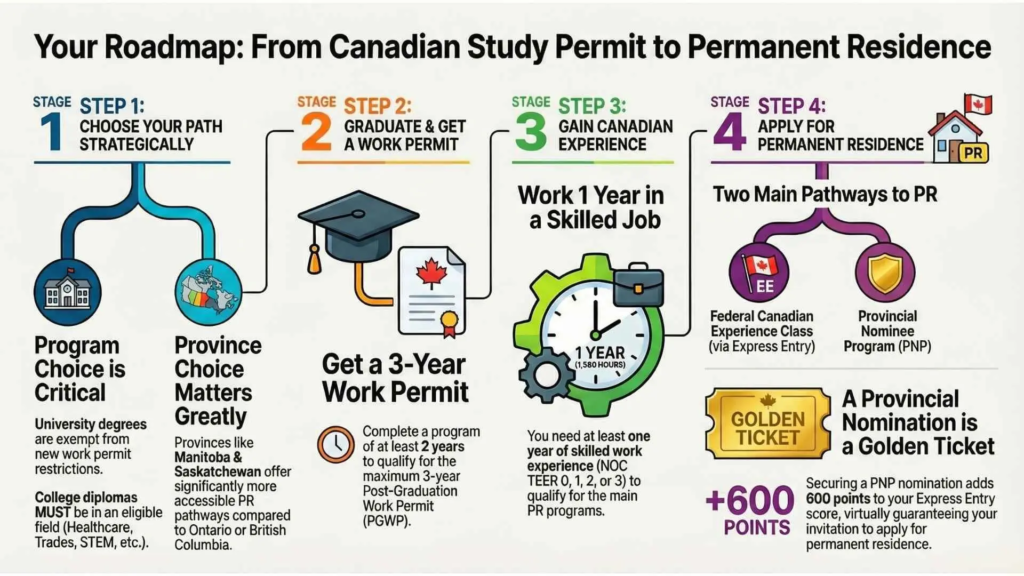
Why Canada Student Visas Are Being Refused – And How to Avoid It
With 69% of study permit applications being refused in 2025, understanding common refusal reasons and how to avoid them is absolutely critical. These aren’t theoretical possibilities; these are the actual reasons stated in refusal letters issued by visa officers in 2024-2025.
Refusal Reason #1: "I am not satisfied that you will leave Canada at the end of your stay"
Still the single most common refusal reason, accounting for approximately 30-40% of all refusals. This is officer code for “I believe you’re using education as a pretext to immigrate, and I’m not convinced you’re a genuine temporary resident.”
Why this happens:
❌ Program doesn’t match previous education or work experience:
- Civil engineer with 8 years experience enrolling in basic 2-year business administration diploma
- Master’s degree holder in economics enrolling in 1-year office administration certificate
- Accountant with professional designation enrolling in culinary arts program
- Any significant academic downgrade without compelling explanation
❌ Academic downgrade (higher qualification pursuing lower one):
- PhD holder enrolling in college diploma
- Master’s graduate enrolling in bachelor’s degree in unrelated field
- Bachelor’s graduate enrolling in certificate program
❌ Generic, template-based study plan:
- “Canada has world-class education and I want quality degree”
- “This program will help me advance my career when I return home”
- No specific details about program, courses, professors, or institution
- Obvious copy-paste language from internet templates
❌ Weak or non-existent ties to home country:
- No family in home country (entire family already abroad)
- No property ownership or significant assets
- No employment to return to (resigned from job rather than taking leave)
- No compelling reason to return after graduation
❌ Choosing non-PGWP-eligible program with obvious immigration intent:
- Program removed from PGWP eligibility in November 2024
- Extensive research into Canadian immigration pathways visible in application or online presence
- Family already in Canada as permanent residents or citizens
- Previous immigration attempts or inquiries
How to avoid:
✅ Choose programs that logically build on your background:
- Engineer pursuing engineering management postgraduate diploma: Makes sense
- Business professional with 5 years experience pursuing MBA: Makes sense
- Healthcare worker pursuing Canadian nursing credential: Makes sense
✅ Explain any field changes or downgrade compellingly:
- If changing fields, explain why through concrete career narrative
- If pursuing lower qualification, explain why Canadian credential needed despite higher degree (e.g., foreign master’s not recognized in Canada, need Canadian credential to enter regulated profession)
✅ Craft highly personalized, detailed study plan:
- Name specific courses (with course codes) and explain why they interest you
- Reference specific professors or research centers at institution
- Demonstrate genuine research about program’s unique features
- Connect your past → this program → specific future career goals
✅ Demonstrate strong home country ties:
- Property ownership (include property deeds in application)
- Employment letter granting leave of absence (not resignation)
- Family remaining in home country (spouse, parents, children, siblings)
- Business ownership or family business requiring your eventual return
- Cultural, religious, or community leadership commitments
✅ Address dual intent honestly:
Dual intent means you’re allowed to have both temporary intent (completing studies) AND immigration intent (potentially staying if eligible), but you must acknowledge the temporary nature of your study permit while also presenting legitimate home country ties.
Good approach: “While I hope to gain 1-2 years of Canadian work experience through PGWP to enhance my credentials and career prospects, I maintain strong ties to [home country] through my family, property, and professional network. Whether I return immediately after studies or after gaining Canadian work experience, I see significant opportunities to apply these skills in [home country]’s developing [industry] sector.”
Bad approach: Pretending you have no interest in Canadian immigration when your entire profile suggests otherwise, OR being so obvious about immigration intent that you undermine temporary resident narrative.
Refusal Reason #2: "I am not satisfied regarding the financial situation / ability to pay fees"
Increasingly common in 2025 with the September increase to $22,895 CAD and heightened scrutiny on financial documentation. Accounts for approximately 25-35% of refusals.
Why this happens:
❌ Sudden large deposits in bank statements:
- Accounts showing $5,000-$7,000 for 4-5 months
- Suddenly $40,000 deposited in final month before application
- Obvious conclusion: Funds arranged specifically for visa, not genuinely available
❌ Inconsistent income sources that don’t support claimed savings:
- Student claiming to have saved $30,000 CAD from part-time retail work over 18 months
- Mathematical impossibility: At typical wages, couldn’t save that amount while covering living expenses
- Sponsor claiming high income but bank statements showing minimal deposits
- Self-employed sponsor with claimed income not matching business documentation
❌ Insufficient or incomplete sponsor documentation:
- Parent offers to sponsor but provides only vague employment letter
- No income tax returns, no business ownership proof, no property deeds
- Sponsor’s claimed income doesn’t match lifestyle or assets
- Multiple sponsors with complicated explanations (raises suspicion about why so many people needed to contribute)
❌ Showing exactly minimum requirement with no buffer:
- Proving exactly $22,895 or exactly $23,000
- Officer interpretation: Calculated minimum rather than genuine financial capacity
- No buffer for emergencies, unexpected expenses, or miscalculations
❌ Funds in accounts that are frozen, restricted, or not easily accessible:
- Term deposits that cannot be withdrawn for months
- Funds in accounts belonging to distant relatives (not parents/spouse)
- Complicated web of transfers between accounts making it unclear whether funds are actually available
❌ Poor quality or suspicious-looking documents:
- Blurry photocopies of bank statements
- Missing pages (e.g., statement shows page 1 of 8 but only pages 1, 3, 5, 8 provided)
- Documents that appear to have been altered (fonts don’t match, misaligned text, inconsistent formatting)
- Bank stamps/seals that look questionable
How to avoid:
✅ Demonstrate steady financial history over 6-12 months:
- Show consistent balances well above minimum for extended period
- Regular salary deposits matching claimed employment
- Normal account activity (withdrawals for living expenses, bill payments) showing accounts are actively used, not just opened for visa
✅ Show consistent income sources that logically match claimed employment:
- Salary deposits that align with employment letter stating monthly salary
- Business income that aligns with business financial statements and tax returns
- Investment income with supporting documentation from investment accounts
✅ Provide complete, comprehensive sponsor documentation:
If parent is sponsoring:
- Employment letter on company letterhead showing position, salary, years employed, employer contact
- 2-3 years income tax returns showing consistent declared income
- Bank statements (6+ months) showing regular salary deposits and healthy balances
- Property ownership documents (deeds, valuation assessment)
- If self-employed: Business registration, tax filings, business bank statements, client contracts
- Affidavit clearly stating relationship, willingness to support, and financial capacity
✅ Budget and show 30-40% above minimum requirements:
- Minimum for single student: $22,895 + tuition + transportation = ~$40,000-$42,000
- Better to show: $55,000-$60,000 (demonstrates genuine capacity and buffer)
✅ Use GICs (Guaranteed Investment Certificates) when from high-refusal countries:
- Demonstrates binding commitment of funds to Canadian bank
- Particularly valuable for applicants from India, Pakistan, Nigeria, Bangladesh, Philippines
- Shows you’ve actually transferred money to Canada, not just accumulated it for visa appearance
✅ Organize financial documents logically with explanatory cover letter:
Write 1-2 page letter explaining:
- Source of all funds (family savings, parental support, loans, combination)
- How funds were accumulated (steady savings over X years from Y income source)
- Why funds are genuinely available and accessible
- Any unusual patterns or transactions with explanations
✅ Address any irregular financial patterns proactively:
If there WAS a large deposit (inheritance, property sale, business profit distribution), explain it:
- Include supporting documentation (death certificate and will for inheritance, property sale agreement, business profit distribution resolution)
- Provide transaction trail showing source
- Explain in cover letter before officer has to question it
Refusal Reason #3: "I am not satisfied that the applicant's plan of study is reasonable"
Approximately 15-20% of refusals. This means visa officer doesn’t believe your program choice makes sense given your circumstances.
Why this happens:
❌ Generic study plan language:
- “Canada has excellent education system”
- “I have always wanted to study abroad”
- “This program will help me in my career”
- No specific details about program content, structure, or outcomes
❌ No specific details about program or institution:
- Couldn’t name any specific courses beyond program title
- No mention of unique program features, professors, research centers, or facilities
- No demonstration of actual research about institution
❌ No explanation why this program despite PGWP restrictions (if applicable):
- Choosing non-PGWP-eligible program but profile clearly shows immigration interest
- No credible explanation for why willing to forgo work permit eligibility
- Study plan doesn’t address this obvious concern
❌ Unrealistic career goals:
- Claiming 2-year diploma will lead to CEO position
- Career goals that don’t actually require this specific credential
- Plans that don’t align with actual job market realities
❌ No explanation for studying at this life stage:
- Age 40+ pursuing entry-level diploma without explaining why now
- Already having successful career but pursuing program that won’t advance it
- Life circumstances (children, family responsibilities) making full-time studies questionable
How to avoid:
✅ Research program thoroughly and demonstrate it in study plan:
Mention specific courses: “The program’s curriculum includes core courses in [Course Code XXX]: [Course Name] which covers [specific topics], taught by [Professor Name] who specializes in [specialty]. This aligns directly with my goal to [specific objective].”
✅ Reference unique program features:
- Co-op placements with specific industry partners
- Specialized facilities (labs, equipment, studios)
- Industry partnerships and guest lecturers
- Internship opportunities
✅ Explain concrete career goals with realistic job titles:
Not: “I will return to my country and become a senior manager”
Better: “Upon returning to Nigeria, I plan to pursue roles such as Construction Project Coordinator or Estimator with firms like Julius Berger or Reynolds Construction that are expanding into green building projects. These positions typically require 2-3 years Canadian experience or specialized training, which this program provides. My goal within 5-7 years is to advance to Project Manager overseeing LEED-certified construction projects.”
✅ Connect background → education → career logically:
Show clear thread: Your past experience revealed a specific skills gap → This Canadian program fills that gap → Enhanced credentials enable specific career advancement → Concrete examples of opportunities in home country
✅ If choosing non-PGWP program, explain why convincingly:
“While I understand this program became ineligible for PGWP under November 2024 changes, my intention is to return to [home country] to [specific plan], not to pursue Canadian immigration pathways. [Explanation of why Canadian credential valuable even without PGWP—industry recognition, specific technical skills, professional network, etc.]”
✅ Address age/life stage considerations:
If you’re 35+ pursuing college diploma: “At this stage of my career with 12 years of experience in [field], I’ve identified that advancing to [next level] requires [specific technical skills] that theoretical degrees don’t provide. This hands-on diploma program offers [specific benefits] that will enable me to [specific career objective]. My employer [Company Name] has granted me a 2-year leave of absence to pursue this training, with a guaranteed position awaiting my return.”
New 2025 - 2026 Student Visa Refusal Triggers
Provincial Attestation Letter (PAL) Issues:
❌ Application submitted without PAL when required:
- Applicant didn’t realize PAL was mandatory
- Application returned or refused
❌ PAL expired or invalid:
- PAL was issued but student delayed study permit application too long
- PAL expired during processing
❌ Institution couldn’t provide PAL due to provincial cap exhaustion:
- Student received admission but institution had no PAL allocation remaining
- Cannot proceed with study permit application despite acceptance
How to avoid:
- Apply early to institutions to maximize chances of receiving PAL
- Confirm PAL status before paying tuition deposits
- Submit study permit application promptly after receiving PAL (don’t delay)
- Verify PAL validity period and ensure application submitted before expiry
Letter of Acceptance Not Verified (New November 2024 Requirement):
❌ Institution didn’t verify LOA in IRCC system:
- As of November 2024, all DLIs must verify Letters of Acceptance electronically in IRCC’s portal
- Unverified LOAs result in applications being automatically returned unprocessed
How to avoid:
- Contact institution’s international student office to confirm they’ve verified your LOA in IRCC system
- Request confirmation of verification before submitting study permit application
- Coordinate with institution if they haven’t completed verification
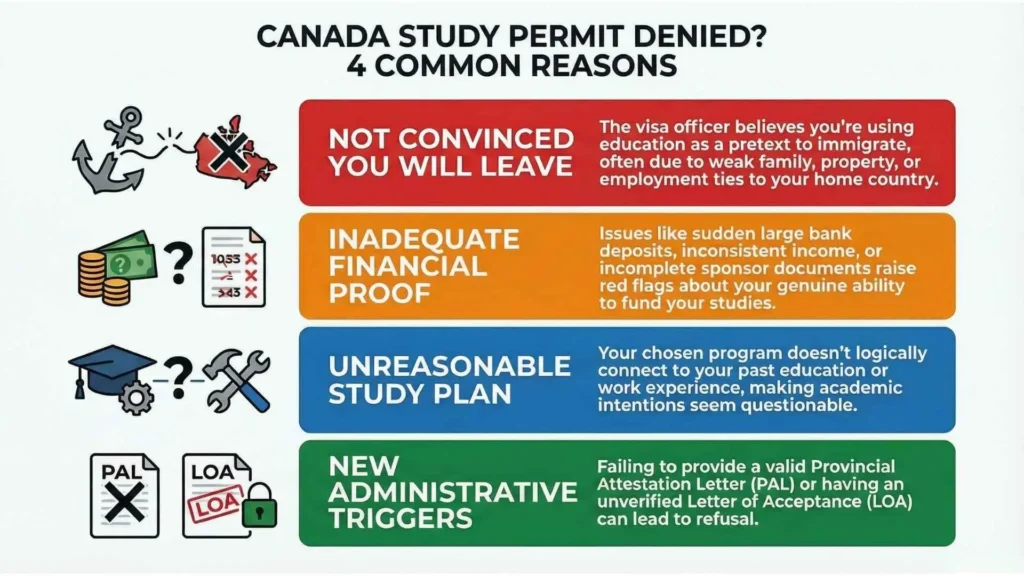
Why Were Study Permit Refusal Rates So High in 2025?
Understanding the systemic reasons helps contextualize individual refusal risks:
1. Canada Study permit caps creating artificial scarcity:
Canada reduced permits from 485,000 (2024) to 437,000 (2025), and will cut further to 309,670 (2026)—a 29% reduction in two years.
With demand unchanged but supply restricted, visa officers must refuse larger percentage of applications.
Officers now scrutinize every application for any reason to refuse, rather than looking for reasons to approve borderline cases.
2. Heightened "genuine temporary resident" concerns:
With Canada’s stated policy goal of reducing temporary resident population, IRCC has directed officers to apply strict scrutiny to temporary resident applications, including study permits.
Any hint that applicant intends to overstay, violate permit conditions, or use study permit as immigration backdoor triggers refusal.
3. Financial documentation skepticism:
The September 2025 increase to $22,895 CAD combined with officers being trained to identify fraudulent financial documentation has led to dramatic increases in refusals on financial grounds.
Officers are now questioning the legitimacy of funds even when documentation appears complete, particularly from countries with histories of fraudulent applications.
4. Country-specific Canada Student Visa refusal patterns:
Certain countries face disproportionately high refusal rates due to historical patterns:
- India: 74-80% refusal rate (Q2 2025) due to previous high rates of visa violations, fraudulent documentation, and overstays
- Nigeria, Pakistan, Bangladesh: 60-80% for similar reasons plus security screening concerns
- Philippines: 55-65% despite historically better approval rates
- China: 45-55% (lower than South Asian countries but still challenging)
Officers apply heightened scrutiny to applications from these countries regardless of individual merits.
5. How we help when market average approval is 31%:
Our 90%+ approval rate maintained through 2024-2025 demonstrates that with proper preparation addressing these specific concerns systematically, approval is still very achievable—even when 7 out of 10 applications overall are refused.
We achieve this by:
- Strategic profile assessment turning away cases unlikely to succeed (15-20% of inquiries)
- Comprehensive financial documentation addressing officer concerns before they arise
- Highly personalized study plans demonstrating genuine intent and research
- Proactive explanation of any profile weaknesses or potential concerns
- Verification of all PGWP eligibility requirements under current rules
- Timing applications to maximize PAL access
- Complete, consistent documentation with no contradictions or gaps
Comprehensive guide: Study Permit Refusals: Causes, Prevention & Reapplication Strategy 2026 – 2027 →
Download: Common Refusal Reasons & How to Address Them – >
Where Should You Study in Canada? Province-by-Province Guide (2026 - 2027)
Where you study affects everything: tuition costs, living expenses, job markets, climate, cultural experience, and, critically, immigration pathways. This isn’t a decision to make lightly or based on name recognition alone.
Ontario
Major cities: Toronto, Ottawa, Mississauga, Hamilton, London, Kingston, Waterloo, Windsor
Why students choose Ontario:
- Largest province by population and economy
- Most diverse job market in Canada (finance, technology, government, healthcare, manufacturing, professional services)
- Highest number of universities and colleges (22 public universities, 24 public colleges)
- Most internationally recognized institutions (U of T, Western, Queen’s, McMaster, Waterloo)
- Multicultural cities with established international communities
- Cultural amenities (museums, theaters, sports, entertainment)
Cost of living:
- Toronto: 💰💰💰 Very High ($2,400-$3,500/month)
- Ottawa: 💰💰💰 High ($2,000-$2,800/month)
- Other cities: 💰💰 Moderate ($1,600-$2,400/month)
Tuition range:
- Colleges: $13,000-$20,000/year
- Universities: $25,000-$45,000/year (higher for engineering, business, computer science)
Job market: ⭐⭐⭐⭐⭐ Excellent
- Largest job market in Canada
- Technology hub (Waterloo-Toronto corridor is “Silicon Valley of the North”)
- Financial services center (Toronto)
- Government jobs (Ottawa is national capital)
- Healthcare constantly hiring
Immigration ease: ⭐⭐⭐ Competitive
Ontario Immigrant Nominee Program (OINP):
- Masters Graduate Stream: No job offer required but extremely competitive (limited spots, intake closes quickly)
- PhD Graduate Stream: No job offer required, more accessible than masters
- Employer Job Offer streams: Require Ontario job offer in skilled occupation
Challenge: OINP is one of Canada’s most competitive PNPs. Many graduates rely on Canadian Experience Class through Express Entry rather than PNP.
2025 PAL impact: Moderate availability—Ontario received significant allocation but also has largest number of institutions and applicants
Best for:
- Students prioritizing top-tier university prestige
- Technology and finance career tracks
- Those with family/community already in Ontario
- Students comfortable with higher costs
Not ideal for:
- Budget-conscious students
- Those prioritizing easy immigration pathway (consider Manitoba, Saskatchewan, Atlantic Canada instead)
British Columbia
Major cities: Vancouver, Victoria, Burnaby, Surrey, Richmond, Kelowna, Kamloops
Why students choose BC:
- Mildest climate in Canada (Vancouver winters rarely below 0°C)
- Beautiful natural environment (mountains, ocean, forests)
- Strong technology sector (Vancouver is growing tech hub competing with Toronto-Waterloo)
- Film and media industry center (Vancouver is “Hollywood North”)
- Outdoor lifestyle (skiing, hiking, water sports)
- Multicultural, especially significant Asian communities
Cost of living:
- Vancouver: 💰💰💰 Very High ($2,300-$3,500/month)
- Victoria: 💰💰💰 High ($2,000-$2,800/month)
- Kelowna, Kamloops: 💰💰 Moderate ($1,700-$2,400/month)
Tuition range:
- Colleges: $14,000-$22,000/year
- Universities: $28,000-$45,000/year
Job market: ⭐⭐⭐⭐ Strong
- Technology (software development, gaming, visual effects)
- Film and television production
- Tourism and hospitality
- Natural resources (forestry, mining)
- Healthcare
Immigration ease: ⭐⭐⭐ Competitive
BC Provincial Nominee Program:
- International Graduate: Requires BC job offer
- BC PNP Tech: Priority processing, weekly draws for 35 technology occupations
- Healthcare/Childcare Priority: Regular draws for healthcare workers and ECE professionals
2025 PAL impact: Moderate availability—BC received good allocation but high demand
Best for:
- Students who prioritize climate and outdoor lifestyle
- Technology careers (especially software development, gaming, visual effects)
- Film/media industry aspirations
- Healthcare workers
- Those who don’t mind high living costs
Alberta
Major cities: Calgary, Edmonton, Red Deer, Lethbridge, Grande Prairie
Why students choose Alberta:
- Strong economy (historically energy-based, now diversifying)
- Significantly lower cost of living than Toronto/Vancouver
- No provincial sales tax (saves 5-7% on all purchases—major savings)
- Growing technology sector (especially Calgary)
- Good job market in engineering, energy, finance
- Entrepreneurial culture
Cost of living:
- Calgary, Edmonton: 💰💰 Moderate ($1,800-$2,600/month)
- Smaller cities: 💰 Low-Moderate ($1,500-$2,200/month)
Tuition range:
- Colleges: $13,000-$19,000/year
- Universities: $22,000-$38,000/year
Job market: ⭐⭐⭐⭐ Strong
- Engineering (petroleum, chemical, civil, mechanical)
- Technology (Calgary tech sector growing rapidly)
- Healthcare
- Finance and business services
- Construction and trades
Immigration ease: ⭐⭐⭐ Moderate
Alberta Advantage Immigration Program (AAIP):
- Alberta Opportunity Stream: Requires Alberta work experience + job offer
- Express Entry Stream: For candidates in Express Entry pool with Alberta connection
2025 PAL impact: Moderate availability
Climate: ⚠️ Very cold winters (-20°C to -30°C common), but dry climate (less humidity than Ontario/Quebec)
Best for:
- Engineering students (especially petroleum, chemical)
- Computer science/technology
- Students wanting lower costs without sacrificing job market
- Those comfortable with cold, dry winters
Manitoba
Major city: Winnipeg (provincial capital and largest city)
Why students choose Manitoba:
- Easiest Provincial Nominee Program pathway for graduates
- Very affordable cost of living
- Welcoming community with strong newcomer support services
- Straightforward MPNP International Education Stream
Cost of living:
- Winnipeg: 💰 Low ($1,500-$2,200/month)
- Significantly lower housing costs than major metros
Tuition range:
- Colleges: $11,000-$17,000/year
- Universities: $16,000-$28,000/year
Job market: ⭐⭐ Smaller market
- Healthcare (constantly hiring)
- Manufacturing and transportation
- Agriculture and agri-food
- Retail and hospitality
- Government
Immigration ease: ⭐⭐⭐⭐⭐ Easiest in Canada
Manitoba Provincial Nominee Program (MPNP) International Education Stream:
- Requires 1 year Manitoba work experience after graduation (in some pathways, only 6 months)
- No job offer needed for many pathways
- Very accessible scoring
- Regular draws with lower score requirements than Ontario/BC PNPs
Why Manitoba is strategic for immigration:
- After completing 2-year program and working 1 year in Manitoba, you’re virtually guaranteed MPNP nomination
- MPNP nomination adds +600 CRS points in Express Entry, guaranteeing PR
- This pathway is significantly more accessible than competing for Canadian Experience Class or Ontario/BC PNPs
- Total timeline arrival → PR: Often just 4-5 years
2025 PAL impact: Good availability—Manitoba actively wants to attract and retain international students
Climate: ⚠️ Extremely cold winters (-30°C to -40°C with wind chill common), colder than other major cities
Best for:
- Students prioritizing guaranteed immigration pathway over prestige or climate
- Budget-conscious students
- Healthcare, trades, transportation careers
- Those who can tolerate harsh winters
- Students wanting lower competition for jobs and PNP
Not ideal for:
- Students who cannot tolerate extreme cold
- Those seeking large, diverse job market
- Students prioritizing prestige of institution
Saskatchewan
Major cities: Saskatoon, Regina
Why students choose Saskatchewan:
- Low cost of living
- Straightforward Saskatchewan Immigrant Nominee Program
- Growing economy (agriculture, mining, energy)
- Affordable housing
Cost of living:
- Saskatoon, Regina: 💰 Low ($1,400-$2,000/month)
Tuition range:
- Colleges: $12,000-$18,000/year
- Universities: $18,000-$30,000/year
Job market: ⭐⭐ Smaller market
- Agriculture and agri-food
- Mining and resources
- Healthcare
- Manufacturing
Immigration ease: ⭐⭐⭐⭐ Accessible
Saskatchewan Immigrant Nominee Program:
- Saskatchewan Experience category for graduates
- Requires 6-12 months work experience in Saskatchewan
- Relatively straightforward application
- Lower competition than Manitoba
2025 PAL impact: Good availability
Climate: Very cold winters (-25°C to -35°C common)
Best for:
- Students wanting affordable education + clear PR pathway
- Agriculture, mining, engineering fields
- Those comfortable in smaller cities
- Budget-conscious students
Atlantic Canada (Nova Scotia, New Brunswick, Prince Edward Island, Newfoundland & Labrador)
Major cities: Halifax (NS), Moncton (NB), St. John’s (NL), Charlottetown (PEI)
Why students choose Atlantic Canada:
- Affordable tuition and living costs
- Atlantic Immigration Program supports graduates
- Beautiful coastal environments
- Safe, friendly smaller communities
- Slower pace of life
- Strong maritime culture
Cost of living:
- Halifax: 💰 Low-Moderate ($1,600-$2,300/month)
- Other cities: 💰 Low ($1,300-$1,900/month)
Tuition range:
- Colleges: $11,000-$17,000/year
- Universities: $17,000-$28,000/year
Job market: ⭐⭐ Limited
- Healthcare (growing demand)
- Tourism and hospitality
- Fishing and seafood processing
- Education
- Small business
Challenge: Brain drain—many young people leave Atlantic Canada for Ontario/BC after graduation due to limited career opportunities
Immigration ease: ⭐⭐⭐⭐ Accessible
Atlantic Immigration Program (AIP):
- Requires job offer from designated employer
- Employer provides settlement support
- Accessible for college graduates
- International graduate pathway doesn’t require work experience
- Can apply even while still studying (with job offer)
2025 PAL impact: Good availability—Atlantic provinces actively recruiting students
Climate: Harsh, wet winters; beautiful summers; significant weather variability (especially Newfoundland)
Best for:
- Students wanting quiet, coastal lifestyle
- Healthcare careers (high demand)
- Those comfortable with smaller communities
- Students seeking lower costs + accessible PR pathway
- Applicants who appreciate maritime culture
Not ideal for:
- Those seeking diverse job market in corporate/technology sectors
- Students who need large international communities
- Career-ambitious professionals seeking rapid advancement
Quebec
Major cities: Montreal, Quebec City, Gatineau, Laval, Sherbrooke
Why students choose Quebec:
- Lower tuition for international students (compared to other provinces)
- Affordable cost of living (especially Montreal)
- Vibrant culture and arts scene
- Bilingual environment (English-French)
- European feel
- Excellent food, music, festivals
Cost of living:
- Montreal: 💰💰 Moderate ($1,700-$2,500/month)
- Quebec City: 💰💰 Moderate ($1,600-$2,300/month)
- Smaller cities: 💰 Low-Moderate
Tuition range:
- Colleges (CEGEPs): $12,000-$18,000/year
- Universities: $18,000-$32,000/year
- Lower than most other provinces
Job market: ⭐⭐⭐ Good
- Technology (especially gaming, AI/ML, visual effects)
- Aerospace
- Pharmaceuticals and life sciences
- Finance
- Arts and culture
Immigration ease: ⭐⭐ Challenging (French requirement)
Quebec immigration system is completely separate from federal:
Programme de l’expérience québécoise (PEQ):
- Requires French language proficiency at advanced intermediate level (B2)
- Quebec degree or diploma
- Intent to settle in Quebec
Challenge: Most international students study in English-medium programs and don’t develop sufficient French for PNP, limiting immigration pathways.
Additional administrative step: Must obtain Quebec Acceptance Certificate (CAQ) before applying for federal study permit (adds processing time and fees)
2025 PAL impact: Separate system—Quebec manages own attestation letter process
Best for:
- French-speaking students or those committed to learning French
- Students wanting affordable, culturally rich experience
- Technology, aerospace, AI/ML careers
- Those who appreciate bilingual environment
Not ideal for:
- Students who don’t speak French and don’t intend to learn to advanced level
- Those seeking straightforward PR pathway
- Applicants who want to keep immigration options open (Quebec PR doesn’t easily transfer to other provinces)
Strategic Province Selection Guide
If your priority is:
Easy immigration pathway: Manitoba, Saskatchewan, Atlantic Canada
Largest job market: Ontario, BC
Lowest cost of living: Manitoba, Saskatchewan, Atlantic Canada
Mildest climate: BC (Vancouver, Victoria)
Technology careers: Ontario (Waterloo-Toronto), BC (Vancouver), Alberta (Calgary)
Healthcare careers: Manitoba, Saskatchewan, Atlantic Canada, Alberta (high demand everywhere, but easier immigration in these provinces)
Engineering careers: Alberta, Ontario
Bilingual environment: Quebec (requires French for PR)
Coastal lifestyle: BC, Atlantic Canada
Maximum PR points (master’s advantage): Any province, but consider cost (cheaper = complete program with less debt)
Complete province guide: Where to Study in Canada: Complete 2026-2027 Province Comparison (Costs, Jobs, Immigration & PAL) →
What Our Students Say About Our Study Abroad Services
“After my study permit was refused twice by other consultants who just submitted generic applications, I was ready to give up on my dream of studying in Canada. I found Amir Ismail & Associates through a friend’s recommendation. During my first consultation, they were brutally honest—they identified the exact problems with my previous applications: weak financial documentation with suspicious deposits, and a study plan that made no sense given my engineering background.
They restructured my entire approach. We reorganized my financial documents showing 8 months of steady banking history instead of last-minute deposits. They helped me choose a different program (Civil Engineering Technology instead of Business Administration) that actually matched my background. The study plan they crafted was so specific and detailed—mentioning actual course codes, professors, and how each aligned with my career goals.
I got approved in 10 weeks. I’m now in my second year at Seneca College in Toronto, maintaining a 3.8 GPA, and I already have a clear plan for PGWP and PR through Ontario’s skilled worker stream. Working with a licensed RCIC who understood both the technical requirements AND the immigration implications made all the difference.”
— Rahul P., India → Seneca College, Toronto
Study Permit Approved: March 2024
Program: Civil Engineering Technology (3-Year Advanced Diploma)
“I consulted Amir Ismail & Associates in 2021 before even applying to programs. This was the best decision I made. Other agents were pushing me toward expensive university programs in Toronto, but AIA asked about my actual goals. When I said my priority was Canadian PR, not a prestigious degree, they recommended a strategic approach: 2-year Computer Programming diploma at Red River College in Winnipeg, Manitoba.
They explained that Manitoba’s PNP was the most accessible in Canada, that the program was PGWP-eligible, and that with lower living costs I could complete my studies with less financial stress. They were completely right.
Today, three and a half years later: Graduated from Red River College with diploma in Computer Programming (December 2023), Received 3-year PGWP (February 2024), Found software developer job in Winnipeg within 6 weeks (March 2024), Worked 1 year, applied to Manitoba PNP (April 2025), Nominated by Manitoba (June 2025), Applied for PR through Express Entry with 600 bonus points (July 2025), Permanent Residence approved November 2025
Total cost: ~$55,000 CAD for entire program (vs $180,000+ if I’d done a 4-year degree in Toronto like other agents suggested)
Their long-term strategic planning—not just getting a study permit, but planning PGWP and PR from day one—made this success possible. I’m now a PR with a great job, and I spent less than a third of what my friends who studied in Toronto spent.”
— Fatima K., Pakistan → Red River College, Winnipeg → Permanent Resident
Study Permit Approved: July 2021
PR Approved: November 2025
Total timeline from arrival to PR: 4.5 years
“I started researching Canadian colleges in summer 2024, planning to enroll in January 2025. The PGWP rules changed in November 2024 while I was in the middle of my research. I had already paid a $5,000 deposit to a Business Administration program at a private college based on advice from an unlicensed education agent.
When I contacted Amir Ismail & Associates for a second opinion, they immediately identified two critical problems:
- The Business Administration program I’d chosen was removed from PGWP eligibility under the new November 2024 rules
- The private college, while it had a DLI number, had very limited PGWP eligibility for most programs
They showed me IRCC’s updated list of eligible fields. My chosen program was gone. If I’d proceeded, I would have completed 2 years and $35,000 in costs, only to discover I was ineligible for PGWP—meaning no work permit, no Canadian experience, no PR pathway.
AIA helped me:
- Get my deposit refunded from the first college (they negotiated on my behalf)
- Choose Electrical Engineering Technology at Humber College—a PGWP-eligible program in skilled trades category
- Understand I’d need CLB 5 language test for PGWP, not CLB 7
- Adjust my timeline to account for PAL requirements
- Prepare a study permit application addressing the November 2024 policy changes explicitly
— Mohammed A., Saudi Arabia → Humber College, Toronto
Study Permit Approved: September 2024
Program: Electrical Engineering Technology
Current status: First year student, already has co-op placement lined up for summer 2026
“During my initial consultation with Amir Ismail & Associates, they told me something I didn’t want to hear: ‘Your financial documentation isn’t strong enough, and your program choice doesn’t make sense for your background. If we submit your application now, it will almost certainly be refused. We recommend you wait 6 months to improve your banking history and choose a different program that matches your engineering degree.’
I was frustrated. Other consultants had been happy to take my money and submit immediately. But I trusted their assessment because they were licensed professionals who had nothing to gain from telling me to wait—they could have taken my fee and submitted a weak application.
I followed their advice:
- Waited 6 months, during which I maintained steady banking history showing consistent balances
- Changed from Business Administration diploma (didn’t match my civil engineering background) to Construction Management postgraduate diploma (logical progression)
- Improved my IELTS score from 6.0 to 7.0 overall
When I applied 6 months later with their help: Approved.
That honesty saved me from a certain refusal. A refusal would have meant:
- Lost $15,000 in tuition deposits
- Lost $2,000 in application fees, biometrics, medical exam
- Damaged credibility for future applications
- 6-12 months wasted time
Their integrity and professional expertise were worth every penny of the consultation fee. I’m now in my final semester at Conestoga College, graduating in April 2026, with a clear PGWP and PR strategy already mapped out.”
— David O., Nigeria → Conestoga College, Ontario
Study Permit Approved: January 2025
Program: Construction Management (Postgraduate Diploma)
“My situation was complex: I’m married with a 7-year-old child. We wanted to move to Canada as a family, and I was exploring skilled worker programs, study permits, and other options. Other immigration consultants gave me conflicting advice.
Amir Ismail & Associates took time to understand our complete situation and goals, then provided a comprehensive strategy:
Option 1: Apply as skilled worker through Express Entry (estimated CRS score: 420 points—below typical cut-offs)
Option 2: Study permit route:
- Enroll in 2-year master’s program at public university in Manitoba
- My wife gets open work permit automatically (can work full-time while I study)
- Child attends elementary school free
- After 2 years: I get PGWP, we both work
- After 1 year combined work experience: Apply through Manitoba PNP
- Estimated timeline to PR: 4 years
- Total cost including tuition, living expenses: ~$110,000 CAD
- But my wife’s income while working (~$35,000/year × 3.5 years) = ~$120,000 CAD offsetting most costs
They recommended Option 2 because:
- Higher probability of success (Manitoba PNP more accessible than competing in Express Entry)
- My wife could work and contribute financially
- Child could experience Canadian education early
- We’d all be together throughout the process
We’re now in year 2. My wife has been working as a customer service manager earning $42,000/year. Our daughter is thriving in school. I’m completing my Master’s in Business Administration at University of Winnipeg. We’ll both apply for PGWP after I graduate, and between our two Canadian work experiences, we’ll have a very strong Manitoba PNP application.
Their family-focused strategic approach made our Canadian immigration dream realistic and financially feasible.”
— Priya & Amit S., India → University of Winnipeg
Study Permit Approved: August 2023
Spouse Work Permit Approved: August 2023
Current status: Second year of master’s program, wife employed, daughter in grade 3
See our 1000+ verified reviews:
⭐ Toronto HQ(89 reviews) | ⭐ Dubai (51 reviews) | ⭐ Karachi (970+ reviews)Why Our Clients Succeed Where Others Are Refused
When 69% of study permit applications are refused in 2025, achieving 90%+ approval isn’t luck; it’s systematic preparation addressing the specific concerns causing refusals:
✅ We turn away unsuitable cases (15-20% of inquiries) rather than taking fees for applications likely to fail
✅ We verify PGWP eligibility under current November 2024 rules before recommending programs
✅ We build financial cases that withstand heightened 2025 scrutiny on funds
✅ We craft personalized study plans that demonstrate genuine intent and research
✅ We stay current with weekly policy changes and adjust strategies accordingly
✅ We plan long-term from study permit through PGWP to PR, not just one step at a time
Frequently Asked Questions – Study in Canada
How do I apply to study in Canada step by step?
Applying to study in Canada involves four main stages:
(1) Choose and apply to programs at Designated Learning Institutions, submitting transcripts, English test scores, and application forms directly to institutions;
(2) Receive Letter of Acceptance from the institution confirming your admission;
(3) Apply for study permit through IRCC with your Letter of Acceptance, proof of funds, passport, language scores, and detailed study plan;
(4) Receive study permit approval and Port of Entry Letter of Introduction, then travel to Canada and obtain study permit stamp at airport immigration.
The entire process typically takes 4-8 months from initial applications to arrival in Canada, depending on program deadlines and study permit processing times for your country.
Detailed guide: Complete Study Permit Application Process →
Do I need a Provincial Attestation Letter (PAL) to study in Canada?
As of January 2024, most international students applying for study permits for programs starting in fall 2024 or later require a Provincial Attestation Letter (PAL) from the province where they intend to study. The PAL confirms that the province has allocated you a spot within their provincial cap on international student study permits. Your designated learning institution will typically assist you in obtaining the PAL after you receive your Letter of Acceptance, or the province may issue it directly. However, PAL requirements don’t apply to elementary and secondary school students, master’s and doctoral degree students at universities, students with valid study permits applying for extensions, and certain other exempted categories. Check current IRCC requirements as policies evolve.
What documents do I need for a Canadian study permit?
Required documents for a Canadian study permit application include:
(1) Letter of Acceptance from a Designated Learning Institution;
(2) Valid passport with at least 6 months validity remaining;
(3) Proof of financial support showing tuition payment plus minimum $20,895 CAD living expenses (or $24,571 CAD for Quebec), through bank statements, GIC, scholarship letters, or sponsor affidavits;
(4) Language test results (IELTS, TOEFL, PTE, or CELPIP) if required by your institution;
(5) Passport photos meeting IRCC specifications;
(6) Detailed study plan (Statement of Purpose) explaining why you chose Canada, this program, and your post-graduation intentions;
(7) Educational documents (transcripts, degrees, diplomas with translations);
(8) Provincial Attestation Letter (PAL) if applicable;
(9) Medical examination results if your program is over 6 months or if you’re from certain countries;
(10) Police certificates if requested; and
(11) Quebec Acceptance Certificate (CAQ) if studying in Quebec. Additional documents may include proof of ties to the home country, employment letters, family information forms, and custodianship declarations for minors.
Complete checklist: Study Permit Document Checklist →
Can I work in Canada while I study?
Yes, international students with valid study permits can work in Canada under specific conditions without needing a separate work permit. You can work up to 24 hours per week during academic sessions and full-time during scheduled breaks (winter break, summer break, reading week) if you’re enrolled full-time at a Designated Learning Institution in a program at least 6 months long leading to a degree, diploma, or certificate. You can work both on-campus (at your institution) and off-campus (for any employer in Canada) once your program begins. If your program includes mandatory co-op placements or internships, you’ll need a co-op work permit issued along with your study permit. Working more than the allowed hours is a serious violation that can result in study permit cancellation and removal from Canada. You must obtain a Social Insurance Number (SIN) before starting work and file Canadian tax returns annually.
Work guide: Working While Studying: Rules & Opportunities →
How long does a Canadian study permit take to process?
Canadian study permit processing times vary by country of application and time of year, with current processing times ranging from 6 to 16 weeks for most countries. As of December 2024, typical timelines include: applications from Pakistan (10-12 weeks), India (8-10 weeks), Philippines (10-14 weeks), China (8-12 weeks), and many other countries (8-12 weeks). Applications requiring biometrics add approximately 2-4 weeks to processing, as you must visit a Visa Application Centre to provide fingerprints and photos. Incomplete applications or those requiring additional documents can add 4-8 weeks as officers request clarifications. Applications during peak periods (April-July for fall term starts) may experience longer processing times. To minimize delays, submit complete applications with all required documents, clear study plans, and comprehensive financial proof as early as possible—ideally 3-4 months before your intended program start date.
Can my spouse work while I study in Canada?
Yes, if you’re studying in certain eligible programs, your spouse or common-law partner may qualify for an open work permit allowing them to work full-time for any employer in Canada while you study. Your spouse is eligible if you’re enrolled full-time in:
(1) a bachelor’s degree program (4 years) at a public university,
(2) a master’s or doctoral program at a public university, or
(3) certain professional degree programs (medicine, law, veterinary medicine, etc.) at public universities. Spouses of college diploma students generally do NOT qualify for open work permits unless the program is a postgraduate diploma of at least 1 year at a public college.
The spouse work permit is valid for the same duration as your study permit. This benefit is significant because it allows your family to generate income, gain Canadian work experience, and potentially improve your combined Express Entry CRS score if you both obtain Canadian work experience. Your spouse must meet admissibility requirements and may need to provide police certificates and medical exams depending on country of origin.
Which study programs in Canada are best for PR?
Programs that lead most directly to permanent residence share several characteristics:
(1) Minimum 2 years in length to qualify for 3-year Post-Graduation Work Permits;
(2) In-demand occupational fields such as software development, engineering, healthcare (nursing, PSW), skilled trades (electrician, plumber, welder), early childhood education, accounting, and business analysis;
(3) Programs at public colleges or universities ensuring PGWP eligibility; and (4) Located in provinces with accessible PNP streams such as Manitoba, Saskatchewan, Atlantic provinces, or provinces with strong job markets in your field (Ontario for tech, BC for tech and healthcare, Alberta for engineering).
The single best “program type” for immigration is a 2-year college diploma in a skilled trade or technical field because it provides maximum PGWP length (3 years), lower costs than university degrees, faster completion, and access to multiple PNP streams that prioritize trades and technical workers. However, if you want maximum Express Entry CRS points, a master’s degree in computer science, engineering, or data science provides higher points and access to master’s graduate PNP streams in Ontario. The optimal program depends on your age, budget, previous education, and target province—which is why strategic planning before enrollment is essential.
What happens if my Canadian study permit is refused?
If your study permit application is refused, you’ll receive a refusal letter explaining the reasons, typically citing concerns about:
(1) insufficient proof you’ll leave Canada after studies,
(2) inadequate financial resources,
(3) unclear study plan or purpose of visit,
(4) lack of ties to home country, or
(5) previous immigration violations. You have several options:
First, request detailed GCMS (Global Case Management System) notes from IRCC showing exactly what the visa officer wrote about your application—this reveals specific concerns beyond the generic refusal letter.
Second, assess whether you can strengthen your application by addressing the refusal reasons (improving study plan, adding financial documentation, choosing different program, etc.) and reapply.
Third, consider whether reconsideration or judicial review is appropriate (rare for study permits; usually only if officer made clear legal error).
Fourth, consult a licensed immigration consultant to review your file and advise on reapplication viability. You typically cannot appeal study permit refusals through immigration tribunals. If you paid tuition deposits to your institution, contact them immediately about refund policies—many institutions offer partial refunds if you provide proof of study permit refusal. Importantly, a study permit refusal doesn’t permanently bar you from Canada, but you must address the underlying concerns before reapplying successfully.
Work With a Licensed Canadian Immigration Consultant Since 1991
International students face a confusing landscape of program options, institution choices, financial requirements, study permit applications, work authorization rules, and permanent residence pathways. Making the wrong decision at any stage can cost you years of time and tens of thousands of dollars.
Since 1991, Amir Ismail & Associates has guided over 7,400 international students through Canadian education and immigration journeys, from initial program selection through study permit applications, PGWP extensions, and permanent residence approvals.
What makes us different:
✓ Licensed RCIC (R412319) with 34 years of experience, not an unlicensed agent or college recruiter
✓ No commission relationships with institutions, we recommend programs based on your goals, not our financial incentives
✓ Comprehensive service from study permit through PGWP to permanent residence planning
✓ 90%+ study permit approval rate across three decades serving students from Pakistan, India, Saudi Arabia, UAE, Qatar, Bangladesh, Nigeria, Kenya, and 40+ other countries
✓ Honest assessment that sometimes includes telling you that studying in Canada isn’t the right path currently
✓ Strategic immigration planning integrated into every education decision
You don’t get a sales pitch, you get a licensed professional who understands both Canadian education systems and immigration law, who can explain how your program choice today affects your permanent residence application three years from now, and who provides guidance based on decades of experience navigating IRCC policies, provincial nominee programs, and Express Entry.
Whether you’re a high school graduate exploring undergraduate options, a working professional considering postgraduate diplomas, or a parent researching programs for your children, you’ll work directly with a regulated consultant who treats your immigration journey with the professionalism and expertise it deserves.