A law passed in December 2025 may have already made you Canadian
If you have a Canadian ancestor and were born before December 15, 2025, you may already be a Canadian citizen. Not potentially eligible. Not on a path to something. Already a citizen, by operation of law.
Not sure you qualify? Take our citizenship eligibility quiz or read the citizenship by descent guide.
Worried the law could be undone? Read our guide to Bill C-3 reversal risk.
Bill C-3, enacted on December 15, 2025, retroactively grants Canadian citizenship to descendants of Canadian citizens across unlimited generations. All you need is an unbroken documentary trail connecting you to a Canadian-born or naturalized ancestor.
You do not need to live in Canada. You do not need to give up your current citizenship. As of September 2026, about 136,000 applications are pending at IRCC, and estimates put the number of eligible Americans at up to 3 million. Over 570,000 more people globally outside the US are thought to qualify.
Most of them have no idea.
Quick Navigation
What the first-generation limit was, and why Canada scrapped it
Key Takeaways: Bill C-3 Citizenship Rules
- First-Generation Limit Removed: Bill C-3 retroactively grants Canadian citizenship to descendants of Canadian citizens, regardless of how many generations were born abroad.
- Retroactive Eligibility: If you were born before December 15, 2025, to a Canadian ancestor, you automatically qualify with no Canadian residency requirement.
- Prospective Rules: For children born on or after December 15, 2025, the Canadian parent must prove a “substantial connection” (1,095 days of physical presence in Canada).
- Dual Citizenship Allowed: Applicants do not need to surrender their current citizenship or relocate to Canada.
The 2009 rule that created “Lost Canadians”
Before Bill C-3, Canadian citizenship had a hard cutoff. Under Bill C-37, passed in 2009, a Canadian citizen who was born outside Canada could not pass their citizenship to a child also born abroad. This “first-generation limit” meant that children born to Canadian expatriates had no claim to the citizenship of a parent they might know, love, and identify with.
The result was a group of people now called “Lost Canadians.” Some were children of Canadians working abroad. Some had lived in Canada for years before their parents relocated. A few were rendered stateless. All had their ancestral ties erased by a single line in the law.
The 2023 court ruling that struck it down
In December 2023, the Ontario Superior Court decided Bjorkquist et al. v. Attorney General of Canada and ruled the first-generation limit unconstitutional. The court found it violated Section 15 of the Canadian Charter of Rights and Freedoms. It had effectively created a lesser class of citizenship based purely on where a parent happened to be born.
The government chose not to appeal. Parliament drafted remedial legislation through 2024, eventually passing Bill C-3. See IRCC’s announcement when Bill C-3 came into effect for the official record.
Two tracks: which one applies to you
| Feature | Retroactive Cohort | Prospective Cohort |
| Birth Date | Born before December 15, 2025 | Born on or after December 15, 2025 |
| Generational Limit | None (unlimited generations) | First generation born abroad automatically qualifies |
| Residency Requirement | No past or future Canadian residency required | Canadian parent must prove 1,095 days of physical presence in Canada |
| Connection Test | Unbroken documentary chain to Canadian ancestor | Substantial connection test for the Canadian parent |
The law creates two distinct categories based on when you were born or adopted.
The retroactive cohort (born before December 15, 2025)
If you were born or adopted outside Canada before the law’s enforcement date, you fall here. This is likely the group reading this article.
For this cohort, the rules are straightforward. There is no limit on how many generations back your Canadian ancestor can be. There is no substantial connection test. You do not need to have lived in Canada, paid Canadian taxes, or even visited. If you can show an unbroken line of descent to a Canadian citizen, citizenship is conferred automatically.
See IRCC’s official Bill C-3 citizenship rules page for the complete statutory details.
The prospective cohort (born on or after December 15, 2025)
If you or your child was born on or after December 15, 2025, different rules apply. Citizenship is still automatic at birth, but only if the Canadian parent can prove a “substantial connection” to Canada: at least 1,095 cumulative days of physical presence in Canada at any point in their lifetime.
The 1,095 days do not need to be consecutive. Tax filings, employment records, school transcripts, and border crossing data all count as evidence. A parent who spent three summers studying in Canada and a year working in Toronto could potentially meet the threshold, even if those stays happened a decade apart.
US Applicants: Claiming Canadian Citizenship by Descent for Americans
“La Grande Hemorragie” and why it matters today
Between 1840 and 1930, roughly 900,000 French-speaking Canadians left rural Quebec and the Atlantic provinces for the mill towns of New England. Historians call this migration “La Grande Ém Hémorragie.” They settled in Lewiston and Biddeford in Maine, Manchester and Nashua in New Hampshire, and Fall River, Lowell, and Worcester in Massachusetts.
They built churches, formed parishes, and maintained distinct French-Canadian communities for generations. Their descendants, now numbering in the millions, carry that ancestry through family trees that may stretch back four or five generations. Because of Bill C-3, anyone with French-Canadian ancestry from these New England migration waves can likely trace an unbroken line to claim Canadian citizenship by descent.
Regional concentrations
A 2026 analysis by CIC News estimated a 1-in-4 chance that any given resident of New England is eligible for Canadian citizenship under the new law. Androscoggin County in Maine, site of the historical “Little Canadas,” has roughly 33% of residents identifying with French or Canadian ancestry.
Maine statewide sits at approximately 20%, as does New Hampshire. Massachusetts has over 235,000 residents who specifically identify as French Canadian. Demographers note the true figure is likely much higher, given intermarriage and surname changes across generations.
Why Americans are acting now
Many Americans are seeking a secondary passport as a backup option. A major advantage of this route is that Canada fully permits dual nationality with the United States. A Canadian passport gives you the right to live, work, and access healthcare in Canada without surrendering your US citizenship.
Furthermore, the financial implications are favorable because Canada does not tax based on citizenship. Unlike the United States, which taxes its citizens on worldwide income, Canadian tax obligations are strictly residency-based. An American who obtains Canadian dual citizenship but remains living in the US does not trigger a Canadian income tax liability.
The application fee? $75 CAD.
The European Case: Unlocking Working Holiday Visas and Global Mobility
The youth mobility advantage
For Europeans, Canadian citizenship is less about political insurance and more about what the passport unlocks. The gap between a US passport and a Canadian one tells the story clearly.
A US passport grants access to working holiday visas in six countries. A Canadian passport grants access to 36 countries, including 28 European nations.
Working holiday access for Canadians
A massive advantage of Canadian citizenship is access to international youth mobility programs without needing employer sponsorship. For example, a Canadian citizen under the age of 35 is eligible for the UK Youth Mobility Scheme visa, granting an open work permit for up to three years.
Key Working Holiday advantages for Canadian passport holders include:
European Union: Canada maintains reciprocal youth mobility agreements granting open work permits in France, Germany, Spain, Italy, and the Netherlands.
Ireland: Offers Canadians a two-year working holiday permit (compared to one year for most other nationalities).
Australia: Extends its Working Holiday Maker program age limit to 35 for Canadians (other nationalities age out at 30).
For a young person in London, Dublin, or Berlin with Canadian ancestry, this is not an abstract benefit. It is the difference between navigating a work visa process and arriving with a valid passport.
Why do Europeans have a different motivation
The European cohort is drawn from the 570,000+ individuals outside the US estimated to be globally eligible under Bill C-3. Their Canadian ancestors left generations ago. Many are third- or fourth-generation descendants of people who emigrated from Canada to the UK, Ireland, or continental Europe over the 20th century.
For this group, a Canadian passport is a practical tool. It opens 36 countries for work and travel in ways that no EU or UK passport can match in the other direction.
What documents do you need to prove your lineage
Building your chain of documentation
A citizenship by descent application requires proof of an unbroken line of descent from a Canadian citizen. In practice, that means a chain of birth, marriage, and death certificates, one for every generation between you and your qualifying ancestor.
For a three-generation claim, you typically need your own birth certificate, your parent’s birth certificate, your grandparent’s birth certificate showing Canadian birth or naturalization, and marriage certificates wherever surnames changed along the way.
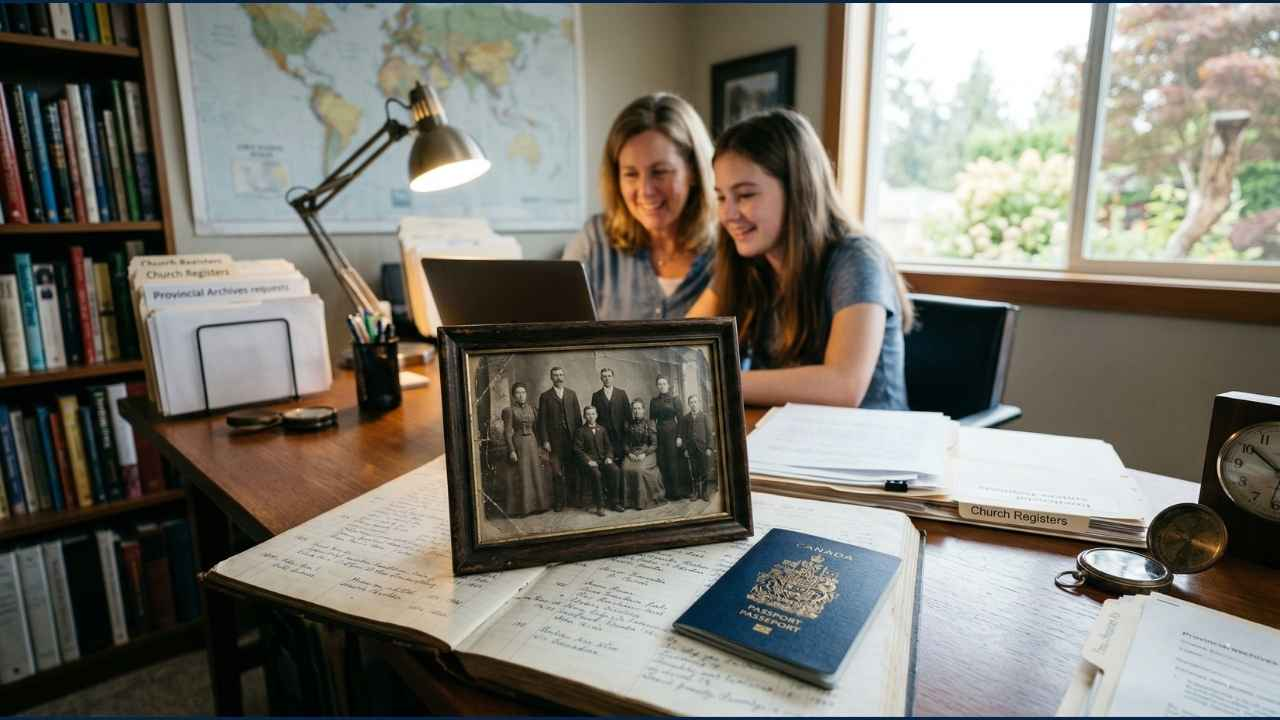
For multi-generational claims going back to the 19th century, this can involve historical records, church registries, and archival documents held by provincial governments in multiple languages.
Where to get Quebec vital records in 2026
Most Americans with Canadian ancestry trace their roots to Quebec and the Atlantic provinces. Quebec’s Direction de l’etat civil holds birth, marriage, and death records from 1994 onward. Older records are held by the Bibliothèque et Archives nationales du Québec (BAnQ) and Library and Archives Canada.
Following Bill C-3, Quebec’s archival institutions reported a 3,000% increase in requests for vital records within months of the law coming into force. Wait times have extended significantly. Order records early, and order certified copies. IRCC requires certified documentation, not photocopies.
Core documents required for a Bill C-3 application include:
- The applicant’s long-form birth certificate.
- Birth and marriage certificates for every generation linking the applicant to the Canadian ancestor.
- The Canadian ancestor’s birth certificate, naturalization certificate, or historical Canadian census record.
- Official translations for any documents not in English or French.
Read our detailed article for a complete list of documents
Processing times and what to realistically expect in 2026
Citizenship by descent is conferred automatically by law, but to exercise that citizenship, you need a proof of citizenship certificate from IRCC. That requires a formal application.
As of 3 September 2026, IRCC reports about 136,000 proof of citizenship applications waiting and a processing time of 33 months. Before Bill C-3 came into force, the average was roughly 9 months. The Parliamentary Budget Officer projected a base-case take-up of 115,000 individuals over five years, but application volumes from the American cohort are already outpacing that estimate.
Apply now rather than later. The backlog is not shrinking.
Why do Canadian citizenship by descent cases benefit from working with a regulated consultant
A regulated consultant does not just help you fill out the form.” to “As a Regulated Canadian Immigration Consultant (RCIC), I ensure that your documentary chain is complete and legally compliant before submission.
Citizenship by descent applications are more document-intensive than most immigration files. A gap in the lineage chain, a missing marriage certificate, a surname discrepancy across generations, or a document that was not properly certified can result in a rejection or a long delay.
A regulated consultant does not just help you fill out the form. An RCIC reviews your documentary chain before submission, identifies potential gaps or inconsistencies, and manages correspondence with IRCC. For multi-generational claims tracing back to 19th-century Quebec or provincial records in multiple languages, that review matters.
If you think you may qualify, the best first step is a conversation about your specific lineage before you start pulling records together. Start with a Canadian citizenship by descent application review.
Book a Strategy Consultation to get a clear picture of your eligibility, the documents you need, and what to realistically expect from IRCC.
Not sure you qualify?
Take our Canadian citizenship eligibility quiz in about two minutes, read the Canadian citizenship guide, then Book a Strategy Consultation with Amir Ismail, RCIC R412319, to confirm your path.
Frequently asked questions
Can I claim Canadian citizenship if my grandparent or great-grandparent was Canadian?
Yes, under Bill C-3’s retroactive provisions. If your grandparent or great-grandparent held Canadian citizenship and you were born before December 15, 2025, you can claim citizenship through that line of descent. There is no generational limit for the retroactive cohort, provided you can document the unbroken chain with certified records.
Do I need to live in Canada or give up my current citizenship to apply under Bill C-3?
No, to both. Canadian citizenship through descent does not require you to relocate. You keep whatever citizenship you currently hold. Canada permits dual and multiple nationality, and there is no residency requirement for the retroactive cohort.
How do I prove Canadian ancestry if my family records are incomplete or in French?
Start with what you have: birth certificates, family bibles, census records, or church records. Library and Archives Canada and Quebec’s BAnQ hold historical vital records, many in French. An RCIC can assess which records are required, which substitutes IRCC accepts, and how to handle documents in a language other than English.
Does claiming Canadian citizenship affect my US taxes or FATCA obligations?
Canadian citizenship alone does not trigger Canadian tax obligations. Canada taxes based on residency, not citizenship. An American living in the US pays Canadian taxes only if they spend enough time in Canada to be considered a Canadian tax resident. US citizens remain subject to US worldwide income reporting requirements regardless of any other citizenship they hold. For your specific situation, speak to a cross-border tax advisor.
What is the 1,095-day substantial connection test for Canadian citizenship?
Possibly. You fall into the prospective cohort, which means your Canadian-born parent must prove at least 1,095 cumulative days of physical presence in Canada at any point in their lifetime. If your parent lived, studied, or worked in Canada long enough to meet that threshold, your citizenship is conferred automatically at birth.
How much does a Canadian citizenship by descent application cost and how long does it take?
As of 2026, the Canadian government processing fee is $75 CAD. Processing time is 33 months as of 3 September 2026, with about 136,000 applications in the queue since Bill C-3 took effect.
About the author
Amir Ismail is a Regulated Canadian Immigration Consultant (RCIC #R412319) and founder of Amir Ismail & Associates. He advises skilled workers, families, and international students on Canadian immigration from offices serving clients in North America, Europe, and the Gulf region.
More Immigration and Citizenship Articles By Amir Ismail

Section 8 Lost Canadians: Bill C-3 Gives Back Citizenship Lost at Age 28
Section 8 Lost Canadians: Bill C-3 Gives Back Citizenship Lost at Age 28 If you…

Bill C-3 Reversal Risk: Could You Lose Citizenship by Descent?
Bill C-3 Reversal Risk: Could You Lose Citizenship by Descent? By Amir Ismail, RCIC #R412319…
Proof of Canadian Citizenship Processing Time 2026 (33‑Month Wait and 136,000‑File Queue Explained)
Proof of Canadian Citizenship Processing Time 2026 (33-Month Wait and 136,000-File Queue Explained) By Amir…
Canadian Citizenship by Descent: Eligibility Checklist for Americans (Bill C‑3)
Do I Qualify for Canadian Citizenship by Descent? The American’s Eligibility Checklist By Amir Ismail,…

Canadian Citizenship by Descent: Complete Document Guide (Bill C-3 2025)
Baptismal Records for Canadian Citizenship by Descent: 2026 Guide
Baptismal Records for Canadian Citizenship by Descent: A Complete Ordering Guide (2026) LAST UPDATED: AUGUST…
No post found!