
Proof of Canadian Citizenship Processing Time 2026 (33-Month Wait and 136,000-File Queue Explained)
By Amir Ismail, RCIC R412319 | Last Updated: 06 September 2026
IRCC’s proof of Canadian citizenship backlog has climbed to 136,000 applications, and the wait now sits at 33 months. If you qualify under Bill C‑3, moving now protects your place in a line that has grown every single month since the rule changed.
This guide covers who qualifies, what documents you need, how to apply, and what to do if your situation is urgent. For a deeper dive into documents, see my full Canadian citizenship by descent documents guide under Bill C‑3.
Key takeaways
- Proof of Canadian citizenship processing time has hit 33 months as of September 3, 2026, up sharply from 25 months just one month earlier.
- IRCC’s proof of citizenship queue has grown to 136,000 applications, up every single month since Bill C-3 took effect.
- The queue no longer explains the size of the increase. The queue grew about 12% this month, but the estimated wait grew 32%, the first time since Bill C-3 that the two numbers have diverged this sharply.
- The 1,095‑day substantial connection rule trips up more applicants than any other part of Bill C-3. Check it before you collect a single document.
- A complete, correct application on day one is the only part of the process you fully control once you file.
If the 33-month wait changes your plans, Book Your Strategy Assessment before you start gathering documents.
What is the proof of Canadian citizenship processing time in 2026?
As of September 3, 2026, the proof of Canadian citizenship processing time is 33 months based on IRCC’s official processing times for citizenship certificates. The queue stands at 136,000 applications, and this estimate can change again as new applications are added.
Quick Navigation
Current Proof of Canadian Citizenship Processing Time & What It Means
If you submit your proof of Canadian citizenship application now, IRCC is estimating 33 months before a decision. The queue has grown to 136,000 applications, a jump of roughly 14,200 people since August. IRCC’s current processing time for citizenship certificates is updated monthly and has moved in one direction every month since December 2025.
Why did the wait jump from 25 to 33 months in September?
This is the first monthly revision where the queue no longer explains the increase. In every prior jump, a bigger backlog tracked a bigger wait. This time the queue grew about 12%, but the quoted wait grew 32%, an eight-month jump in a single update, the largest single-month move since Bill C-3 took effect.
Here is the documented progression:
- December 2025: Bill C-3 takes effect and opens the door to a much larger wave of applications.
- Spring 2026: Processing times begin climbing as the queue expands.
- June 2026: IRCC pauses finalizing some Bill C-3 citizenship certificates to review roughly 6,500 already-issued certificates.
- June 30, 2026: IRCC completes that review and resumes normal finalization work.
- August 10, 2026: The backlog reaches 121,800 applications, and processing time hits 25 months, more than doubling the May figure in three months.
- September 3, 2026: The backlog reaches 136,000 applications, a queue increase of about 12%. Processing time jumps to 33 months, a 32% increase, meaning the wait grew nearly three times faster than the queue did.
Will waiting a few months lead to a shorter wait?
No. IRCC calculates its processing time estimate based on how many applications are already ahead of yours in the queue. More people file every week, and most of them get in line ahead of you, not behind you. Based on the trend since December 2025, someone who files today can reasonably expect a longer total wait than someone who filed in August.
The full processing time timeline since Bill C-3
Seeing the numbers month by month makes the trend impossible to miss. Here is every official update since the rule change that started it all.
| Month | Processing time | Applications in queue | What happened |
|---|---|---|---|
| December 2025 | 9 months | 40,400 | Bill C-3 takes effect Dec 15, removing the first-generation limit |
| January 2026 | 10 months | Not published | First full month under the new rules |
| May 12, 2026 | 12 months | 70,400 | Over 14,000 new applicants join in one month |
| June 2026 | 15 months | 82,000 | IRCC pauses finalizing some Bill C-3 certificates for review |
| July 7, 2026 | 19 months | ~99,500 | Review completes June 30; queue grows ~17,500 in one cycle |
| August 10, 2026 | 25 months | 121,800 | Wait more than doubles versus May in three months |
| September 3, 2026 | 33 months | 136,000 | Wait jumps 8 months in one revision; queue grows only ~12% — the largest gap between queue growth and wait growth since Bill C-3 |
What does this table tell you that the headline number doesn’t?
The wait has grown every single month without exception since Bill C-3 took effect. There is no month in this table where the queue shrank or the processing time held steady. Every jump before September could be explained by a proportionally similar jump in the queue. September breaks that pattern: the queue grew about 12%, but the wait grew 32%, the first sign that queue size alone no longer explains what applicants are being told to expect. If that trend continues, a filing today could face a longer wait than 33 months by the time IRCC gets to it.
Who should apply for proof of Canadian citizenship now?
You should apply now if you were born before December 15, 2025, and can trace an unbroken line of descent from a Canadian‑born ancestor, even if your family has not lived in Canada for several generations. The 33-month wait means timing matters more than it used to; a decision you delay by even a few months could push your certificate out well past three years.
You should also move quickly if you’ll need a Canadian passport for work, family, or study within the next two to three years. A citizenship certificate is the mandatory first step, and there is no way to rush the process later once you’re in the queue.
Who qualifies for proof of Canadian citizenship under Bill C-3?
Bill C-3 is an amendment to Canada’s Citizenship Act that took effect on December 15, 2025. It removed the first-generation limit on citizenship by descent for anyone born before that date. If you can trace an unbroken line of descent from a Canadian-born ancestor, you may already be a Canadian citizen.
According to Canada’s official Bill C-3 citizenship rule changes, there is no cap on how many generations back an ancestor can be, as long as the connection is documented and unbroken.
What changed when Bill C-3 came into effect?
Before Bill C-3, citizenship by descent ended after the first generation born outside Canada. Your Canadian parent could pass citizenship to you, but you could not pass it to your child if you were also born abroad. Bill C-3 removed that limit for anyone born before December 15, 2025. If you qualify, you are not applying to become a Canadian citizen. You are already one. You are applying for the certificate that proves it.
In June 2026, IRCC temporarily paused finalizing some Bill C-3 citizenship certificate files while it reviewed about 6,500 certificates that had already been issued, and that review was completed on June 30, 2026.
Does it matter how many generations back my Canadian ancestor is?
Not in principle. What matters is that you can document an unbroken line of Canadian citizenship from your ancestor down to you. The more generations involved, the more records you will likely need to gather.
I was born in the US. Can I still be a Canadian citizen?
Yes. Bill C-3 applies regardless of where you were born or have lived. Many Americans whose families have not been to Canada in four or more generations now qualify. Once you receive your certificate, you can apply for a Canadian passport, which currently ranks 7th in the world and offers visa-free or visa-on-arrival access to 183 countries (Henley Passport Index, via CIC News, July 2026).
What is the 1,095-day substantial connection rule, and does it apply to you?
Definition: The 1,095‑day substantial connection rule means that if a Canadian parent was born outside Canada, they must show at least 1,095 days (3 years) of physical presence in Canada before their child’s birth for that child to qualify under Bill C‑3.
This is the most commonly misunderstood part of Bill C-3. It is where many applications run into trouble before they even begin.
Who does the 1,095-day rule affect?
It affects you if:
- You were born outside Canada, and
- Your Canadian parent was also born outside Canada
If both conditions apply, your Canadian parent must show at least 1,095 cumulative days of physical presence in Canada before your birth date. If they cannot show that, you likely do not qualify under this provision. Check this before you spend time collecting documents.
What counts as physical presence in Canada for this rule?
Physical presence means time actually spent inside Canada. Days as a tourist, student, worker, or permanent resident all count. Time outside Canada does not count, even if you held Canadian status at the time. You will need documents to back this up: entry and exit records, tax filings, school records, employment records, or IRCC landing documents.
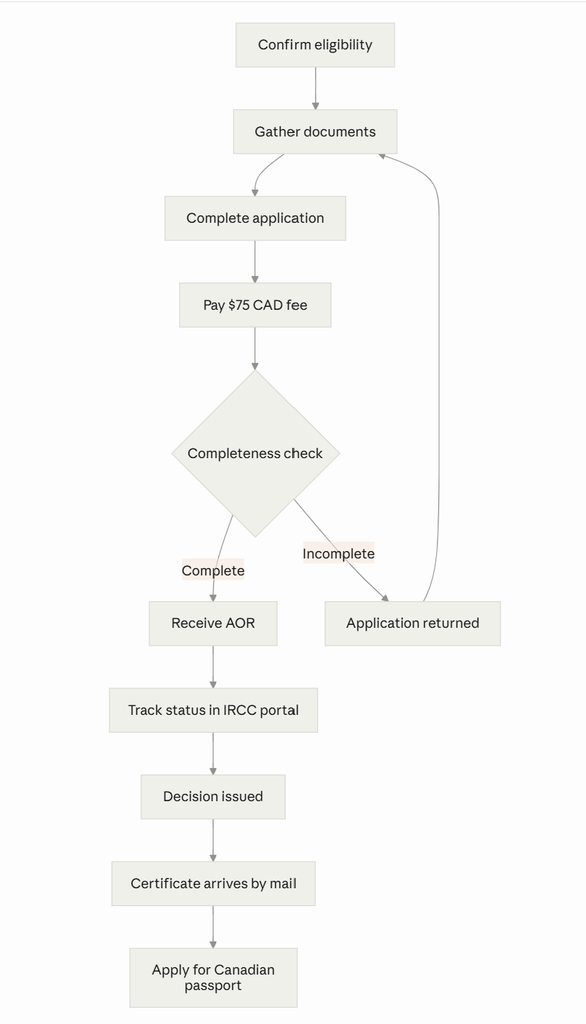
How to apply for proof of Canadian citizenship: step by step
Most applicants must apply online through IRCC’s secure portal. Paper applications using form CIT 0001 are available for those who cannot apply online. Either way, your processing clock starts the day IRCC receives your complete application.
Here is the process from start to finish:
- Confirm your eligibility. Review your family history against the Bill C-3 rules, or speak with an RCIC before you start gathering documents
- Gather your documents. Collect birth certificates, marriage records, and baptismal records for every generation between you and your Canadian ancestor
- Complete the application. Apply online through the IRCC portal, or download form CIT 0001 for paper applications
- Pay the fee. The adult citizenship certificate fee is $75 CAD as of 2026
- Submit and receive your AOR. IRCC sends an Acknowledgement of Receipt once your application passes the completeness check
- Track your status. Log into the IRCC portal using your AOR number to monitor where your application stands
- Receive your decision. If approved, your certificate arrives by mail. You can then apply for a Canadian passport
For guidance on working with a Canadian RCIC to prepare your citizenship application and avoid a completeness failure, Book Your Strategy Assessment before you submit.
Should I apply online or use the paper form CIT 0001?
Apply online when you can. Online applications process faster and reduce the risk of a completeness failure. Paper applications are available for those who cannot access online services or meet specific criteria outlined in the CIT 0001 guide on canada.ca. If you apply by paper, your clock starts when IRCC receives your mail, not when you post it.
What happens after IRCC receives my application?
IRCC runs a completeness check before your application enters the processing queue. If anything is missing, they return the entire application. This is not a rejection, but it removes you from the queue entirely. You must resubmit and rejoin the back of the line. With 136,000 already ahead of you as of September 3, 2026, a completeness failure is a costly setback.
How do I check the status of my citizenship certificate application?
Log into the IRCC online portal with your AOR number. Status updates are not always frequent, but the portal will confirm when your application moves to each stage of processing.
What documents do you need for a citizenship by descent application?
You need documents that prove an unbroken line of Canadian citizenship from your ancestor down to you, covering every generation in between. Each person in the chain needs proof of identity and proof of their connection to the next generation.
Here is what IRCC typically requires:
- Your documents: Valid government-issued photo ID and your birth certificate
- Your parent’s documents: Their birth certificate and evidence of Canadian citizenship or Canadian birth
- Linking documents: Marriage certificates or legal name change records for any generation where a name differs between consecutive documents
- Presence evidence (if the 1,095-day rule applies): Tax records, school records, employment records, lease agreements, or IRCC landing documents showing Canadian physical presence
What if I cannot find original birth, marriage, or baptismal records?
Contact the vital statistics office in the province or country where the event was registered. For older records, church registries, census records, and genealogical archives are accepted in many cases. IRCC allows secondary evidence when primary records are genuinely unavailable, but you must include a written explanation for the gap.
How do I prove my Canadian ancestor’s status?
Acceptable documents include a Canadian birth certificate, a Certificate of Canadian Citizenship, a Canadian passport, or official naturalization records. For ancestors from earlier generations, provincial birth registrations or baptismal records from a recognized institution are commonly accepted.
Can you get urgent processing for a citizenship certificate?
IRCC offers urgent processing for citizenship certificates in specific circumstances, but the threshold is high. Personal travel plans, general frustration with wait times, and wanting to use your passport sooner do not qualify. With the standard wait now at 33 months, more applicants than ever will be tempted to ask, and most requests will still be declined. Per IRCC’s official guidance on urgent citizenship certificate requests, the accepted criteria are narrow.
What qualifies as an urgent reason under IRCC’s rules?
IRCC accepts the following as valid urgent reasons:
- A confirmed job offer that requires Canadian citizenship, with a specific start date in the near term
- A family emergency abroad where a Canadian passport is the only viable travel document for the destination
- A documented medical situation requiring urgent international travel
“I want to travel soon” or “I have been waiting long enough” do not qualify. Neither does a trip you booked without accounting for your processing time.
How do I request urgent processing, and what should I include?
Submit your request through IRCC’s web form and include:
- A clear written explanation of why your situation meets the urgent criteria
- Supporting evidence: a job offer letter with a specific start date, medical documentation, or proof of a family emergency
- Your AOR number and full legal name
IRCC reviews urgent requests individually. Approval is not guaranteed. If approved, it means your file is prioritized within the queue, not that you receive an instant decision.
Proof of citizenship vs. grant of citizenship: which one do you need?
Proof of citizenship is for people who are already Canadian citizens and need a certificate to document that status. Grant of citizenship is the process by which permanent residents apply to become Canadian citizens. These are two separate applications with different rules, fees, and timelines.
If you qualify under Bill C-3, you need proof of citizenship. If you are a permanent resident, you need a grant of citizenship.
I am a permanent resident who wants to become Canadian. Is this the right application?
No. As a permanent resident, you apply for a grant of citizenship. You must meet a physical presence requirement: at least 1,095 days in Canada in the 5 years before you apply. If you are approaching that threshold or are unsure when to file, AIA can help you map out your citizenship timeline.
What are the processing times for a grant of citizenship in 2026?
As of September 3, 2026, the citizenship grant queue held 327,100 applications with a processing time of 12 months. This is a separate queue from the proof of citizenship queue, and it is holding steady against IRCC’s published 12-month service standard while the proof of citizenship wait keeps climbing. The gap between the two categories is now wider than ever: a queue roughly 2.4 times larger carries a wait roughly a third as long. If you are a permanent resident approaching your 3-year physical presence mark, build at least 12 months of processing time into your planning.
Frequently asked questions about proof of Canadian citizenship in 2026
How long does it take to process proof of Canadian citizenship?
As of September 3, 2026, IRCC’s proof of Canadian citizenship processing time is 33 months for citizenship certificates. This means most applicants filing today should plan for a wait of nearly three years from the day IRCC receives a complete application.
How do I know if I qualify as a Canadian citizen by descent?
You may qualify if you were born before December 15, 2025, and can trace an unbroken line of descent from a Canadian-born ancestor, no matter how many generations back. You do not need to have ever visited Canada. Start with the Canada.ca eligibility checker, then gather family documents to confirm your lineage. If you are unsure, an RCIC can review your family history before you commit to collecting records.
What happens if my citizenship certificate application is incomplete?
IRCC will return your full application, removing you from the queue entirely. You must resubmit and rejoin the back of the line. With 136,000 applications already waiting as of September 3, 2026, a completeness failure is a serious setback. A professional review before you submit is the best way to avoid it.
Can I get a Canadian passport while waiting for my citizenship certificate?
No. You cannot apply for a Canadian passport until you have your citizenship certificate in hand. There is no provisional passport for applicants in the queue. If you have an urgent and documented travel need, the only path is to request urgent processing of the certificate itself, as outlined in the section above.
Is proof of citizenship the same as a citizenship grant?
No, they are two different applications with two different queues. Proof of citizenship confirms status you already hold. A citizenship grant is how permanent residents become citizens. As of September 3, 2026, the grant queue sits at 327,100 applications with a 12-month wait, while the proof of citizenship queue sits at 136,000 with a 33-month wait.
Can you speed up the Canadian citizenship process?
You can speed up the Canadian citizenship process by applying for urgent processing through Immigration, Refugees and Citizenship Canada (IRCC) if you meet specific exceptional criteria. IRCC only grants expedited review for time-sensitive, exceptional circumstances. Valid reasons include: Needing Canadian citizenship to secure a new job or prevent losing a current one. Urgent travel due to a family death or serious illness, combined with an inability to get a passport from your current nationality. Acting on a favorable Federal Court ruling regarding a past application. Needing a citizenship certificate to access essential social benefits like health care or a pension.
For personalized guidance on your citizenship by descent application or permanent residence to citizenship path, contact Amir Ismail and Book Your Strategy Assessment today.
Amir Ismail is a Regulated Canadian Immigration Consultant (RCIC R412319) and founder of Amir Ismail & Associates. He advises skilled workers, families, and internationally trained professionals on Canadian immigration pathways. All processing times and policy analyses in this guide are based on current IRCC data as of September 3, 2026.
Sources: Canada.ca Bill C-3 rule changes (December 2025); IRCC processing times, via CIC News (September 3, 2026); IRCC urgent processing guidance.
Read More Citizenship By Descent Resources By Amir Ismail
Canadian Citizenship by Descent: Eligibility Checklist for Americans (Bill C‑3)
Do I Qualify for Canadian Citizenship by Descent? The American’s Eligibility Checklist By Amir Ismail,…

Canadian Citizenship by Descent: Complete Document Guide (Bill C-3 2025)

Baptismal Records for Canadian Citizenship by Descent: 2026 Guide
Baptismal Records for Canadian Citizenship by Descent: A Complete Ordering Guide (2026) LAST UPDATED: AUGUST…
Six Wrong Reasons People Rule Themselves Out of Canadian Citizenship by Descent
Six Wrong Reasons People Rule Themselves Out of Canadian Citizenship by Descent By Amir Ismail,…

Married to a Brand-New Canadian Citizen? What Descent Does (and Does Not) Do for You
Married to a Brand-New Canadian Citizen? What Canadian Citizenship By Descent Does (and Does Not)…
Canadian Vital Records for Citizenship by Descent: How to Find the Right Office in Every Province
Mandatory Vital Records for Canadian Citizenship by Descent (Canada‑Wide: Every Province, Every Office) By Amir…