
Not sure you qualify? Take our Canadian citizenship eligibility quiz first.
Need the official document? See our citizenship certificate guide.
Worried the law could be undone? Read our guide to Bill C-3 reversal risk.
Executive Summary (TL;DR):
- The Issue: In June 2026, IRCC began emailing Bill C‑3 citizenship certificate surrender notices to some new proof‑of‑citizenship holders, asking them to send back their Canadian citizenship certificates.
- The Reason: IRCC is doing an administrative review under Subsection 26(1) of the Citizenship Regulations, saying some files relied on genealogy websites instead of primary civil records.
- The Impact: This is a suspension and review, not an automatic loss of citizenship through the Federal Court. Bill C‑3’s removal of the first‑generation limit is still law.
- Your Next Steps: Do not ignore the IRCC letter. Collect your original documents, keep copies of all emails, and get legal advice before responding, especially about the doctrine of legitimate expectation and Somers‑Edgar.
Update, October 2026: This review did not reverse Bill C-3, and IRCC says about 1% of applicants were affected. CIC News reported that IRCC flagged about 100 certificates out of roughly 6,500 files reviewed, reinstated some without new evidence, and set finalizing to resume in July. The proof of citizenship wait is now 33 months (IRCC, 3 September 2026), so build your file to the original-source standard before you apply.
If you received a Bill C‑3 proof of Canadian citizenship certificate this year and then got an IRCC citizenship certificate surrender notice email asking you to return it, you are not imagining things, and you are not alone. Starting the weekend of June 13 to 14, 2026, the Registrar of Canadian Citizenship sent surrender notices to a group of recently approved applicants. This guide explains what is happening, why it is happening, and what your realistic options are right now.
I want to be direct about something. This is a fast-moving, contested situation. Some facts below are confirmed government actions. Others are legal arguments being made by affected applicants and their lawyers that have not yet been tested in court on this specific issue. I will tell you which is which as we go.
What you will find on this page
What Is the IRCC Citizenship Certificate Surrender Notice?
An IRCC citizenship certificate surrender notice is an official administrative letter requesting a recently approved citizen to return their certificate pending a departmental review. Sent primarily to Bill C-3 applicants starting in June 2026, these letters are issued under Subsection 26(1) of the Citizenship Regulations for an “individualized” administrative review, rather than a formal, court-ordered revocation.. The letters were signed by the Registrar of Canadian Citizenship and went out the weekend of June 13 to 14, 2026. IRCC describes the action as an “individualized” administrative review, not a court-ordered revocation.
The letters state that the recipient “may not be entitled to hold a Canadian certificate of citizenship.” They do not list specific missing documents. Recipients are told evidence may have come from genealogy compilations rather than from what IRCC calls “original source authorities,” such as a civil registry or provincial archive.
What is Bill C‑3 and why does it matter for citizenship by descent?
Bill C-3 is the law that removed Canada’s first-generation limit on citizenship by descent. It received Royal Assent on November 20, 2025, and came into force on December 15, 2025. Before this law, a Canadian citizen born abroad generally could not pass citizenship to a child also born abroad. That rule, known as the first-generation limit, was struck down as unconstitutional in Bjorkquist et al. v. Attorney General of Canada (2023 ONSC 7152) on December 19, 2023.
For anyone born or adopted abroad before December 15, 2025, Bill C-3 works automatically and retroactively. There is no deadline to apply, and no requirement to show a personal connection to Canada today. You only need to trace an unbroken line back to a Canadian “anchor” ancestor, someone who got their citizenship by birth in Canada or through naturalization.
For children born or adopted abroad on or after December 15, 2025, a different and stricter rule applies. The Canadian parent must show 1,095 days (three years) of cumulative physical presence in Canada before the child’s birth or adoption. This is called the Substantial Connection Test, and it is separate from the surrender crisis affecting older, retroactive claims.
Why Is IRCC Suspending Already-Approved Certificates?
IRCC states that some Canadian citizenship certificates may have been ‘issued in error’ because the supporting evidence relied on genealogy databases instead of primary civil records. Consequently, applicants are receiving an IRCC citizenship revocation letter or suspension notice, prompting fear and confusion. Minister Lena Diab told the House of Commons on June 16, 2026, that “having a Canadian ancestor does not mean you’re automatically eligible” and that applicants “must definitively prove your link to Canada at each and every generation.”
The legal mechanism behind this is Subsection 26(1) of the Citizenship Regulations. It lets the Registrar direct someone to surrender a certificate if there is “reason to believe” the person may not be entitled to it. This is a lower bar than formal revocation, which requires a hearing before the Federal Court and proof of fraud or false representation. By using Subsection 26(1) instead, IRCC is keeping the dispute inside its own department rather than in front of a judge.
Bill C‑3 citizenship review vs. formal revocation
| Process type | Who uses it | Legal basis | What IRCC asks for | Court hearing? |
|---|---|---|---|---|
| Bill C‑3 citizenship certificate surrender review | Registrar of Canadian Citizenship | Subsection 26(1) of the Citizenship Regulations | Return of certificate and possibly more documents | No Federal Court hearing at this stage |
| Formal citizenship revocation | Minister and Federal Court | Citizenship Act revocation provisions | Evidence of fraud, misrepresentation, or concealment | Yes, decided by the Federal Court |
Is It True That Genealogy Records Like Census Data Are Not Valid Evidence?
No, not according to IRCC’s own published guidance. The official proof of citizenship checklist, Form CIT 0014, explicitly allows alternative evidence under Scenario 3 when a primary birth record cannot be obtained. This can include a written account plus “any other evidence” of the ancestor’s citizenship, including census records, parish registers, and military service files.
In a House of Commons response tabled on May 26, 2026, IRCC itself stated that where no formal birth certificate exists, “alternative evidence reflecting the parental relationship should be submitted and assessed on a balance of probabilities.” That is the department’s own written position, and it directly conflicts with letters now calling identical evidence insufficient after the fact.
It also matters that for ancestors born in places like early Quebec, civil registration was often handled by churches, not the state. A government-issued birth certificate for a great-great-grandparent born in 1885 frequently does not exist anywhere, in any archive. Requiring one is, for many applicants, requiring a document that was never created in the first place.
What Has Happened to People Who Received the Letters?
The human impact has been significant for the people affected. Shawn Davis Mooney, a US military veteran now living in Victoria, British Columbia, received his certificate in spring 2026 after submitting a 114-page evidentiary package. He had already switched his identification, gotten a Canadian Social Insurance Number, and begun sponsoring his husband for permanent residency when the surrender letter arrived by email on a Saturday.
Rana Charron, who traced her lineage to a great-great-grandmother from Quebec using census data and US immigration records, had already started a passport application when her letter arrived. Both described the lack of specific instructions in the letters as confusing and said IRCC gave them no clear path to respond.
One especially strange pattern has emerged. According to immigration lawyer Sara Pesko, who represents about 50 clients with similar claims, some parents received surrender letters while their children, who applied using the exact same family evidence, did not. Nobody has offered a clear explanation for this inconsistency yet.
The common theme is shock, confusion, and a lack of clear instructions in the IRCC letters.
Do Affected Applicants Have a Legal Argument Against the Surrender Notices?
Many affected applicants and their lawyers are relying on the doctrine of legitimate expectation, arguing that IRCC cannot invite alternative evidence on its own forms and then treat that same evidence as a reason to question already‑approved citizenship certificates.
For a deeper dive into how these legal arguments play out in real citizenship‑by‑descent files, see my Bill C‑3 citizenship-by-descent guide for Americans and Europeans, where I break down legitimate expectation in everyday language.
Somers-Edgar v. Canada (2026 FC 417): Applied this doctrine specifically to citizenship by descent, noting that IRCC carries the burden of clearly stating what evidence it requires upfront.
Thompson v. Canada (2021 FC 914): Affirmed the doctrine of legitimate expectation, meaning applicants are entitled to rely on the government’s published instructions.
In Somers-Edgar, the Federal Court found that IRCC carries the burden of clearly stating what evidence it requires, and that the department “would have imposed no burden” by simply saying so in advance. Because Form CIT 0014 already permits “any other evidence,” applicants and their lawyers argue IRCC cannot now penalize people for following that exact instruction.
I want to be careful here. This is the argument affected applicants are making, supported by a real precedent. It is not a guaranteed outcome, and no court has yet ruled on whether it applies to these specific June 2026 surrender notices.
What Should You Do If You Receive a Surrender Notice?
- Do not ignore the letter or the deadline it states. Missing a response window can weaken your position even if your underlying evidence is solid.
- Gather a copy of everything you originally submitted, including any correspondence where IRCC requested clarification, and you provided it.
- Do not assume your certificate was wrongly issued. The letter does not list specific deficiencies, and IRCC’s own Form CIT 0014 already permits the kind of evidence many applicants used.
- Get legal advice before responding. A response drafted without understanding Somers-Edgar and the legitimate expectation doctrine may miss your strongest argument.
- Keep your other applications and plans on hold where appropriate. Sponsorship applications and other status changes tied to your citizenship may need to wait until the review concludes.
What Should Prospective Applicants Do Now?
If you have not yet applied under Bill C-3, this situation does not mean you should not apply. It means you should apply carefully. Build the strongest possible evidentiary file from the start, including any primary records that do exist, and document clearly why any unavailable records cannot be obtained, exactly as Form CIT 0014 already permits.
Keep copies of absolutely everything you submit and every piece of correspondence with IRCC. If your file is later questioned, your own paper trail becomes your best protection.
If you’re in the United States or Europe and are looking at Canadian citizenship by descent under Bill C‑3, the rules are the same – but the way you build your evidence file can make or break your case.
For a full list of recommended documents, see my Canadian citizenship by descent document guide for Bill C‑3 applicants.
If you are unsure whether you qualify, start with my eligibility checklist for Americans and Europeans considering Canadian citizenship by descent.
Not sure you qualify?
Take our Canadian citizenship eligibility quiz in about two minutes, read the Canadian citizenship guide, then Book a Strategy Consultation with Amir Ismail, RCIC R412319, to confirm your path.
Frequently Asked Questions
Did IRCC revoke these citizenships through the courts?
No. IRCC is using Subsection 26(1) of the Citizenship Regulations, an internal administrative process that asks people to surrender their citizenship certificates while the file is reviewed, instead of a formal Federal Court revocation.
How many people received surrender letters?
IRCC has called the number “limited” and has stated that only about 1% of affected Bill C‑3 applicants were asked to surrender their certificates. While exact totals are still not published, this confirms that the surrender notices are hitting a small slice of files, not the entire citizenship‑by‑descent backlog.
Does this affect new applications under Bill C-3?
IRCC paused some processing of new Bill C‑3 citizenship‑by‑descent certificates while the initial surrender reviews were underway, but has since clarified that only about 1% of reviewed applicants were impacted. New applications remain possible; you just need to follow IRCC’s current checklist closely and be ready to prove every generation with the strongest available evidence.
Is the first-generation limit still removed?
Yes. Bill C‑3 permanently removed Canada’s old first‑generation limit on citizenship by descent, and that change remains in force. The current crisis is about how IRCC is reviewing certain approved files, not about reversing Bill C‑3.
Does this affect the Substantial Connection Test?
Not directly. The surrender notices are focused on retroactive citizenship‑by‑descent claims for people born before December 15, 2025, while the Substantial Connection Test applies to children born or adopted abroad on or after that date.
Has IRCC returned any certificates after a surrender notice?
Yes. In some reviewed files, IRCC has already begun returning previously surrendered or requested certificates once officers complete their internal check and are satisfied with the evidence. That means a surrender notice is the start of a review, not an automatic, permanent loss of Canadian citizenship status.
Get Help With Your Citizenship by Descent File
Whether you have already received a Bill C‑3 citizenship certificate surrender notice or you are preparing your first citizenship‑by‑descent proof of Canadian citizenship application, the stakes are too high to guess. Book a Strategy Consultation with Amir Ismail & Associates and get a clear, honest read on where your file stands before you respond to IRCC.
This article is for general information and reflects publicly reported facts and legal arguments as of June 2026. It is not legal advice for any individual case. Citizenship by descent files involving surrender notices should be reviewed individually with a qualified representative.
You do not have to walk through this alone. Get informed. Get support. Then move forward with confidence.
Amir Ismail is a Regulated Canadian Immigration Consultant (RCIC #R412319) with over 34 years of experience in Canadian immigration and citizenship law. He leads Amir Ismail & Associates, with offices in Toronto, Dubai, and Karachi, and has assisted more than 25,000 clients with Canadian citizenship, residency, and citizenship‑by‑descent cases.
Source: IRCC, Bill C-3: An Act to amend the Citizenship Act (2025) comes into effect
Read More Citizenship By Descent Resources By Amir Ismail

Bill C-3 Reversal Risk: Could You Lose Citizenship by Descent?
Bill C-3 Reversal Risk: Could You Lose Citizenship by Descent? By Amir Ismail, RCIC #R412319…
Proof of Canadian Citizenship Processing Time 2026 (33‑Month Wait and 136,000‑File Queue Explained)
Proof of Canadian Citizenship Processing Time 2026 (33-Month Wait and 136,000-File Queue Explained) By Amir…
Canadian Citizenship by Descent: Eligibility Checklist for Americans (Bill C‑3)
Do I Qualify for Canadian Citizenship by Descent? The American’s Eligibility Checklist By Amir Ismail,…
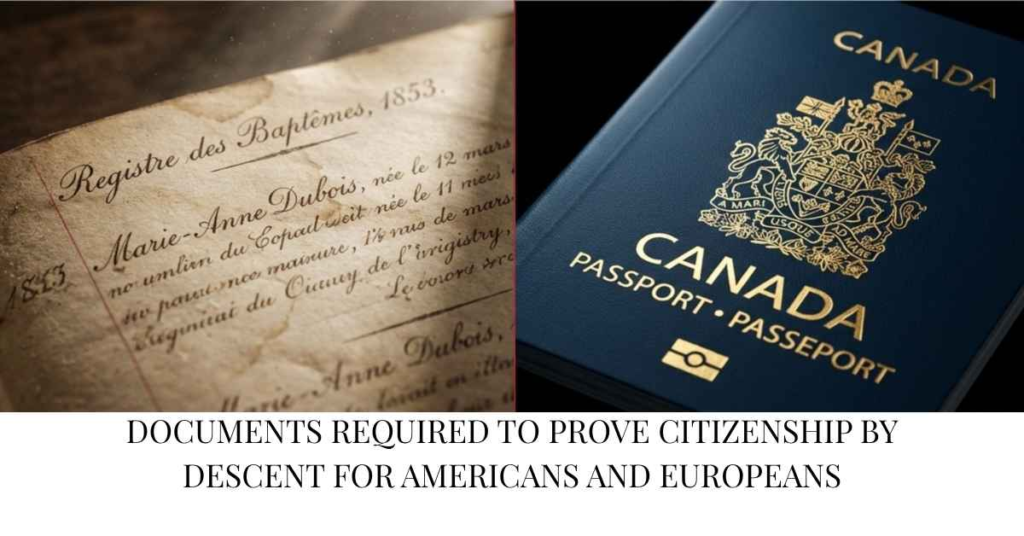
Canadian Citizenship by Descent: Complete Document Guide (Bill C-3 2025)
Baptismal Records for Canadian Citizenship by Descent: 2026 Guide
Baptismal Records for Canadian Citizenship by Descent: A Complete Ordering Guide (2026) LAST UPDATED: AUGUST…
Six Wrong Reasons People Rule Themselves Out of Canadian Citizenship by Descent
Six Wrong Reasons People Rule Themselves Out of Canadian Citizenship by Descent By Amir Ismail,…

Married to a Brand-New Canadian Citizen? What Descent Does (and Does Not) Do for You
Married to a Brand-New Canadian Citizen? What Canadian Citizenship By Descent Does (and Does Not)…