
Ontario eliminated all eight existing OINP streams on June 26, 2026, and replaced them with one new stream: the Ontario Workforce Priority (OWP) stream. The change came through amendments to Ontario Regulation 422/17 under the Ontario Immigration Act, 2015. The new stream has three pathways instead of eight separate programs.
This changes who qualifies, what employers must prove, and what happens to your pending application. If you had an OINP plan before today, that plan probably needs an update.
Ontario Workforce Priority Stream: Key Changes Effective June 26, 2026
- Ontario shut down all eight legacy OINP streams on June 26, 2026, and replaced them with a single new stream built around three pathways.
- The Master’s Graduate and PhD Graduate streams are permanently closed. International graduates now need a job offer like everyone else.
- Sponsoring employers need $1,000,000 in gross annual revenue in the GTA, or $500,000 outside it, plus a minimum employee headcount.
- If you already applied before June 26, your file is grandfathered under the old rules. If your EOI profile never got an invitation, it’s being withdrawn automatically.
- The real reason behind all of this: a federal rule change, SOR/2026-63, made Ontario solely responsible for every nominee’s outcome, with no federal backstop left.
Let’s walk through exactly what changed and what you should do about it.
Quick Navigation
What Is the Ontario Workforce Priority Stream?
The Ontario Workforce Priority (OWP) stream is Ontario’s single provincial nomination program as of June 26, 2026. It consolidates eight former OINP streams into three pathways, TEER 0–3 (skilled workers), TEER 4–5 (essential workers), and Self-Employed Physicians, each requiring a full-time, permanent Ontario job offer except the physician pathway.
This is the biggest structural change to the OINP in its history. For years, Ontario ran the Foreign Worker, International Student, In-Demand Skills, Master’s Graduate, PhD Graduate, Human Capital Priorities, French-Speaking Skilled Worker, and Skilled Trades streams side by side. As of today, none of those streams exist anymore.
What happened to the OINP on June 26, 2026?
Ontario closed its Expression of Interest (EOI) system, shut down all eight legacy streams, and launched the OWP stream in their place. The OWP stream is built around three distinct pathways, one for higher-skilled workers, one for essential workers, and one for self-employed physicians. The EOI system itself is temporarily closed and is not accepting any new registrations right now.
This isn’t a soft transition. Ontario didn’t phase the old streams out gradually. It cut them off and replaced them in a single regulatory action, which is part of why so many people are scrambling for answers today.
Why did Ontario replace eight streams with one?
Ontario consolidated its streams because the province now carries full legal accountability for every nominee it approves. A federal regulatory change, SOR/2026-63, removed the backstop that federal officers used to provide when reviewing provincial nominations. We’ll dig into exactly how that connects later in this article, because it’s the real reason behind almost every new rule you’re about to read.
For years, Ontario could afford to run broad, generalist streams because federal officers still had a final say. That safety net is gone now. Every nomination Ontario issues is final the moment it’s approved, so the province tightened its own front door instead.
The Three Pathways Under the Ontario Workforce Priority Stream
The OWP stream sorts every applicant into one of three pathways based on their occupation and job offer status. Two pathways require a full-time, permanent Ontario job offer. The third, for self-employed physicians, does not.
Here’s how the three pathways compare at a glance.
Table: Ontario Workforce Priority (OWP) Stream — Comparison of Three Pathways (June 2026)
| Feature | TEER 0-3 Pathway | TEER 4-5 Pathway | Self-Employed Physicians |
|---|---|---|---|
| Occupational Target | Management, professional, technical, trades | Intermediate and essential services | CPSO-registered physicians |
| Job Offer Required | Yes, full-time and permanent | Yes, full-time and permanent | No |
| Minimum Language | CLB 6 (CLB 5 for select trades) | CLB 4 | Set by CPSO licensure |
| Minimum Education | Post-secondary degree or diploma | Secondary school diploma | Medical degree compliant with CPSO |
| Work Experience | 6 months current job, OR 3 months for recent grads, OR 2 years global | 9 months cumulative in current job over the past 2 years | None beyond OHIP billing eligibility |
| Wage Floor | Regional median wage | Regional median wage | Self-employed / fee-for-service |
Who qualifies for the TEER 0-3 pathway?
The TEER 0-3 pathway is for workers with a full-time, permanent job offer in management, professional, technical, or skilled trades roles. You need CLB 6 in all four language skills, with CLB 5 permitted for certain trades occupations. You also need a post-secondary credential, verified through an Educational Credential Assessment if it was earned abroad.
Work experience here is flexible. You can qualify three different ways, and each one fits a different kind of candidate.
If you’re currently working in the exact job and with the exact employer named in your application, you need six consecutive months of that experience in the past 12 months. Recent Ontario graduates get a discount on this: just three months, as long as your credential was completed within the last three years.
If you’re applying from outside Canada, you can instead show two years of cumulative experience in the same occupation over the past five years. This route lets Ontario employers recruit specialized talent internationally. And if you already hold a valid license to practice in a regulated Ontario profession, you’re exempt from the work experience requirement entirely.
There’s also an Alternate NOC allowance worth knowing about. Experience in a related, higher-level occupation can validate a job offer in a lower one. For example, prior experience as a Registered Nurse can support a job offer as a Nurse Aide, and experience as a Pharmacist can support a job offer as a Pharmacy Assistant.
Who qualifies for the TEER 4-5 pathway?
The TEER 4-5 pathway covers essential and intermediate roles like healthcare support, transport, food service, agriculture, and manufacturing. You need CLB 4 and a Canadian secondary school diploma or its equivalent. The wage floor still applies here too. Employers must pay at least the regional median wage for the occupation.
This pathway works differently from TEER 0-3 in one important way: there’s no global experience route. You need nine months of cumulative work experience in the exact job, with the exact employer, within the past two years. That means you’ve likely already been working in Ontario, probably on a temporary work permit, before you can apply here.
Can self-employed physicians apply without a job offer?
Yes. Self-employed physicians are the only OWP applicants who don’t need a job offer, an employer, or a sponsoring business at all. You must be in good standing with the College of Physicians and Surgeons of Ontario (CPSO).
You also need a valid certificate of registration in an independent, academic, or provisional class, and you must be eligible to bill through the Ontario Health Insurance Plan (OHIP).
Ontario built this carve-out specifically to address the province’s primary care physician shortage. By tying eligibility directly to CPSO registration and OHIP billing rights, Ontario lets its own medical regulator do the vetting instead of building a separate immigration assessment from scratch.
Employer Requirements Under the New OINP Rules
Sponsoring employers need $1,000,000 in gross annual revenue if the job is located in the Greater Toronto Area, or $500,000 if it’s outside the GTA. They also need a minimum number of full-time Canadian or permanent resident employees at the work location. These thresholds are confirmed directly on Ontario’s official OINP page as of today.
The redesign puts most of the compliance burden on the employer, not the candidate. That’s deliberate. Ontario wants to verify a business is real and financially stable before it lets that business sponsor anyone.
What are the OWP employer revenue thresholds in Ontario?
A sponsoring business needs $1,000,000 in gross annual revenue from its most recent fiscal year if the applicant will work in the Greater Toronto Area. Outside the GTA, that threshold drops to $500,000.
Ontario has also confirmed that employers in rural communities, defined as a census division with a population under 150,000, will get a lower revenue threshold than the standard $500,000 figure. As of today, Ontario has not published the exact rural dollar amount. Confirm the current number directly with the OINP before relying on a specific figure you may see elsewhere.
How many employees must a sponsoring business have?
Employers in the Greater Toronto Area need at least 5 full-time employees who are Canadian citizens or permanent residents working at the same location. Outside the GTA, that minimum drops to 3 full-time employees. A full-time employee is defined as someone working at least 30 hours per week.
Employers also need at least three years of active business operations in Ontario, and they can’t have outstanding violations under the Employment Standards Act or the Occupational Health and Safety Act. Any of those violations disqualifies the business from sponsoring a candidate outright.
What Happened to the Master’s and PhD Graduate Streams?
The Master’s Graduate and PhD Graduate streams closed permanently on May 30, 2026, and they are not coming back. International graduates who previously qualified for permanent residence based on their degree alone must now compete under the TEER 0-3 pathway like any other skilled worker. A job offer is now mandatory, where it never used to be.
This is, candidly, the most painful part of this whole redesign for a specific group of people. For years, these streams let international graduates secure a provincial nomination based purely on their Ontario degree, with no job offer and no prior work experience required. That’s gone.
Are the OINP Master’s Graduate and PhD Graduate streams permanently closed?
Yes. The final Master’s Graduate draw happened on April 22, 2026, issuing 674 invitations at a cutoff of 61 points. The same day, Ontario issued 244 invitations under the PhD Graduate stream at a cutoff of 56 points. Both cutoffs were sharply higher than prior draws, a clear sign of a last-minute rush before the streams closed. Source: Ontario Immigrant Nominee Program — Draw History, accessed June 2026.
Immigration advisers have noted that the closure creates zero predictability for recent graduates who enrolled in Canadian master’s or PhD programs specifically to access the graduate immigration pathway.
Ontario did soften the landing slightly. Recent graduates applying under TEER 0-3 only need three months of work experience instead of six, and they’re allowed to meet a lower wage threshold instead of the full regional median. But the core requirement, a real job offer from a financially qualified employer, is now non-negotiable.
Is Your Pending OINP Application Still Valid?
If you already submitted an application before June 26, 2026, it will be assessed under the rules that were in place when you submitted it, not the new OWP rules. This is a grandfathering protection that Ontario has confirmed explicitly. Your file does not get re-scored under the new criteria.
This is probably the single most urgent question for anyone currently mid-process, so let’s be precise about it.
What happens to EOI profiles that didn’t get an invitation?
If you had an Expression of Interest profile that never received an Invitation to Apply, that profile will be automatically withdrawn over the coming weeks. You don’t need to take any action to make this happen. It happens on Ontario’s end.
Once the new EOI system reopens, you’ll need to register a completely new profile under the OWP stream and meet the new eligibility criteria. The old profile and its score don’t carry over.
Employers in the same position need to act too. If you’re already registered in the OINP Employer Portal, you don’t need to re-register the business itself. You will, however, need to submit a brand-new job offer and a new application for approval of an employment position once the portal reopens. Source: Ontario Immigrant Nominee Program — Draw History, accessed June 2026.
When Does the OINP EOI System Reopen?
As of June 26, 2026, Ontario has not announced a specific reopening date for the OINP EOI system. The province’s official position is that the new system is expected to open ‘later in the summer of 2026.
Ontario has not set a firm reopening date. The province states only that the new EOI system is anticipated to open “later in the summer” of 2026. Treat any specific month you see floating around online as an estimate, not a confirmed date, until Ontario says otherwise on its official program page.
In the meantime, here’s a simple flowchart to help you figure out where you stand right now.
Ontario Workforce Priority Stream: Where Do You Stand?
Flowchart illustrating the 2026 Ontario Workforce Priority (OWP) Stream transition process, detailing steps for pending OINP applications, withdrawn EOIs, and the TEER 0-3, TEER 4-5, and Physician pathways.
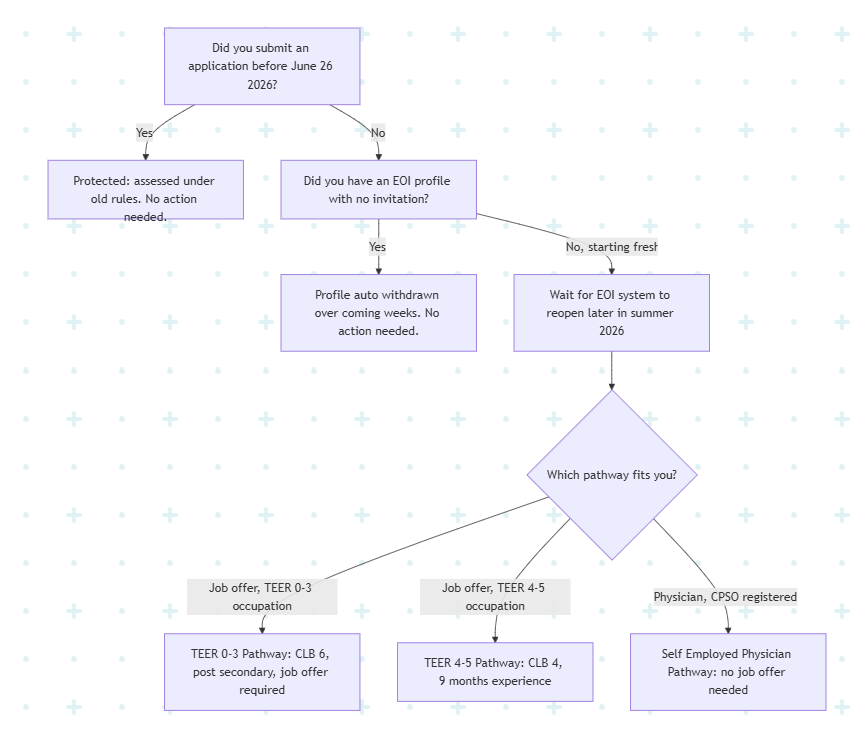
Figure: How to determine which Ontario Workforce Priority (OWP) pathway applies to you as of June 26, 2026.
Why Ontario Had to Tighten the Rules: The SOR/2026-63 Connection
On March 30, 2026, the federal government stripped IRCC officers of the power to override a provincial nomination on two specific grounds. SOR/2026-63 amended Section 87(3) of the Immigration and Refugee Protection Regulations, giving provinces “sole responsibility” to judge a candidate’s intent to reside and ability to economically establish.
That single regulatory change explains almost everything about why Ontario got stricter.
Before this amendment, an IRCC officer could independently decide that a provincial nominee didn’t really intend to live in the nominating province, or wasn’t likely to economically establish there, and refuse the application on that basis alone. The province could nominate someone, and a federal officer could still say no. That backstop is gone now.
Federal officers are now limited to confirming identity and running standard security, criminality, and medical admissibility checks. If new adverse information comes up, they can’t refuse the file outright anymore. They have to refer it back to the province, which then gets a window to decide whether to maintain or revoke its own nomination.
This is exactly why Ontario built such a strict employer-vetting system. The province now owns 100% of the legal risk for every nominee it approves, with no federal officer left to catch a problem after the fact.
The corporate revenue thresholds, the employee headcounts, and the employer portal verification aren’t bureaucratic overreach. They’re Ontario protecting itself from a liability it didn’t carry six months ago.
What Should You Do Right Now?
You don’t need to panic, but you do need a plan. Here’s what matters most depending on where you stand today.
- If your application is already submitted: Confirm it’s complete and sit tight. It’s protected under the old rules.
- If you have an unconverted EOI profile: No action needed. It will be withdrawn automatically, and you’ll register fresh once the new system opens.
- If you’re a recent graduate who lost the Master’s or PhD pathway: Start building toward a TEER 0-3 job offer now. The three-month work experience discount helps, but you still need an employer.
- If you’re an employer: Check your business against the new revenue and headcount thresholds before you commit to sponsoring anyone.
- If you’re not sure which pathway fits: Get a professional read on your file before the EOI system reopens, so you’re not scrambling when it does.
This redesign rewards people who prepare early. The candidates who line up a qualifying job offer and a financially solid employer before the EOI system reopens will be first in line the moment it does.
For personalized guidance on how the Ontario Workforce Priority stream affects your specific situation, Book Your Strategy Assessment at amirismail.com/book-a-consultation.