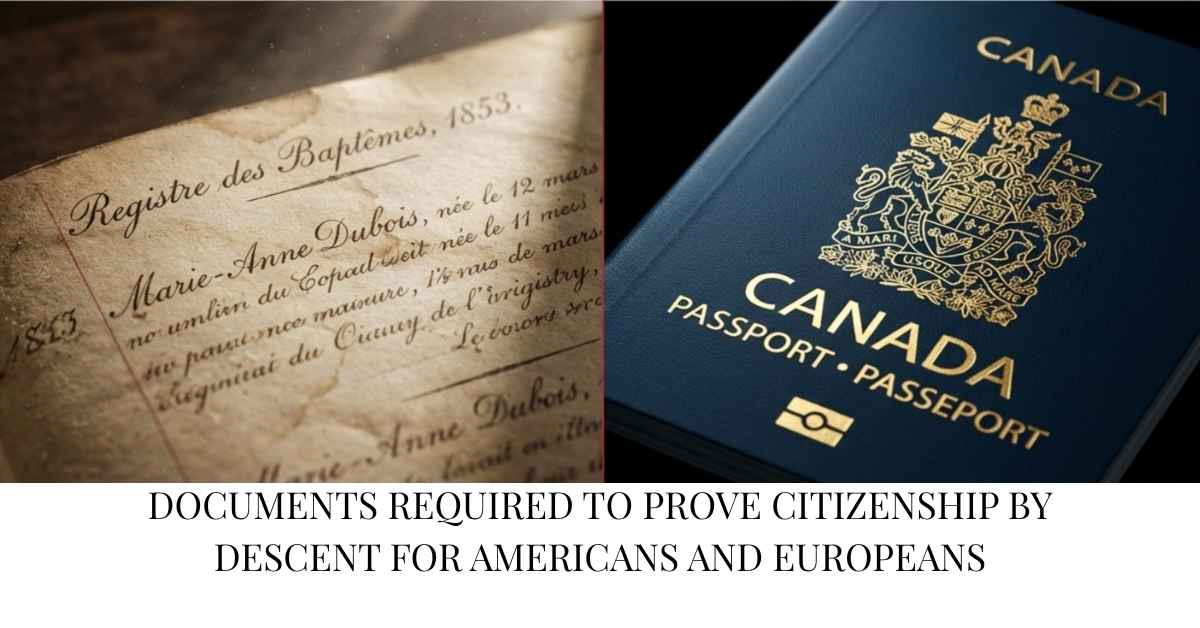
If you were born in the United States, the United Kingdom, or Europe and have a Canadian ancestor, you may already be a Canadian citizen. Claiming Canadian citizenship by descent requires assembling a chain of long-form birth certificates, marriage records, and supporting documents that connect you, generation by generation, to a Canadian-born ancestor. This guide covers exactly what IRCC needs to see, how to source those records from foreign jurisdictions, and the pitfalls that most commonly cause applications to get returned.
Not sure you qualify? Take our citizenship eligibility quiz or read the citizenship by descent guide.
Bill C-3 came into force on December 15, 2025. It permanently removed the first-generation limit that had blocked multi-generational citizenship claims since 2009. An estimated 10 million Americans with French-Canadian or Maritime ancestry are now potentially eligible, and archives across Quebec and Nova Scotia have reported tenfold increases in document requests since the law passed.
Key Takeaways: What You Need to Know
- Bill C-3 removed the generational limit permanently. As of December 15, 2025, you can claim citizenship regardless of how many generations your family has spent outside Canada, provided you can trace a direct line to a Canadian anchor ancestor.
- Short-form birth certificates are categorically rejected. IRCC requires a long-form certificate for every person in your generational chain. This remains the single most common reason applications are returned.
- IRCC now demands “original‑source authority” documents for every generation. Starting June 2026, your birth, marriage, and status records must be issued by the civil registry, vital statistics office, or archive that actually holds the register, not just genealogy websites or secondary databases.
- Marriage certificates are mandatory when surnames changed. Every name inconsistency across generations must be bridged by a marriage certificate or legal name‑change document. An unexplained gap = a returned application.
- Processing time is 33 months as of 3 September 2026, counted from the date IRCC confirms it received a complete application. Your citizenship certificate is not a travel document. You cannot use it to enter Canada while the application is pending.
- Complex genealogical chains benefit significantly from RCIC oversight. Errors are returned, not corrected by IRCC. One missing document or weak original‑source proof can restart the clock and trigger extra scrutiny
Quick Navigation
What Bill C-3 (2025) actually changed
Bill C-3 (2025) is an amendment to the Canadian Citizenship Act that retroactively removes the first-generation limit for citizenship by descent.
The first-generation limit is gone
Before December 2025, a Canadian citizen born abroad could pass citizenship to their child. But if that child was also born abroad, their children were excluded. The rule, known as the first-generation limit (FGL), was introduced in 2009 and declared unconstitutional by the Ontario Superior Court of Justice in December 2023.
Bill C-3 reversed it entirely. If you were born before December 15, 2025, you can now claim citizenship regardless of how many generations your family has spent outside Canada, provided you can trace a direct line to a Canadian anchor ancestor.
Who counts as an anchor ancestor?
An anchor ancestor is someone who held Canadian citizenship either by birth on Canadian soil or through formal naturalization. Anyone descended from an anchor ancestor is now eligible to claim citizenship under the retroactive provisions of Bill C-3, with no generational limit.
The Substantial Connection threshold for future generations
For children born on or after December 15, 2025, to a Canadian parent who was also born abroad, citizenship does not transfer automatically. The Canadian parent must demonstrate at least 1,095 cumulative days of physical presence in Canada prior to the child’s birth or adoption. There is no five-year window restriction, unlike the naturalization process for permanent residents.
Which cohort are you in?
Your evidentiary burden depends entirely on when you were born.
Cohort 1 applies to anyone born or legally adopted outside Canada before December 15, 2025. Your task is purely genealogical. You do not need to show any physical or economic connection to Canada. You need to assemble a clean, unbroken documentary chain from yourself back to your Canadian anchor ancestor.
Cohort 2 applies to those born or adopted outside Canada on or after December 15, 2025, to a Canadian parent who was also born abroad. You must prove both genealogical descent and your parent’s 1,095 days of physical presence in Canada.
| Application cohort | Defining criteria | Core evidentiary burden | Required document types |
|---|---|---|---|
| Retroactive restoration | Born abroad before Dec 15, 2025 | Proof of unbroken lineal descent | Long-form birth certificates, marriage records, anchor ancestor’s Canadian birth or naturalization records |
| First-generation abroad | Born abroad on or after Dec 15, 2025 (parent born in Canada) | Proof of parentage | Applicant’s birth certificate, parent’s Canadian provincial birth certificate |
| Substantial Connection | Born abroad on or after Dec 15, 2025 (parent also born abroad) | Proof of parentage plus parent’s 1,095 days physical presence | Lineage documents plus Form CIT 0555, CRA tax slips, entry and exit border records |
Documents Needed for Canadian Citizenship By Descent
Long-form birth certificates
This is the single most common reason applications get returned. IRCC requires a long-form birth certificate for every person in your generational chain. Short-form, wallet-sized certificates are categorically rejected. They record the fact of a birth but do not list the parents’ names. Without a parent’s name on each certificate, the parent-child link cannot be legally established.
You need a long-form certificate for yourself, your parent, your grandparent, and every subsequent generation back to your Canadian anchor ancestor.
Marriage certificates and the nomenclature gap
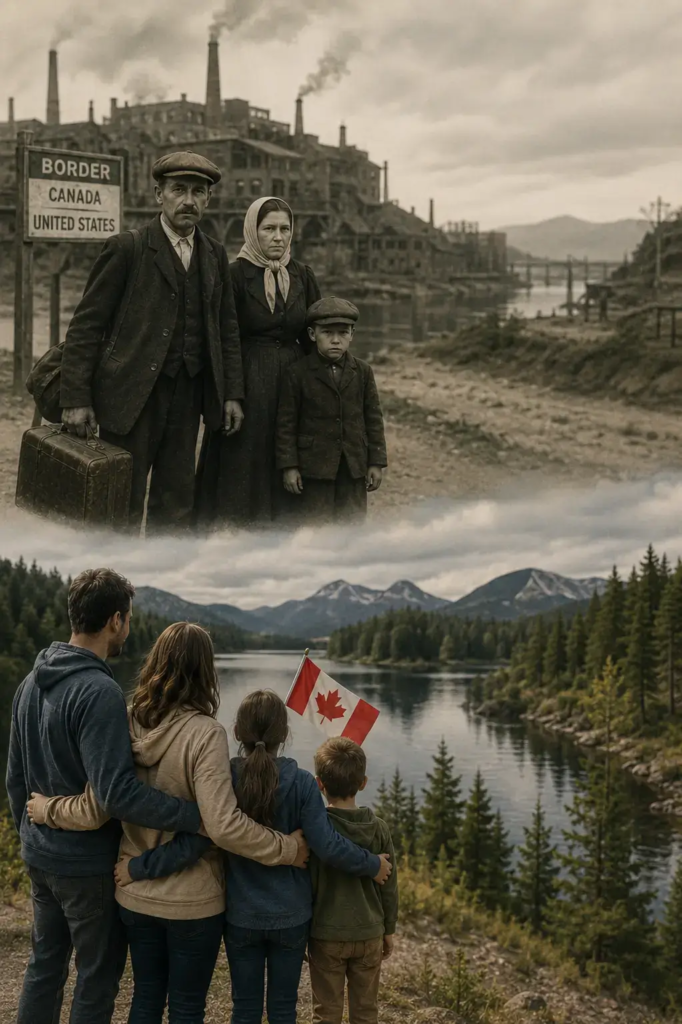
When a female ancestor changed her surname on marriage, or when French-Canadian names were anglicized upon entry into the United States, the documentary chain breaks. IRCC reads name inconsistencies across generations as unexplained gaps.
Marriage certificates close those gaps. A marriage certificate confirms that the person named on one birth certificate is the same individual documented on the next. In cases involving multiple marriages, adoptions, legal name changes, or divorces, the corresponding court orders and legal instruments must be included.
Proof of the anchor ancestor’s Canadian status
At the top of your chain, you need to show that your anchor ancestor was genuinely Canadian. A Canadian provincial birth certificate does this directly since Canada grants citizenship to those born on its soil. If your ancestor naturalized rather than being born in Canada, you need their naturalization certificate or the relevant immigration records.
Pre-1947 naturalization records are held by Library and Archives Canada and can be requested online through their ATIP (Access to Information and Privacy) process. Pre-Confederation records may require provincial archives requests.
IRCC’s 2026 “Original‑Source Authority” Rule
The best part?
You don’t just want documents.
You want the right kind of documents.
Starting in June 2026, IRCC tightened its guidance on what counts as acceptable proof of citizenship by descent.
The new standard is simple but strict: your evidence must come from the original‑source authority that created and holds the record.
What does that mean in plain language?
- Civil registry or vital statistics, not just a website.
Birth, marriage, and death records should be issued by the government office that actually keeps the register – the state vital statistics office, provincial civil status office, or national registry.
A printout from a genealogy site like Ancestry or FamilySearch is now treated as a research clue, not proof on its own. - Government archives for older records.
When you’re dealing with pre‑1947 naturalization records, parish civil registers, or wartime documents, IRCC expects certified copies from the archive or authority that holds the originals – not just a scan someone posted online. - Every generation needs original‑source proof.
IRCC’s updated instructions now say your application must be backed by authentic, reliable, and verifiable documents for every generation in the chain between you and your Canadian anchor ancestor. In practice, that means: long‑form birth certificates, marriage certificates, and Canadian status records, all issued by the authorities that own the registers. - If you can’t get an official record, you must show your homework.
IRCC now has a dedicated section explaining what to do when you can’t provide documents from the original authority.
They expect:- A written explanation of why the record isn’t available (destroyed, never kept, restricted, etc.), and
- Proof you tried to get it – emails or letters from the registry, archive responses, or formal confirmations that no record exists.
Why this matters for you
The truth is… many of the June 2026 “please surrender your certificate” notices were triggered not because people lacked Canadian ancestry, but because their files relied too heavily on secondary sources.
Weak documentation from non‑original authorities gave IRCC grounds to question whether the certificate should have been issued at all.
If you build your file the way IRCC now expects- original‑source records for every generation, plus clear explanations wherever gaps exist- you dramatically reduce the risk of delays, document requests, or, worst case, a certificate being reviewed later.
Everything you want exists on the other side of a strong paper trail.
Top 3 Reasons Bill C-3 Applications Are Returned:
- Submitting Short-Form Birth Certificates: IRCC categorically rejects wallet-sized or short-form certificates. A long-form certificate listing the parents’ names is required for every generation to legally establish the parent-child link.
- Unexplained Name Inconsistencies: Any change in surname across generations (e.g., due to marriage, adoption, or anglicization) without a corresponding marriage certificate or legal name-change document will result in a returned file.
- Improper foreign document authentication and weak original‑source proof: Documents from non‑Hague countries that lack proper authentication and Canadian consular legalization, or documents missing required Apostilles, are not accepted. On top of that, IRCC now expects records from the original‑source authority (civil registry, vital statistics office, or archive), not just copies from genealogy sites or secondary databases.
How to get long-form birth certificates by country
United States
There is no national vital statistics office in the United States. Each state maintains its own records through its Department of Health or Office of Vital Statistics. Fees, processing times, and identity verification requirements vary significantly by state. Most states offer online ordering through VitalChek or the state’s own portal, but processing times for certified copies can range from two weeks to four months depending on the state and the year of the record.
For records predating 1910, many states did not require mandatory birth registration. In those cases, you will need to request alternative documentation such as census records, church records, or delayed birth certificates filed later in the ancestor’s life.
United Kingdom
British applicants need a “full” birth certificate from the General Register Office (GRO). The short version, which most people have, shows only the child’s name and basic registration information. The full version lists both parents’ names, occupations, and address at the time of registration. Full certificates can be ordered directly from the GRO website. Processing time is typically five business days for standard service.
France and continental Europe
French birth records are maintained by the commune (municipality) where the birth occurred, not by a central authority. An acte de naissance intégrale (full birth certificate) is what IRCC requires. The livret de famille, a family booklet common in France and French-speaking countries, is not acceptable as standalone proof for IRCC. It is treated as a summary document, not a primary civil record.
For other European countries, the equivalent of a full birth certificate must be obtained from the local civil registry (Standesamt in Germany, Registro Civil in Spain, Comune in Italy). Processing times and apostille requirements vary by country.
When civil records don’t exist: archival reconstruction
Baptismal and parish records
For ancestors born before mandatory civil registration, IRCC accepts certified copies of baptismal records from religious institutions when civil records do not exist. The key word is certified: the record must be authenticated by the institution and accompanied by a statement that no civil record exists or that the civil record was destroyed.
Quebec’s mandatory civil registration began in 1994. For births recorded before that date, parish records held by the Directeur de l’état civil (DEC) are the primary source. The DEC digitized most Quebec parish records and can provide certified extracts.
Quebec DEC Wait times
As of mid-2026, Quebec civil status certificate (birth, marriage, or death) wait times vary based on application completeness, with recent efforts targeting a 20-working-day turnaround. However, in late 2024 and early 2025, wait times for these certificates peaked over 60–80 days due to processing backlogs.
The Quebec pre-1994 rule
Quebec did not transfer control of vital statistics records from the Catholic Church to the provincial government until January 1, 1994. Records created before that date were maintained exclusively by parishes. The DEC holds copies of most pre-1994 parish registers for Quebec, but gaps exist for some remote communities and early records from the 17th and 18th centuries.
Canadian census records and pre-1947 naturalization files
Library and Archives Canada (LAC) holds digitized census records going back to 1851, as well as pre-1947 naturalization files, passenger manifests, and military service records. These are invaluable for establishing that an ancestor resided in Canada or held Canadian status at a given time. The 1921 census is the most recent one publicly available; the 1931 census became accessible in January 2023.
Proving the Substantial Connection test (Cohort 2 applicants only)
What counts as a day of physical presence
For the Substantial Connection test, a day of physical presence means any day on which the Canadian parent was physically located within Canada’s borders. There is no minimum stay per visit; a single day counts. Days spent in transit through a Canadian airport do not count unless the parent cleared customs and entered Canada.
Which documents prove your parent’s days in Canada
IRCC’s paper application guide (CIT 0001, Appendix F) lists six kinds of proof for your parent’s days in Canada: employment and education records such as T4 slips and school transcripts, travel records such as passports and entry or exit records, residential records such as rental, mortgage or insurance papers, Canadian government records, affidavits from organizations, and affidavits from third parties. IRCC also accepts other proof that shows presence.
Every affidavit must show the affiant’s name, mailing address, and email or phone number. Family members cannot give affidavits, and IRCC may contact the people or organizations you name to check what you declared.
Send clear colour copies of authentic documents. Tax slips and school records are easy for an officer to verify, so lead with them when you have them.
Form CIT 0555 is the specific form used to document physical presence for Substantial Connection claims. It asks for every date your parent entered and left Canada, in year, month and day format, and then a total of days in Canada. The days do not have to be consecutive.
Why the flexible timeframe creates a documentation challenge
The absence of a five-year window means the parent’s 1,095 days can be drawn from any period in their life prior to the child’s birth. That flexibility sounds helpful, but it means applicants may need to produce records spanning decades. Tax records older than seven years may not be available from CRA. CBSA electronic records only go back to 2013 for most travelers. Applicants relying on older presence need to reconstruct it from employment records, school transcripts, mortgage documents, and utility bills.
Military families and War Brides: a specialized path
The DND 419 birth certificate trap
Children of Canadian Forces members born on NATO bases or other foreign postings received a DND 419 birth certificate issued by the Department of National Defence. This certificate confirms Canadian citizenship at birth but is not a provincial birth certificate and does not establish that the child was born in Canada.
For a citizenship by descent application, the DND 419 alone is insufficient. It must be accompanied by the parent’s service records from Library and Archives Canada confirming the parent was a Canadian Forces member, and the parent’s own proof of Canadian citizenship. The DND 419 establishes the child’s status; the parent’s records establish the link back to Canada.
Accessing Canadian servicemen’s military records
Service records for Canadian military personnel are held by Library and Archives Canada. Records for veterans who died more than 20 years ago are publicly accessible. Records for recently deceased veterans or living former members require an ATIP request, which typically takes 30 to 90 days. Personnel records contain deployment postings, which establish where a servicemember was stationed at the time of a child’s birth.
War Bride descendants
Children and grandchildren of War Brides (spouses of Canadian servicemen who immigrated to Canada after World War II) are increasingly using Bill C-3 to claim citizenship. The evidentiary challenge in these cases is proving the War Bride’s formal acquisition of Canadian citizenship, which in many cases occurred through naturalization rather than birth. Naturalization records from the 1940s and 1950s are held by LAC and are accessible through ATIP.
Translation and Apostille requirements
IRCC’s translation rules
All documents submitted to IRCC that are not in English or French must be accompanied by a certified translation. The translation must be prepared by a certified translator who is a member of a recognized professional association, such as the Association of Translators and Interpreters of Ontario (ATIO) or its provincial equivalents. The translator must include their credentials and certification stamp with the translation.
Machine translations are not accepted. Translations by family members are not accepted, even if that family member holds professional credentials in an unrelated field.
The Hague Apostille
Documents from countries that are signatories to the Hague Convention Abolishing the Requirement for Legalisation of Foreign Public Documents (the Apostille Convention) must be apostilled before submission to IRCC. An Apostille is a specific certification attached to the original document by a competent authority in the issuing country, confirming the authenticity of the signature and seal.
Documents from non-Hague countries require authentication through a two-step process: first, authentication by the issuing country’s Ministry of Foreign Affairs, then legalization by the Canadian diplomatic mission in that country. IRCC will not accept documents that bypass either step.
Paper application vs. online portal
Why most Bill C-3 claims should go paper
IRCC’s online portal for citizenship applications was designed primarily for straightforward cases involving a small number of documents. A multi-generational Bill C-3 claim routinely involves 20 to 50 individual documents, many of which require accompanying translations, apostilles, and explanatory letters. The online portal’s file size and document count limitations make it impractical for most descent claims.
Paper applications are submitted to the Case Processing Centre in Sydney, Nova Scotia. The mailing address and current submission requirements are published on IRCC’s official guidance page for proof of citizenship applications.
Current processing times
Standard processing times for proof of citizenship applications is 33 months as of 3 September 2026. Avoiding a return-to-sender situation is worth whatever additional time goes into preparing a thorough paper file. Read our guide on urgent processing of Canadian Citizenship Certificate
For full submission requirements, see IRCC’s official Guide 0001: Application for a Citizenship Certificate.
After approval: the citizenship certificate, the passport, and the travel trap
The citizenship certificate is not a travel document
A Canadian citizenship certificate confirms your status as a citizen. It does not allow you to travel to Canada or enter Canada as a citizen. To cross an international border as a Canadian citizen, you need a Canadian passport. These are two separate documents with two separate application processes.
The dual citizen travel requirement
Canadian law requires dual citizens to enter and exit Canada on their Canadian passport. If you are a US-Canadian dual citizen, for example, you must present a Canadian passport when boarding a flight to Canada, not your US passport. Attempting to board a Canada-bound flight on a foreign passport as a Canadian citizen can result in boarding denial or complications at the border.
Factor in 6 to 8 weeks for a passport
Standard processing time for a Canadian passport application from outside Canada is 20 business days. Urgent processing is available at Canadian passport offices and some consulates but requires demonstrating imminent travel need. Plan your timeline accordingly: citizenship certificate processing (33 months) plus passport processing (20 business days, plus mailing time) is your minimum runway before you can travel on a Canadian document.
When to work with an RCIC on a citizenship by descent application
Most citizenship by descent applications are not simple. They involve records spanning multiple countries, multiple languages, multiple decades, and archival systems that were not designed to communicate with each other. A single weak link in the documentary chain, an unexplained name discrepancy, a missing marriage record, an undocumented generation, can stall or sink the entire file. Book a Strategy Consultation with Amir Ismail (RCIC #R412319) to review your genealogical chain before you submit.
An RCIC who has handled citizenship certificate applications understands what IRCC officers look for and what a complete file needs to include. The value of professional involvement is not just in assembling documents. It is in identifying gaps before they become returns, in knowing which archival sources to pursue when civil records are missing, and in writing explanatory letters that address IRCC’s specific concerns about complex genealogies.
A citizenship by descent file that is returned adds another 33 months or more to your timeline from the date of resubmission. The cost of a professional review is substantially less than the cost of starting over.
Not sure you qualify?
Take our Canadian citizenship eligibility quiz in about two minutes, read the Canadian citizenship guide, then Book a Strategy Consultation with Amir Ismail, RCIC R412319, to confirm your path.
Frequently asked questions about Canadian citizenship by descent documents
Can I claim Canadian citizenship if my grandparent was born in Canada?
Yes. Under Bill C-3 (2025), the first-generation limit has been removed. If your grandparent was born in Canada or was a naturalized Canadian citizen, you can claim citizenship by descent provided you can establish an unbroken documentary chain from yourself back to that grandparent. The chain requires long-form birth certificates and marriage records for every generation in between.
What is the Substantial Connection test under Bill C-3?
The Substantial Connection test requires a Canadian parent born abroad to prove 1,095 days of physical presence in Canada to pass down citizenship. The Substantial Connection test applies only to Cohort 2 applicants: those born on or after December 15, 2025, to a Canadian parent who was also born outside Canada. The Canadian parent must demonstrate at least 1,095 cumulative days of physical presence in Canada prior to the child’s birth or adoption. Acceptable evidence includes CRA tax records, border entry records, employment records, and school enrollment documents.
Does IRCC accept Quebec birth certificates issued before 1994?
Pre-1994 Quebec birth certificates registered under parish or civil authority before the provincial registry was centralized require special handling. IRCC accepts these records but may require supplementary documentation from the Directeur de l’état civil (DEC) confirming the record’s authenticity. Baptismal records from the same period are accepted as corroborating evidence but cannot substitute for a civil birth record.
Can I use my DND 419 military birth certificate for a descent claim?
No. A DND 419 certificate confirms Canadian citizenship at birth but is not a provincial birth certificate and does not establish place of birth within Canada. For citizenship by descent applications, it must be accompanied by the parent’s service records and the parent’s own proof of Canadian citizenship.
Do I need an Apostille on my foreign birth certificate?
It depends on the issuing country. Documents from countries that have signed the Hague Apostille Convention require an Apostille. Documents from non-Hague countries require authentication through that country’s Ministry of Foreign Affairs followed by Canadian consular legalization. IRCC does not accept documents that bypass this chain.
How long does a citizenship certificate application take in 2026?
Current processing time for a citizenship certificate under a descent claim is 33 months as of 3 September 2026, counted from the date IRCC acknowledges receipt of a complete application. Applications returned for missing documents restart the clock from the date of resubmission.
Can I travel to Canada while my citizenship certificate application is in process?
Not on the basis of your pending certificate. You must continue to use your existing travel document and applicable visa or eTA until the certificate is issued. Once issued, you must apply for a Canadian passport separately before using it for international travel, adding 20 business days plus mailing time to your timeline.
Read More Canadian Citizenship By Descent Resources By Amir Ismail

Section 8 Lost Canadians: Bill C-3 Gives Back Citizenship Lost at Age 28
Section 8 Lost Canadians: Bill C-3 Gives Back Citizenship Lost at Age 28 If you…

Bill C-3 Reversal Risk: Could You Lose Citizenship by Descent?
Bill C-3 Reversal Risk: Could You Lose Citizenship by Descent? By Amir Ismail, RCIC #R412319…
Proof of Canadian Citizenship Processing Time 2026 (33‑Month Wait and 136,000‑File Queue Explained)
Proof of Canadian Citizenship Processing Time 2026 (33-Month Wait and 136,000-File Queue Explained) By Amir…
Canadian Citizenship by Descent: Eligibility Checklist for Americans (Bill C‑3)
Do I Qualify for Canadian Citizenship by Descent? The American’s Eligibility Checklist By Amir Ismail,…
Baptismal Records for Canadian Citizenship by Descent: 2026 Guide
Baptismal Records for Canadian Citizenship by Descent: A Complete Ordering Guide (2026) LAST UPDATED: AUGUST…
Six Wrong Reasons People Rule Themselves Out of Canadian Citizenship by Descent
Six Wrong Reasons People Rule Themselves Out of Canadian Citizenship by Descent By Amir Ismail,…

Married to a Brand-New Canadian Citizen? What Descent Does (and Does Not) Do for You
Married to a Brand-New Canadian Citizen? What Canadian Citizenship By Descent Does (and Does Not)…
Canadian Vital Records for Citizenship by Descent: How to Find the Right Office in Every Province
Mandatory Vital Records for Canadian Citizenship by Descent (Canada‑Wide: Every Province, Every Office) By Amir…
Ancestor Birth Record Missing? IRCC Alternatives 2026
When the Birth Certificate Never Existed: Proving Your Canadian Ancestor’s Identity to IRCC By Amir…
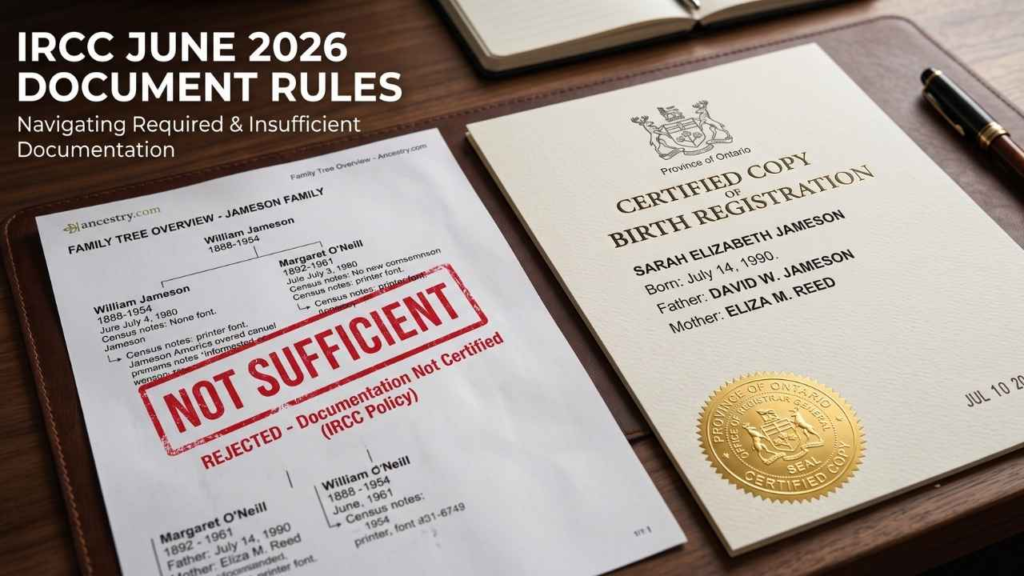
Ancestry Printouts Are Out: The Document Rules IRCC Rewrote for Citizenship by Descent in June 2026
Ancestry Printouts Are Out: The Document Rules IRCC Rewrote for Citizenship by Descent in June…
Canadian Citizenship by Descent Documents 2026: IRCC Rules to Avoid Refusal
Canadian Citizenship by Descent Documents 2026: New IRCC Rules You Must Follow By Amir Ismail…
Citizenship Certificate Surrender Notice Under Bill C‑3 (IRCC 2026): What It Means and What to Do
Citizenship Certificate Surrender Notice Under Bill C-3: What It Means and What to Do Last…