Not sure you qualify? Take our Canadian citizenship eligibility quiz first.
The fastest way to verify an ancestor’s Canadian citizenship is to request a Search of Citizenship Records using Form CIT 0058. IRCC uses this search to check whether it has a record for that person, and the result can help you match your application details to the exact name, dates, and file number already on file.
According to IRCC, a search of citizenship records is the way to ask whether the department already has a record for a person’s citizenship or naturalization.
Most citizenship by descent applicants have never heard of this search, and most do not need it. But if there is any doubt about how your ancestor’s name or details appear in Canada’s registry, running this search before you apply can save months.
What is a Search of Citizenship Records?
A Search of Citizenship Records is an official IRCC record check. It tells you whether IRCC holds a citizenship or naturalization record for a specific person, and what that record shows.
Key facts
- A search of citizenship records checks whether IRCC holds a record for a specific ancestor, such as someone who naturalized or received a citizenship certificate.
- It does not cover ancestors born in Canada, because someone born in Canada is a citizen from birth and IRCC usually holds no separate citizenship record for them.
- The result letter is valid for one year if the person searched is alive, and does not expire if they have died.
- If you are already applying for a citizenship certificate, you do not need a separate search. IRCC runs the same check internally as part of processing your file.
Who should request a search of Citizenship Records?
Most people applying for proof of Canadian citizenship by descent do not need a separate search.
You consider this search when there is any doubt about how your ancestor’s name, dates, or details appear in IRCC’s records.
It is especially helpful if family documents are incomplete, names were changed over time, or you are not sure whether your ancestor ever naturalized or received a citizenship certificate.
What IRCC’s Search of Citizenship Records shows
Am I a Canadian citizen by descent?
Trace your family line one generation at a time. Each link is tested against the law in force when that person was born, so you see exactly where your chain holds and where it breaks. About three minutes, and no account needed.
Check my family lineIRCC can usually find records for people who naturalized, received a Canadian citizenship certificate, or were registered as British subjects before 1947.
A successful IRCC match provides key registry details: the date citizenship was granted, the person’s full legal name, date and place of birth, and a unique IRCC file number.
What a Search of Citizenship Records cannot do
A Search of Citizenship Records letter is not proof of citizenship. It is a record check that confirms whether IRCC has a citizenship or naturalization record for a person.
Even if the search confirms your ancestor’s record, you still need to apply for a citizenship certificate if you are claiming Canadian citizenship by descent.
How a Search of Citizenship Records strengthens your application
When you apply for a citizenship certificate, IRCC will still search its records. If your ancestor’s name is spelled differently, a date is off, or a file number is missing, your application can slow down while IRCC tries to match the record.
A prior search reveals the registry’s exact spelling and file number so you can mirror those details on your application. This reduces the risk of delays caused by mismatched information.
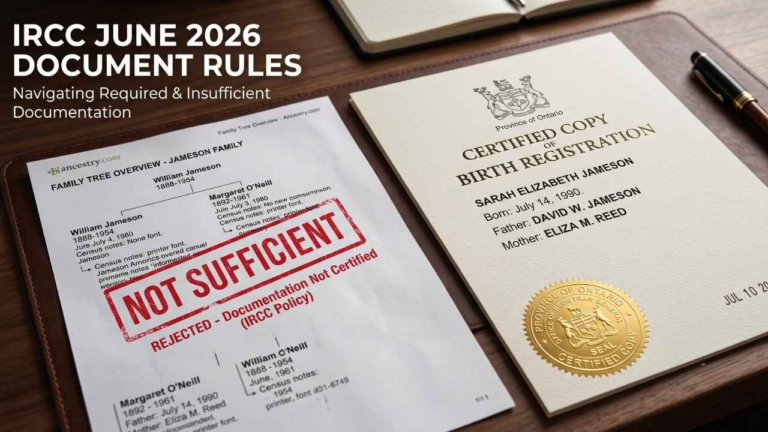
IRCC has tightened what counts as proof of citizenship by descent and now expects original-authority documents wherever possible. When one cannot be produced, file details from a completed search let you give a precise explanation that points back to IRCC’s own record.
Our complete document guide explains what counts as an original-authority document for each generation in your chain.
How to request a Search of Citizenship Records
You request a search by submitting Form CIT 0058, Application for a Search of Citizenship Records, on paper.
If the search is for a living person, that person must sign the consent section so IRCC can release information about their record.
If the person is deceased, IRCC usually asks for proof of death and proof of your relationship to that person.
IRCC does not charge a separate fee for a standalone search request. It only becomes redundant, not costly, if you are already partway through a citizenship certificate application, because IRCC’s internal check covers the same ground.
What a mismatch actually costs you
A small mismatch between your ancestor’s story and IRCC’s records can turn into months of delay.
Picture a fictional applicant, a retired teacher near Buffalo, who knew her grandfather had immigrated from Scotland and naturalized in Winnipeg in the 1920s. She had the story right but not the details. Her family’s spelling of his surname differed slightly from the version a clerk recorded generations earlier, and she had no certificate number at all.
IRCC’s internal check could not cleanly match her claim, so the file was flagged and she was asked for more documents. Months passed while she reconstructed information a single search would have given her at the outset. That is the value of running the search first: it turns a family story into a confirmed record before a mismatch can cost you the better part of a year, on top of the roughly 33-month wait the application already carries.
If the answer comes back “no record”
A no-record letter is not a dead end. A no-record result does not automatically mean your claim is weak. In many cases, it simply means the ancestor was born in Canada and no separate citizenship record exists.
A no-record letter can also serve as official proof that a record does not exist. This can help you explain a documentation gap under IRCC’s tightened proof rules, or show a foreign government that you are not a Canadian citizen.
For ancestors from before 1947, remember that Canadian citizenship as we know it did not exist yet. People were British subjects, and naturalization was not always required, so a blank result there simply means you build the chain with original-authority documents for each generation, as outlined in our guide on citizenship by descent for war brides and military families.
If IRCC has already sent your family a related notice, such as a citizenship certificate surrender request, review our explainer on the citizenship certificate surrender notice before responding.
Not sure you qualify?
Take our Canadian citizenship eligibility quiz in about two minutes, read the Canadian citizenship guide, then Book a Strategy Consultation with Amir Ismail, RCIC R412319, to confirm your path.
Frequently asked questions
Do I need a search of citizenship records before applying?
No. It is not mandatory for every file, but it is useful when you need to confirm an ancestor’s record or resolve a name or date mismatch. Many applicants rely only on the documents in their citizenship chain, and IRCC still runs its own internal record check as part of the certificate process.
Is there a fee for a search of citizenship records?
IRCC does not charge a separate fee for a standalone search request. If you are already applying for a citizenship certificate, IRCC performs the record check as part of that process.
What if IRCC finds no record for my ancestor?
A no-record result often means the person was born in Canada and no separate record exists. You still build your claim with the documents in the citizenship chain. If your case is complex, get professional help to make sure your explanation lines up with IRCC’s proof rules.
How long is a search of citizenship records valid?
If the person is alive, the result letter is valid for one year. If the person is deceased, it does not expire.
Disclaimer: This article is for educational purposes only and does not constitute legal advice. Immigration policies are subject to change. For official government policy, visit the IRCC proof of citizenship page. Amir Ismail is a Regulated Canadian Immigration Consultant (RCIC #R412319).
If your family’s records are incomplete or spread across generations and countries, a Regulated Canadian Immigration Consultant can help you sort what IRCC already knows from what you still need to prove.
Access more Citizenship By Descent Resources By Amir Ismail
Proof of Citizenship From the US: Does a Representative in Canada Save Time?
A representative in Canada does not move your proof of citizenship from the US to…

Canadian Citizenship for an Adopted Child Abroad: Grant or PR?
If you are a Canadian in the US who adopted a child, you have two…
Canadian Passport Application From the USA: Guarantor, References and Fees
A Canadian passport application from the USA is a mail-in process. You fill out form…
British Home Children Citizenship by Descent: Who Qualifies Under Bill C-3
Many descendants of British Home Children can claim Canadian citizenship by descent. The key fact…
Proof of Canadian Citizenship Wait by Application Month: Why Your Date Matters
Your proof of citizenship wait by application month is not one number. The processing times…

American Dual Citizenship With Canada: What Changes and What Does Not
Yes, you can keep both. American dual citizenship with Canada is legal in both countries,…