Amir Ismail is a Regulated Canadian Immigration Consultant (RCIC), licensed by the College of Immigration and Citizenship Consultants (CICC), specializing in Express Entry and healthcare occupation pathways.
CRS cutoffs on Canada’s 2026 healthcare draws have run anywhere from 169 to 475. Physicians with Canadian Work Experience: 169 to 223, across three draws. Healthcare and Social Services: 467 to 475, across six draws total between February and September 2026. Combined, that’s 12,391 invitations to apply.
All draw dates, CRS scores and ITA counts in this article are based on Immigration, Refugees and Citizenship Canada’s (IRCC) official Express Entry: Rounds of invitations page and category-based selection criteria, combined with my own analysis as a licensed immigration consultant.
Executive Summary: Six targeted healthcare draws ran between February and September 2026, for 12,391 Invitations to Apply (ITAs). The physician category went from a record-low 169 up to 223, then dropped to 198 in September. Healthcare and Social Services climbed from 467 to 475, paused for ten weeks, then resumed on September 4 at that same 475 cutoff.
These figures come from IRCC’s published rounds of invitations; the patterns and implications discussed in this article are my professional interpretation of that data.
Key Takeaways
- Canada ran six healthcare-targeted Express Entry draws between February and September 2026, issuing 12,391 ITAs across two separate categories.
- The Physicians category hit a record-low CRS of 169 in February, climbed to 223 by June, then dropped back to 198 in a third draw on September 3.
- The general Healthcare and Social Services category climbed from 467 to 475 over the same period. Overseas candidates without Canadian experience are feeling the squeeze.
- The four-month pause between draws was not random. It reflected a genuinely small physician pool and a policy shift that removed job offer points.
- Ontario’s provincial overhaul, especially the new Self-Employed Physicians pathway, moved in lockstep with the federal draws, often within a day of each other.
- February, June, and September all followed the same rhythm: a physician draw one day, a Healthcare and Social Services draw the next. September 3 brought physicians at CRS 198. September 4 brought healthcare at CRS 475, the same cutoff as June, after a ten-week pause.
What Happened in Canada’s 2026 Healthcare Express Entry Draws
The Comprehensive Ranking System (CRS) is the point-based scoring system Immigration, Refugees and Citizenship Canada (IRCC) uses to rank candidates in the Express Entry pool, with a maximum of 1,200 points awarded across factors including age, education, language ability, work experience, and provincial nominations.
Canada ran six healthcare-targeted Express Entry draws between February and September 2026, split across two categories: the broad Healthcare and Social Services Occupations category, and the Physicians with Canadian Work Experience category. Together, these draws issued 12,391 Invitations to Apply (ITAs). The draw numbers, dates, CRS cutoffs and ITA counts below mirror IRCC’s official rounds of invitations; any strategy guidance is commentary based on those official results.
Comprehensive Ranking System (CRS) cutoffs ranged from a record low of 169 points to a high of 475.
If you are a doctor, nurse, or allied health worker watching these numbers, that gap is the whole story. Two draws back-to-back in February. Four months of silence. The same pairing again in June. Then September did it again: physicians on September 3, healthcare on September 4.
This article walks through all six draws in order: the February blitz, the spring pause, the June resurgence, and the September return. Then it connects the dots to Ontario’s provincial overhaul, because the two levels of government were not moving independently. By the end, you will know exactly where your profile stands and what to expect in the second half of the year.
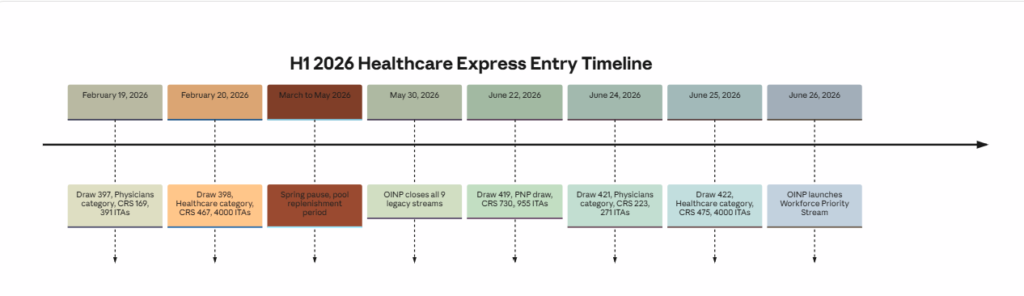
Every major healthcare move IRCC made had a mirror image on the provincial side, often within a day or two. That is not a coincidence, and we get into why later in this piece.
Why the February Blitz Sent CRS Scores to a Record Low
Between February 16 and 20, 2026, IRCC ran a rapid sequence of draws to clear separate applicant pools before they could compete against each other. Two of those draws targeted healthcare, and one of them produced the lowest CRS cutoff in Express Entry history.
What Caused the CRS 169 Physician Draw?
The record-low CRS 169 cutoff for the February 2026 physician draw was caused by a regulatory change that classified fee-for-service arrangements as valid employee work experience. Because this change opened the Canadian Experience Class to a very small, newly eligible pool of practicing doctors (limited to NOC 31100, 31101, and 31102), IRCC was able to set a historically low score to invite nearly all qualified candidates in a single round of 391 ITAs. This change aligns with IRCC’s updated guidance on Canadian work experience for physicians under Express Entry and the Canadian Experience Class, as reflected in its category-based selection framework for physicians with Canadian work experience.
Before this change, fee-for-service was classified as self-employment, which made most practicing doctors ineligible for the Canadian Experience Class. Removing that barrier opened up a small but previously invisible pool of foreign-trained physicians.
Because the eligible pool was so small (limited to NOC 31100, 31101, and 31102, with 12 months of Canadian experience), IRCC could set the cutoff low enough to invite nearly everyone who qualified in a single draw.
How Did the General Healthcare Draw Reach 4,000 ITAs?
One day later, on February 20, 2026, IRCC issued 4,000 ITAs to the broader Healthcare and Social Services Occupations category at a CRS cutoff of 467. This category spans 35 NOC codes across TEER levels 1 through 3, including registered nurses, pharmacists, physiotherapists, and social workers. IRCC’s official category-based selection page confirms that Healthcare and Social Services occupations are defined as a group of NOC codes across TEER 1 to 3.
Unlike the physician pool, this pool is large and continuously replenished by both Canadian and overseas experience. That scale, not scarcity, is what drove this draw’s higher cutoff and larger volume.
Below is the complete data table summarizing all IRCC Express Entry healthcare-targeted draws in the first half of 2026, including the specific category, CRS cutoff scores, and the number of ITAs issued. This table is derived directly from IRCC’s Express Entry draw results for 2026, filtered to the Healthcare and Social Services and Physicians with Canadian Work Experience categories.
| Draw # | Date | Category | CRS Cutoff | ITAs Issued |
|---|---|---|---|---|
| 397 | Feb 19, 2026 | Physicians with Canadian Work Experience | 169 | 391 |
| 398 | Feb 20, 2026 | Healthcare and Social Services Occupations | 467 | 4,000 |
| 421 | June 24, 2026 | Physicians with Canadian Work Experience | 223 | 271 |
| 422 | June 25, 2026 | Healthcare and Social Services Occupations | 475 | 4,000 |
| 440 | Sept 3, 2026 | Physicians with Canadian Work Experience | 198 | 229 |
| 441 | Sept 4, 2026 | Healthcare and Social Services Occupations | 475 | 3,500 |
Across these six healthcare draws, CRS cutoffs ranged from a low of 169 (Physicians with Canadian Work Experience, February 19, 2026) to a high of 475 (Healthcare and Social Services Occupations, June 25 and September 4, 2026). Draw #441 is inferred from IRCC’s sequential numbering; secondary sources covering the September 4 draw had not published an official round number at the time of writing.
If you are weighing your options between the physician stream and provincial routes, our Express Entry service page breaks down eligibility for every federal pathway side by side.
Why Did IRCC Pause Healthcare Draws for Four Months
IRCC did not run another healthcare draw between February 20 and June 24, 2026. That gap was deliberate, not accidental. Two things had to happen before the next round made sense: the physician pool needed to refill, and the CRS math itself had shifted.
What Changed During the Spring Maturation Phase
During March, April, and May, IRCC redirected its draws toward the Canadian Experience Class, Provincial Nominee Program, and French-language proficiency candidates instead. The following three points are my professional analysis of IRCC’s draw pattern and candidate behavior, based on the official draw schedule and category rules published by IRCC:
- New international medical graduates were finishing their licensing steps.
- Temporary foreign workers were accumulating the 12 months of Canadian experience required for category eligibility.
- Overseas applicants were finalizing Educational Credential Assessments and language test results.
A separate policy shift added pressure. Job offer points were removed from the CRS formula in early 2025, so healthcare candidates entering the pool in spring 2026 had to compete on language proficiency, provincial nominations, and years of Canadian experience alone. There was no shortcut left. This reflects IRCC’s documented changes to the CRS points grid, where arranged employment points were adjusted, forcing healthcare candidates to rely more heavily on human capital and provincial nomination factors.
What Happened in the June Resurgence
By late June, the applicant pool had matured enough to support a second wave. IRCC ran a rapid sequence of draws that, in practice, cleared separate applicant pools before they could compete against each other, which suggests an intentional effort to manage category overlap. The structure and timing of these draws come from IRCC’s official rounds-of-invitation records; the explanation of why this pattern matters is my analysis.
Why Did the Physician CRS Rise from 169 to 223?
On June 24, 2026, IRCC issued 271 ITAs to physicians with Canadian work experience at a CRS cutoff of 223, a 54-point increase from February. That rise reflects four months of new candidates accumulating eligibility.
Even so, a CRS of 223 remains far below the general pool average. In-country physicians are still receiving extraordinary preferential treatment compared to any other occupational group.
Why Is the General Healthcare CRS Still Climbing?
On June 25, 2026, the general healthcare category issued another 4,000 ITAs, but the cutoff rose to 475, up 8 points from February’s 467. This upward drift signals that the global supply of internationally trained allied health professionals keeps growing and keeps getting more competitive.
For overseas candidates without Canadian work experience, a CRS below 470 is becoming increasingly hard to work with. If your profile relies on standard human capital factors alone, closing that gap now matters more than it did six months ago. Our Category-based Selection guide explains how to calculate where you stand across every active category.
How Ontario’s OINP Overhaul Connects to the Federal Draws
The federal and provincial governments were not operating on separate tracks in 2026. On May 30, 2026, Ontario amended the Ontario Immigration Act, 2015 (O. Reg. 47/26) to revoke all nine of its legacy immigration streams.
One day after the federal government finished its June healthcare blitz, on June 26, 2026, Ontario launched Phase 1 of its replacement: the Ontario Workforce Priority Stream.
That new stream includes a specialized Self-Employed Physicians pathway. It mirrors the federal fee-for-service reclassification exactly: physicians no longer need a formal employer job offer. They only need an active College of Physicians and Surgeons of Ontario registration and eligibility to bill OHIP.
This creates a genuine safety net. A physician who narrowly misses the federal CEC baseline for the Express Entry physician category can pivot to the OINP Self-Employed pathway instead.
That route secures a provincial nomination worth 600 CRS points and bypasses the federal category limitations entirely. If you want the full mechanics of that stream, see our detailed breakdown of the Ontario Workforce Priority Stream.
What Happened in the September Reset
September delivered two draws, one day apart, just like February and June. On September 3, 2026, IRCC invited 229 physicians with Canadian work experience at CRS 198, down 25 points from June. One day later, on September 4, IRCC invited 3,500 candidates in Healthcare and Social Services at CRS 475, its first draw in that category since June 25.
Why Did the Physician CRS Drop to 198?
Why 198? The physician pool refilled after June emptied it out. It is still just three NOC codes (31100, 31101, 31102) plus 12 months of Canadian experience, so it fills and drains fast. Three draws in, this is not a category climbing steadily. It is a small pool that resets.
Physicians: 891 ITAs across three draws this year (391 in February, 271 in June, 229 in September). Healthcare and Social Services: 11,500 ITAs across three draws (4,000 in February, 4,000 in June, 3,500 in September), after its longest pause of the year.
Why Did Healthcare Return at Exactly 475?
Healthcare and Social Services resumed on September 4, 2026, after ten weeks of silence, its longest gap of the year. IRCC invited 3,500 candidates at a CRS cutoff of 475, the same score as June. Candidates needed a profile created before May 26, 2026, 12:26 a.m. UTC to qualify.
A flat cutoff after a ten-week pause is worth noting. The pool did not get easier to clear, and it did not get harder either. For candidates sitting just under 475, waiting out the pause did not close the gap on its own. Language score, Canadian experience, or a provincial nomination still do the heavy lifting.
What These Draws Mean for H2 2026
Based on the H1 pattern, three trends look set to continue into the third and fourth quarters. This is an analysis and projection based on the data above, not a confirmed IRCC policy. IRCC does not publish a future draw calendar or guaranteed cutoff levels, so any references to likely trends for H2 2026 should be treated as informed projections, not promises of specific scores.
- The physician category keeps behaving this way: the September 3 draw kept the cutoff low at 198, since the eligible pool is finite and gets depleted with each draw.
- The general healthcare category resumed on September 4 at the same 475 cutoff as June, not higher, after a ten-week pause. Whether it climbs from here or holds flat will show up in the next round. Either way, Canadian experience or a provincial nomination stays the safer bet for overseas candidates.
- Provincially nominated healthcare workers will keep flooding the top of the pool, which means more PNP-specific draws (similar to Draw #419’s 955 ITAs) should be expected to clear that backlog before the next healthcare-specific round.
Should Overseas Healthcare Candidates Still Apply?
Yes, but timing and preparation matter more than they did a year ago. If you do not have Canadian work experience, focus on maximizing language scores, finishing your Educational Credential Assessment early, and researching provincial healthcare streams that do not require Canadian experience. See IRCC’s category-based selection page for the current list of eligible occupations before you plan your profile. That IRCC page is the definitive source for which healthcare and social services occupations qualify for category-based selection at any given time.
If your CRS score sits below the current healthcare cutoff and you are not sure which lever to pull first, that is exactly the kind of question worth a second set of eyes. Book your Strategy Assessment, and we will map your fastest realistic route.
Frequently Asked Questions
What is the difference between the physician and healthcare Express Entry categories?
The primary difference lies in the eligible professions and work experience requirements. The Physicians category is strictly limited to three specific NOC codes (31100, 31101, 31102) and mandates at least 12 months of Canadian work experience. In contrast, the general Healthcare and Social Services category covers a much broader range of 35 NOC codes (including nurses and allied health workers) and accepts both Canadian and overseas work experience. These eligibility rules match IRCCu2019s category-based selection criteria for Healthcare and Social Services occupations and Physicians with Canadian work experience.
What is the current CRS score for Express Entry healthcare draws in 2026?
As of September 4, 2026, physicians with Canadian work experience need CRS 198 (set September 3). Healthcare and Social Services needs CRS 475, its cutoff since it resumed on September 4 after a ten-week pause. Both numbers come straight from IRCC’s rounds of invitations.
Will Express Entry healthcare draws continue for the rest of 2026?
Yes, and it already has. Four healthcare-targeted draws ran in the last week alone: physicians on September 3 and Healthcare and Social Services on September 4, matching the same one-day pairing seen in February and June. There’s no published draw calendar, so treat this as a pattern, not a promise.
Does a provincial nomination help if my CRS score is too low for the federal healthcare draw?
Yes. A provincial nomination adds 600 points to your CRS score, which is enough to guarantee an Express Entry invitation in a subsequent round regardless of your baseline human capital score. IRCCu2019s Express Entry rules confirm that a valid provincial nomination adds 600 CRS points, which consistently pushes candidates above the cutoff in subsequent rounds.
Did a Healthcare and Social Services draw follow the September 2026 physician round?
Yes. IRCC invited physicians on September 3, 2026, then invited 3,500 candidates in Healthcare and Social Services one day later, on September 4, at a CRS cutoff of 475. That’s the same one-day pairing pattern seen in February and June 2026.
Ready to find out exactly where your profile stands against these numbers? Book Your Strategy Assessment at amirismail.com/book-a-consultation.
Are you a nurse? Read our guide to Canadian immigration for nurses and healthcare draw of September 4, 2026.
Read More Express Entry Resources By Amir Ismail

French Express Entry Draw October 16, 2026: 5,000 Invited at CRS 435
The French Express Entry draw on October 16, 2026 invited 5,000 candidates at a cut-off…

October 15 CEC Draw: 2,500 Invited at CRS 519
The October 15 CEC draw of 2026 invited 2,500 Canadian Experience Class candidates at a…

PNP Express Entry Draw October 13, 2026: 752 Nominees Invited at CRS 772
The PNP Express Entry draw on October 13, 2026 invited 752 provincial nominees at a…

Express Entry Draws October 2026: French Cut-off Hits 435 as 8,252 Are Invited in One Week
Express Entry draws October 2026 update: Immigration, Refugees and Citizenship Canada (IRCC) invited 8,252 candidates…

Express Entry High-Wage Points: New CRS Rules Start November 3, 2026
Starting November 3, 2026, Express Entry adds a new high-wage factor to the Comprehensive Ranking…

Express Entry Police Certificate Requirements: Every Country You Lived In
The Express Entry police certificate requirements are simple to state and easy to get wrong….