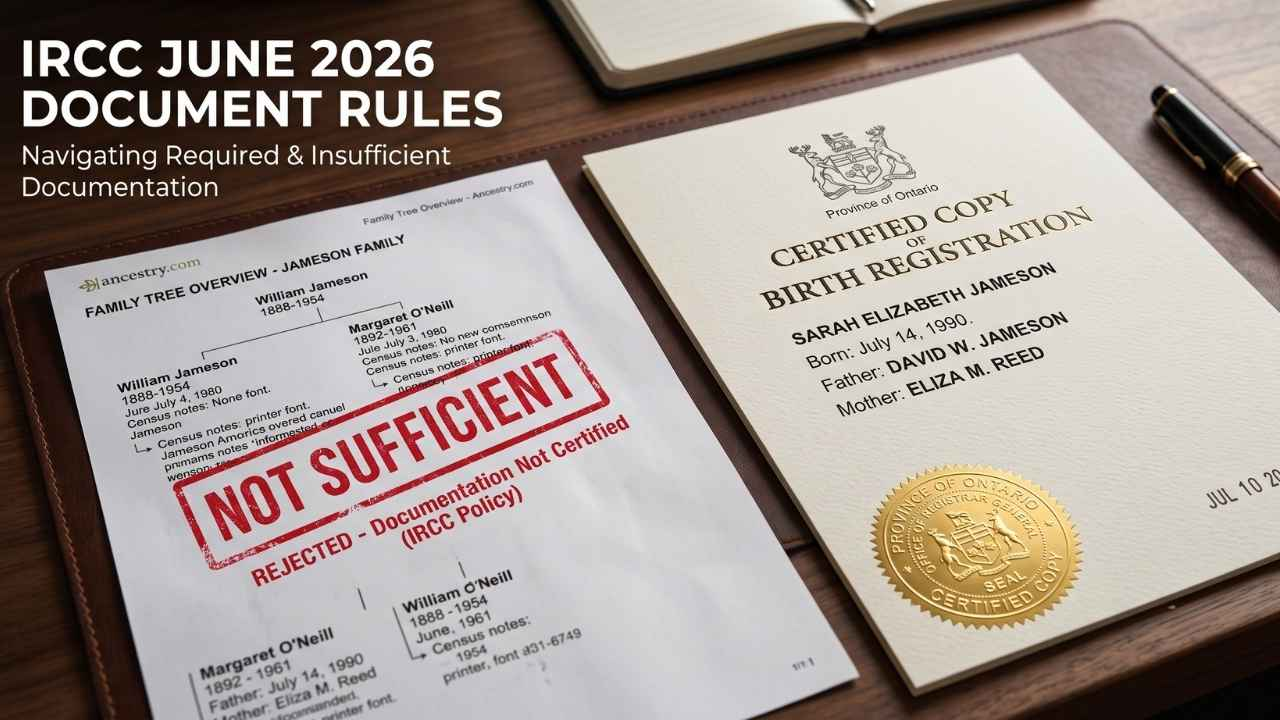
On June 17 and 18, 2026, IRCC updated the CIT 0014 Document Checklist and its proof of citizenship guidance page. The core change: your application cannot be supported solely by third-party records.
Every generation in your line of descent must now be proven with documents from the original issuing authority. That means a civil registry, vital statistics office, or provincial archive. A printout from Ancestry or FamilySearch no longer stands on its own.
If you spent months building your family tree online, do not panic. That research still matters. It just needs to be converted into official paper. This guide shows you exactly how.
Key Takeaways
- IRCC updated form CIT 0014 on June 17, 2026, adding a new requirement: applications cannot rely solely on third-party records.
- Genealogy site printouts (Ancestry, FamilySearch, MyHeritage) are now research tools, not proof.
- Every generation in your chain needs a record from the original source authority.
- If a record truly cannot be obtained, IRCC wants a written explanation plus evidence of your genuine efforts to get it.
- Applications filed before the June update may still be judged against the stricter standard. IRCC has not confirmed how it treats files already in the queue.
What Changed, in Plain Terms
The June 2026 CIT 0014 update added three core requirements to the top of the checklist. Your documents must be authentic, reliable, and verifiable for every generation in your application. Your application cannot be supported solely by third-party records. And where an official record is missing, you must show real effort to obtain it.
Before this update, many applicants submitted family trees and record images downloaded from genealogy platforms. Some of those applications were approved. That door is now closed.
Think of it this way. A genealogy site tells you where the proof exists. IRCC now wants the proof itself, issued by the office that created it or legally keeps it.
Why IRCC Made This Change
The tightened checklist landed weeks after IRCC asked some certificate holders to return their documents. On June 13, 2026, IRCC emailed several self-represented applicants who had received citizenship by descent certificates under Bill C-3, directing them to surrender those certificates pending a file review.
Then on June 18, IRCC confirmed it had paused finalizing some applications while it reviewed how weakly documented files were approved.
The message between the lines is simple. Files built on printouts caused a problem. IRCC fixed the standard so it does not happen again. We covered the surrender letters in detail in our citizenship certificate surrender notice guide.
Worried your file relies too heavily on genealogy records? Get it reviewed before IRCC does. Book a Strategy Consultation with Amir Ismail, RCIC #R412319.
What Counts as an “Original Source Authority” by Document Type
An original source authority is the government office, registry, or archive that created a record or is legally responsible for keeping it. For most vital events, that means a provincial vital statistics office or its archive. The sections below break this down by document type.
Birth Certificates
A birth certificate is acceptable when it is issued by the vital statistics office or provincial archive of the province where the birth happened. Each province holds its own records, so where you request the certificate depends on where your ancestor was born.
Order a certified copy or long-form certificate directly from the province. A scan of the same certificate found on a genealogy site does not carry the same weight, because IRCC cannot verify the chain of custody.
Marriage Certificates
A marriage certificate is acceptable when it comes from the vital statistics office of the province where the marriage took place. Marriage records matter more than many applicants expect. They are the connective tissue that links maiden names, married names, and generations together.
Am I a Canadian citizen by descent?
Trace your family line one generation at a time. Each link is tested against the law in force when that person was born, so you see exactly where your chain holds and where it breaks. About three minutes, and no account needed.
Check my family lineIf your line includes name changes, request the marriage record for every generation where the surname shifts. One missing link can stall the whole chain.
Baptismal and Church Records (Quebec Note)
A baptismal or parish record is acceptable as birth evidence for ancestors born before civil registration became standard practice. In Quebec, church registers legally doubled as the civil record for a long stretch of the province’s history, so IRCC treats certified copies from the proper archive as strong evidence.
For Quebec ancestors, request records through BAnQ (Bibliothèque et Archives nationales du Québec) or the Directeur de l’état civil, depending on the year. Our French-Canadian ancestry guide walks through the Quebec paper trail step by step.
What If You Already Gathered Documents from a Genealogy Site?
Your research is not wasted. It is your map. Here is how to convert it into an IRCC-ready file.
Step 1: List every record in your chain. Write down each birth, marriage, and death record you found online, with the person, event date, and location.
Step 2: Identify the issuing authority for each record. The genealogy site usually names the source archive or registry in the record details.
Step 3: Request certified copies directly from each authority. Order from the provincial vital statistics office or archive, not from the platform.
Step 4: Keep every receipt and email. If an office says a record does not exist, that correspondence becomes your proof of genuine effort.
Step 5: Write an explanation letter for any record you cannot get. IRCC wants to know why the document is unavailable, what you tried, and what you are submitting instead.
    A[Record found on genealogy site] --> B{Who issued the original?}
    B --> C[Provincial vital statistics office]
    B --> D[Provincial archive]
    B --> E[Church register held by archive e.g. BAnQ]
    C --> F[Order certified copy]
    D --> F
    E --> F
    F --> G{Copy received?}
    G -->|Yes| H[Add to application file]
    G -->|No| I[Save refusal or no-record letter]
    I --> J[Write explanation letter + submit alternative evidence]
    J --> H
How AIA Verifies Documents Before Submission
At Amir Ismail & Associates, every citizenship by descent file goes through a document audit before anything reaches IRCC. We check three things. First, that every generation is covered by an original-authority record. Second, that names, dates, and places match across the chain.
Third, that marriage records or name-change orders bridge any gaps, and that any missing record is backed by written proof of effort and a clear explanation.
This is exactly the standard IRCC formalized in June 2026. We have applied it as internal practice for years, because weak files get returned, delayed, or now, reviewed after approval. Our complete document guide for Bill C-3 applications covers the full checklist.
With proof of citizenship processing now sitting at roughly 33 months and a queue of about 136,000 files, you cannot afford a returned application. See our current processing time breakdown for what that wait really looks like.
Frequently Asked Questions
Are Ancestry or FamilySearch records still useful for a citizenship by descent application?
Yes, as research tools. Genealogy platforms help you locate which archive or registry holds the original record. The June 2026 CIT 0014 update means those printouts cannot serve as your proof on their own. You must order certified copies from the original issuing authority.
What does IRCC accept when an original document cannot be obtained?
IRCC asks for two things. A written explanation covering why the document is unavailable, what steps you took, and what alternative evidence you are submitting. And proof of your genuine efforts, such as emails or letters from the archive confirming no record exists.
Does the new documentary standard apply to applications already in the queue?
IRCC has not issued specific guidance on this. Applicants who filed before June 17, 2026 may still find their files assessed against the stricter standard. If your submitted file leans on genealogy printouts, prepare original-authority copies now so you can respond quickly if IRCC requests them.
Which form is the CIT 0014?
CIT 0014 is IRCC’s Document Checklist for the Application for a Citizenship Certificate. It lists every document required for proof of citizenship, including citizenship by descent claims under Bill C-3. The version dated June 2026 introduced the tightened documentary standard. The current version is available on the official CIT 0014 page.
The rules changed fast, and files that looked fine in May can fail the June standard. If you want a professional eye on your document chain before you submit, Book a Strategy Consultation.
About the Author: Amir Ismail is a Regulated Canadian Immigration Consultant (RCIC #R412319), licensed by the College of Immigration and Citizenship Consultants (CICC). He founded Amir Ismail & Associates in 1991 and has served 25,000+ clients from offices in Toronto, Dubai, and Karachi. Book a Strategy Consultation for advice specific to your case.
Access More Canadian Citizenship By Descent Resources By Amir Ismail
Proof of Citizenship From the US: Does a Representative in Canada Save Time?
A representative in Canada does not move your proof of citizenship from the US to…

Canadian Citizenship for an Adopted Child Abroad: Grant or PR?
If you are a Canadian in the US who adopted a child, you have two…

Canadian Passport Application From the USA: Guarantor, References and Fees
A Canadian passport application from the USA is a mail-in process. You fill out form…
British Home Children Citizenship by Descent: Who Qualifies Under Bill C-3
Many descendants of British Home Children can claim Canadian citizenship by descent. The key fact…
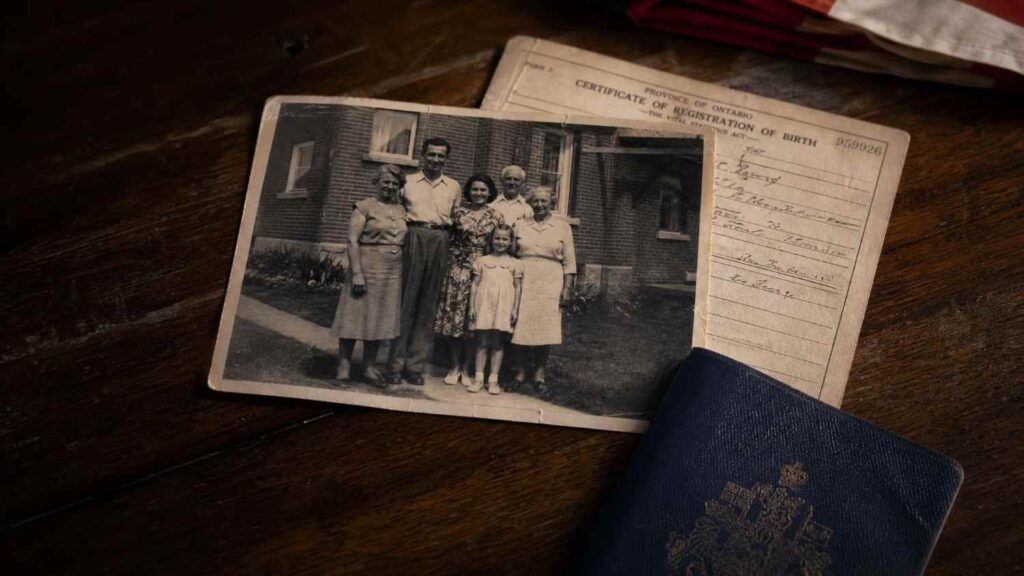
Proof of Canadian Citizenship Wait by Application Month: Why Your Date Matters
Your proof of citizenship wait by application month is not one number. The processing times…

American Dual Citizenship With Canada: What Changes and What Does Not
Yes, you can keep both. American dual citizenship with Canada is legal in both countries,…

Moving to Canada as a New Citizen by Descent: Health Coverage by Province
If you are moving to Canada as a new citizen by descent, your health coverage…
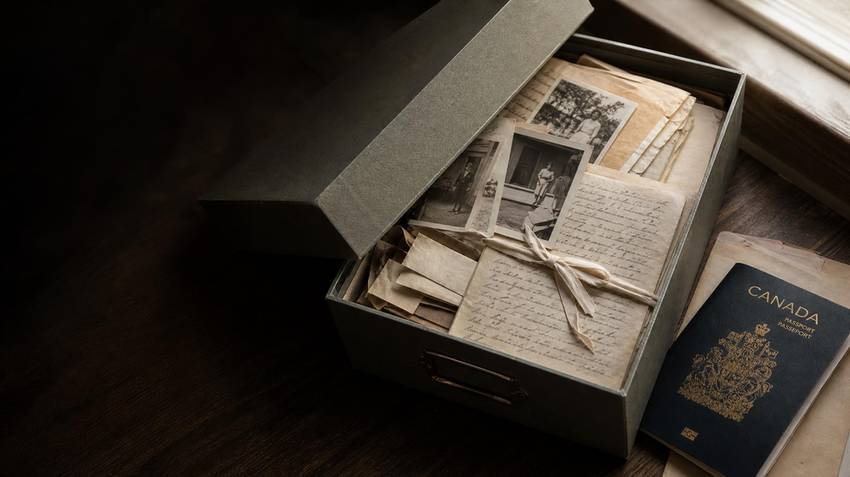
Is 1867 a Cut-Off for Citizenship by Descent? Why Older Ancestors Still Count
No, 1867 is not a legal cut-off, so you can still pursue citizenship by descent…
Bill C-3 Second Generation Children: Are Your Kids Canadian?
If you are an American who became Canadian under Bill C-3, your children born before…

After Your Citizenship Certificate: What It Does Not Give Americans
After your Canadian citizenship certificate arrives, you are a Canadian citizen on paper, but the…

Section 8 Lost Canadians: Bill C-3 Gives Back Citizenship Lost at Age 28
Section 8 Lost Canadians: Bill C-3 Gives Back Citizenship Lost at Age 28 If you…

Bill C-3 Reversal Risk: Could You Lose Citizenship by Descent?
Bill C-3 Reversal Risk: Could You Lose Citizenship by Descent? By Amir Ismail, RCIC #R412319…
Proof of Canadian Citizenship Processing Time 2026 (34-Month Wait and 130,700-File Queue Explained)
Proof of Canadian Citizenship Processing Time 2026 (34-Month Wait and 130,700-File Queue Explained) IRCC’s proof…
Canadian Citizenship by Descent: Eligibility Checklist for Americans (Bill C‑3)
Do I Qualify for Canadian Citizenship by Descent? The American’s Eligibility Checklist By Amir Ismail,…
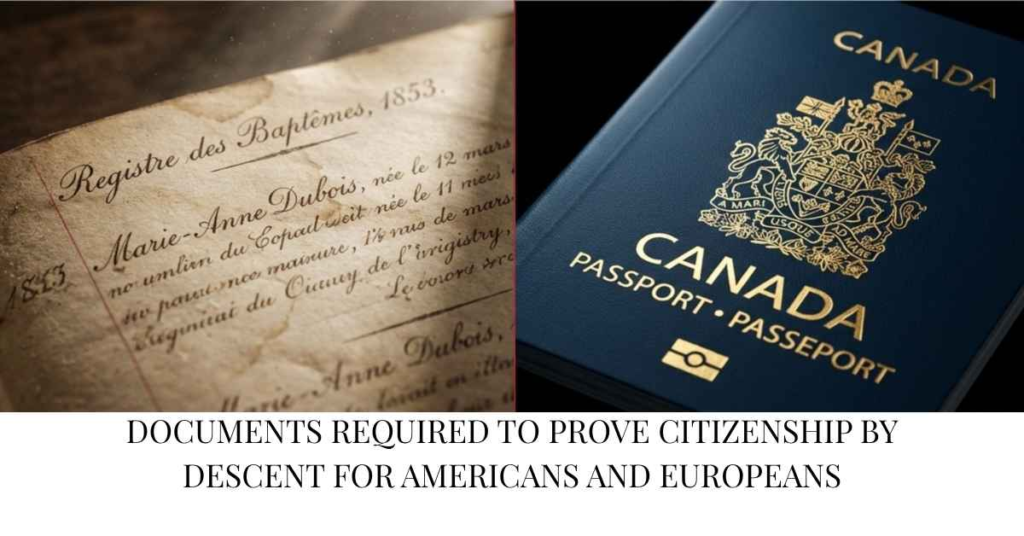
Canadian Citizenship by Descent: Complete Document Guide (Bill C-3 2025)
Baptismal Records for Canadian Citizenship by Descent: 2026 Guide
Baptismal Records for Canadian Citizenship by Descent: A Complete Ordering Guide (2026) LAST UPDATED: AUGUST…
Six Wrong Reasons People Rule Themselves Out of Canadian Citizenship by Descent
Six Wrong Reasons People Rule Themselves Out of Canadian Citizenship by Descent By Amir Ismail,…

Married to a Brand-New Canadian Citizen? What Descent Does (and Does Not) Do for You
Married to a Brand-New Canadian Citizen? What Canadian Citizenship By Descent Does (and Does Not)…
Canadian Vital Records for Citizenship by Descent: How to Find the Right Office in Every Province
Mandatory Vital Records for Canadian Citizenship by Descent (Canada‑Wide: Every Province, Every Office) By Amir…
Ancestor Birth Record Missing? IRCC Alternatives 2026
When the Birth Certificate Never Existed: Proving Your Canadian Ancestor’s Identity to IRCC By Amir…
Not sure you qualify?
Take our Canadian citizenship eligibility quiz in about two minutes, read the Canadian citizenship guide, then Book a Strategy Consultation with Amir Ismail, RCIC R412319, to confirm your path.