
Practice-Ready Assessment Canada: The Complete Pathway for International Medical Graduates, work permit and Permanent Residence Options
Written by Amir Ismail, RCIC – Last updated 27 July, 2026
Canada needs doctors. If you trained and practiced medicine outside Canada, there is a real path to a Canadian medical license that does not require you to repeat residency. This guide walks through exactly how the Practice-Ready Assessment works, which of the nine provinces fits your background, and how your Return of Service work can lead straight to permanent residency.
Key Takeaways
- The Practice-Ready Assessment lets qualified international medical graduates skip a full Canadian residency, replacing it with a 12-week supervised clinical assessment.
- Eligibility rules vary sharply by province. Saskatchewan and Manitoba accept as little as 12 months of postgraduate training; Ontario requires 48 months combined and strict PR/citizenship status upfront.
- The “currency of practice” rule quietly disqualifies more applicants than any exam. Non-clinical survival jobs do not count toward it, and gaps can end your eligibility before you even apply.
- A 2023 federal policy exemption lets self-employed physicians (NOC 3111/3112) count fee-for-service Return of Service work toward Express Entry, a real path from provisional license to permanent residency.
- Most provinces cap lifetime assessment attempts at two. This is a one-shot process in most cases, not a trial run, so matching your profile to the right province the first time matters enormously.
What Is the Practice-Ready Assessment Pathway?
The Practice-Ready Assessment is an accelerated licensing route for international medical graduates who already completed postgraduate training and independent practice abroad. It replaces a full Canadian residency with a 12-week, workplace-based clinical evaluation supervised by a licensed physician assessor. The Medical Council of Canada sets national standards, but nine provinces run their own independent programs.
You didn’t spend years building a medical career just to start over. That’s the exact problem this pathway was built to solve. If you’ve already practiced independently, Canada wants to test what you know, not make you relearn it from scratch.
The assessment itself is simple to picture. You work in a real clinic or hospital for twelve weeks. A trained physician assessor watches how you handle patients, make decisions, manage charts, and communicate. That’s it. No lectures. No repeated coursework. Just proof that you can practice safely at a Canadian standard.
Do I have to repeat a Canadian residency to practice medicine here?
No, IMGs who qualify for PRA do not repeat a Canadian residency. Instead they complete a 12-week supervised clinical assessment in a real practice setting. Eligibility depends on your postgraduate training and years of independent practice.
This is the single biggest relief point for most applicants. You already did the hard part. The system just needs to confirm it in a Canadian context.
Who runs the Practice-Ready Assessment framework?
The Medical Council of Canada oversees the National Assessment Collaboration (NAC) PRA framework nationally. Nine provincial medical regulatory colleges administer their own independent assessment programs under this framework. Prince Edward Island, Yukon, Nunavut, and the Northwest Territories do not currently run PRA programs.
Here’s the part that trips people up. There is no single national application. Each province sets its own rules on top of the shared national exam standards. That’s why picking the right province matters as much as passing the exams.
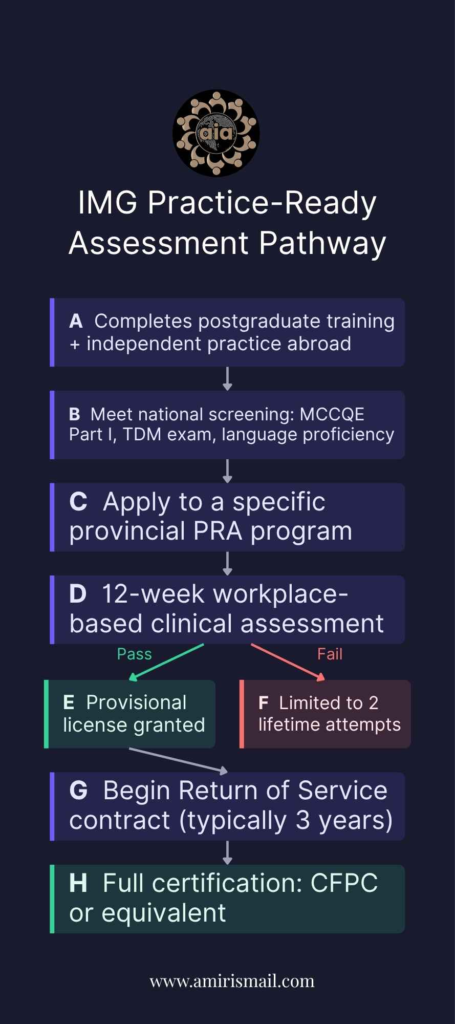
The following chart demonstrate the flow of steps for International Medical Graduates for Practiec-Ready Assessment in Canada
https://amirismail.com/book-a-consultation/skilled-worker if you want to know which province actually fits your training history before you spend money on exams.
Am I Eligible for a Practice-Ready Assessment Program?
Eligibility depends on three things: your postgraduate training length, your years of independent practice, and your recent clinical hours. Requirements vary sharply by province, ranging from 12 months of training in Saskatchewan to 48 months combined in Ontario. Standard exams like the MCCQE Part I and TDM exam are required almost everywhere.
Before you touch a single application form, you need to know where you actually stand. Not where you hope you stand. Provinces check three specific things, and missing any one of them can end your application before it starts.
Here’s what regulators are really measuring:
- Postgraduate training length: how many months of formal training you completed after medical school
- Independent practice years: how long you’ve worked as the most responsible physician, not as a resident or assistant
- Currency of practice: how recently and how consistently you’ve been practicing clinically
What is the currency of practice rule and why does it disqualify so many applicants?
The currency of practice rule requires a minimum number of recent clinical hours, usually within the past three years, as the most responsible physician. Provinces reject candidates with significant gaps or episodic practice patterns. Observerships, shadowing, and telemedicine do not count toward this requirement.
This is where good doctors get quietly knocked out. You can have a strong resume and still fail this test if your recent hours don’t add up. British Columbia requires 960 hours in the past three years. New Brunswick sets the bar lower at 450 hours. Every province counts differently, so check the exact number before you assume you qualify.
Which exams do I need before I apply?
Most family medicine streams require the MCCQE Part I, the Therapeutic Decision-Making (TDM) exam, and often the NAC Examination (OSCE). English or French language testing, such as IELTS or OET, is also mandatory. Credential verification runs through the physiciansapply.ca portal.
Here’s your standard exam checklist:
- MCCQE Part I: computer-based exam on medical knowledge and clinical decision-making
- TDM exam: 3.5-hour assessment of therapeutic judgment, mandatory for most family medicine streams
- NAC Examination (OSCE): half-day clinical readiness exam, required or preferred in several provinces
- Language test: IELTS, OET, or CELPIP, generally requiring 7.0 per component on IELTS Academic
- Credential verification: completed through physiciansapply.ca, confirming your degree is listed in the World Directory of Medical Schools
One more thing worth saying plainly: the TDM exam allows a maximum of four lifetime attempts, with no more than two passes, and your score only stays valid for two to three years. Time your exams around your target province’s intake dates, not the other way around.
Comparing the 9 Provincial PRA Programs
Each province sets its own training, practice, and immigration status requirements. Saskatchewan and Manitoba accept as little as 12 months of postgraduate training. Ontario requires 48 months combined and strictly requires permanent residency or citizenship at the time of application.
This is the part where most applicants waste months applying to the wrong province. Your training history points to specific provinces. Some doors are wide open for you. Others are closed no matter how good a physician you are. Know the difference before you spend money.
| Province | Minimum PG Training | Minimum Independent Practice | Currency of Practice Required | Immigration Status Required at Application |
|---|---|---|---|---|
| British Columbia | 24 months (incl. 7 core rotations) | 24 months | 960 hours in past 3 years | PR/Citizen preferred (varies by sponsorship) |
| Alberta | 24 months (must be continuous) | Case-by-case | Evaluated by CPSA | Eligible to work in Canada |
| Saskatchewan | 12 months (internship accepted) | 36 months | 6 months in past 3 years (as of June 2026) | None required (sponsorship available) |
| Manitoba | 12 to 24 months | 36 months in past 5 years | 3 years active within past 5 years | PR, Citizen, or Work Permit eligible |
| Ontario | 48 months combined training and practice | Included in combined 48 months | 960 hours (720 in-person) in past 3 years | PR or Citizen strictly required |
| Quebec | Equivalent to Quebec residency | 12 months (for sponsored professor) | Currently active in practice | Eligible to work in Canada (RSQ sponsorship) |
| New Brunswick | 12 to 24 months (incl. 7 core rotations) | 12 to 24 months | 450 hours in past 3 years | PR, Citizen, or legally entitled to work |
| Nova Scotia | 12 to 24 months | 24 months | 6 months in past 3 years | Eligible to work in Canada |
| Newfoundland & Labrador | Equivalent to Canadian standards | Assessed by CPSNL | Significant gaps (>1 year) penalized heavily | PR or Citizen |
Which province has the easiest entry requirements for IMGs?
Saskatchewan and Manitoba have the most accessible postgraduate training requirements, accepting a 12-month internship if paired with several years of independent practice. Saskatchewan also does not require permanent residency at the time of application. This makes it a common entry point for offshore physicians.
If your training was shorter than 24 months but your practice history is long, Saskatchewan and Manitoba deserve your first look, not Ontario or British Columbia.
Which province is best if I don’t have permanent residency yet?
Saskatchewan does not require permanent residency or citizenship to apply, and the Saskatchewan Health Authority frequently sponsors PR applications for successful candidates. Alberta uses an employer-sponsorship model through DoctorJobsAlberta.com that also bypasses the need for prior PR status. Most other provinces require PR or citizenship upfront.
This matters more than people realize. Applying to Ontario without PR isn’t just harder, it’s a non-starter. Ontario requires PR or citizenship at the time of application, full stop.
Which province works for French-speaking or bilingual physicians?
New Brunswick runs Canada’s only fully bilingual PRA program, with assessments available in English or French. Quebec’s restrictive permit pathway requires passing the Office québécois de la langue française exam and includes a specific mutual recognition route for French-trained physicians.
If French is your working language, New Brunswick gives you flexibility that no other province offers. Quebec is a different track entirely, with its own permit structure and language exam.
Book Your Strategy Assessment to map your exact training and practice history against these nine provinces before you commit to one.
What Happens After You Pass the Assessment?
Passing the 12-week assessment grants a provisional license, not full independent practice. Physicians must complete a Return of Service contract, typically three years, in an assigned community. Full certification through the College of Family Physicians of Canada or equivalent is usually required within five to six years.
Passing the assessment feels like the finish line. It isn’t. It’s the starting gate for the next phase of your career in Canada. You’re now a licensed physician on a provisional or defined register, working under a legal commitment.
How long is the Return of Service commitment?
The Return of Service commitment is three years in nearly every province, tied to practicing full-time in a designated underserved or rural community. Breaking the contract can trigger severe financial penalties, such as British Columbia’s structured estimate of $90,000 plus compound interest.
During this period, some provinces add extra layers of support and oversight:
- Alberta runs a bifurcated model: a three-month Preliminary Clinical Assessment followed by a three-month Probationary Assessment, where you bill independently while a supervisor reviews your charts
- Manitoba mandates a formal one-year mentorship program after the assessment, called the International Medical Graduate Mentorship and Clinical Enhancement program
- Ontario restricts your Return of Service location to areas with a Rurality Index score of 40 or higher, or specific Northern Urban Referral Centres like Sudbury and Thunder Bay
- Quebec’s restrictive permit prohibits private or independent practice entirely and must be renewed annually
This is a real, binding legal contract. Read it as carefully as you’d read a mortgage. Location, hours, and penalty clauses vary by province, and breaking one has serious financial consequences.
What if I fail the assessment?
Most provinces cap lifetime PRA attempts across Canada at two. Failing assessments in two different provinces effectively closes this pathway permanently. The 12-week assessment itself is purely evaluative, with no remedial or training component.
This is the mistake that costs people their entire Canadian medical career. The assessment is not training. It’s a test of whether you can already perform at a Canadian standard, starting on day one. Regulators are explicit about this. Don’t walk in hoping to learn as you go.
How Does This Pathway Lead to Canadian Permanent Residency?
A 2023 federal public policy exemption allows physicians in NOC 3111 and NOC 3112 to count self-employed, fee-for-service work toward Express Entry, reversing a longstanding barrier. This lets IMGs use their Return of Service work experience toward the Canadian Experience Class or Federal Skilled Worker Program.
Here’s the problem this fixed. Canadian physicians almost always bill as independent contractors. For years, that self-employed status quietly disqualified them from claiming their own Canadian work experience for immigration purposes.
If you were doing your Return of Service in good faith, you were still stuck outside the points system that was supposed to reward exactly that experience. You can review the official policy directly on IRCC’s Canadian Experience Class page
Can self-employed physicians qualify for Express Entry?
Before April 2023, self-employed work experience did not count toward Express Entry eligibility, which excluded most Canadian physicians since they bill on a fee-for-service basis. The 2023 Temporary Public Policy exempts NOC 3111 and 3112 physicians from this rule. Candidates must avoid checking “self-employed work” in their Express Entry profile to apply the exemption correctly.
This one detail trips up qualified physicians constantly. One wrong checkbox, and you lose the exemption. Your profile has to reflect this policy correctly from the start, not get corrected after an invitation arrives.
How do I use my Return of Service work experience for the CRS score?
Once a physician accumulates validated Canadian clinical work experience during their Return of Service, that experience can now count toward Comprehensive Ranking System eligibility. IRCC also runs category-based selection draws targeting healthcare occupations, which lowers the points needed for an invitation. Provincial programs like Ontario’s Workforce Priority Stream add 600 points through direct nomination.
Put plainly, here’s the sequence most physicians actually follow:
- Pass your provincial PRA and receive a provisional license
- Begin your Return of Service contract on a facilitated temporary work permit, often without a full Labour Market Impact Assessment
- Accumulate one year of validated Canadian clinical experience as a self-employed physician
- Apply through Express Entry using the NOC 3111/3112 exemption, or through a provincial nominee stream like Ontario’s Workforce Priority Stream
- Receive an Invitation to Apply, often accelerated through healthcare-targeted category draws
Ontario’s approach deserves a specific mention. The province removed old requirements that a sponsoring employer needed three or more employees and over $500,000 in gross revenue, which used to shut out solo and small-practice physicians entirely. Getting your Express Entry profile documented correctly from day one, including how you report fee-for-service income, prevents this exemption from being lost by accident.
Common Mistakes That Disqualify IMG Applicants
The most common disqualifying mistake is losing currency of practice while studying for exams in Canada. Taking a non-clinical survival job to cover living costs can quietly age a physician out of eligibility. Sequencing your exams around your target province’s intake dates matters as much as passing them.
This section exists because it’s the mistake nobody warns you about early enough. You move to Canada. You need income while you study for the MCCQE and TDM. You take a job that isn’t clinical work, because it’s the job available.
Eighteen months later, your clinical hours have quietly fallen below the threshold your target province requires. You didn’t do anything wrong. You just didn’t know the clock was running.
Why do survival jobs hurt my eligibility?
Non-clinical work, including administrative or research roles, does not count toward currency of practice hours. Physicians who take survival jobs while preparing for exams risk falling below the required recent clinical hours. This creates a structural trap where the path to eligibility can quietly close while an applicant is doing everything they think is right.
A few other mistakes worth naming directly:
- Assuming observerships count: shadowing, telemedicine, and observership roles do not count as independent practice hours, no matter how many you complete
- Treating the assessment as training: the 12-week clinical field assessment is purely evaluative; provinces expect Canadian-standard performance from day one, not gradual improvement
- Failing in two provinces: most provinces cap lifetime attempts across Canada at two; a second failure anywhere typically ends this pathway for good
- Checking “self-employed” on Express Entry: this single checkbox can cancel out the entire 2023 NOC 3111/3112 exemption
- Letting TDM exam validity lapse: TDM scores are only valid for two to three years, so timing your application to your target province’s intake matters as much as passing the exam
The pattern behind almost every disqualification is the same: a gap between what an applicant assumes counts and what a provincial college actually counts. Assumptions are expensive here. Verifying every requirement against the specific province you’re targeting, before taking a job, booking an exam, or committing to a move, protects your exam timeline, your income, and your family’s plans.
Which Canadian Province Fits Your Profile as an International Medical Graduate?
Given how differently each province defines eligibility, the fastest way to move forward is to match your specific background against the provinces most likely to accept you. Below is a strategic breakdown based on common IMG profiles.
| Your Profile | Best-Fit Province(s) | Why |
|---|---|---|
| No permanent residency or citizenship yet | Saskatchewan, Alberta | Saskatchewan accepts applications without prior PR and frequently sponsors PR for successful candidates. Alberta’s employer-sponsorship model through DoctorJobsAlberta.com bypasses the need for upfront PR status. |
| French-speaking or bilingual | New Brunswick, Quebec | New Brunswick runs Canada’s only fully bilingual clinical assessment. Quebec offers a distinct restrictive permit pathway with a dedicated mutual recognition route for French-trained physicians. |
| Only 12 months of postgraduate training | Saskatchewan, Manitoba | Both accept a 12-month rotating internship if combined with several years of independent practice, unlike BC or Ontario, which require 24 to 48 months of formal training. |
| Established PR already living in Ontario | Ontario | Demanding (48 months combined training and practice), but ideal for physicians already settled in the province who meet the 720 in-person clinical hours and want to avoid relocating. |
| Medical specialist, not family medicine | Nova Scotia, Manitoba, Quebec | Most PRA programs serve family medicine only. Nova Scotia’s PACE program, Manitoba’s Specialty Practice stream, and Quebec’s restrictive permits offer dedicated pathways for specialists and hospitalists. |
The takeaway here is simple. Don’t apply to the province you’ve heard of. Apply to the province that matches your actual training history. A strong physician with 14 months of training and five years of practice is a weak Ontario candidate and a strong Saskatchewan candidate. Same doctor, different odds.
Book Your Strategy Assessment to get a written match between your credentials and the provinces most likely to say yes, before you spend a single dollar on exams or applications.
Amir Ismail, RCIC #R412319, is the founder of Amir Ismail & Associates, an immigration consultancy with offices in Toronto, Dubai, and Karachi. Last updated July 2026.
Access More Healthcare Immigration Options for Canada
Express Entry Healthcare Draws 2026: Full CRS Breakdown
Express Entry Healthcare Draws 2026: Complete IRCC CRS Breakdown (169 to 475) Last Updated: September…
Latest Express Entry Healthcare Draw June 25, 2026: CRS 475 Explained (And What To Do Next)
Latest Express Entry Healthcare Draw June 25, 2026: CRS 475 Explained (And What To Do…
Express Entry Reforms 2026: How to Prepare Now | AIA
How to prepare for Canada’s 2026 Express Entry reforms: a practitioner’s guide Last Updated: June…

Express Entry Draw Results 2026 – Latest CRS Scores & IRCC Categories | Amir Ismail
Express Entry Draw Results 2026: All CRS Scores, Dates & IRCC Categories Live Tracker —…

CRS Score 501 to 600: Express Entry Strategy to Get an ITA
CRS Score 501 to 600: Your Express Entry Strategy for an ITA (2026) Last Updated:…
How to Immigrate to Canada as a Physiotherapist 2026
Canadian Immigration Guide · 2026 How to Immigrate to Canada as a Physiotherapist By Amir…