Not sure you qualify? Take our Canadian citizenship eligibility quiz first.
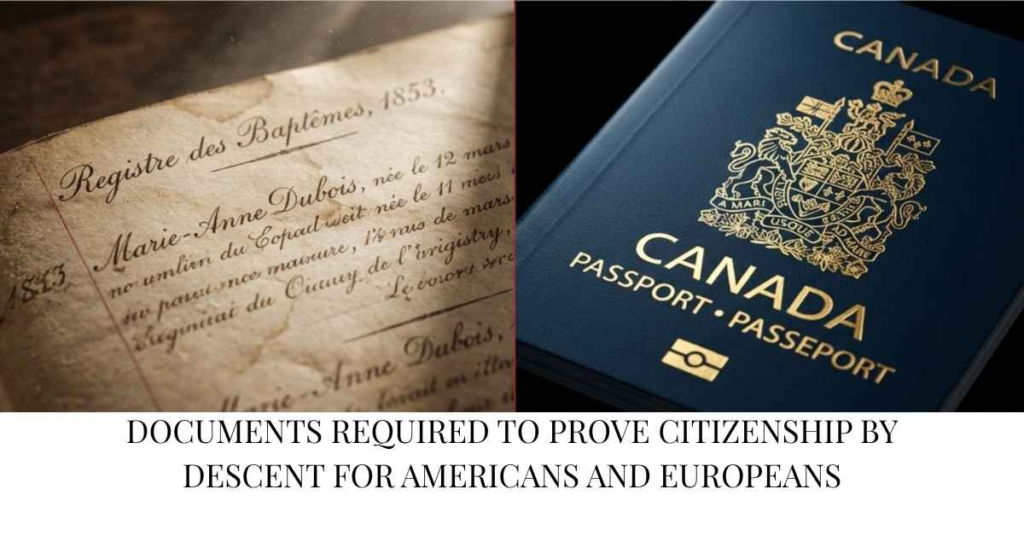
If your Quebec ancestor was born before 1921, there may be no civil birth certificate in existence for them. IRCC accepts baptismal records as a direct substitute, provided the baptism happened within a reasonable time of the birth. For millions of Franco-American families tracing a citizenship claim through Quebec, a baptismal act from a Catholic parish register is not a fallback document. It is the primary document.
Quick Answer for IRCC Applications: To claim Canadian citizenship by descent through a Quebec ancestor born before 1921, you need documents issued by the original authority. IRCC says an application cannot be supported solely by third-party records such as genealogy printouts, so order a copy of the record from BAnQ or the Directeur de l’état civil.
This guide explains what a baptismal record actually contains, why IRCC treats it as primary evidence, exactly which office issues the certified version you need, how to find the record before spending money on an order, and what to do when the archives come up empty.
If the baptism took place more than 100 years ago, request a copy of the record from BAnQ. If it is less than 100 years old, request it from the Directeur de l’état civil. IRCC asks for documents issued by the original authority.
Why Does IRCC Accept a Baptismal Record for Canadian Citizenship by Descent Instead of a Birth Certificate?
IRCC’s list of other documents for a missing birth certificate or birth record includes a baptismal certificate or record, including copies or certified records, issued by the original authority, as long as the baptism took place within a reasonable time after the birth (IRCC, CIT 0001 paper guide). BAnQ explains that the Catholic church kept two copies of each record, a parish copy and a government copy sent each year to the local court clerk’s office, that the right to keep vital records later widened to Protestant denominations and Jewish communities, and that since the 1994 changes to the Civil Code of Québec, births, marriages and deaths are registered solely with the Registrar of Civil Status.
A parish priest recorded every baptism in the parish register, and a duplicate went to the local courthouse annually. The church register and the provincial record were one and the same source, just held in two places.
Because IRCC lists baptismal records among the accepted other documents when a birth record is missing, a copy of a baptismal record from BAnQ can serve that purpose. In June 2026, IRCC updated its guidance to say documents must be issued by the original authority, such as a civil registry or vital statistics office, and that an application cannot be supported solely by third-party records. A genealogy website printout or a photograph of a baptismal record from a family scrapbook is a research lead, not a substitute.
IRCC does impose one condition: the baptism must have occurred within a reasonable time after the birth. In practice, most French-Canadian Catholic baptisms happened within days of birth. Delays of several weeks are generally acceptable. Baptisms recorded months or years later require a written explanation. If the baptism record is the only surviving document, you should note its date relative to the birth date and include any supporting evidence that the delay was ordinary for the region and era.
For the broader context of how these Quebec records fit into a citizenship application, see our guide on French-Canadian ancestry and Canadian citizenship by descent.
What Information Does a Quebec Baptismal Record Actually Contain?
A Quebec Catholic baptismal record is one of the most information-dense documents in genealogical research. It typically contains:
- The child’s full baptismal name
- The exact date of baptism
- The name of the parish and the officiating priest
- The full names of both parents (including the mother’s maiden name)
Many baptismal records also name the godparents and record their relationship to the family or their place of origin. This is genealogically useful but also legally useful: a godparent named from the same village as the father can help you locate additional records confirming the family’s geographic and social connections.
Marriage acts in the same parish registers are even more powerful. A Catholic marriage record in Quebec historically required recording the names of both sets of parents for both the bride and the groom. One marriage act can therefore establish three consecutive generations in a single document. If you can locate your ancestor’s marriage record before ordering anything, it will often give you their parents’ names, approximate ages, and parish of origin, which are all the data points you need to request the next record in your lineage chain.
The records are handwritten in French. They use Latin for standardized religious phrases. IRCC accepts French-language documents without translation, as French is one of Canada’s two official languages.
How Do You Find Your Ancestor’s Baptismal Record Before Ordering Anything Official?
To help BAnQ locate the record, have the exact parish name, the exact date of the baptism, the filiation (parents’ full names), and the folio and act numbers ready. Quebec has some of the best-digitized genealogical records in the world, and three databases let you identify the exact record before you order.
Quebec has some of the best-digitized genealogical records in the world. Three databases let you identify the exact record before spending a dollar on an official order.
- LAFRANCE (available through GenealogyQuebec.com) covers Catholic baptisms from 1621 to 1861. If your ancestor was baptized before 1861, start here. View the scanned page image, not just the index entry. Write down the exact parish name, the baptism date, the act number, and the folio reference. These details help BAnQ locate the record.
- The Drouin Collection covers Quebec records up to 1968 with over 100 million images. If your ancestor was baptized between 1861 and 1921, Drouin is your primary source, since LAFRANCE’s baptism index ends at 1861.
Am I a Canadian citizen by descent?
Trace your family line one generation at a time. Each link is tested against the law in force when that person was born, so you see exactly where your chain holds and where it breaks. About three minutes, and no account needed.
Check my family line- PRDH-IGD (Universite de Montreal) covers 1621 to 1849 with Family Reconstructions that link multiple documents together. This is especially useful when a name was spelled inconsistently across records, which happened constantly in Quebec parish registers.
One naming pattern to watch for in baptismal records: some Quebec families used “dit” names. A person baptized as “Jean Auger dit Robichaud” might appear as “Auger” in one record and “Robichaud” in another, or the dit portion might disappear entirely when the family moved to the United States. If your ancestor’s surname seems to shift across generations, search both forms of the name in each database. Quebec genealogists and IRCC adjudicators both treat dit variations as ordinary, provided the surrounding details such as birth year, parents, and parish remain consistent.
For a full Quebec research guide covering all record types and how they support a citizenship application, see our article on French-Canadian ancestry and Canadian citizenship by descent. That article covers the research workflow from start to finish. This guide picks up from where the record is found: how to order the certified document IRCC will accept.
Once you have confirmed the record exists and noted its precise details, you are ready to place an official order. The office depends on the age of the event.
When Should You Order From BAnQ vs the Directeur de l’etat civil?
Quebec vital records are divided by a strict 100-Year Rule. Depending on the date of your ancestor’s baptism, you must order from one of two specific offices:”
Events under 100 years ago: You must order a “copy of an act” from the Directeur de l’état civil (DEC).
Events over 100 years ago: You must order a “certified reproduction” from BAnQ (Bibliothèque et Archives nationales du Québec).=
BAnQ (Bibliotheque et Archives nationales du Quebec) holds records for events that occurred more than 100 years ago. For citizenship applications, BAnQ issues “certified reproductions” of the original acts from the parish registers. For events in this older period, BAnQ does not issue modern birth certificates. BAnQ says it can provide a copy of a baptismal certificate, not a birth certificate, because before 1994 births in Quebec were recorded only in municipal and parish registers. What BAnQ issues is a certified copy of the baptismal act itself, taken from the original parish register. This is the document you need.
The Directeur de l’etat civil (DEC) holds records for events from less than 100 years ago up to the present. BAnQ says the Registrar keeps the vital records that are less than 100 years old, and that each year the records that have turned 100 are sent to BAnQ. A birth from 1940 or a marriage from 1965 is a DEC request, not a BAnQ request, even though both events predate 1994. The DEC can issue a current certificate or a copy of an act from these records, and because the DEC prints the document today, it satisfies IRCC’s standard regardless of when the event occurred.
This leads to one of the most important points about Quebec records for citizenship applications: IRCC does not care when your ancestor was born. IRCC cares when the office printed the document you are submitting. A certificate printed in 1987 fails. A certified reproduction printed this month describing an 1887 event is fully accepted. The print date is what matters.
A complete explanation of this rule and its practical implications for citizenship applications is in our article on French-Canadian ancestry and Canadian citizenship by descent. For the province-wide picture of which office holds which records across all of Canada, see our guide on Canadian vital records by province.
How Do You Order a Certified Reproduction From BAnQ?
BAnQ says this service is spread across its 10 centres in Quebec, and that turnaround times can be longer depending on the number and nature of requests in a region.
Follow these steps to order your certified reproduction:
- Search BAnQ numérique: Enter the exact parish name and event details in their search interface.
- Note the exact references: If the digitized images are available, identify the folio number, the act number, and the register reference.
- Fill out BAnQ’s online form: BAnQ says requests made by phone or email are not processed, and that if you need several records you must request them in the same form.
- Wait for the quote, then pay online: BAnQ sends a quote when the documents have been located and you pay through a secure online link (the payment form is in French). Fees are $55 for Quebec residents, and $350 for the first copy plus $100 for each additional copy for non-residents. Postal delivery is not included (BAnQ, vital records page).
BAnQ says its fees include opening a case file, research, administrative processing, colour reproduction and record certification. BAnQ can also provide a letter declaring that it was unable to locate a requested document, at $350, and $100 for each additional copy.
BAnQ says that because of an exceptionally high number of requests it cannot estimate how long this service takes. It asks you not to call or email for a follow-up, even after several weeks or months, and it ships documents by Canada Post regular service within days of receiving payment.
For context on how long the overall process takes once your documents are submitted to IRCC, IRCC’s processing times tool showed about 34 months and about 130,700 files in the queue in data updated October 9, 2026. Our guide on citizenship certificate processing times in 2026 tracks these figures as they are updated.
What Do You Do When BAnQ Cannot Find the Record?
BAnQ holds the majority of surviving Quebec parish registers, but not every record survived. Fires, floods, and institutional transfers have left gaps in the archives. If BAnQ returns a no-record letter, you have three options.
- Check the diocese archives. Some Quebec parishes sent records directly to their diocese rather than to BAnQ. The Catholic dioceses of Montreal, Quebec City, Trois-Rivieres, Sherbrooke, Gatineau, and others maintain their own archives separate from BAnQ. Contact the relevant diocese directly. Most have archivists who respond to written or email requests. Bring the exact event details you confirmed in LAFRANCE or Drouin.
- Contact the original parish. Some rural parishes still hold their own historical registers, particularly those that were never fully transferred to central archives. If the parish still exists, its current priest or administrator may be able to provide a certified extract directly. IRCC accepts documents from the original issuing authority, which includes the original parish for records never transferred to a provincial archive.
- Submit the no-record letter alongside alternative evidence. IRCC changed its standards in June 2026: when a record genuinely does not exist, applicants must now show documented proof that they tried to obtain it. A no-record letter from BAnQ is that proof. Pair it with a BAnQ online search result showing the gap in coverage, a supporting affidavit, and any alternative government-issued documents that establish the facts indirectly. A death certificate naming the parents, a census record listing the household, or a sibling’s birth record identifying the same parents can all corroborate a missing birth or baptism entry.
For detailed guidance on handling document gaps in any generation of the family chain, see our complete Canadian citizenship by descent document guide.
Do French-Language Records Need to Be Translated for IRCC?
No. IRCC accepts documents in either English or French. French is one of Canada’s two official languages, and Quebec parish registers are written primarily in French with standardized Latin phrases for the religious sections. Officers reviewing citizenship by descent applications are trained to read French-language vital records. A handwritten French baptismal record from a small Quebec parish in the 1870s is valid evidence without any translation.
This applies equally to the standardized Latin phrases common in baptismal records, such as “ego infra scriptus parochus” (I, the undersigned parish priest) and “patrini fuerunt” (the godparents were). These phrases follow a consistent format across all Quebec Catholic registers, and IRCC officers are familiar with them.
The only exception worth noting is if you are supplementing your application with records from a country other than Canada or the United States where the language is neither English nor French. Those documents need an English or French translation and an affidavit from the translator, unless a translator certified in Canada did the translation. Quebec records, even handwritten ones in archaic French, do not.
A Note on the No-Record Letter Requirement
When BAnQ cannot locate a requested record, it informs you by email and provides a letter declaring that it was unable to locate the document (BAnQ). IRCC says that if you cannot provide official documents from the original authority, you must explain in writing why you cannot and show proof that you tried to get them, and it gives emails or letters with original authorities, or confirmation that the records are not available, as examples.
Submitting a gap in your documentation without a no-record letter creates a significant problem. IRCC adjudicators cannot tell whether the record was never sought or simply not found. Under the updated standards, an undocumented attempt to obtain a record is one of the named reasons IRCC may flag or return an application. The no-record letter converts an evidentiary gap into a documented exception, which IRCC handles very differently.
Plan for the no-record letter as a standard part of your document-gathering process, not an afterthought. Order it simultaneously with any other BAnQ requests so you do not lose weeks waiting for a separate acknowledgement.
Not sure you qualify?
Take our Canadian citizenship eligibility quiz in about two minutes, read the Canadian citizenship guide, then Book Your Strategy Consultation with Amir Ismail, RCIC #R412319, to confirm your path.
Frequently Asked Questions
Can I submit a photocopy I found in a family box of old papers in support of my Canadian Citizenship By Descent Application?
No. IRCC requires documents from the original issuing authority. A photocopy from a family collection, a scan from a genealogy website, or an image you downloaded from a digitized archive does not qualify as certified evidence. You must order a certified reproduction from BAnQ or a copy of an act from the DEC, depending on the age of the record. These are the documents issued by the original authority. Your family copy can serve as a research guide to identify the exact record details before you order, which is a legitimate and useful role for it.
My ancestor was baptized as a Protestant in Quebec. Does this change anything in my Application for Canadian Proof of Citizenship?
The process is essentially the same. Protestant denominations also kept parish registers in Quebec and submitted duplicates to civil authorities. LAFRANCE indexes Protestant marriages from 1760 to 1849, and BAnQ holds the archived Protestant registers. The main practical difference is that Protestant records may have less standardized format and may be less consistently digitized, particularly for smaller congregations. You may need to contact a specific denomination’s historical archives directly if BAnQ does not hold the records for that congregation.
The baptismal record I found lists a different date for the baptism than I expected. Which date goes on the IRCC application?
Always use the dates exactly as they appear in the certified document. If the baptism date and the birth date are both listed, include both and note the distinction in your cover letter. If only the baptism date appears and no birth date is given, the baptism date is the relevant date for that record in the chain. IRCC officers understand that baptism dates and birth dates differ. Precision and consistency across documents matter more than trying to reconcile dates that may never perfectly align.
I found the record in the LAFRANCE database. Can I submit the digitized image directly to the IRCC?
No. The LAFRANCE image is a research tool, not a certified document. It confirms the record exists and gives you the details you need to order the certified reproduction from BAnQ. IRCC requires the certified reproduction from BAnQ, which is a physically produced document bearing the archive’s authentication. The LAFRANCE image has no such authentication.
We are three siblings all applying at the same time using the same Quebec ancestor. Do we each need to order a separate BAnQ certified reproduction?
IRCC’s document checklist asks for colour copies of documents and says not to submit originals unless stated, so one BAnQ copy can be photocopied in colour for each sibling’s file. Non-residents pay $350 for the first copy and $100 for each additional copy (BAnQ). Keep the original in case IRCC asks to verify it, because IRCC says it may request additional documents or information while it processes an application.
How long does BAnQ take to produce and ship a certified reproduction?
BAnQ says it cannot estimate how long this service takes because of an exceptionally high number of requests, and that it ships documents by Canada Post regular service within days of receiving payment. Submit the BAnQ request early in your document gathering.
Your Quebec Ancestor Left a Trail. The Right Office Has It.
Baptismal records are not second-best evidence. For any Quebec ancestor born before 1921, they are often the best evidence available. The dual-register system that ran for over 350 years in Quebec means these documents are well-preserved, well-indexed, and fully accepted by IRCC when certified by the right office.
The challenge is procedural, not evidentiary. Knowing which database to search first, which office to order from, and what to do when the archive comes up empty is what separates an application that moves forward from one that stalls.
For Americans wondering whether their Quebec family connection qualifies under Bill C-3, our eligibility checklist for Americans is the right starting point. To understand how to confirm the Canadian status of your specific ancestor before investing in document orders, see our guide on searching citizenship records to confirm your ancestor’s status.
Amir Ismail (RCIC #R412319) has guided citizenship by descent claims for over three decades. He knows where Quebec records are held, which offices respond quickly, and how to structure a submission that anticipates the questions an IRCC adjudicator will ask.
Book Your Strategy Consultation before you spend a dollar on archives or weeks gathering the wrong documents.
Amir Ismail is a Regulated Canadian Immigration Consultant (RCIC #R412319) who has been associated with the immigration consulting industry since 1991. AIA has assisted over 25,000 clients across Canada, the UAE, and Pakistan and is a 2026 Canadian Choice Award recipient.
Access More Canadian Citizenship By Descent Resources By Amir Ismail
How IRCC Assesses Citizenship by Descent: What an Officer Checks in Your Family Tree
IRCC assesses Canadian citizenship by descent by checking your family tree one official record at…

Canadian Ancestor Naturalized in the US: Was Citizenship Lost?

Canadian Citizenship Through a Grandparent: A Check for Americans
If you were born in the United States before December 15, 2025, and your parent…
Proof of Citizenship From the US: Does a Representative in Canada Save Time?
A representative in Canada does not move your proof of citizenship from the US to…

Canadian Citizenship for an Adopted Child Abroad: Grant or PR?
If you are a Canadian in the US who adopted a child, you have two…

Canadian Passport Application From the USA: Guarantor, References and Fees
A Canadian passport application from the USA is a mail-in process. You fill out form…
British Home Children Citizenship by Descent: Who Qualifies Under Bill C-3
Many descendants of British Home Children can claim Canadian citizenship by descent. The key fact…
Proof of Canadian Citizenship Wait by Application Month: Why Your Date Matters
Your proof of citizenship wait by application month is not one number. The processing times…

American Dual Citizenship With Canada: What Changes and What Does Not
Yes, you can keep both. American dual citizenship with Canada is legal in both countries,…

Moving to Canada as a New Citizen by Descent: Health Coverage by Province
If you are moving to Canada as a new citizen by descent, your health coverage…
Is 1867 a Cut-Off for Citizenship by Descent? Why Older Ancestors Still Count
No, 1867 is not a legal cut-off, so you can still pursue citizenship by descent…
Bill C-3 Second Generation Children: Are Your Kids Canadian?
If you are an American who became Canadian under Bill C-3, your children born before…

After Your Citizenship Certificate: What It Does Not Give Americans
After your Canadian citizenship certificate arrives, you are a Canadian citizen on paper, but the…

Section 8 Lost Canadians: Bill C-3 Gives Back Citizenship Lost at Age 28
Section 8 Lost Canadians: Bill C-3 Gives Back Citizenship Lost at Age 28 If you…

Bill C-3 Reversal Risk: Could You Lose Citizenship by Descent?
Bill C-3 Reversal Risk: Could You Lose Citizenship by Descent? By Amir Ismail, RCIC #R412319…
Proof of Canadian Citizenship Processing Time 2026 (34-Month Wait and 130,700-File Queue Explained)
Proof of Canadian Citizenship Processing Time 2026 (34-Month Wait and 130,700-File Queue Explained) IRCC’s proof…
Canadian Citizenship by Descent: Eligibility Checklist for Americans (Bill C‑3)
Do I Qualify for Canadian Citizenship by Descent? The American’s Eligibility Checklist By Amir Ismail,…
Canadian Citizenship by Descent: Complete Document Guide (Bill C-3 2025)
Six Wrong Reasons People Rule Themselves Out of Canadian Citizenship by Descent
Six Wrong Reasons People Rule Themselves Out of Canadian Citizenship by Descent By Amir Ismail,…

Married to a Brand-New Canadian Citizen? What Descent Does (and Does Not) Do for You
Married to a Brand-New Canadian Citizen? What Canadian Citizenship By Descent Does (and Does Not)…