

Inland Spousal Sponsorship Open Work Permit in 2026: Processing Time, Eligibility, and A74 Rules
By Amir Ismail, RCIC #R412319 | Updated June 2026 | Based on official IRCC guidelines and processing times
Are you sponsoring your spouse inside Canada and worried about their open work permit? Wondering if A74, AOR, and maintained status will make or break your case? In this guide, I’ll walk you through 2026 inland spousal sponsorship rules, SOWP eligibility, and real processing times so you can plan with confidence.
Key Takeaways
If you only read one part of this article, read this summary of 2026 inland spousal sponsorship and spousal open work permit (SOWP) rules.
- Your spouse must hold valid temporary resident status in Canada on the day they apply for the Spousal Open Work Permit (SOWP). If status has already expired, SOWP approval becomes much harder, and options are limited.
- In most cases, IRCC must issue the Acknowledgment of Receipt (AOR) before your spouse applies for the SOWP under LMIA exemption code A74.
- In 2026, IRCC’s posted SOWP processing time is about 186 days (around 6 months) for applications submitted from inside Canada.
- IRCC’s 2026 spousal sponsorship processing times are roughly 26 months for inland and 16 months for outland sponsorships outside Quebec.
- The January 2025 and March 2026 IRCC restrictions on spousal work permits under codes C41 and C42 do not affect Family Class spousal sponsorship applicants using code A74.
Quick Navigation
What Is the Inland Spousal Sponsorship Stream in Canada?
The inland spousal sponsorship stream is an official IRCC pathway. It lets Canadian citizens or permanent residents sponsor their spouse or common‑law partner for permanent residence while they live together inside Canada.
This stream is governed by the Immigration and Refugee Protection Act (IRPA) and administered by Immigration, Refugees and Citizenship Canada (IRCC). The formal name is the Spouse or Common-Law Partner in Canada Class, and applications are submitted using forms IMM 1344 (sponsorship), IMM 0008 (principal application), and supporting schedules.
The key feature that draws couples to this stream is work authorization. Inland applicants may apply for a Spousal Open Work Permit (SOWP) after receiving an Acknowledgment of Receipt (AOR) from IRCC, allowing them to work for any employer in Canada while the PR application is processed. That is the financial lifeline most families are counting on.
There is a real cost to choosing this stream, though. If IRCC refuses an inland application, there is no right of appeal to the Immigration Appeal Division. The only recourse is judicial review at the Federal Court. That is a meaningful risk. Outland sponsorship preserves your full appeal rights. Before you choose inland, you need to understand exactly what you are trading away.
Who Qualifies for the Spousal Open Work Permit?
To get a Spousal Open Work Permit under the inland sponsorship stream in 2026, your spouse must meet two non‑negotiable conditions on the day they apply:
They must already have the Acknowledgment of Receipt (AOR) for the inland spousal sponsorship application.
They must have valid temporary resident status in Canada (visitor, worker, student, or maintained status).
The SOWP is issued under LMIA exemption code A74 (Spouse or Common-Law Partner in Canada Class). A74 is for spouses being sponsored under the Spouse or Common‑Law Partner in Canada Class, which is inland spousal sponsorship. A75 is the Bridging Open Work Permit code for economic‑class PR applicants such as Express Entry or PNP. Using the wrong code is a common refusal trigger. This distinction matters more than most applicants realize.
One more important point: in early 2025, IRCC tightened Open Work Permit eligibility for spouses of temporary foreign workers and international students. These new restrictions generated significant concern. But spousal sponsorship applicants are exempt from these restrictions. Your eligibility for the SOWP is derived from the sponsorship application itself, not your sponsor’s job classification.
You Must Have Valid Temporary Status in Canada on the Day You Apply
Valid temporary status means holding one of the following active documents on the exact date you submit the SOWP application:
- Visitor record
- Work permit
- Study permit
- Maintained (implied) status based on a timely extension application
This is the single rule that catches the most families off guard.
In most cases, you can apply after IRCC issues an Acknowledgement of Receipt confirming your PR application is complete. You must be sponsored as a spouse or common-law partner, be living in Canada with the sponsor and plan to continue living together, show the relationship is genuine, and be admissible to Canada. You must also have valid temporary resident status, maintained status, or be eligible for restoration.
The good news is that maintained status (also called implied status) counts. A foreign national who is already inside Canada as a visitor and files an inland spousal sponsorship application together with an open work permit application before their visitor record or entry authorization expires is entitled to maintained status under R183(5) while that open work permit application is being processed. The maintained status counts as valid temporary resident status for the spousal sponsorship application and the corresponding open work permit eligibility assessment.
There is a critical nuance here, though. Implied (maintained) status does not give your spouse the right to work on a new SOWP before it is approved. They must wait until IRCC approves the new spousal open work permit and issues the document. Maintained status keeps your spouse legally in Canada. It does not allow them to work. These are two separate things.
Your AOR Must Be Issued Before You Apply for the SOWP in 2026 (With One Exception)
The Acknowledgment of Receipt (AOR) is the official IRCC letter confirming your PR sponsorship application is complete and in processing. You cannot apply for the SOWP without it.
For inland spousal sponsorships, the AOR is not issued immediately. Typically, it takes several weeks to a few months after submission. Many applicants receive their AOR within one to three months, although processing times can vary based on intake volumes and whether the application is complete upon initial review.
IRCC conducts a completeness check, verifying every form is present, signed, and includes mandatory documents. One missing document returns the entire application. This is not bureaucratic overreach. This is the rule. A single missing signature or an unsigned form can reset your timeline entirely.
Once the AOR arrives, the sequence is clear. Your spouse applies online for the Open Work Permit using LMIA exemption code A74. During the gap before the AOR, they must maintain valid temporary status (visitor, student, or worker).
Exception (two‑week rule): If your spouse’s status will expire within 2 weeks and the AOR has still not arrived, IRCC allows you to submit the SOWP application without the AOR. This rule only helps when status is still valid. If status has already lapsed, the exception does not apply.
Spousal Open Work Permit (SOWP) Processing Time in Canada in 2026
Processing times for the Spousal Open Work Permit have increased significantly this year. As of June 2026, IRCC’s processing time tool shows about 186 days (around 6 months) for spousal open work permit applications submitted from inside Canada. In simple terms, in 2026 most inland SOWP applicants should plan for 6 months or more from AOR to work permit approval.
IRCC updates its processing time estimates weekly. The 186-day figure reflects work permit applications submitted inside Canada and represents the 80th percentile of completed decisions.
Here is how the full timeline maps out in 2026:
From submission to AOR: Most applicants receive the AOR within 4 to 8 weeks of submission.
From AOR to SOWP: Approximately 186 days (6 months) for applications inside Canada, subject to change based on application volume. Plan for 8 to 10 months from the date you submit the PR application to the date your spouse receives work authorization.
From submission to PR decision: As of May 2026, IRCC’s published processing time for spousal sponsorship is about 26 months for applicants inside Canada (inland) and about 16 months for applicants outside Canada (outland), for applications processed outside Quebec.
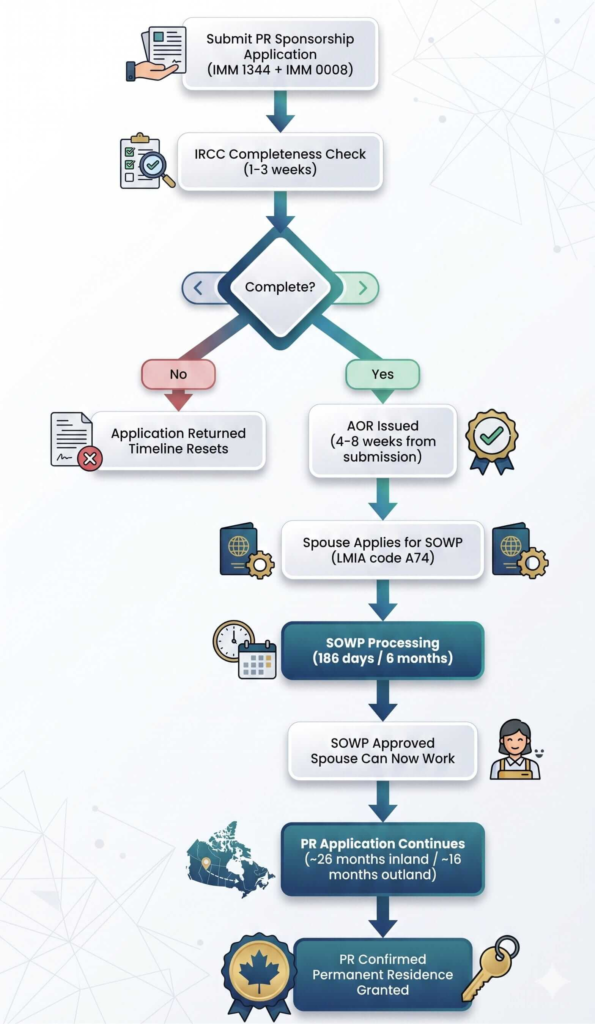
Processing times are updated weekly by IRCC and are subject to change based on application volume. Verify at ircc.canada.ca before submitting.
What Happens If Your Status Expires Before You Apply?
This is the question that causes the most stress, and it deserves a straight answer. If your temporary status has already expired, you are in a different situation than someone on maintained status. These two scenarios require different responses.
Scenario One: Status expired, but you applied to extend it before it ran out.
If your partner’s temporary status is about to expire and they apply for an extension before it expires, they gain maintained status. This lets them legally remain in Canada while the extension is processed. Under maintained status, your spouse can remain in Canada legally. They cannot, however, start working until a work permit is actually approved.
Scenario Two: Status has already lapsed, and no extension was filed.
This is where the path narrows significantly. Restoration does not grant maintained status. You cannot work while the restoration application is pending. You must stop working immediately until IRCC approves the new permit. Restoration is also not guaranteed. Restoration is a discretionary remedy. IRCC is not required to approve it, and a history of non-compliance will weigh against the applicant. If the 90-day window passes without a restoration application, there are no remaining options inside Canada.
The 90-day restoration window runs from the day status actually expires, not from the date you realized it expired. Missing that window closes the door to restoration entirely.
Here is the practical message: do not let your status lapse. For many inland sponsorship applicants, the spousal open work permit is not simply a convenience. It is the mechanism that allows them to maintain employment while waiting for permanent residence processing. Where the applicant was extending an existing work permit, a refusal may immediately end their authorization to work in Canada.
Proactive status management is the only safe strategy in 2026. Apply for a status extension 30 to 60 days before your current document expires. Do not wait for the AOR before doing this.
Inland vs Outland Spousal Sponsorship in 2026: Which Is Better?
This is the highest-stakes decision in the entire spousal sponsorship process. The right answer depends on your specific situation. But the data in 2026 tilts clearly in one direction for most couples.
The core comparison:
| Criteria | Inland Spousal Sponsorship (in Canada) | Outland Spousal Sponsorship |
|---|---|---|
| PR Processing Time (non-Quebec) | ~26 months | ~16 months |
| SOWP Eligibility | Yes, after AOR | Yes, if spouse is in Canada and has valid status |
| Travel Freedom | No (leaving may cancel application) | Yes |
| Appeal Rights if Refused | None (Federal Court only) | Full IAD appeal rights |
| Best For | When partner cannot safely re-enter Canada | Most other situations |
In 2026, Outland spousal sponsorship is faster for most couples. IRCC’s June 2026 processing times are about 16 months for Outland versus 26 months for Inland, both outside Quebec.
Outland also provides travel flexibility and full appeal rights. For most couples, applying Outland, even if the spouse is already in Canada, is the recommended 2026 strategy.
A critical and widely misunderstood point: your spouse can be physically in Canada and still apply under the Outland spousal sponsorship stream, as long as they maintain valid temporary resident status.
What is the one scenario where inland is the right call? When your spouse cannot safely re-enter Canada after leaving. If re-entry is uncertain, preserving status inside Canada is the priority. Your RCIC needs to assess your specific country of citizenship, travel document status, and admissibility history before making this call.
The only strong reason to choose inland in 2026 is when your partner cannot re-enter Canada once they leave and their current status needs to be preserved.
Your spouse’s legal status in Canada and their ability to work on a spousal open work permit depends on getting this right the first time. Amir Ismail (RCIC #R412319) has guided thousands of families through inland and outland spousal sponsorship and SOWP applications since 1991.
How an RCIC Reviews Your File Before You Submit
Getting professional review before you submit is not optional when the stakes include your spouse’s legal right to live and work in Canada. A licensed Regulated Canadian Immigration Consultant (RCIC), governed by the College of Immigration and Citizenship Consultants (CICC), will work through your file before anything goes to IRCC.
Here is what a professional file review covers:
Step 1: Status check. Your consultant will confirm your spouse’s current status document, expiry date, and whether maintained status applies. This is the foundation. Everything else depends on it.
Step 2: Stream selection. Your RCIC will assess whether inland or outland sponsorship is the right choice based on your spouse’s ability to re-enter Canada, their current status type, and your specific country context.
Step 3: Form audit. Every required form, IMM 1344, IMM 0008, Schedule A, and applicable schedules, will be reviewed for completeness and consistency. One missing document returns the entire application. Officers verify every form is present, signed, and includes mandatory documents.
Step 4: Relationship evidence review. IRCC is refusing an increasing number of inland spousal open work permit applications due to insufficient proof of residence in Canada with the sponsor. Many applicants assume that an Acknowledgment of Receipt for their inland spousal sponsorship application is enough, only to face unexpected refusals. Your RCIC will identify the specific cohabitation and relationship evidence that your file needs.
Step 5: Exemption code confirmation. Your RCIC confirms whether you are filing under code A74 (Family Class spousal sponsorship) or a different category. LMIA exemption code errors, specifically confusing A74 and A75, are one of the most common refusal triggers.
Step 6: Timeline mapping. Your RCIC will give you a realistic timeline based on current IRCC processing times, your status expiry dates, and your submission date. This prevents the common mistake of applying for the SOWP before the AOR arrives, or letting status lapse while waiting.
Amir Ismail (RCIC #R412319) has been practising Canadian immigration since 1991 and has guided over 25,000 clients through exactly this process. The firm maintains offices in Toronto, Dubai, and Karachi.
One incomplete document can delay your open work permit by months. Do not guess. Book your Strategy Assessment with RCIC #R412319 today.
Frequently Asked Questions – Inland Spousal Sponsorship Open Work Permit
What is the Spousal Open Work Permit processing time in 2026?
The inland spousal open work permit processing time in Canada is currently approximately 186 days (about 6 months) for applications submitted from inside Canada in 2026.
Do I need an AOR (Acknowledgment of Receipt) to apply for a Spousal Open Work Permit in 2026?
In most cases, yes. IRCC expects you to wait for the Acknowledgment of Receipt (AOR) on your inland spousal sponsorship application before you apply for the SOWP under code A74. The only common exception is the two‑week rule, where status will expire within 2 weeks, and the AOR has still not arrived.
Do the January 2025 SOWP restrictions affect inland spousal sponsorship applicants?
Spousal sponsorship applicants are exempt from these restrictions. Your eligibility for the SOWP is derived from the sponsorship application itself, not your sponsor’s job classification. The restrictions on code C41 (spouses of temporary workers) and code C42 (spouses of students) do not apply to Family Class sponsorship under code A74.
What happens if my spouse leaves Canada during inland sponsorship?
If your partner leaves Canada and CBSA denies re-entry, the inland application is cancelled, not just delayed. Leaving Canada during inland processing carries real risk. Discuss this with your RCIC before any travel plans.
Is inland or outland sponsorship faster in 2026?
IRCC’s June 2026 official processing time is approximately 16 months for Outland versus 26 months for Inland, both outside Quebec.
Last updated: June 2026. Processing times sourced from the IRCC Processing Times Tool (updated weekly at ircc.canada.ca). This article is based on more than 34 years of practical experience with Canadian spousal sponsorship and spousal open work permit applications.
Author: Amir Ismail, RCIC #R412319 | Amir Ismail & Associates | amirismail.com
Read More Canada Spousal Sponsorship Resources By Amir Ismail

Spousal Sponsorship Canada Timeline 2026: 16 vs 25 Months Explained
Spousal Sponsorship Canada Timeline 2026: 16 vs 25 Months Explained 🟢 Updated July 10, 2026:…

Sponsoring a New Spouse After Divorce in Canada: The 2026 Rules Explained

Cost to Sponsor a Spouse to Canada 2026: Full Breakdown

Inland vs Outland Canadian Spousal Sponsorship 2026

Spousal Sponsorship Evidence: The 4-Pillar Framework (2026)

Why Spousal Sponsorship Applications Get Returned Before Anyone Reads Them | Amir Ismail
Why Spousal Sponsorship Applications Get Returned Before Anyone Reads Them | Amir Ismail Why Your…