

Canada AI work permit 2026: how the 20-day Global Talent Stream fast-track really works
Last Updated: June 2026 By Amir Ismail, RCIC R412319
Canada unveiled plans on June 4, 2026, to introduce a new fast-track immigration stream for AI professionals under its Global Talent Stream (GTS). Once officially launched, the pathway targets a total start-to-finish processing window of 20 business days or less, combining a 10-day expedited Labour Market Impact Assessment (LMIA) with a 10-day work permit turnaround. This proposed speed sharply cuts down the standard two-to-six-month window under the typical Temporary Foreign Worker Program, a delay that has historically caused Canadian firms to lose top global tech candidates to competing hubs in the US and Europe.
Prime Minister Mark Carney announced the stream as the core talent piece of the “AI for All” national strategy. The targets are specific: $200 billion in additional economic growth, 250,000 new AI-related jobs by 2031, and AI adoption scaled from 12% to 60% by 2034 (Government of Canada, June 2026).
Here is what most articles leave out. You cannot apply for this permit yourself. The entire process is initiated by a Canadian employer, and without a qualifying job offer, there is no application to file. This guide covers who qualifies, how the employer triggers the fast-track, and how to turn a temporary permit into permanent residency for your family.
Key takeaways
- What it is: A fast-track immigration pathway under the Global Talent Stream (GTS) processing AI and tech work permits in 20 business days.
- Who is eligible: Tech professionals in qualifying NOC codes (e.g., Data Scientists, Software Engineers) with a formal job offer from a Canadian employer paying the prevailing wage.
- How it works: The Canadian employer must file a Labour Market Impact Assessment (LMIA), which is expedited to 10 days, followed by a 10-day work permit processing window.
- Path to PR: After 12 months of Canadian work experience, candidates become eligible for the Canadian Experience Class (CEC) and STEM-targeted Express Entry draws.
What is Canada’s AI work permit fast-track in 2026?
The 2026 Canada AI work permit fast-track is a specialized immigration pathway within the Global Talent Stream (GTS) designed to process tech-sector Labour Market Impact Assessments (LMIAs) and work permits in a combined 20 business days. It allows Canadian employers to rapidly hire international AI professionals, data scientists, and software engineers without the standard two-to-six-month processing delays.. The stream is expected to be launched as the core talent mechanism of PM Mark Carney’s “AI for All” national strategy (Government of Canada, June 2026).
How does the 20-day timeline actually break down?
The 20-day target is two sequential 10-business-day processing phases. In Phase 1, ESDC approves the employer’s Labour Market Impact Assessment (LMIA). In Phase 2, IRCC processes the candidate’s work permit application.
Here is how the full sequence flows:

The 20-day clock starts only after your employer submits a complete LMIA application, not from when you start gathering documents. Both sides typically need several additional weeks of preparation before the formal processing window opens.
Why did Canada create this stream?
Canada ranked among the slowest G7 nations for AI adoption, with just over 12% of businesses using AI as of 2026. The federal government acknowledged that domestic talent alone cannot meet the immediate demand of Canadian AI companies. The fast-track permit removes the delay that was pushing Canadian firms to hire offshore or lose candidates to the US and Europe.
The “AI for All” strategy targets AI adoption rising from 12% to 60% by 2034, 250,000 new AI jobs by 2031, and $200 billion in added economic output. Every one of those targets depends on getting senior international talent inside Canada fast enough to actually build those companies here.
There is also a political context worth knowing. NDP MP Don Davies publicly criticized the program, arguing it leaves Canadian workers exposed. The government’s position is that international hires build the companies that will eventually hire Canadians at scale (CBC, June 2026).
Who qualifies for Canada’s AI work permit via the Global Talent Stream?
To qualify, your role must map to a high-skill NOC TEER code on the federal Global Talent Occupations List. The most common qualifying titles include data scientists (NOC 21211), software engineers (NOC 21231), computer systems developers (NOC 21230), and computer and information systems managers (NOC 20012). IRCC has not yet published a finalized AI-exclusive occupation list, but the GTS covers the full range of AI, machine learning, and data roles.
Which NOC codes are eligible for the Global Talent Stream?
The primary eligible NOC codes for Canada’s AI work permit under the Global Talent Stream include Data Scientists (NOC 21211), Software Engineers (NOC 21231), Computer Systems Developers (NOC 21230), and Computer and Information Systems Managers (NOC 20012). The full list of primary qualifying codes and their wage floors are detailed below:
| Occupation title | NOC code (2021) | Minimum wage floor |
|---|---|---|
| Data scientists | 21211 | Prevailing wage |
| Software engineers and designers | 21231 | Prevailing wage |
| Computer systems developers | 21230 | Prevailing wage |
| Software developers and programmers | 21232 | Prevailing wage |
| Computer and information systems managers | 20012 | Prevailing wage |
| Computer network technicians | 22220 | $85,000 CAD/year |
| Information systems testing technicians | 22222 | $85,000 CAD/year |
“Prevailing wage” means your employer must pay at least the regional median wage for that NOC code according to the Government of Canada’s Job Bank, or the salary paid to Canadian staff in identical roles at the same location, whichever is higher.
Do you need a degree or years of experience to qualify?
Requirements differ by GTS category. Category A requires either an advanced specialized degree or at least five years of highly specialized industry experience to demonstrate “exceptional knowledge.” Category B has no formal degree requirement beyond matching the NOC TEER description and the prevailing wage floor.
If you do not hold an advanced degree, your years of experience must be documented in reference letters from previous employers. Those letters must describe your exact technical duties and specific years worked, formatted to map directly to the target NOC code.
Why you cannot self-apply for this work permit
You cannot self-apply for the Canada AI work permit. The 20-day Global Talent Stream is strictly an employer-driven process. To qualify, a Canadian employer must first formally offer you a job, commit to the prevailing wage, and submit a Labour Market Impact Assessment (LMIA) on your behalf.
How does the employer-driven LMIA process work step by step?
The LMIA is the foundational document a Canadian employer must obtain from ESDC to prove the economic necessity of hiring an international candidate over a domestic worker. Without an approved LMIA, IRCC will not process the work permit. You can review the official Global Talent Stream program requirements on Canada.ca for the full employer checklist. Here is how the process flows:
- Confirm the job offer. Your employer agrees to pay the applicable prevailing wage for the target NOC code.
- File the LMIA. Your employer submits the LMIA application to ESDC under the Global Talent Stream, paying a $1,000 CAD processing fee per position. Canadian law prohibits passing this cost to the foreign worker.
- LMIA approved. ESDC approves the LMIA within 10 business days under the GTS fast-track.
- Submit your work permit. You submit your work permit application to IRCC along with the approved LMIA.
- Work permit approved. IRCC processes the work permit within 10 business days, completing the 20-day cycle.
- Travel to Canada. You arrive and begin employment.
Your personal out-of-pocket costs are low: $155 CAD for the IRCC work permit fee plus $85 CAD for biometrics. An applicant from India typically adds roughly $395 CAD more in medical, translation, and courier costs, for an estimated total of $635 CAD. Unlike Express Entry without a job offer, the GTS requires zero proof of settlement funds.
What is the Labour Market Benefits Plan and why does it matter for your job search?
In exchange for priority 10-day LMIA processing, the employer must sign a legally binding Labour Market Benefits Plan (LMBP) with the federal government. The LMBP commits the employer to creating net-new jobs for Canadian citizens, upskilling existing domestic staff, formally transferring technical knowledge from the foreign hire to Canadian junior employees, and establishing educational partnerships with local universities.
This creates a direct tactical advantage for you as a candidate. An AI engineer who makes clear in interviews that they will run internal ML training workshops, mentor junior Canadian developers, and engage with local co-op programs helps the employer satisfy LMBP compliance. That makes you far more attractive than a candidate with an identical technical profile who says nothing about knowledge transfer.
Category A vs. Category B: which Global Talent Stream path fits your profile?
The Global Talent Stream has two access routes with different requirements for employers and candidates. Category A is restricted to innovative scale-ups referred by an IRCC-designated partner, requiring the candidate to demonstrate exceptional knowledge. Category B is open to any Canadian employer whose role appears on the federal Global Talent Occupations List, with no referral required. For most candidates, Category B is the higher-probability path.
What are the salary and access requirements for Category A?
Category A requires a formal referral to the employer from an IRCC-designated partner organization. These partners act as gatekeepers, verifying the company’s innovation focus and growth stage. Key referral partners include the BC Tech Association, Communitech, the Business Development Bank of Canada, the Council of Canadian Innovators, Invest in Canada, and the National Research Council of Canada.
The salary obligations under Category A are strict. For the first two positions, the employer must pay a minimum of $80,000 CAD annually. If the employer later sponsors a third or additional specialist, the mandatory salary floor rises to $150,000 CAD per year, and ESDC grants no flexibility on this requirement.
Who should target Category B and what are the wage floors?
Category B is open to any eligible Canadian employer without a referral, provided the role is on the Global Talent Occupations List and the salary meets the prevailing wage floor. For most technology roles, that floor sits between $40.87 and $41.35 per hour. Roles like computer network technicians carry a minimum of $85,000 CAD annually.
The practical test is straightforward. If your job title and daily duties align with one of the NOC codes on the list, and your employer is willing to meet the wage floor and sign the LMBP, you are a Category B candidate. The referral requirement that restricts Category A does not apply to you.
How the AI work permit becomes a path to permanent residency
The 20-day AI work permit grants temporary resident status only, but it is designed as a direct bridge to permanent residency. After 12 continuous months of full-time skilled work in Canada, you become eligible for the Canadian Experience Class (CEC) under Express Entry. IRCC’s 2026-27 Departmental Plan commits to accelerating up to 33,000 temporary workers to permanent residency (IRCC, 2026).
When do you become eligible for Canadian Experience Class after arriving on a GTS permit?
CEC eligibility is triggered after 12 continuous months of full-time skilled employment in Canada at a NOC TEER 0, 1, 2, or 3 role. Canadian work experience carries significant weight in the Comprehensive Ranking System (CRS) used to rank Express Entry candidates. If your Canadian employer supports your permanent residency application with a formal written job offer, you receive an additional 50 to 200 CRS points, separating you decisively from overseas applicants who hold no Canadian experience.
Here is the full permanent residency pathway for GTS permit holders:
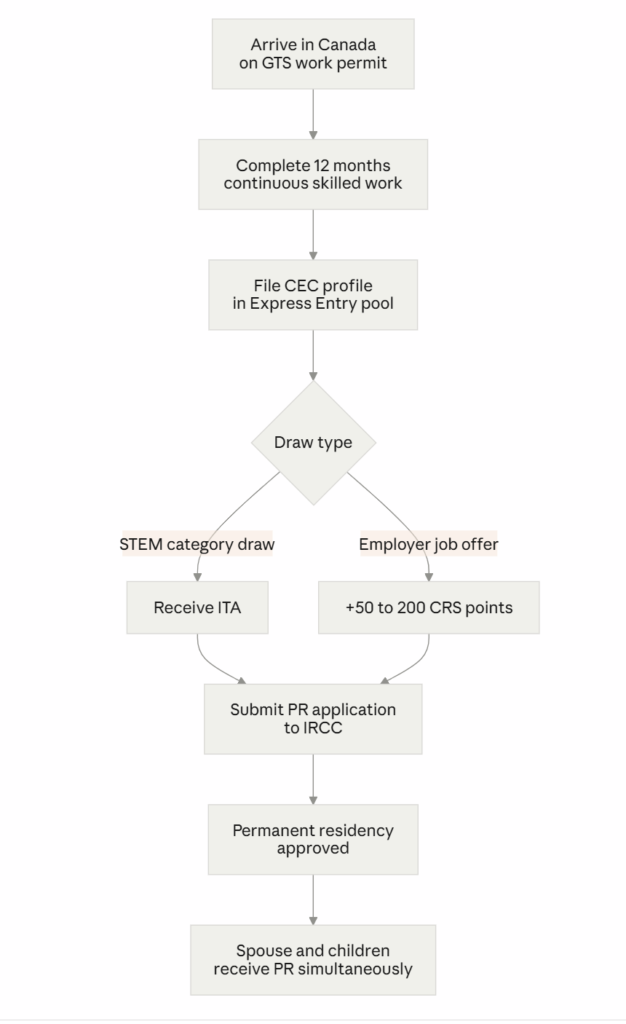
Your spouse can accompany you from day one. Under the GTS, spouses of work permit holders are eligible for an open work permit, meaning they can work for any Canadian employer while you build experience toward CEC eligibility.
How do STEM category-based Express Entry draws help AI professionals?
IRCC regularly runs category-based selection draws within the Express Entry pool that specifically target STEM occupations. AI professionals who build Canadian experience through the GTS match exactly the profile these draws are designed to select. Combined with CEC work experience points and a potential employer job offer, AI professionals in STEM roles routinely receive Invitations to Apply (ITA) in these targeted rounds.
French-language proficiency adds a further advantage. IRCC also runs francophone category draws in parallel, and candidates with strong French skills can qualify for both draw types, often receiving ITAs ahead of English-stream STEM candidates.
For a detailed breakdown of how category-based Express Entry draws work for internationally trained professionals, see the AIA Express Entry guide.
Where to find Canadian employers who can use the Global Talent Stream
The highest concentration of GTS-eligible employers is in three geographic clusters: the Toronto-Waterloo corridor, the Montreal AI ecosystem, and British Columbia. These areas have the most companies with established LMIA processing capacity and direct connections to Canada’s national AI research infrastructure.
What companies are hiring AI professionals in Toronto and Waterloo?
The Toronto-Waterloo corridor is the second-largest technology cluster in North America, with over 373,000 technology workers and nearly 15,000 tech companies. The anchor institution is the Vector Institute in Toronto, a globally recognized AI research facility. Vector Institute platinum and gold sponsors that actively recruit international machine learning talent through the Vector Talent Hub include Google, NVIDIA, RBC, Scotiabank, Shopify, and Thomson Reuters.
The tech talent market in Waterloo alone grew 58.2% between 2021 and 2024. Startups and scale-ups in this corridor frequently access Category A through referral partners such as Communitech, making them strong targets for internationally trained AI professionals seeking GTS sponsors.
What do AI professionals need to know about Quebec and the Montreal ecosystem?
Montreal is anchored by Mila, the Quebec Artificial Intelligence Institute, one of the world’s leading deep-learning research centers. The Montreal ecosystem also benefits from the SCALE.AI supercluster, backed by a $290 million federal investment to advance applied AI and supply chain optimization. Companies such as Cohere operate within this network and recruit internationally.
There is a critical Quebec-specific point. Quebec’s dedicated AI immigration pilot for permanent residency ended on January 1, 2026. If you are targeting Montreal for long-term settlement, that pilot is closed. You must now express interest through the Arrima portal and meet the requirements of the Programme de sélection des travailleurs qualifiés (Quebec Skilled Worker Selection Program) for the permanent residency stage.
What documents do you need to prepare before your employer applies?
The 20-day processing window opens when your employer files the LMIA, not when you start gathering paperwork. Your documents must be completely ready before that moment. Candidate-side delays are the most common reason fast-track timelines slip past the 20-day target.
Prepare the following well in advance:
- Educational Credential Assessment (ECA). Have your foreign degrees evaluated by an IRCC-approved body such as World Education Services (WES) or ICAS. Not strictly required for the GTS work permit itself, but essential for Category A eligibility and completely mandatory for your subsequent CEC permanent residency application.
- Language test results. Complete IELTS, CELPIP (for English), or TEF/TCF (for French) before your employer triggers the GTS. The work permit has no language cut-off, but your score is required for the Express Entry CEC application 12 months later.
- CV mapped to your target NOC code. Your resume must explicitly reflect the technical duties described in the target NOC TEER category. Vague job titles cause delays at the ESDC review stage.
- Reference letters from previous employers. Letters must detail your exact technical duties, employment start and end dates, and hours worked per week. For Category A, letters must clearly demonstrate the five-year specialized experience minimum if you do not hold an advanced degree.
- Valid passport. Confirm at least 24 months of remaining validity from your expected work start date.
- Biometrics appointment. Book early. The $85 CAD fee is paid when you attend, and appointment availability varies significantly by country.
One significant structural advantage for AI professionals: AI, data science, and software engineering are unregulated occupations in Canada. Unlike civil engineers (who need a P.Eng license from Professional Engineers Ontario) or healthcare workers (who go through the Medical Council of Canada), you can begin high-level AI work the day your permit arrives. No provincial licensing exam, no board registration, no recertification period.
Frequently asked questions about Canada’s AI work permit fast-track
Can I apply for Canada’s AI work permit without a job offer?
No. Canada’s AI work permit fast-track cannot be initiated without a Canadian employer. Regardless of your qualifications, you cannot file a GTS application independently. The employer must submit the LMIA to ESDC to start the process. Your job as a candidate is to secure the offer that triggers the employer’s application.
Does the 20-day timeline start when I submit my application?
No. The 20-day timeline starts when your employer submits a complete and accepted LMIA application to ESDC. It does not begin when you start collecting documents or when the employer first contacts ESDC. Document preparation and employer compliance steps add several weeks before the 20-day window formally opens.
Will my spouse get a work permit if I come through the Global Talent Stream?
Yes. Spouses and common-law partners of GTS work permit holders are eligible for an open work permit, which allows them to work for any Canadian employer without restriction. They can apply at the same time you submit your work permit application.
Is Quebec included in Canada’s AI work permit fast-track?
The Global Talent Stream applies across all of Canada, including Quebec, for the temporary work permit stage. However, Quebec’s dedicated AI immigration pilot for permanent residency ended January 1, 2026. Candidates targeting long-term settlement in Quebec must use the Arrima portal under the Quebec Skilled Worker Selection Program for the permanent residency stage.
Ready to use Canada’s AI work permit pathway?
Canada’s 20-day AI work permit is one of the most direct immigration pathways available to skilled technology professionals right now. The key is understanding that the employer is the application trigger, not you. Your job is to target the right companies, show them how you help satisfy their LMBP commitments, and have your documents ready before they file.
After 12 months of Canadian work experience, you will be well positioned for CEC and STEM category Express Entry draws that can deliver permanent residency for your entire family.
For professional guidance on determining your Global Talent Stream eligibility or mapping your path from a temporary permit to permanent residency, book your Strategy Assessment. Please note that all consultations are paid and non-refundable.
Amir Ismail is the founder and principal consultant of Amir Ismail & Associates, holding professional experience associated with the immigration consulting industry since 1991. As a Regulated Canadian Immigration Consultant (RCIC R412319), he specializes in corporate tech immigration and global mobility. This article is for informational purposes only and does not constitute legal advice.
Explore Canadian Immigration Resources By Amir Ismail

Which Province Is Easiest to Get PR in Canada in 2026?
Which Province Is Easiest to Get PR in Canada in 2026? Last Updated: August 17,…

PGWP Refusal Rate Jumped to 21% in 2025: What Graduates Must Know
Last Updated: 16 August 2026 By Amir Ismail, RCIC #R412319 | Amir Ismail & Associates…

Express Entry Healthcare Draws 2026: Full CRS Breakdown
Express Entry Healthcare Draws 2026: Complete IRCC CRS Breakdown (169 to 475) Last Updated: September…

Practice-Ready Assessment Canada: Full IMG Guide 2026
Practice-Ready Assessment Canada: The Complete Pathway for International Medical Graduates, work permit and Permanent Residence…
IRCC’s proof of Canadian citizenship backlog tops 82,000 as Bill C-3 applications surge
IRCC’s proof of Canadian citizenship backlog tops 82,000 as Bill C-3 applications surge By Amir…

Latest Express Entry Healthcare Draw June 25, 2026: CRS 475 Explained (And What To Do Next)
Latest Express Entry Healthcare Draw June 25, 2026: CRS 475 Explained (And What To Do…