Not sure you qualify? Take our Canadian citizenship eligibility quiz first.
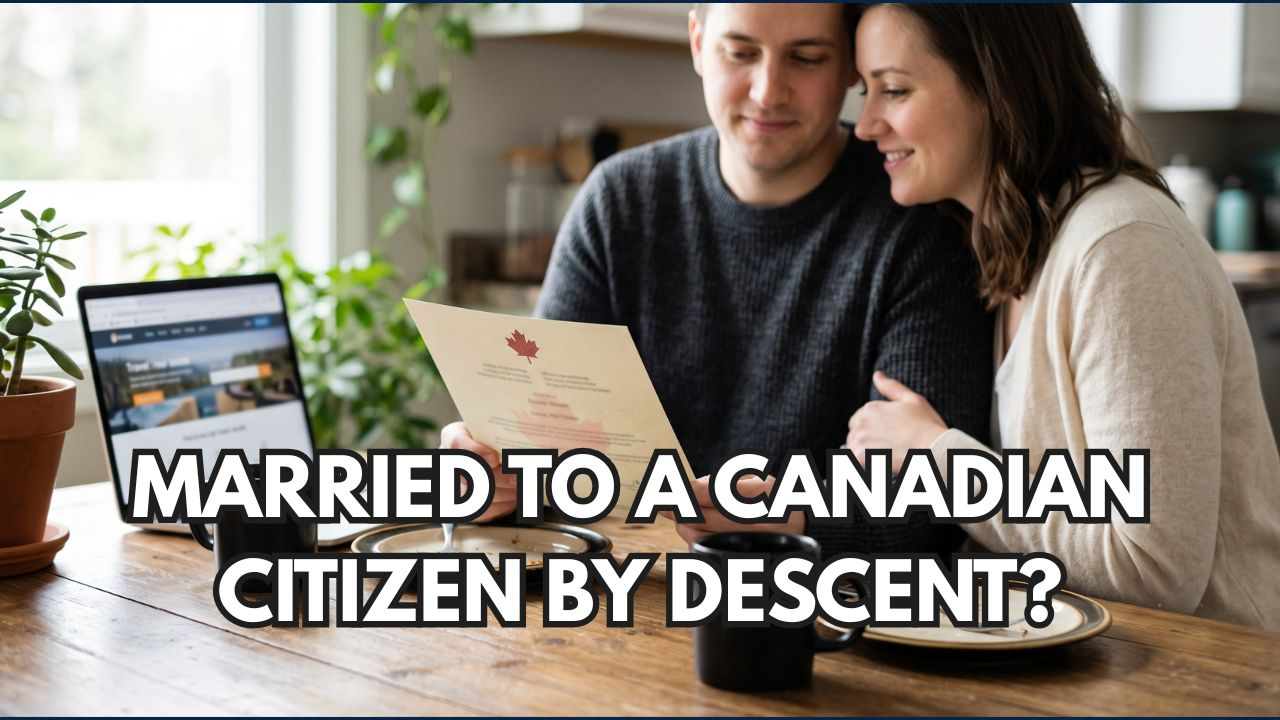
Marriage does not make you a Canadian citizen by descent. Citizenship by descent flows through bloodline or adoption, not through a spouse.
But here is the good news. Once your partner confirms their citizenship, they can sponsor you for permanent residence, and IRCC’s Outland spousal sponsorship stream is currently processing in about 18 months as of 3 September 2026. Your shared children may also already be citizens through the same family line.
So your household likely has not one path to Canada, but two or three running in parallel. Let’s map them.
Key Takeaways
- Citizenship by descent never passes through marriage. It flows by birth or adoption only.
- Your citizen spouse can sponsor you for permanent residence once their citizenship is confirmed.
- Outland spousal sponsorship is processing in roughly 18 months; Inland takes about 26 months (IRCC, 3 September 2026).
- Your children may already be Canadian citizens through your spouse’s line, no sponsorship needed.
- The smart play is running the descent claim and the sponsorship prep in parallel, not in sequence.
The Short Answer: No, But You Have a Faster Path Than You Think
Under Bill C-3, citizenship by descent depends on documented lineage. Your spouse qualified because a parent, grandparent, or earlier ancestor was Canadian. You did not inherit that lineage by signing a marriage certificate.
But do not read that as bad news. Spouses of Canadian citizens have one of the most established routes into Canada: family class sponsorship. It is a well-worn path with clear rules, and your spouse’s new citizenship certificate is the key that opens it.
How Your Spouse’s Citizenship Affects Your Children
Your children may already be citizens. If your spouse is a Canadian citizen by descent, your shared children can also be citizens through that same line, depending on when they were born and the generational rules under Bill C-3.
For children born on or after December 15, 2025 to a parent who is second generation or beyond, the parent must show 1,095 days of physical presence in Canada before the birth. Children born before that date generally follow the more open rules. Check your family’s exact position against our eligibility checklist for Americans.
If the children qualify, they apply for proof of citizenship, not sponsorship. That is a different form, a different queue, and often a very different timeline.
Sponsorship: Your Route to Permanent Residence
Spousal sponsorship is the process where a Canadian citizen or permanent resident sponsors their spouse or common-law partner for permanent residence. Your spouse becomes eligible to sponsor you as soon as their citizenship is confirmed.
Am I a Canadian citizen by descent?
Trace your family line one generation at a time. Each link is tested against the law in force when that person was born, so you see exactly where your chain holds and where it breaks. About three minutes, and no account needed.
Check my family lineIRCC does not require citizen sponsors to live in Canada while sponsoring, as long as they show they will return to Canada once you become a permanent resident.
What Spousal Sponsorship Requires
The basics, before you get into forms:
- A genuine relationship, proven with evidence (photos, communication history, joint finances)
- A sponsor who is 18 or older and not barred by bankruptcy, sponsorship default, or certain convictions
- An undertaking: your spouse commits to supporting you financially for three years
- Medical exam, police certificates, and biometrics for you as the applicant
There is no minimum income requirement for sponsoring a spouse alone, which surprises many couples. The full picture lives on our spousal sponsorship service page.
Spousal Sponsorship Typical Timeline
As of 3 September 2026, IRCC publishes roughly 18 months for Outland applications (spouse outside Canada, outside Quebec) and 26 months for Inland (spouse inside Canada, outside Quebec). Outland is faster, keeps your travel flexibility, and preserves full appeal rights. See the current family processing times.
Those numbers move monthly. Our spousal sponsorship timeline guide breaks down the phases, the Quebec exception, and how couples reunite in as little as 30 days using a Dual Intent visitor visa while the PR file processes.
Want to know which stream fits your family before you touch a form? Book a Strategy Consultation with Amir Ismail, RCIC #R412319.
The Combined Family Strategy: Citizenship By Descent and Spousal Sponsorship in Parallel
Most families we advise in this situation run three tracks at once. Done in sequence, these steps can stack into three or more years. Done in parallel, the waits overlap.
Step 1: Confirm your spouse’s citizenship first. Their proof of citizenship application anchors everything. The queue is long (about 33 months right now, per our processing time guide), so file it early and file it clean.
Step 2: Apply for the children’s proof of citizenship. If the kids qualify through the same line, their applications can go in alongside or shortly after your spouse’s.
Step 3: Prepare the sponsorship file while you wait. Relationship evidence, police certificates, and translations take months to gather. Build the file now so it is ready to submit the moment your spouse’s certificate arrives.
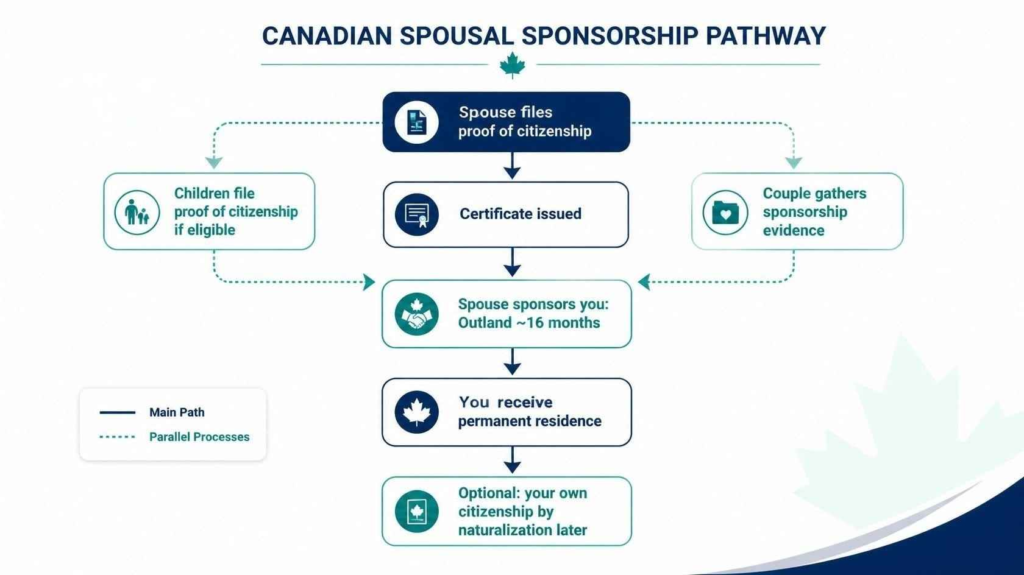
One caution. Do not submit the sponsorship before the citizenship is confirmed, unless your spouse already holds another qualifying status. A sponsorship filed by someone whose citizenship is still unproven invites delays and questions. Sequence the submissions even while you parallel the preparation.
Not sure you qualify?
Take our Canadian citizenship eligibility quiz in about two minutes, read the Canadian citizenship guide, then Book a Strategy Consultation with Amir Ismail, RCIC R412319, to confirm your path.
Frequently Asked Questions
Does marrying a Canadian citizen make me a citizen?
No. Canada has no citizenship by marriage. Marriage to a Canadian citizen makes you eligible to be sponsored for permanent residence. After becoming a permanent resident and meeting physical presence requirements, you can later apply for citizenship by naturalization.
Can my spouse sponsor me while living outside Canada?
Yes, if your spouse is a Canadian citizen. Citizen sponsors can apply from abroad, but must show they intend to live in Canada once you become a permanent resident. Permanent resident sponsors must already reside in Canada.
Are our children automatically Canadian citizens?
Possibly. If your spouse is a citizen by descent, your shared children may hold citizenship through the same line, subject to Bill C-3’s generational rules. Children born on or after December 15, 2025 to a second-generation-or-later parent need that parent to show 1,095 days of physical presence in Canada before the birth.
Which should we do first: citizenship claim or sponsorship?
Confirm the citizenship first, prepare the sponsorship in parallel, and submit the sponsorship once the certificate arrives. This sequencing avoids questions about the sponsor’s status while wasting no waiting time.
Two programs, three family members, one plan. If you want the sequencing mapped for your exact family, Book a Strategy Consultation.
About the Author: Amir Ismail is a Regulated Canadian Immigration Consultant (RCIC #R412319), licensed by the College of Immigration and Citizenship Consultants (CICC). He founded Amir Ismail & Associates in 1991 and has served 25,000+ clients from offices in Toronto, Dubai, and Karachi. Book a Strategy Consultation for advice specific to your case.
Access More Canadian Citizenship By Descent Resources By Amir Ismail
Proof of Citizenship From the US: Does a Representative in Canada Save Time?
A representative in Canada does not move your proof of citizenship from the US to…

Canadian Citizenship for an Adopted Child Abroad: Grant or PR?
If you are a Canadian in the US who adopted a child, you have two…

Canadian Passport Application From the USA: Guarantor, References and Fees
A Canadian passport application from the USA is a mail-in process. You fill out form…
British Home Children Citizenship by Descent: Who Qualifies Under Bill C-3
Many descendants of British Home Children can claim Canadian citizenship by descent. The key fact…
Proof of Canadian Citizenship Wait by Application Month: Why Your Date Matters
Your proof of citizenship wait by application month is not one number. The processing times…

American Dual Citizenship With Canada: What Changes and What Does Not
Yes, you can keep both. American dual citizenship with Canada is legal in both countries,…
Moving to Canada as a New Citizen by Descent: Health Coverage by Province
If you are moving to Canada as a new citizen by descent, your health coverage…

Is 1867 a Cut-Off for Citizenship by Descent? Why Older Ancestors Still Count
No, 1867 is not a legal cut-off, so you can still pursue citizenship by descent…
Bill C-3 Second Generation Children: Are Your Kids Canadian?
If you are an American who became Canadian under Bill C-3, your children born before…

After Your Citizenship Certificate: What It Does Not Give Americans
After your Canadian citizenship certificate arrives, you are a Canadian citizen on paper, but the…

Section 8 Lost Canadians: Bill C-3 Gives Back Citizenship Lost at Age 28
Section 8 Lost Canadians: Bill C-3 Gives Back Citizenship Lost at Age 28 If you…

Bill C-3 Reversal Risk: Could You Lose Citizenship by Descent?
Bill C-3 Reversal Risk: Could You Lose Citizenship by Descent? By Amir Ismail, RCIC #R412319…
Proof of Canadian Citizenship Processing Time 2026 (34-Month Wait and 130,700-File Queue Explained)
Proof of Canadian Citizenship Processing Time 2026 (34-Month Wait and 130,700-File Queue Explained) IRCC’s proof…
Canadian Citizenship by Descent: Eligibility Checklist for Americans (Bill C‑3)
Do I Qualify for Canadian Citizenship by Descent? The American’s Eligibility Checklist By Amir Ismail,…
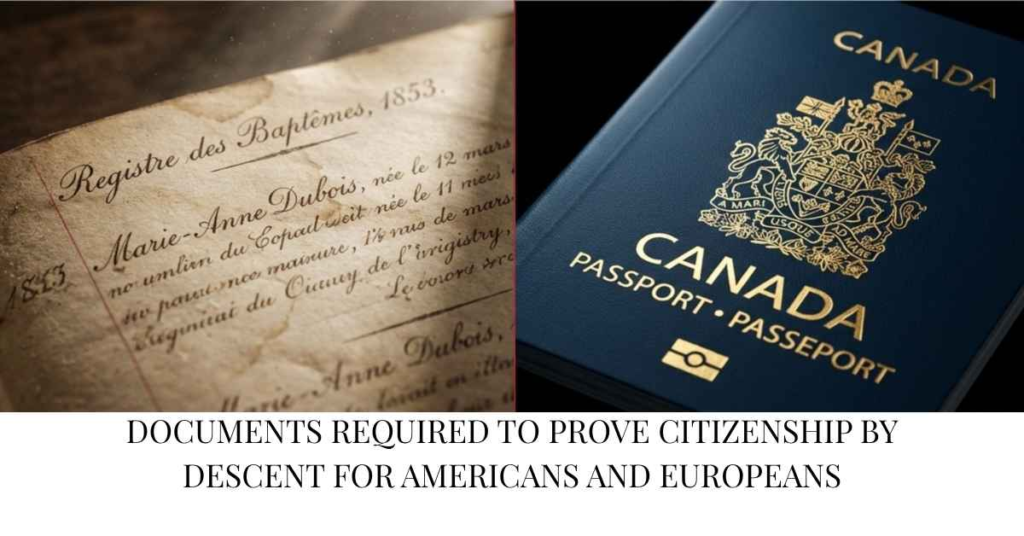
Canadian Citizenship by Descent: Complete Document Guide (Bill C-3 2025)
Baptismal Records for Canadian Citizenship by Descent: 2026 Guide
Baptismal Records for Canadian Citizenship by Descent: A Complete Ordering Guide (2026) LAST UPDATED: AUGUST…
Six Wrong Reasons People Rule Themselves Out of Canadian Citizenship by Descent
Six Wrong Reasons People Rule Themselves Out of Canadian Citizenship by Descent By Amir Ismail,…
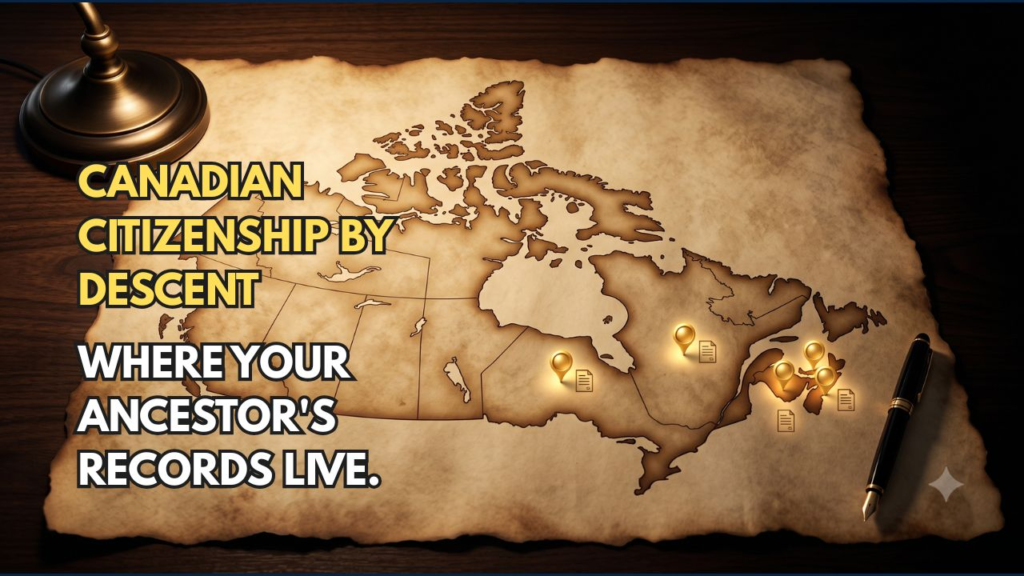
Canadian Vital Records for Citizenship by Descent: How to Find the Right Office in Every Province
Mandatory Vital Records for Canadian Citizenship by Descent (Canada‑Wide: Every Province, Every Office) By Amir…
Ancestor Birth Record Missing? IRCC Alternatives 2026
When the Birth Certificate Never Existed: Proving Your Canadian Ancestor’s Identity to IRCC By Amir…
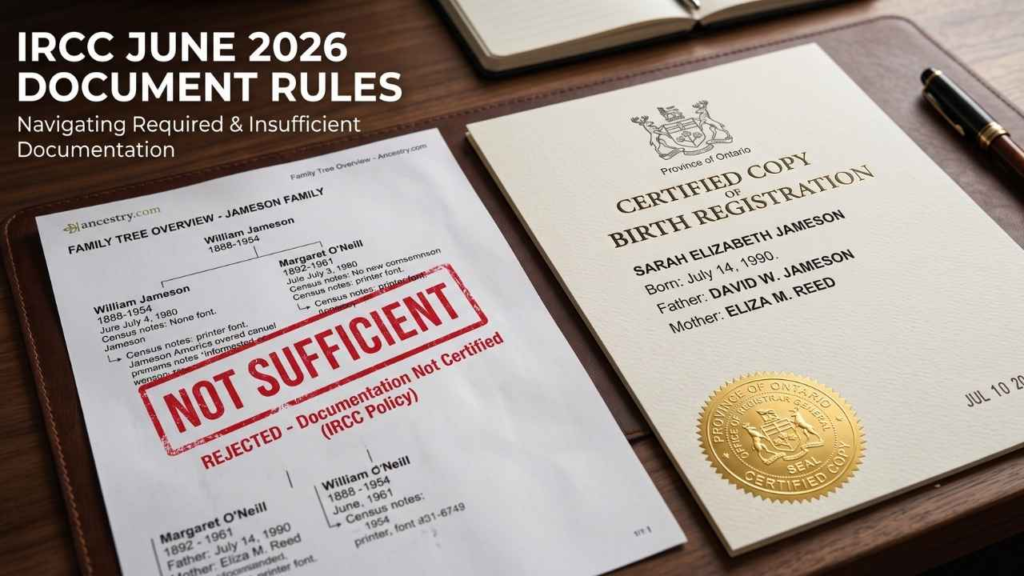
Ancestry Printouts Are Out: The Document Rules IRCC Rewrote for Citizenship by Descent in June 2026
Ancestry Printouts Are Out: The Document Rules IRCC Rewrote for Citizenship by Descent in June…