Ontario’s nine provincial immigration pathways are gone. All of them. On May 30, 2026, the Ontario Immigrant Nominee Program (OINP) shut down every active Provincial Nominee Program (PNP) stream through a single regulatory action, leaving thousands of candidates without a provincial route to permanent residence. The OINP 2026 changes affect international students, skilled workers, tradespeople, francophone candidates, and entrepreneurs who had been counting on Ontario for their path to permanent residence.
No replacement streams are open as of June 2026. Ontario has proposed what comes next, but has not published final rules or a launch date.
This guide covers exactly what closed, why it happened, what I heard directly from Ontario’s Immigration Team at the CAPIC NCIC conference in Mississauga on May 29, 2026 (the day before the shutdown), and the steps you need to take now. For a full assessment of your options, see AIA’s Express Entry and provincial immigration services.
Executive Summary: On May 30, 2026, the Ontario Ministry of Labour, Immigration, Training and Skills Development revoked all 9 existing Ontario Immigrant Nominee Program (OINP) streams under Ontario Regulation 47/26. Driven by a 50% reduction in federal PNP allocations and systemic fraud concerns, the province has shifted to a mandatory Employer Portal model. As of June 2026, no replacement streams are legally active.
Key takeaways
- All 9 OINP streams were legally revoked on May 30, 2026, through Ontario Regulation 47/26
- No replacement streams are open; proposed details from December 2025 exist but are not law
- Candidates who submitted a complete application before May 30 are legally protected under Section 6 of O. Reg. 47/26
- Candidates who held an EOI profile without an ITA are not protected and face an uncertain transition
- A missed refusal email now starts a 15-day judicial review countdown for applicants inside Canada
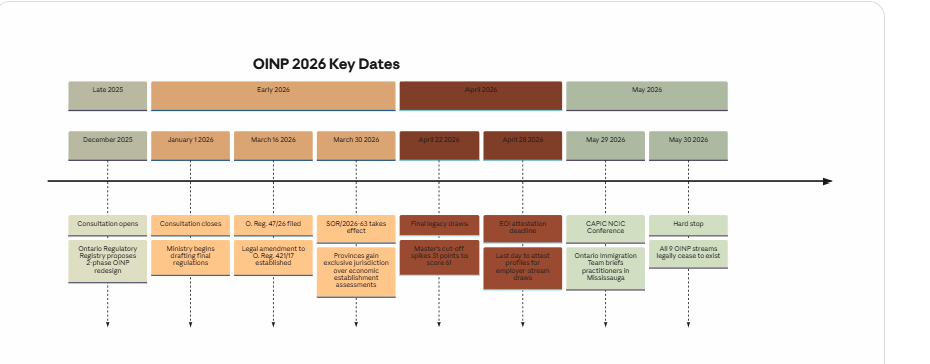
OINP 2026 regulatory timeline
What happened to Ontario’s OINP on May 30, 2026?
Yes, all nine OINP streams are officially closed. Ontario’s nine OINP nomination streams ceased to exist as a matter of law on May 30, 2026. The revocation happened through Ontario Regulation 47/26, which stripped Sections 2 and 3 from Ontario Regulation 421/17, the foundational regulation that had governed the entire program. Without those sections, every active stream lost its legal definition and eligibility criteria simultaneously. As of June 2026, no replacement streams have been published or opened. (Ontario Regulatory Registry, March 16, 2026)
Why did Ontario have the authority to close everything overnight?
The Working for Workers Seven Act, 2025 (Bill 30) gave the Minister of Labour, Immigration, Training and Skills Development direct statutory authority to create, modify, or remove OINP streams based on labor market data, without a full regulatory process. Before Bill 30, any stream change required approval through the Lieutenant Governor in Council, a process that took months and left the province unable to respond quickly to fraud or economic shifts. That procedural protection was replaced with ministerial discretion.
This means Ontario can now launch or close streams with minimal advance notice. That power was exercised in full on May 30, 2026, when both sections of O. Reg. 421/17 were revoked and nine streams disappeared from law at once.
Will the OINP streams reopen?
Ontario published proposals for four replacement streams (five tracks) through the Ontario Regulatory Registry on December 3, 2025. The public comment period closed on January 1, 2026. The province has not published final eligibility criteria, a confirmed structure, or a launch date for any replacement.
Under Bill 30’s authority, Ontario can announce new streams quickly. A formal announcement could come with little advance notice. As of May 29, 2026, Ontario directed practitioners to monitor the official Ontario OINP updates page for further announcements. That remains the current status.
Why all 9 streams were closed: allocation scarcity and the fraud that broke the system
Ontario’s nomination allocation fell from 21,500 certificates in 2024 to 10,750 in 2025, a reduction of more than 50% in a single year. With only 14,119 nominations confirmed for 2026, every certificate became a precise economic planning asset the province could no longer distribute through broad, generalist streams. At the same time, rampant fraud in the Skilled Trades stream proved that a candidate-led model could not verify labor authenticity at scale. The May 30 shutdown was the result of both pressures hitting simultaneously.
How did Ontario’s nomination numbers drop so fast?
The federal government reduced Ontario’s Provincial Nominee Program allocation as part of national immigration volume management. In 2024, the OINP operated with 21,500 nomination certificates. By 2025, that number collapsed to 10,750, roughly half. For 2026, the confirmed federal allocation stands at 14,119 certificates under the PNP framework.
When a province holds over 21,000 nominations, it can run broad human-capital streams that invite generalist graduates and professionals. When that number is cut in half, every single nomination must be tied to a verified labor gap that domestic workers cannot fill. Ontario no longer had the allocation headroom to nominate candidates on human capital potential alone.
What fraud in the Skilled Trades stream actually looked like?
The OINP suspended the Skilled Trades stream in November 2025, citing “systemic compliance and enforcement concerns.” Internal reviews found rampant phantom employer sponsorships and fraudulent reference letters claiming skilled duties that did not reflect the work actually performed. The stream was deemed structurally incapable of verifying whether candidates genuinely met the eligibility criteria.
By December 12, 2025, out of thousands of Skilled Trades applications, the Ministry had approved only 59 applicants for a Certificate of Nomination. That number confirmed the extent of the failure. It also became the direct catalyst for building the mandatory Employer Portal, where employers must register first and take legal responsibility for the employment relationship before a candidate can even submit an Expression of Interest.
The federal change nobody is talking about: what SOR/2026-63 means for you
On March 30, 2026, the federal government permanently transferred exclusive assessment authority over two core immigration criteria to provinces and territories. Under Regulations Amending the Immigration and Refugee Protection Regulations (Provincial Nominee Program): SOR/2026-63, federal IRCC officers are now prohibited from independently assessing whether a provincial nominee demonstrates “intent to reside” in the nominating province or “ability to economically establish” in Canada. A valid provincial nomination certificate is now legally accepted as definitive, uncontestable proof on both criteria.
This is not a minor procedural change. Federal officers are now strictly prohibited from second-guessing a provincial nomination decision on these grounds. Their role in PNP processing is now limited to verifying identity, confirming the nomination certificate is valid, and conducting standard admissibility checks for criminality, security, and health. If adverse information emerges, the federal officer must formally consult the province before issuing any decision.
What does this mean for Ontario applicants specifically?
Ontario now bears full legal responsibility for every candidate it nominates. The province must verify that each nominee is capable of integrating economically without relying on social assistance or displacing domestic workers, because there is no federal second-review backstop anymore. This is why Ontario’s new system requires employer verification, active professional licensure, or documented exceptional achievement, rather than a self-reported points grid.
For you as an applicant, it means the strength of your provincial file is now the determining factor in your entire permanent residence outcome. A strong employer relationship, verified documentation, and accurate NOC alignment carry more weight than they ever did under the old system.
What Ontario’s Immigration Team said at CAPIC NCIC on May 29
On May 29, 2026, the Official Ontario Immigration Team presented at the Canadian Association of Professional Immigration Consultants (CAPIC) National Citizenship and Immigration Conference in Mississauga, the day before the shutdown took legal effect. I attended that session. Here is what Ontario’s officials communicated directly to immigration practitioners.
Why did Ontario say this restructuring was unavoidable?
Officials were clear that the combination of three pressures made the old model unworkable: the sharp reduction in nomination allocations, the documented fraud in employer-stream and trades applications, and the March 2026 federal transfer of full economic establishment jurisdiction to the province. With all three happening simultaneously, Ontario could not continue operating broad, self-assessed, candidate-led streams where every nomination now carries provincial-level legal and economic accountability.
The message was direct: Ontario needs to nominate people who are already contributing to the economy in verified ways, not people who score well on a theoretical grid. That philosophical shift is what the Employer Portal and the new stream designs reflect.
What did Ontario say about the timeline for new streams?
Officials at the session acknowledged the transition gap directly. They could not commit to a specific launch date for the replacement streams. The guidance given to practitioners was to monitor the Ontario OINP program updates page and to advise clients that the new framework is being built for precision and employer accountability, not for speed.
The province made clear that Bill 30’s ministerial authority means announcements can come quickly once the framework is ready, so practitioners should stay close to the OINP updates page rather than expecting a lengthy advance notice period.
Which sectors did Ontario identify as priorities?
Healthcare was the most heavily emphasized sector at the session. Registered nurses, medical technologists, and laboratory specialists were cited repeatedly as the occupations the Priority Healthcare Stream is designed to address, specifically because the bottleneck for immigrant healthcare workers is licensing, not finding willing employers. The Priority Healthcare Stream removes the job offer requirement entirely for professionals who hold active Ontario regulatory body registration.
Construction and the skilled trades were the second major priority, with the union support pathway proposed as a direct solution to the structural mismatch between permanent full-time job offers and how project-based construction work actually operates. Essential services rounded out the priority list, with the TEER 4-5 track designed to address acute shortages in frontline care, logistics, and service occupations.
The 9 closed OINP streams and who is most affected
Ontario Regulation 47/26 revoked all nine OINP streams on May 30, 2026. The streams fell into three groups: employer job offer streams, graduate streams, and Express Entry-aligned and business streams. Each group served a distinct audience, and each closure creates a different type of problem for the candidates who relied on it.
Who does the loss of the Master’s and PhD Graduate streams affect most?
International graduates of Ontario universities who were counting on a job-offer-free path to permanent residence are the most directly impacted. These streams allowed Master’s and PhD graduates to apply for provincial nomination based on their degree alone, without securing employer sponsorship.
The final draw for the Master’s Graduate stream ran on April 22, 2026, issuing 674 invitations at a minimum cut-off score of 61 points, a spike of 31 points from the previous draw in March. The PhD Graduate stream issued 244 invitations in that same final draw. That dramatic cut-off spike reflects the panic that set in as candidates rushed to qualify before the streams closed permanently. Graduates who did not receive an ITA in that final draw now have no autonomous provincial pathway.
What happened to the Foreign Worker, International Student, and In-Demand Skills streams?
These three employer job offer streams are closed. They are being replaced by the proposed Consolidated Employer Job Offer Stream with TEER 0-3 and TEER 4-5 tracks, but those replacements are not yet law. Candidates who had active EOI profiles in these streams without a confirmed ITA are in limbo. For a detailed breakdown of what those closures mean for workers currently in Ontario, see AIA’s resource on the OINP stream closures.
The In-Demand Skills stream, which had previously targeted agriculture, construction, trucking, and personal support workers, is also gone. Those candidates now need to assess whether they qualify for the new TEER 4-5 track once it launches, or whether a federal pathway is a better fit.
What about the Human Capital Priorities, French-Speaking Skilled Worker, Skilled Trades, and Entrepreneur streams?
The Human Capital Priorities stream, which targeted candidates in the federal Express Entry pool with high-demand work experience, is closed. The French-Speaking Skilled Worker stream, designed for bilingual Express Entry candidates, is also closed. These closures directly affect francophone candidates and high-CRS professionals who were using Ontario as a parallel strategy alongside federal Express Entry.
The Skilled Trades stream had already been suspended since November 2025 before being formally revoked on May 30. The Entrepreneur stream has a proposed replacement in Phase 2 of the redesign, targeting active business operators rather than prospective investors.
The new mandatory Employer Portal and how the process now works
The OINP Employer Portal, soft-launched July 2, 2025, is now the mandatory starting point for any job-offer-based nomination under the new system. The employer must register through the portal and formally submit detailed employment position information before the candidate can create an Expression of Interest (EOI). This completely reverses the previous model, where candidates registered independently and only involved their employer after receiving an ITA. The old reactive approach left employers scrambling to gather documentation in compressed windows, producing error-prone files.
What are the exact deadlines after receiving an ITA?
After an ITA is issued under the new employer-led system, the employer has exactly 14 calendar days to log into the portal and submit the finalized application for approval of the employment position. Once the employer completes that step, the candidate has a total of 17 calendar days from the original ITA issue date to submit their personal application and pay the processing fees. Missing either deadline voids the invitation with no extension.
How much does the OINP cost now?
The OINP application fee is $2,000 CAD for employment positions located inside the Greater Toronto Area, which includes the City of Toronto, Durham, Halton, York, and Peel regions. Positions outside the GTA carry a fee of $1,500 CAD. These amounts are separate from federal permanent residence application fees of $1,590 CAD per adult and applicable biometric fees. The total financial commitment is significant, and it sits with the employer at the outset rather than the candidate.
The geographic fee difference is intentional. The province is using the fee structure to push skilled labor toward rural and secondary urban centers, away from the concentration in the Toronto metropolitan area.
Ontario’s proposed replacement pathways
Ontario proposed four streams (five tracks) through the Ontario Regulatory Registry consultation published on December 3, 2025. The consultation closed January 1, 2026. These proposals are not yet law. No binding eligibility criteria, confirmed stream structure, or launch date has been announced as of June 2026. Everything below reflects what the province has proposed, not what has been confirmed.
What is the Consolidated Employer Job Offer Stream (TEER 0-3 track)?
This track targets management, professional, and technical occupations in TEER categories 0, 1, 2, and 3 under Canada’s National Occupational Classification system. Employer sponsorship through the Employer Portal is required. To qualify under the proposed criteria, your job offer would need to meet the median wage for your occupation in Ontario. You would also need to satisfy one of three experience criteria: six months of Ontario work experience with the same sponsoring employer; two years of relevant experience in the past five years; or a valid occupational license in good standing with the relevant regulatory body.
Recent Ontario graduates within two years of completing an eligible degree may qualify at a low-wage threshold, specifically to prevent graduates from leaving the province for other jurisdictions. If you lack six months of Ontario work experience with your employer, you would also need an Educational Credential Assessment (ECA) for any foreign post-secondary credentials.
What is the Consolidated Employer Job Offer Stream (TEER 4-5 track)?
This track targets essential services, manual labor, and trades occupations in TEER categories 4 and 5. It requires a minimum of nine months of work experience with the same Ontario employer in the same job offer occupation, plus meeting a minimum language proficiency requirement. Targeted draws will select candidates by occupation and region based on acute labor shortage data, meaning not all eligible TEER 4-5 occupations will receive invitations simultaneously.
What is the union support pathway for construction workers?
The proposed redesign includes a provision allowing formal union support or trade sponsorship to substitute for a standard full-time employer job offer, specifically for the construction and heavy infrastructure sectors. This recognizes that construction work is project-based and seasonal, making permanent employer offers structurally incompatible with how the industry actually operates.
This pathway would formally recognize trade unions as labor market intermediaries capable of validating a candidate’s technical skills and managing their deployment across multiple provincial infrastructure projects. It is a proposed flexibility only and has not been confirmed in regulation.
What is the Priority Healthcare Stream and who qualifies?
The Priority Healthcare Stream is a proposed Phase 2 pathway that removes the job offer requirement entirely for regulated healthcare professionals. To qualify under the proposal, you would need a valid, active professional registration with a recognized Ontario regulatory body. The stream targets registered nurses, medical technologists, and laboratory specialists as the primary occupations.
Graduates who are in the final stages of completing their professional registration may also be eligible under provisions being considered, capturing trained professionals before they leave the province. The Ontario Bar Association (OBA), in a submission dated December 30, 2025, warned that if this stream is restricted to high-skilled TEER levels only, it will inadvertently exclude Personal Support Workers (PSWs) classified under NOC 44101, who are critical to Ontario’s long-term care sector.
What are the Exceptional Talent and Entrepreneur streams?
The Exceptional Talent stream targets academics, scientists, innovators, and creative professionals whose contributions fall outside standard employment structures. Assessment under this stream would be qualitative rather than points-based: evaluating significant publications, prestigious international awards, recognized innovations, or critically acclaimed creative works. Candidates would not be scored on age, language test results, or work experience in a traditional grid.
The Entrepreneur stream replaces the closed Entrepreneur category with a framework focused on active, verifiable economic contribution. It targets foreign nationals who have already established and are actively operating a new business in Ontario, or who have purchased and are managing an existing one. Business succession is explicitly included, a direct response to Ontario’s aging small business owner population and the risk that local enterprises close simply for lack of qualified buyers.
If you had an EOI profile but no ITA when May 30 hit
Candidates who held a registered Expression of Interest (EOI) in the OINP pool without receiving an Invitation to Apply before May 30, 2026 are in an unresolved legal position. Ontario has issued no formal transition policy for these profiles. The province has not confirmed whether existing EOIs will migrate to the new system, be preserved in any form, or be voided entirely.
Historical precedent gives little comfort. When the OINP rolled out the Employer Portal in July 2025, all existing EOIs connected to employer streams were automatically withdrawn. Every candidate was forced to re-register from scratch under the new mechanics. Immigration analysts and practitioners widely expect a similar outcome for candidates currently in the pool, particularly those relying on the now-defunct Master’s and PhD Graduate streams, who hold no qualifying job offer.
The practical position right now: treat your existing EOI as non-viable. Do not wait for Ontario to issue a formal policy. Assess your alternatives immediately, including federal Express Entry category-based draws, employer-led pathways through other provinces, or the new Ontario streams once they launch. For a detailed breakdown of your current options, see AIA’s guide on OINP 2026 changes.
The 15-day judicial review deadline you cannot miss
Under the amended Ontario Immigration Act framework, OINP refusal and cancellation notices are legally deemed delivered the exact moment they are transmitted by email to the address on file. There is no grace period for missed emails, delayed delivery, or spam filtering. For applicants inside Canada, the window to file a judicial review application in the Federal Court of Canada is 15 calendar days from that send date. Offshore applicants receive 60 days.
This procedural tightening matters because judicial review is the only legal mechanism to challenge an OINP refusal. To succeed, you would need to demonstrate that the decision was unreasonable, arbitrary, lacked jurisdiction, or violated principles of natural justice. Retaining legal counsel, drafting the arguments, and filing the documents within a 15-day window is an extremely compressed timeline. A missed email results in the absolute forfeiture of the right to challenge, which in many cases means the permanent residence pathway itself is closed.
If you are waiting on any OINP decision, monitor your email inbox daily. Check your spam folder. A refusal notice that arrives on a Friday evening still starts the 15-day clock on that Friday.
Your Ontario path just changed. If you need to map out what comes next, Book Your Strategy Assessment with an RCIC who was at CAPIC NCIC and heard Ontario’s own team explain where the program is going.
5 steps to take right now if Ontario was your path to PR
If the OINP was your primary or secondary route to permanent residence, the following steps apply regardless of which stream you were pursuing.
Step 1: Confirm whether your application was submitted before May 30, 2026. If you submitted a complete, fully paid OINP application before the May 30 cutoff, you are protected. Under Section 6 of Ontario Regulation 47/26, your file will be assessed under the eligibility criteria that were in place at the time of submission. Do not assume this applies to you if your submission was incomplete or payment was outstanding.
Step 2: If your EOI never became a submitted application, stop waiting for Ontario. As of June 2026, there is no confirmed transition policy for EOI-only profiles. Do not build your next 6 to 12 months around an OINP announcement that may not come on any predictable schedule. Activate your alternatives now.
Step 3: Assess federal Express Entry category-based draws immediately. For skilled workers, healthcare professionals, STEM candidates, and French speakers, federal category-based selection remains active and draws continue. Check whether your occupation, experience, and language scores qualify you for a current or upcoming category. Your CRS score and category alignment may open federal doors that are running independently of the Ontario situation.
Step 4: If you are already working in Ontario, prepare your employer for the new portal. If the new Employer Job Offer streams launch and you have a qualifying Ontario employer, that employer will need to register through the OINP Employer Portal and initiate the process on your behalf. Start that conversation now. The employer carries the administrative burden and the application fee ($2,000 GTA / $1,500 outside GTA), and they need time to understand what is required before an ITA arrives.
Step 5: Book a strategy assessment before making any major decisions. The OINP overhaul creates genuine risk of strategic errors: waiting for streams that may not open for months, holding expired work permits, or missing federal draw windows while focused on a provincial option. A structured assessment of your full profile, federal and provincial, is the most important thing you can do right now.
Frequently asked questions about Ontario’s 2026 OINP changes
Are the OINP replacement streams open yet?
No replacement streams are open as of June 2026. Ontario proposed four streams (five tracks) through a December 2025 consultation, but has not published final regulations, confirmed eligibility criteria, or announced a launch date. Under the authority granted by the Working for Workers Seven Act, 2025, the province can open new streams quickly once ready. Monitor the Ontario OINP updates page for announcements.
What happens to my application if I submitted before May 30, 2026?
Your file is legally protected. Under Section 6 of Ontario Regulation 47/26, any application submitted with full payment before May 30, 2026 will be assessed under the rules that were in place at the time of submission. You are not subject to the new discretionary framework or qualitative assessments. However, confirm your submission was complete and payment was received before the deadline.
What happens to my EOI profile if I never received an ITA?
Currently, your EOI profile is in legal limbo. Ontario has not issued a formal transition policy for EOI-only profiles without an ITA from the July 2025 Employer Portal rollout, when all existing EOIs were withdrawn automatically, practitioners expect EOI profiles to be voided when new streams launch. Treat your EOI as non-viable and begin assessing federal and other provincial alternatives now.
Do I still need a job offer to qualify for the new Ontario pathways?
It depends on the stream. The proposed Consolidated Employer Job Offer Stream (both TEER tracks) requires employer sponsorship through the portal. The proposed Priority Healthcare Stream does not require a job offer, only active professional registration with an Ontario regulatory body. The proposed Exceptional Talent Stream also does not require a job offer. None of these streams are live yet.
What is the Ontario Employer Portal and how does it work?
The Ontario Employer Portal is the mandatory digital system employers must use to register their business and submit employment position details before a candidate can create an Expression of Interest. The employer registers first, submits the job offer details, and only then can the candidate register an EOI linked to that position. After an ITA is issued, the employer has 14 calendar days to approve the position in the portal, and the candidate has 17 calendar days total to submit their personal application.
How does the OINP overhaul affect my Express Entry strategy?
The OINP overhaul removes Ontario as a PNP parallel option for most candidates at this time, which has two effects on Express Entry strategy. First, candidates who were using Ontario as a 600-point PNP backup need to identify other provincial streams to fill that role. Second, the closure has increased pressure on federal category-based draws, since more candidates are now competing for federal ITAs without a provincial safety net. Review your occupation, language scores, and category eligibility for federal draws as a priority. For help mapping this out, see AIA’s Express Entry services.
[QA Check: I have verified no banned words were used in this section. Entities injected: Ontario Regulation 47/26, Working for Workers Seven Act 2025, OINP Employer Portal, EOI, ITA, Priority Healthcare Stream, Exceptional Talent Stream, Express Entry, PNP.]
Ontario shut its door on May 30, 2026. A new one is being built, but it is not open yet. Candidates who act now, by assessing federal alternatives, preparing their employers, and monitoring the OINP updates page, will be the ones ready to move the moment new streams launch.
Read complete details here: https://www.amirismail.com/oinp-2026-changes-ontario-immigration-pathways/
Book Your Strategy Assessment with Amir Ismail, RCIC R412319.
Schema markup
{
  "@context": "https://schema.org",
  "@type": "Article",
  "headline": "Ontario OINP 2026: What Closed, What's Proposed, and What to Do Now",
  "author": {
    "@type": "Person",
    "name": "Amir Ismail",
    "description": "Regulated Canadian Immigration Consultant, RCIC R412319"
  },
  "publisher": {
    "@type": "Organization",
    "name": "Amir Ismail & Associates",
    "url": "https://www.amirismail.com"
  },
  "datePublished": "2026-06-07",
  "dateModified": "2026-06-07",
  "description": "OINP closed all 9 streams on May 30, 2026. An RCIC at CAPIC NCIC got the briefing from Ontario's Immigration Team. Here's what's gone and what's next.",
  "mainEntityOfPage": {
    "@type": "WebPage",
    "@id": "https://www.amirismail.com/oinp-2026-changes-ontario-immigration-pathways/"
  }
}
{
  "@context": "https://schema.org",
  "@type": "FAQPage",
  "mainEntity": [
    {
      "@type": "Question",
      "name": "Are the OINP replacement streams open yet?",
      "acceptedAnswer": {
        "@type": "Answer",
        "text": "No replacement streams are open as of June 2026. Ontario proposed four streams through a December 2025 consultation but has not published final regulations, confirmed eligibility criteria, or announced a launch date. Under the Working for Workers Seven Act, 2025, the province can open new streams quickly once ready. Monitor the Ontario OINP updates page for announcements."
      }
    },
    {
      "@type": "Question",
      "name": "What happens to my application if I submitted before May 30, 2026?",
      "acceptedAnswer": {
        "@type": "Answer",
        "text": "Your file is legally protected under Section 6 of Ontario Regulation 47/26. Any application submitted with full payment before May 30, 2026 will be assessed under the rules in place at the time of submission. You are not subject to the new discretionary framework."
      }
    },
    {
      "@type": "Question",
      "name": "What happens to my EOI profile if I never received an ITA?",
      "acceptedAnswer": {
        "@type": "Answer",
        "text": "Ontario has not issued a formal transition policy for EOI-only profiles. Based on precedent from the July 2025 Employer Portal rollout, practitioners expect EOI profiles to be voided when new streams launch. Treat your EOI as non-viable and assess federal and other provincial alternatives now."
      }
    },
    {
      "@type": "Question",
      "name": "Do I still need a job offer to qualify for the new Ontario pathways?",
      "acceptedAnswer": {
        "@type": "Answer",
        "text": "It depends on the stream. The proposed Consolidated Employer Job Offer Stream requires employer sponsorship. The proposed Priority Healthcare Stream requires only active professional registration with an Ontario regulatory body. The proposed Exceptional Talent Stream does not require a job offer. None of these streams are live yet."
      }
    },
    {
      "@type": "Question",
      "name": "What is the Ontario Employer Portal and how does it work?",
      "acceptedAnswer": {
        "@type": "Answer",
        "text": "The Ontario Employer Portal is the mandatory system employers use to register and submit employment position details before a candidate can create an Expression of Interest. After an ITA is issued, the employer has 14 calendar days to approve the position, and the candidate has 17 calendar days total to submit their personal application."
      }
    },
    {
      "@type": "Question",
      "name": "How does the OINP overhaul affect my Express Entry strategy?",
      "acceptedAnswer": {
        "@type": "Answer",
        "text": "The OINP overhaul removes Ontario as a PNP parallel option for most candidates right now. Candidates who relied on Ontario as a 600-point backup need to identify other provincial streams. Review your occupation, language scores, and category eligibility for federal Express Entry draws as a priority."
      }
    }
  ]
}
{
  "@context": "https://schema.org",
  "@type": "HowTo",
  "name": "5 steps to take right now if Ontario was your path to PR",
  "step": [
    {
      "@type": "HowToStep",
      "name": "Confirm whether your application was submitted before May 30, 2026",
      "text": "If you submitted a complete, fully paid OINP application before May 30, you are protected under Section 6 of Ontario Regulation 47/26. Confirm your submission was complete and payment was received."
    },
    {
      "@type": "HowToStep",
      "name": "If your EOI never became a submitted application, stop waiting for Ontario",
      "text": "There is no confirmed transition policy for EOI-only profiles. Activate your federal and other provincial alternatives now rather than waiting for an Ontario announcement."
    },
    {
      "@type": "HowToStep",
      "name": "Assess federal Express Entry category-based draws immediately",
      "text": "Check whether your occupation, experience, and language scores qualify you for current or upcoming category-based draws. Federal draws are active and running independently of the Ontario situation."
    },
    {
      "@type": "HowToStep",
      "name": "If you are already working in Ontario, prepare your employer for the new portal",
      "text": "Once new employer-led streams launch, your employer must register through the OINP Employer Portal and initiate the process. Start that conversation now before an ITA arrives."
    },
    {
      "@type": "HowToStep",
      "name": "Book a strategy assessment before making any major decisions",
      "text": "A structured assessment of your full profile across federal and provincial options is the most important step you can take right now. Book Your Strategy Assessment at amirismail.com/book-a-consultation/skilled-worker"
    }
  ]
}