Not sure you qualify? Take our Canadian citizenship eligibility quiz first.
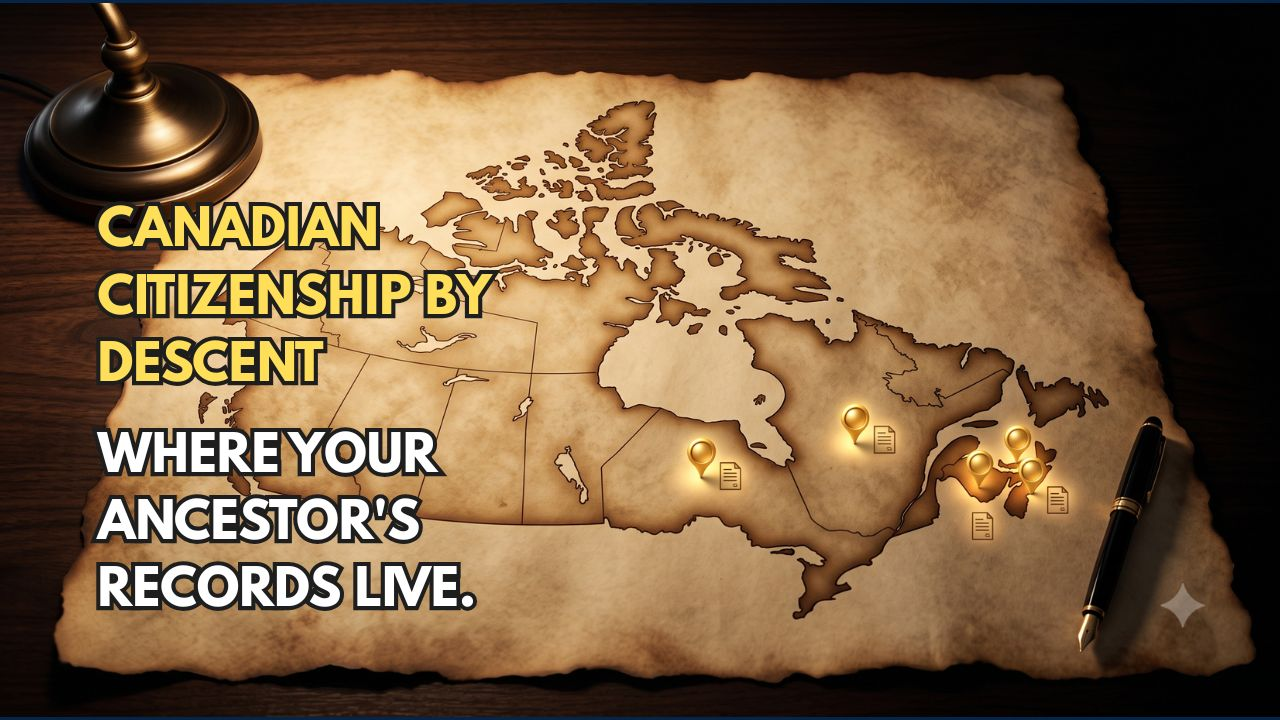
To apply for Canadian citizenship by descent, you must request vital records from the province where the event actually happened. Canada does not have one national office for birth, marriage, or death records.
Detailed guides by province: Ontario, Quebec, Alberta, Manitoba, New Brunswick, Newfoundland and Labrador, Nova Scotia, Prince Edward Island and Saskatchewan.
If you’re still confirming whether you qualify, read my Canadian citizenship by descent document guide for the June 2026 rules before you start ordering records.
Each province and territory runs its own vital statistics office and archives, so your request depends completely on where your ancestor’s event took place. This guide shows you which office to contact in each province, what to ask for, and how long requests usually take.
Immigration, Refugees and Citizenship Canada (IRCC) requires long-form certificates (or certified copies of registration) that display parental information for every generation in your lineage. Short-form or wallet-sized birth certificates are categorically rejected because they do not legally establish the parent-child link.
Amir Ismail and Associates provides dedicated representation, eligibility analysis, and strategic guidance for Canadian citizenship by descent applications. Applicants use the factual guidelines provided below for us to evaluate these records and handle your application representation with IRCC.
Quick Answer: Where Do I Order Canadian Ancestor Records?
For Canadian citizenship by descent, you order your ancestor’s birth, marriage, and death records from the provincial vital statistics office or archive in the province where the event was registered.
There is no central Canadian office for these documents. Each province and territory keeps its own records and has its own request process.
Always ask for a long‑form certificate or certified copy of registration that shows parents’ names, plus a no‑record letter if nothing is found.
Key Takeaways
- Vital records are PROVINCIAL. Request birth, marriage, and death certificates from the province where the event happened – there is no national office.
- Older records usually sit in the provincial archive, while recent ones stay with the vital statistics office; the cutoff year changes by province.
- In Quebec, historical parish records are at BAnQ, and modern civil status records come from the Directeur de l’état civil.
- For IRCC, always order a certified copy or long‑form certificate with parents’ names, and ask for a no‑record letter if the search fails.
- Since Bill C‑3 and the 33-month IRCC queue, archive turnaround times are part of your strategy, not an afterthought.
Why There Is No National Records Office for Canadian Ancestors’ Vital Documents
Canada’s constitution puts vital statistics under provincial control. Births, marriages, and deaths have always been registered where they happened, by the province or its predecessor bodies.
That means a family that moved from New Brunswick to Ontario to Alberta left records in three separate systems. Your job is matching each event in your family chain to the right provincial office.
The general pattern across provinces: recent records come from the vital statistics office, and records older than a certain cutoff transfer to the provincial archive with more open access. The exact cutoff year varies, so check before you file a request.
Quebec Vital Records for Citizenship by Descent
Quebec separates vital records between modern civil status certificates and historical parish registers, and both can be used for Canadian citizenship by descent when properly certified.
For fees, offices and year ranges, see our Quebec records guide.
When applying with historical Quebec records for citizenship by descent, you must obtain a certified copy of the parish register entry directly from BAnQ or the holding archive.
- Civil Status Records: The Directeur de l’état civil du Québec issues certified copies of birth, marriage, and death acts for modern events.
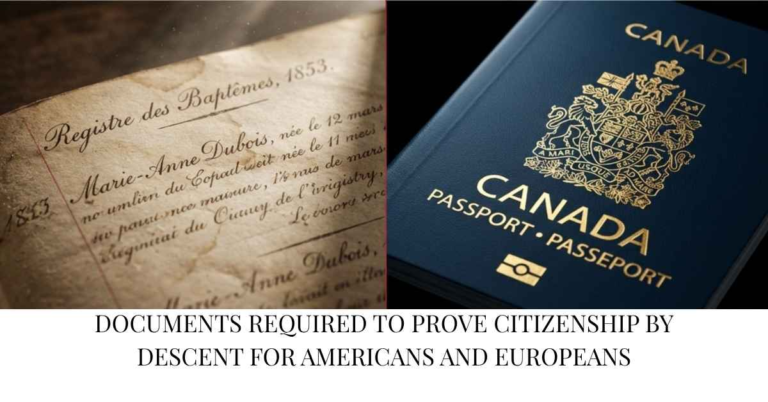
- Historical Parish Records: Bibliothèque et Archives nationales du Québec (BAnQ) manages older parish and historical records. Many historical “birth records” in Quebec are actually baptismal entries recorded in church parish registers.
Quebec’s history makes it uniquely rich for genealogy. Parish registers served as the civil record for generations, and duplicate copies were deposited with the state, which is why French‑Canadian lines are often the easiest to document. Our French‑Canadian ancestry guide covers this in depth.
Pre‑1994 vs. Post‑1994 Documents
Quebec centralized civil status registration in 1994. Events from 1994 onward are certified by the Directeur de l’état civil, while earlier events trace back to church and judicial registers, with certified copies available through the appropriate archive route.
For IRCC purposes, note that Quebec church records carry official weight for the eras when they were the legal register. Request certified copies, not database screenshots, to satisfy the June 2026 documentary standard.
Am I a Canadian citizen by descent?
Trace your family line one generation at a time. Each link is tested against the law in force when that person was born, so you see exactly where your chain holds and where it breaks. About three minutes, and no account needed.
Check my family lineNew Brunswick Vital Records for Canadian Ancestors
New Brunswick vital records are managed by Service New Brunswick (Vital Statistics) for recent events and the Provincial Archives of New Brunswick (PANB) for older records.
For fees, offices and year ranges, see our New Brunswick records guide.
- Recent Records: Service New Brunswick’s Vital Statistics office holds birth records registered after 1930, and marriage or death records registered after 1976.
- Historical Records: The Provincial Archives of New Brunswick (PANB) holds birth records before 1930, and marriage or death records before 1976. PANB also holds historical church and sacramental records which can be used if standard vital statistics records are unavailable.
To request a search through PANB, applicants must provide the individual’s first and last name, an exact date or a 3‑ to 5‑year range, the specific location (county, city, town, or parish), and the religious denomination for church records. Civil registration was inconsistent before the late 1800s, so many older births exist only in church registers.
Typical turnaround – Service New Brunswick (recent records):
- Birth certificates: up to 5 business days for regular service.
- Marriage certificates: up to 10 business days for regular service.
- Death certificates: up to 10 business days for regular service.
- Expedited service (where available): processed within 48 hours if the application is complete and the event is already registered.
Provincial Archives of New Brunswick (older records):
Public reports suggest email inquiries and document requests can take around 2–3 weeks, depending on volume and complexity. For archival searches on 1800s material, a wait of several weeks is normal and should be built into your timeline.
If a search comes up empty, that is common for 1800s New Brunswick births and not fatal to your claim. Our guide on proving an ancestor without a birth record shows accepted workarounds, including collateral‑evidence approaches that have worked in our own New Brunswick casework.
Nova Scotia and Prince Edward Island and Western Provinces
For other provinces and territories, records are centralized within their respective provincial vital statistics agencies.
For fees, offices and year ranges, see our Nova Scotia records guide, our Prince Edward Island records guide, our Alberta records guide, our Manitoba records guide, our Saskatchewan records guide and our Newfoundland and Labrador records guide.
Nova Scotia Vital Records and Archives
Nova Scotia routes historical vital records through the Nova Scotia Archives, while recent events go through Service Nova Scotia – Vital Statistics.
- Recent Records: Service Nova Scotia – Vital Statistics issues birth, marriage, and death certificates for modern registrations.
- Historical Records: The Nova Scotia Archives holds older civil registrations and church records that often act as the only evidence for 19th‑century events.
When requesting historical Nova Scotia records for citizenship by descent, ask for a certified copy of the original register entry, not a simple transcript. This gives IRCC the exact wording and signatures recorded at the time of the event.
Typical turnaround – Nova Scotia:
Vital Statistics (recent records): certificate requests are usually processed within a few weeks plus mailing time, assuming the event is already correctly registered.
Nova Scotia Archives: certified paper copies are generally processed within 2–4 weeks, with delays possible during major digitization or indexing projects.
Prince Edward Island Vital Records and Archives
Prince Edward Island Vital Records and Archives
Prince Edward Island uses PEI Vital Statistics for recent records and the Public Archives and Records Office of PEI for historical material.
- Recent Records: PEI Vital Statistics issues birth, marriage, and death certificates for modern events.
- Historical Records: The Public Archives and Records Office of PEI preserves older civil registrations and church records that document many pre‑20th‑century births and marriages.
For citizenship by descent, PEI applicants should order long‑form certificates or certified copies of registration so IRCC can verify parents’ names and the exact line of descent.
Typical turnaround – Prince Edward Island:
PEI Public Archives and Records Office: archival requests have recently seen waits of roughly three months, as demand from citizenship and genealogy claimants has surged.
PEI Vital Statistics: current estimates for birth, marriage, and death certificates are around 3–4 months from submission of a complete application, documentation, and fees.
Western Provinces: British Columbia and Alberta Vital Records
In British Columbia and Alberta, most vital records for citizenship by descent come directly from their provincial vital statistics agencies, which centralize registration and certificate issuance.
- British Columbia: BC’s Vital Statistics Agency handles birth, marriage, and death certificates and offers certified copies suitable for IRCC citizenship by descent applications.
- Alberta: Alberta’s Vital Statistics office issues birth, marriage, and death certificates and certified copies of registrations for events recorded in the provincial system.
As everywhere, you should order certified copies or long‑form certificates and keep every piece of correspondence, because IRCC can and does ask for proof of how and where a record was obtained.
Typical turnaround – Western provinces (general pattern):
- Standard certificate requests: processing typically ranges from several business days to a few weeks, depending on the province and current demand.
- Archival or special requests: searches that involve older registers or special handling can take several weeks, and this should be factored into your citizenship by descent timeline.
Ontario Vital Records for Citizenship by Descent
Ontario vital records are divided between two government bodies based on the year the event occurred.
For fees, offices and year ranges, see our Ontario records guide.
- Recent Records: The Office of the Registrar General (via ServiceOntario) holds recent birth, marriage, and death registrations.
- Historical Records: The Archives of Ontario holds older registrations. This generally covers birth registrations up to about 1919/1920, marriage registrations up to 1944/1945, and death registrations up to 1954/1955.
For a citizenship by descent application, you must order either a Birth Certificate with Parental Information or a Certified Copy of Birth Registration. A basic short‑form birth certificate does not list parents’ names and will be rejected by IRCC because it cannot prove the parent‑child link.
Typical turnaround – ServiceOntario (recent records):
- Regular online birth certificate service: about 15 business days plus Canada Post delivery.
- Premium/urgent online service: about 5 business days plus delivery.
- Mail or fax applications: approximately 6–8 weeks processing time, with an expedited option around 10 days where offered.
Typical turnaround – Archives of Ontario (older records):
- Standard reproduction orders: target of around 14 business days to complete.
- Rush services (where available): some requests can be completed in about 4 business days.
- When conservation work or special handling is needed, total time can extend beyond the standard service levels due to backlog and preservation requirements.
Template: How to Request Canadian Ancestor Vital Records
Use this template when you email or mail any Canadian provincial office or archive for your ancestor’s vital records for citizenship by descent.
- Full name of the person, including known spelling variants
- Event type and approximate date (birth, marriage, or death, with a year range if unsure)
- Location as precisely as known (town, parish, county)
- Parents’ names if known, to distinguish common names
- The format you need: certified copy or long-form certificate
- Ask for a no‑record letter if nothing is found. Under the June 2026 rules, a no-record letter is your proof of genuine effort when a document cannot be obtained, and IRCC expects to see it.
Chasing records across three provinces while the clock runs? We do this every week. Book a Strategy Consultation with Amir Ismail, RCIC #R412319.
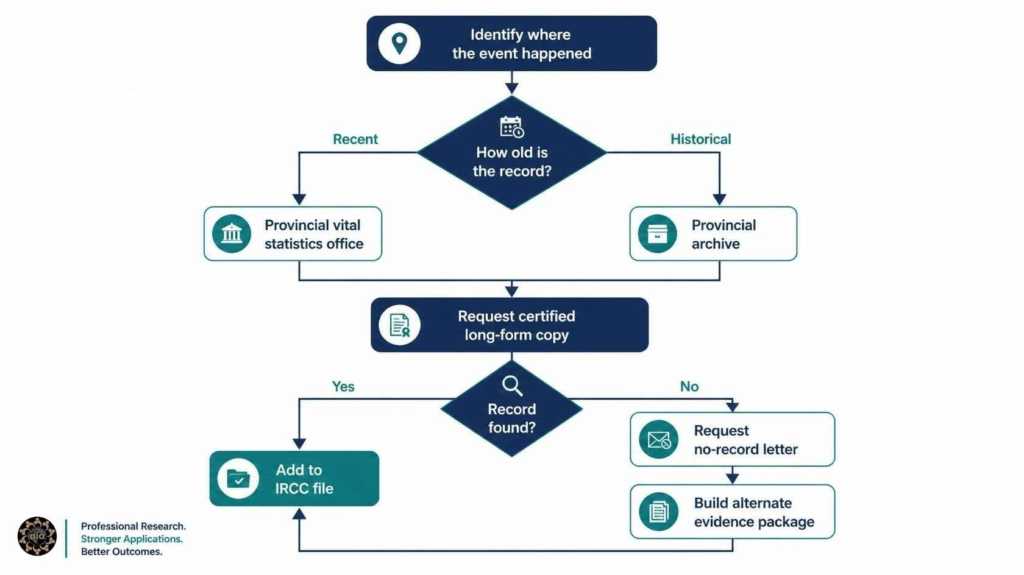
The following Flow Chart explains how to order your Canadian Ancestor’s vital records
Not sure you qualify?
Take our Canadian citizenship eligibility quiz in about two minutes, read the Canadian citizenship guide, then Book a Strategy Consultation with Amir Ismail, RCIC R412319, to confirm your path.
Frequently Asked Questions About Canadian Ancestor Records
What is the first step to find my Canadian ancestor’s records?
Start by confirming which province the birth, marriage, or death happened in, then locate that province’s vital statistics office or archive using this guide.
Do I order records from IRCC or from the province?
You do not order ancestor records from IRCC. You order them from the provincial vital statistics office or archive, then submit those documents to IRCC with your citizenship application.
Will IRCC accept documents printed from genealogy websites?
No, IRCC does not accept printouts from genealogy websites such as Ancestry or FamilySearch as proof of citizenship. The civil registry must issue all birth, marriage, and status records, vital statistics office, or official government archive that holds the original register.
Can I order my ancestor’s birth certificate online?
Often, yes. Most provincial vital statistics offices and several archives accept online orders for certified copies. For restricted recent records, you may need to prove your relationship to the person. For archival records, access is generally open.
Why is my short-form birth certificate not accepted for citizenship by descent?
Short-form birth certificates do not list the parents’ names and therefore cannot legally establish the parent-child relationship. IRCC strictly requires long-form certificates or certified copies of registration to verify the exact line of descent.
What if my ancestor’s record is in a province I did not expect?
Follow the event, not the family home. A grandmother who lived her whole life in Ontario may have been born during a family stint in Manitoba. Census records and church registers help pin down where each event actually happened before you pay for searches.
Do I need records from every province my family lived in?
Yes, you must obtain a vital record for every qualifying event in your ancestral chain to prove Canadian citizenship by descent. This requirement includes a birth certificate for each generation and marriage certificates that bridge any legal name changes to establish an unbroken lineage.
How long do provincial offices take to respond?
It varies widely by office and by current demand, and Bill C-3 has pushed request volumes up at several archives. Confirm current turnaround with each office when you order, and remember the IRCC queue itself is running about 33 months. Our processing time guide covers the full timeline picture.
The paperwork lives in five different systems, but your application only gets one shot at a first impression. Build your record strategy before you spend a dollar on certificates. Book a Strategy Consultation and let us map your ancestor records province by province.
About the Author: Amir Ismail is a Regulated Canadian Immigration Consultant (RCIC #R412319), licensed by the College of Immigration and Citizenship Consultants (CICC). He founded Amir Ismail & Associates in 1991 and has served 25,000+ clients from offices in Toronto, Dubai, and Karachi. Book a Strategy Consultation for case-specific advice.
Access More Citizenship By Descent Resources By Amir Ismail
Proof of Citizenship From the US: Does a Representative in Canada Save Time?
A representative in Canada does not move your proof of citizenship from the US to…

Canadian Citizenship for an Adopted Child Abroad: Grant or PR?
If you are a Canadian in the US who adopted a child, you have two…

Canadian Passport Application From the USA: Guarantor, References and Fees
A Canadian passport application from the USA is a mail-in process. You fill out form…
British Home Children Citizenship by Descent: Who Qualifies Under Bill C-3
Many descendants of British Home Children can claim Canadian citizenship by descent. The key fact…
Proof of Canadian Citizenship Wait by Application Month: Why Your Date Matters
Your proof of citizenship wait by application month is not one number. The processing times…

American Dual Citizenship With Canada: What Changes and What Does Not
Yes, you can keep both. American dual citizenship with Canada is legal in both countries,…

Moving to Canada as a New Citizen by Descent: Health Coverage by Province
If you are moving to Canada as a new citizen by descent, your health coverage…
Is 1867 a Cut-Off for Citizenship by Descent? Why Older Ancestors Still Count
No, 1867 is not a legal cut-off, so you can still pursue citizenship by descent…
Bill C-3 Second Generation Children: Are Your Kids Canadian?
If you are an American who became Canadian under Bill C-3, your children born before…

After Your Citizenship Certificate: What It Does Not Give Americans
After your Canadian citizenship certificate arrives, you are a Canadian citizen on paper, but the…

Section 8 Lost Canadians: Bill C-3 Gives Back Citizenship Lost at Age 28
Section 8 Lost Canadians: Bill C-3 Gives Back Citizenship Lost at Age 28 If you…

Bill C-3 Reversal Risk: Could You Lose Citizenship by Descent?
Bill C-3 Reversal Risk: Could You Lose Citizenship by Descent? By Amir Ismail, RCIC #R412319…
Proof of Canadian Citizenship Processing Time 2026 (34-Month Wait and 130,700-File Queue Explained)
Proof of Canadian Citizenship Processing Time 2026 (34-Month Wait and 130,700-File Queue Explained) IRCC’s proof…
Canadian Citizenship by Descent: Eligibility Checklist for Americans (Bill C‑3)
Do I Qualify for Canadian Citizenship by Descent? The American’s Eligibility Checklist By Amir Ismail,…
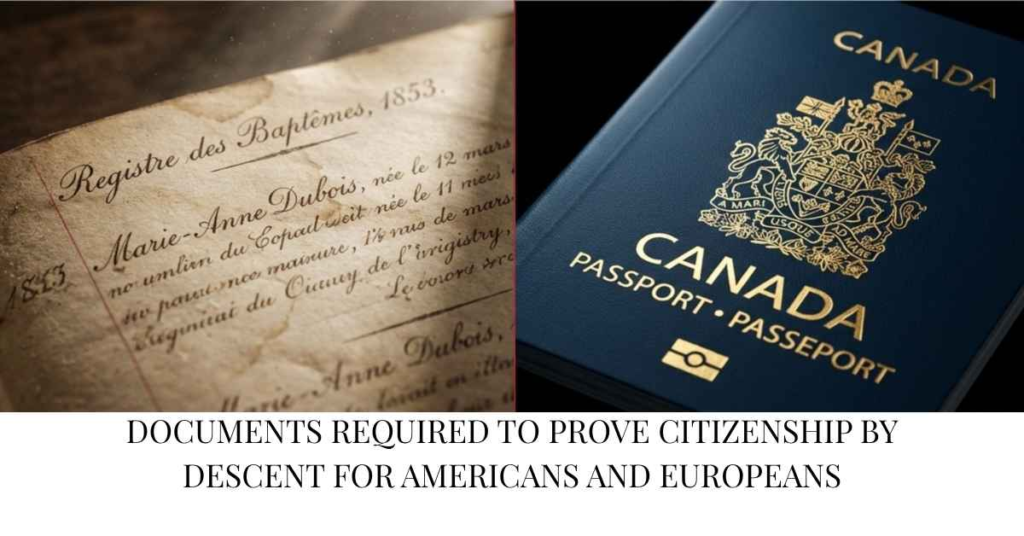
Canadian Citizenship by Descent: Complete Document Guide (Bill C-3 2025)
Baptismal Records for Canadian Citizenship by Descent: 2026 Guide
Baptismal Records for Canadian Citizenship by Descent: A Complete Ordering Guide (2026) LAST UPDATED: AUGUST…
Six Wrong Reasons People Rule Themselves Out of Canadian Citizenship by Descent
Six Wrong Reasons People Rule Themselves Out of Canadian Citizenship by Descent By Amir Ismail,…

Married to a Brand-New Canadian Citizen? What Descent Does (and Does Not) Do for You
Married to a Brand-New Canadian Citizen? What Canadian Citizenship By Descent Does (and Does Not)…
Ancestor Birth Record Missing? IRCC Alternatives 2026
When the Birth Certificate Never Existed: Proving Your Canadian Ancestor’s Identity to IRCC By Amir…
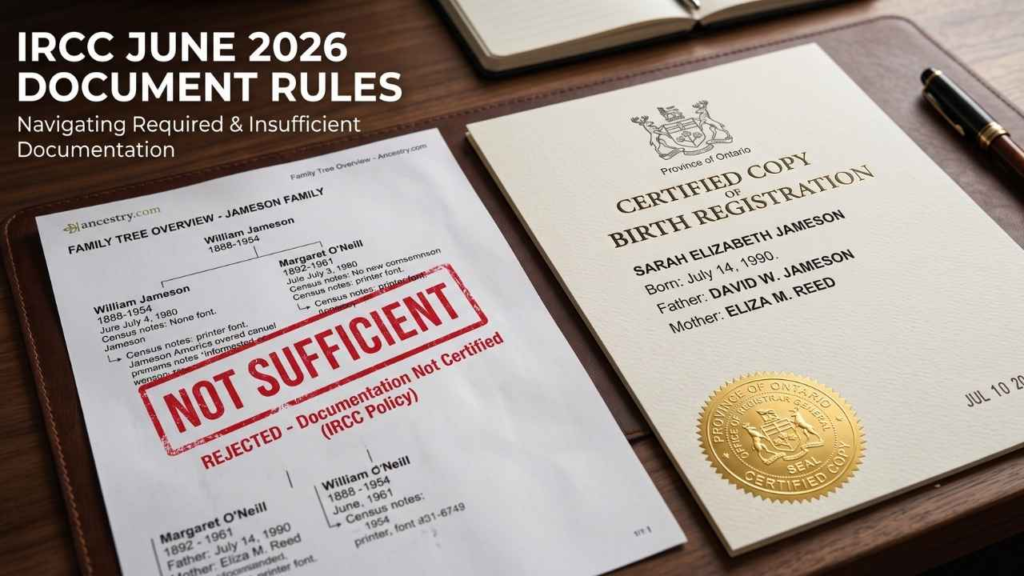
Ancestry Printouts Are Out: The Document Rules IRCC Rewrote for Citizenship by Descent in June 2026
Ancestry Printouts Are Out: The Document Rules IRCC Rewrote for Citizenship by Descent in June…