
Not sure you qualify? Take our Canadian citizenship eligibility quiz first.
If you have French-Canadian ancestry, Canadian citizenship might be yours automatically under Bill C-3. Americans born before December 15, 2025, simply need to prove an unbroken line of descent to a Quebec-born ancestor. No Canadian residence is required, no Canadian taxes are owed, and there is no limit on how many generations back that ancestor can be.
This is one of the most powerful citizenship-by-descent opportunities in the world. But it comes with a very specific documentary challenge. Quebec has a civil registration system unlike any other province, and IRCC applies strict, unforgiving evidentiary standards to documents originating from it. Getting this right the first time saves you months of delays.
Key Takeaways
- Americans born before December 15, 2025, can claim Canadian citizenship through Quebec ancestors.
- There is no generational limit. It can be a parent, grandparent, or great-grandparent.
- You do not need to live in Canada or pay Canadian taxes to qualify.
- Quebec’s 100-Year Rule means you must order specific civil records from either BAnQ or the DEC.
Table of Contents
Why Franco-Americans Are at the Center of Bill C-3
The Franco-American community in New England is not just a beneficiary of Bill C-3. It is the primary demographic the legislation was built for. Between 1840 and 1930, up to a million French-Canadians left Quebec for the textile mills, lumber camps, and shoe factories of states like Maine, New Hampshire, Massachusetts, and Rhode Island. Their descendants today number in the millions.
In the first three months after Bill C-3 took effect (December 15, 2025 to March 31, 2026), IRCC issued 4,075 citizenship certificates under the new extended descent rules. Nearly 48 percent, or 1,955 of those, went to people born in the United States. During that same period, another 6,135 Americans received certificates under the legacy rules. Americans are dominating this process by a wide margin compared to every other country combined.
The reasons driving applications go beyond genealogical curiosity. Immigration lawyers report that American applicants frequently cite political concerns, including changes to reproductive rights, protections for LGBTQ+ family members, and concerns about military draft exposure for their children. A Canadian passport is increasingly seen as a strategic safeguard, not just a heritage certificate.
And unlike the United States, Canada does not tax citizens based on citizenship. You can hold Canadian citizenship and a Canadian passport while living entirely in the US, and you owe nothing to the Canada Revenue Agency, provided you do not establish Canadian residency. That removes the single biggest financial barrier most Americans fear when exploring dual citizenship.
For a full overview of Bill C-3 and how it affects Americans broadly, see our guide on Canadian citizenship by descent and Americans.
Does Your Ancestor Losing Their Canadian Status Matter?
No. This is the most important thing to understand, and it trips up a large number of Franco-American applicants. Thousands of French-Canadians who emigrated to New England in the late 1800s and early 1900s eventually naturalized as American citizens to vote, work, or participate in local civic life. Under the original 1947 Citizenship Act, naturalizing in a foreign country automatically stripped you of your Canadian status. Those ancestors lost their Canadian citizenship the moment they swore an oath to the United States.
Am I a Canadian citizen by descent?
Trace your family line one generation at a time. Each link is tested against the law in force when that person was born, so you see exactly where your chain holds and where it breaks. About three minutes, and no account needed.
Check my family lineBut the 2009 amendments to the Citizenship Act retroactively restored citizenship to most Lost Canadians, including those who had lost status by naturalizing abroad. That retroactive restoration is the legal key that makes Bill C-3 work for Franco-Americans today.
Here is how it works in practice. Your great-grandfather was born in Quebec, moved to Lowell, Massachusetts in 1905, and naturalized as a US citizen in 1918. Under the old law, he lost his Canadian citizenship in 1918. Under the 2009 amendments, that citizenship was retroactively restored. Bill C-3 then allows that restored citizenship to cascade down through his children, grandchildren, and great-grandchildren born before December 15, 2025, with no generational limit.
What you need to show IRCC is the complete chain: your great-grandfather’s Quebec birth record, his US naturalization papers (which actually help, because they confirm his identity and prove why he lost status), and then each subsequent generation linking down to you. The 2009 retroactive restoration is what holds the chain together legally.
For a deeper look at how Bill C-3 changed the rules, read our full breakdown at Canadian citizenship by descent and Bill C-3.
How Do You Trace Your Quebec Genealogy Before Ordering Documents?
Do not contact BAnQ or the Directeur de l’état civil without knowing exactly what you are looking for. These institutions receive tens of thousands of requests. An incomplete or vague inquiry will be rejected immediately, adding weeks to your timeline.
Quebec has arguably the best-digitized genealogical records in the world. The Catholic Church kept duplicate registers of every baptism, marriage, and burial from 1621 onward. One copy stayed with the parish, the other went to civil authorities annually. This dual-register system means the records survived. Most of them are now searchable online through the following tools.
The LAFRANCE (via GenealogyQuebec.com) is where you start. It catalogs every Catholic marriage in Quebec from 1621 to 1918, every Protestant marriage from 1760 to 1849, and every Catholic baptism and burial from 1621 to 1861. You can view scanned images of the original parish register pages. This is where you identify the exact parish name, the exact date, and the exact names of the principals and their parents before ordering anything official.
The Drouin Collection (also via GenealogyQuebec.com) holds over 100 million images and indexed records covering Quebec records up to 1968. If the LAFRANCE index does not capture your ancestor, the Drouin images often will.
PRDH-IGD (Programme de recherche en démographie historique, run with the University of Montreal) covers 1621 to 1849 in depth, with Family Reconstructions that link multiple records together. This is useful when your ancestor’s name was spelled inconsistently across different documents, which happened constantly.
Marriage acts are your most powerful document in Quebec research. Catholic marriage records historically required the listing of the parents of both the bride and the groom. A single marriage act can therefore bridge three consecutive generations in one document. Look for your ancestor’s marriage record first. It will often tell you their parents’ names, their approximate age, and their parish of origin, giving you everything you need to order the next document in the chain.
Write down the following identifiers for every record you find: the exact name of the parish or municipality, the precise date, the type of act (baptism, marriage, or burial), the names of all principals and their parents, and the page or act reference number. You will need all of this to complete the official request forms.
What Makes Quebec Documents Different From Every Other Province?
Quebec is the only province in Canada where IRCC will not accept birth or marriage certificates issued before January 1, 1994. Understanding why explains the entire documentary challenge Franco-American applicants face.
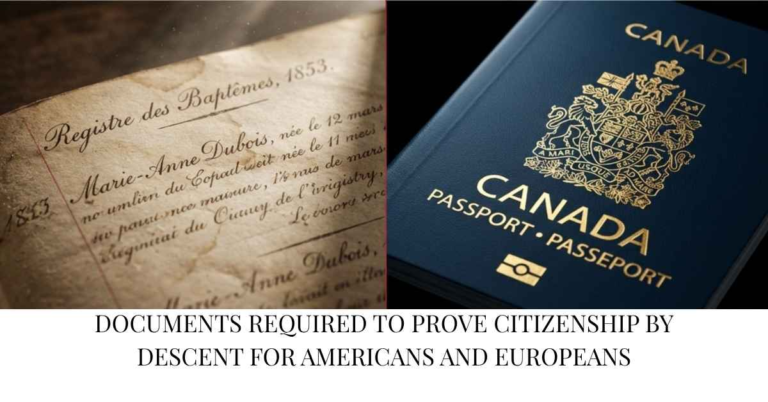
Until 1994, the Catholic Church was the de facto civil registration authority in Quebec. Priests issued baptismal records, not birth certificates in the modern sense. A baptism record was the legal proof of identity and civil status. The provincial government allowed civil registrations outside the church beginning in 1926, but the overwhelming majority of French-Canadians continued using parish registers well into the 1960s.
On January 1, 1994, Quebec overhauled its Civil Code and created the Directeur de l’état civil (DEC), a centralized secular authority that took over all vital records registration. The old dual-register parish system was abolished. From 1994 forward, the DEC became the only authority issuing birth, marriage, civil union, and death certificates.
IRCC refuses all pre-1994 Quebec documents because they lack modern security features and cannot be centrally verified. This means you cannot submit a photocopy of a baptism record you found online, even a high-quality scan of the original parish register. You must obtain a newly issued, certified reproduction from the relevant Quebec authority.
Which authority that is depends on one simple rule: the 100-Year Rule.
Where Do You Actually Order the Documents?
The 100-Year Rule decides where you need to go. If your record is older than 100 years, you order it from BAnQ (Bibliothèque et Archives nationales du Québec). If it is less than 100 years old, you go through the DEC (Directeur de l’état civil).
These are two completely different systems. They have different rules, different fees, and different ID requirements. Here is a quick breakdown to show you exactly what to expect:
| Feature | BAnQ (Over 100 Years Old) | DEC (Under 100 Years Old) |
| Record Type | Certified parish reproductions | Civil birth/death certificates |
| Accessibility | Public | Confidential (Requires proof of relationship) |
| Non-Resident Fee | CAD $350 | Variable |
| ID Required | None | Primary Photo ID & Proof of Address |
Ordering from BAnQ (100+ Years Old)
BAnQ provides “certified reproductions” of the old parish registers. For a Bill C-3 citizenship application, IRCC treats these just like a modern birth certificate.
The cost is steep for non-residents. You will pay CAD $350 for the first copy and CAD $100 for each extra copy in the same order. This fee helps them cover the cost of extra staff needed to handle the high volume of American requests.
Pro Tip: IRCC usually accepts a high-quality color photocopy of a BAnQ certified reproduction. If you and your siblings are applying together, you can order one original, share the CAD $350 cost, and submit color copies for each of your individual files.
To order, you send BAnQ the exact parish and event details you found online, plus your email address. They find the document and email you a payment link. Because they are so busy right now, it can take several weeks just to get that initial quote.
Ordering from the DEC (Under 100 Years Old)
The DEC process is much harder, especially for Americans. These records are strictly confidential. They require serious identity checks before they release any documents.
If you do not live in Quebec, you need a primary photo ID and a secondary proof of address. They do not accept digital driver’s licenses. Most Americans use a valid US Passport or Green Card as their photo ID. For the address proof, you need a utility bill, bank statement, or pay slip from the last three months.
The DEC’s online system, DEClic!, does not work well for Americans because it requires a Quebec health card or tax record. You will likely need to download paper forms, attach physical photocopies of your ID, and mail everything to Quebec City by international courier.
The Recursive Loop for Deceased Ancestors
Here is a common roadblock. If a grandparent passed away in Quebec within the last 100 years, you need their DEC death certificate. But the DEC only gives those to close relatives. To prove you are related, you have to show them your birth certificate and maybe your parent’s birth certificate too.
You end up building a long chain of evidence just to unlock one single document. This can be incredibly frustrating, which is why working with an experienced professional helps keep your application on track.
For a complete document checklist covering what IRCC requires at each stage of the application, see our guide on Canadian citizenship by descent documents and Bill C-3.
How Does IRCC Handle Anglicized Names and Spelling Changes?
Name changes across generations are expected, and IRCC adjudicators are trained to accommodate them. An ancestor documented as “Jean-Baptiste Leblanc” in a Quebec parish register might appear as “John White” in a Massachusetts marriage certificate from 1910. This kind of anglicization was a standard part of assimilation for French-Canadians moving to industrial New England.
IRCC will generally accept this fluidity, but only when the surrounding evidence makes the identity unmistakable. The dates of birth must be consistent. The geographic locations must be plausible. Most importantly, the names of the principals’ parents should appear consistently across multiple documents spanning the same generation. If your great-grandfather’s Quebec baptism record lists his parents as “Edouard Tremblay” and “Marie Gagnon,” those same two people should appear, even in anglicized form, in his US naturalization record or American marriage certificate.
Any gap, inconsistency, or missing generational link in the documentation trail will trigger a Procedural Fairness Letter from IRCC. These letters demand additional evidence and effectively halt your application, adding months to a process that IRCC now lists at 33 months.
Always request a “Copy of an Act” rather than a “Certificate” when ordering from BAnQ or the DEC for older records. The Certificate is an abbreviated document. The Copy of an Act is a full reproduction of the original register entry, including all marginal notations and filiation data. IRCC needs that full context. Requesting the abbreviated version and having it rejected costs you months and CAD $350.
How Long Does the Process Take and What Does It Cost in 2026?
IRCC lists 33 months for proof of citizenship as of 3 September 2026, and it does not publish a separate time for simple or complex files. A multigenerational claim with three or more generations of Quebec records, including BAnQ and DEC documents, takes longer to prepare before you can even file. About 136,000 people are in the queue. IRCC is issuing acknowledgement of receipt letters for applications submitted in late December 2025 only now, meaning there is a multi-month delay just to confirm they have your file.
The application fee for a citizenship certificate (proof of citizenship) is CAD $75 per person as of April 2026. That is the only fee paid directly to IRCC. But the real costs are in the documents. A BAnQ certified reproduction costs CAD $350 for non-residents. DEC documents have their own fee schedule. Add provincial birth certificate requests (CAD $25 to $50 each), potential translation costs for French-language documents, and courier fees for international mailing, and most Franco-American applicants spend CAD $500 to $1,500 or more on documents before submitting to IRCC.
One way to reduce the documentary burden is urgent processing. IRCC offers an expedited track for citizenship certificates in certain circumstances. If this applies to your situation, read our breakdown of urgent processing for Canadian citizenship certificates.
Not sure you qualify?
Take our Canadian citizenship eligibility quiz in about two minutes, read the Canadian citizenship guide, then Book a Strategy Consultation with Amir Ismail, RCIC R412319, to confirm your path.
Frequently Asked Questions
u003cstrongu003eCan I claim Canadian citizenship through a great-great-grandparent who was born in Quebec?u003c/strongu003e
Yes. Bill C-3 removed the first-generation limit for people born before December 15, 2025. There is no cap on how many generations back your qualifying ancestor can be. If your great-great-grandparent was born in Quebec and was a Canadian citizen, and you can document every generational link from them to you, you are eligible.
u003cstrongu003eMy Quebec ancestor naturalized as a US citizen in the 1920s. Does that disqualify me?u003c/strongu003e
No. The 2009 amendments to the Citizenship Act retroactively restored citizenship to Canadians who lost it by naturalizing in a foreign country. That restoration creates a valid legal anchor. You will need your ancestor’s Quebec birth record and their US naturalization papers as part of your documentation package, but the naturalization itself does not break the chain.
u003cstrongu003eWill IRCC reject my documents because my ancestor’s name was spelled differently in Quebec versus in the US?u003c/strongu003e
Not automatically. IRCC adjudicators are trained to recognize French-to-English name anglicization as a historical practice. What matters is that the dates, locations, and parental names remain consistent across your documents. If the same generation appears as u0022Jean Bouchardu0022 in Quebec and u0022John Bushu0022 in Rhode Island but the birth year, parents’ names, and geography all align, IRCC will generally accept the connection.
u003cstrongu003eWhat is the difference between BAnQ and the DEC, and how do I know which one to use?u003c/strongu003e
The 100-Year Rule governs this. Records for events that occurred 100 or more years ago are held by BAnQ, Quebec’s national archives, and are considered public. Records for events less than 100 years old are held by the Directeur de l’état civil (DEC) and are legally confidential. You need a valid primary photo ID and secondary proof of address to access DEC records, and the DEC’s online system is largely inaccessible to Americans, so most applicants submit paper forms by international courier.
u003cstrongu003eCan I share one BAnQ document across multiple siblings who are all applying?u003c/strongu003e
Yes, in practice. IRCC generally accepts a high-quality color photocopy of a BAnQ certified reproduction. If you and your siblings are all applying based on the same common ancestor, order one BAnQ original at CAD $350, divide the cost, and each submit a color photocopy in your individual IRCC applications.
u003cstrongu003eHow long will my application actually take in 2026?u003c/strongu003e
IRCC lists 33 months for proof of citizenship as of 3 September 2026, whatever the number of generations. A multigenerational Quebec claim takes longer to prepare, because BAnQ and DEC records can add months before you file. As of September 2026, about 136,000 people are in the queue. Submit your application as complete as possible to avoid Procedural Fairness Letters, which halt processing and add months to the timeline.
Your Next Step: Talk to a Licensed RCIC Before You Submit
The Quebec archival trail is navigable. Millions of Franco-Americans have exactly the right ancestry to claim Canadian citizenship under Bill C-3. But this process rewards people who get the documents right the first time and punishes incomplete submissions with Procedural Fairness Letters that extend an already long wait by months.
Amir Ismail (RCIC R412319) has guided clients through Canadian citizenship claims for decades. He knows where the evidentiary gaps typically appear in Franco-American files, how to frame anglicized name discrepancies for IRCC adjudicators, and which documents to order from BAnQ and which to pursue through the DEC before you spend a dollar.
Book a Strategy Consultation to review your genealogical chain, identify the documents you need, and build a submission that stands up to IRCC scrutiny.
Amir Ismail is a Regulated Canadian Immigration Consultant (RCIC R412319) with 35 years of professional experience in the consulting and advisory industry, established in 1991. The firm has served over 25,000 clients globally and is a 2026 Canadian Choice Award recipient.
Read More Canadian Citizenship By Descent Resources By Amir Ismail
Proof of Citizenship From the US: Does a Representative in Canada Save Time?
A representative in Canada does not move your proof of citizenship from the US to…

Canadian Citizenship for an Adopted Child Abroad: Grant or PR?
If you are a Canadian in the US who adopted a child, you have two…

Canadian Passport Application From the USA: Guarantor, References and Fees
A Canadian passport application from the USA is a mail-in process. You fill out form…
British Home Children Citizenship by Descent: Who Qualifies Under Bill C-3
Many descendants of British Home Children can claim Canadian citizenship by descent. The key fact…
Proof of Canadian Citizenship Wait by Application Month: Why Your Date Matters
Your proof of citizenship wait by application month is not one number. The processing times…

American Dual Citizenship With Canada: What Changes and What Does Not
Yes, you can keep both. American dual citizenship with Canada is legal in both countries,…