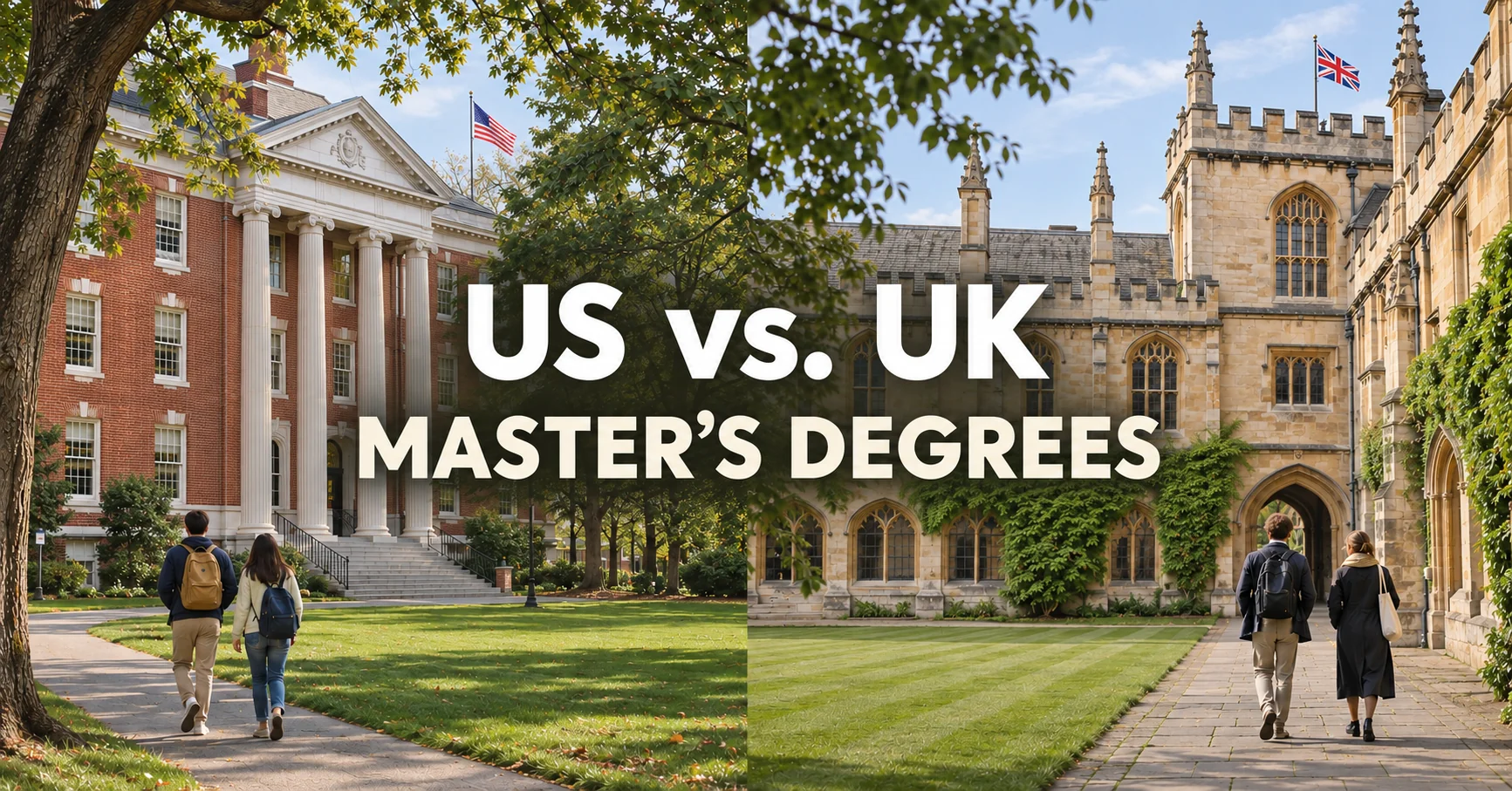
Many full-time UK master’s programs take one year. US master’s programs generally take one to three years. A shorter course can lower your total cost, but tuition, rent and scholarships can change which offer is cheaper.
For eligible master’s graduates applying on or after January 1, 2027, the UK Graduate visa lasts 18 months and allows work in most jobs. In the US, eligible F-1 students can get up to 12 months of Optional Practical Training (OPT) in work related to their degree. Those who qualify for the STEM extension can get up to 36 months in total.
Amir Ismail & Associates helps international students compare programs and apply for admission. We checked the government rules and fees in this guide on November 23, 2026. Official sources are linked under the comparison tables.
For country basics, see our guide to studying in the USA, our guide to studying in the UK and the Study Abroad hub.
Not sure your grades fit a master’s in either country? Check My Admission Chances.
What is the difference between a US and a UK master’s?
A UK master’s usually takes one year and a US master’s one to three. The UK gives broader post-study work rights; the US lets family join on F-2.
| What to compare | United Kingdom | United States |
|---|---|---|
| Typical program length | Many full-time master’s programs take one year. | A master’s generally takes one to three years. |
| Student visa charges | £558 application fee plus the student health surcharge, charged at £776 per year and calculated using visa length. | US$185 visa application fee plus US$350 I-901 SEVIS fee for the F-1 student. Some consulates also charge a US$250 visa integrity fee at issuance, and a reciprocity fee may apply depending on nationality. |
| Proof of funds | If required, show outstanding course fees for one academic year plus living costs for up to nine months: up to £13,761 in London or £10,539 outside London if you apply before November 30, 2026, or £14,130 and £10,827 if you apply on or after that date. | Show that you or your sponsor can cover the costs your school lists for issuing Form I-20. |
| Work while studying | Eligible full-time degree students can usually work up to 20 hours a week in term. | Eligible F-1 students can generally work on campus up to 20 hours a week while school is in session. Off-campus work follows separate rules. |
| Work after graduation | The Graduate visa lasts 18 months for eligible master’s graduates who apply from January 1, 2027. | Up to 12 months of degree-related OPT, with a possible 24-month extension for eligible STEM graduates. A proposed DHS fee for OPT is not in effect. |
| Bringing family | Most students on taught master’s programs cannot bring dependents on the Student route. Limited exceptions apply. | A spouse and unmarried children under 21 may qualify for F-2 status. F-2 dependents cannot work. |
Rules and fees checked November 23, 2026. Sources: GOV.UK Student visa, GOV.UK Graduate visa, US Department of State visa fees and USCIS Optional Practical Training.
How long does a master’s take in the US and the UK?
A full-time UK master’s usually takes 12 months. A US master’s takes one to three years, and every extra term adds tuition and rent.
Check the published course length for each offer, including any summer term, placement or thesis period. Use the full number of months when you estimate rent and living costs. The US range comes from EducationUSA.
Why does length matter so much? Every extra term adds tuition and living costs, and it pushes back the date you can start working full time.
What does the student visa cost in each country?
A UK Student visa costs £558 plus £776 a year in health surcharge. A US F-1 costs US$535 in fees, plus a US$250 integrity fee where charged.
The US total is the US$185 visa application fee plus the US$350 SEVIS fee. Some US consulates have started charging the US$250 visa integrity fee when the visa is issued, but the rollout has been uneven, so check with the consulate where you will apply. A reciprocity fee may also apply depending on nationality. The UK health surcharge depends on the length of your visa.
| Cost item | United Kingdom | United States |
|---|---|---|
| Visa application fee | £558 per applicant. | US$185 for the standard F visa application. Some consulates also charge a US$250 visa integrity fee when the visa is issued, and a reciprocity fee may apply depending on nationality. |
| Other required charge | Student health surcharge of £776 per year, calculated using visa length. | US$350 I-901 SEVIS fee for the F-1 student. F-2 dependents are exempt from the SEVIS fee. |
| Family members | Each dependant pays the £558 fee, where dependents are allowed | F-2 dependents do not pay the SEVIS fee (Study in the States) |
| Post-study permit fee | £2,489.50 for an 18-month Graduate visa at current rates. That includes the £937 application fee and £1,552.50 health surcharge. | Initial OPT employment authorization, Form I-765: US$470 online or US$520 by mail at current rates. A proposed DHS rule would add separate OPT fees; it is not in effect. |
These are government charges only. Tuition, school deposits, insurance and travel come on top, and they are usually much larger.
How much money must you show?
From November 30, 2026, UK students must show up to £14,130 for London or £10,827 elsewhere, plus unpaid fees. US students show the I-20 amount.
If you must show funds for a UK Student visa, budget for the outstanding course fees for one academic year shown on your Confirmation of Acceptance for Studies (CAS), plus living funds for up to nine months. The monthly rate depends on where you study and when you apply:
| UK application date | Studying in London | Studying outside London |
|---|---|---|
| Before November 30, 2026 | £1,529 a month, up to £13,761 | £1,171 a month, up to £10,539 |
| On or after November 30, 2026 | £1,570 a month, up to £14,130 | £1,203 a month, up to £10,827 |
Source: GOV.UK Student visa: money you need and the Home Office Statement of Changes HC 584.
Does the UK maintenance increase affect my application?
Yes, if you apply on or after November 30, 2026. Your application date sets the rate, and London students need £369 more over nine months.
The math: £14,130 minus £13,761 is £369 for London. Outside London, £10,827 minus £10,539 is £288. If your application date is close to the cut-off, check the GOV.UK money page on the day you apply.
If you use bank funds as evidence, the required balance generally needs to be held for 28 consecutive days. The last day of that period must fall within 31 days before you apply. Some applicants have different evidence requirements.
The US has no single government figure. Your school’s designated school official must see evidence that you or a sponsor can cover tuition and living expenses before issuing a Form I-20. For your personal budget, add up costs for every month you expect to study. Your school’s Form I-20 figure is a starting point for showing financial ability.
Keep one thing in mind. The visa minimum is not your real budget, and rent in a big city can run well above it.
Want to see which programs fit your budget and your grades? Check My Admission Chances.
Can you work while you study?
Both allow up to 20 hours of work a week in term. UK students can work off campus; US F-1 students need CPT or OPT approval to do so.
In the UK, eligible full-time degree students can work up to 20 hours a week in term and full time outside term. Ask your university which dates count as term time for your course, including any dissertation period.
In the US, the standard 20-hour limit applies to on-campus work while school is in session. Off-campus work requires separate authorization. Your school’s designated school official can authorize eligible Curricular Practical Training (CPT). Initial OPT requires approval from US Citizenship and Immigration Services (USCIS).
What can you do after you graduate?
UK master’s graduates get an 18-month Graduate visa for most jobs. US graduates get 12 months of OPT, or up to 36 months with a STEM degree.
This is where the two countries split most. The UK gives you a broad open permission for a fixed time. The US ties work to your field of study.
| After graduation | UK Graduate visa | US OPT |
|---|---|---|
| Length | 18 months for eligible master’s graduates who apply on or after January 1, 2027. Applications made by December 31, 2026 qualify for two years. The application date determines the length. | Up to 12 months of OPT at a degree level. Any pre-completion OPT used at that level reduces the time available after graduation. |
| STEM bonus | None | 24-month extension for eligible STEM degrees |
| Type of work | Most jobs, self-employment allowed | Work directly related to your major |
| Can it be extended? | No, but you may switch to another visa such as Skilled Worker | Only through the STEM extension |
| Where you apply | From inside the UK, before your Student visa expires | Form I-765 with USCIS, inside a set filing window |
Sources: GOV.UK Graduate visa, USCIS Optional Practical Training, US proposed OPT fee.
Both options provide temporary work permission. UK Graduate visa holders can work in most jobs and may be self-employed. US OPT work must relate directly to the student’s field of study. Staying longer requires qualifying under another immigration route.
Will the proposed OPT fee affect me?
Not yet. A DHS rule proposed on October 8, 2026 would charge schools US$70,000 for each student’s initial OPT, but it is not final or in effect.
The proposal would also charge US$30,000 for a later OPT period, such as the 24-month STEM extension. Schools would pay the fee before recommending OPT in SEVIS. Public comments closed on November 9, 2026, and DHS proposed that a final rule take effect 60 days after it is published. If you are weighing a US offer, ask the school how it plans to handle OPT if the rule is finalized. Source: Federal Register proposed rule.
Can you bring your family?
Most international students starting a taught UK master’s cannot bring a partner or children as Student visa dependents. For courses starting on or after January 1, 2024, the postgraduate exception generally requires a full-time PhD, other doctorate or research-based higher degree lasting at least nine months at an eligible provider. A separate exception applies to government-sponsored students on courses longer than six months.
In the US, the spouse and unmarried children under 21 of an F-1 student may qualify for F-2 status. F-2 dependents cannot work. Ask the US school how much extra funding it requires for each family member before you accept the offer.
Which country fits which student?
Choose the UK to finish fast and spend less. Choose the US for a STEM degree, longer post-study work, or to bring your spouse and children.
- The UK often suits students who want to finish fast, keep total costs down, and come alone, and who value a broad work permission after graduation.
- The US may suit students with an eligible STEM degree who want more time for degree-related work after graduation, or students who need the option to bring a spouse or children. If your spouse needs to work, factor the F-2 work restriction into your budget.
- Either can work for business and computing graduates. Compare the total cost of the whole program, not the yearly tuition.
How do you compare a US and a UK master’s offer?
Compare offers by total program cost in one currency: full tuition, living costs for every month, and visa fees, minus confirmed scholarships.
- Write down the full course length in months and the total tuition due for the entire program. If your deposit is credited toward tuition, count it once. Record its payment deadline separately.
- Add rent, food, transit and other living costs for every month you expect to study. Include mandatory school fees, insurance, travel and government charges.
- Subtract confirmed scholarships, tuition waivers and other guaranteed funding. Compare both totals in the same currency and note the exchange rate and date you used.
- Keep a second total for the cash you need before you leave, including deposits, visa fees and any advance rent. A lower-cost offer can still require more money up front.
How much can six extra months add? If one program takes six months longer and your living costs are US$1,500 a month, the longer program adds US$9,000 in living costs. A US$10,000 tuition award would cover that gap and leave US$1,000 toward other costs. This example uses sample figures. Use the actual tuition, funding and living costs from your offers.
Checking your admission chances is free. Our personal program search is US$149 per destination and includes your shortlist and up to 5 applications. You also pay each school’s own fees, such as an application fee or a tuition deposit.
Frequently Asked Questions About US and UK Master’s Degrees
Is a one-year UK master’s recognized in the US?
Recognition depends on the employer, the school or the licensing body that reviews it. Ask the US employer or school you have in mind how it evaluates a 12-month UK degree before you enroll.
Can I switch from a UK Student visa to a Graduate visa without leaving?
Yes, you apply from inside the UK before your Student visa expires. Your university must first tell the Home Office that you completed the course.
Does the US STEM extension apply to every master’s?
No. Only eligible F-1 graduates qualify for the 24-month STEM OPT extension. Check the degree’s program code on Form I-20 against the DHS STEM list. You also need an eligible E-Verify employer and a training plan on Form I-983.
When can I start working on initial OPT?
You can start once USCIS approves your initial OPT, you receive your Employment Authorization Document (EAD), and the start date on the card has arrived. The word initial matters because a timely filed STEM extension can follow different rules.
Which is cheaper overall, the US or the UK?
The UK is often cheaper overall because many master’s take 12 months instead of one to three years. A US scholarship can reverse that. Compare the full-program total, including living costs for every month you study.
Check your admission chances free, then let us build your personal shortlist. Check My Admission Chances.
Amir Ismail is the founder of Amir Ismail & Associates, which helps international students plan their studies and admission applications.