
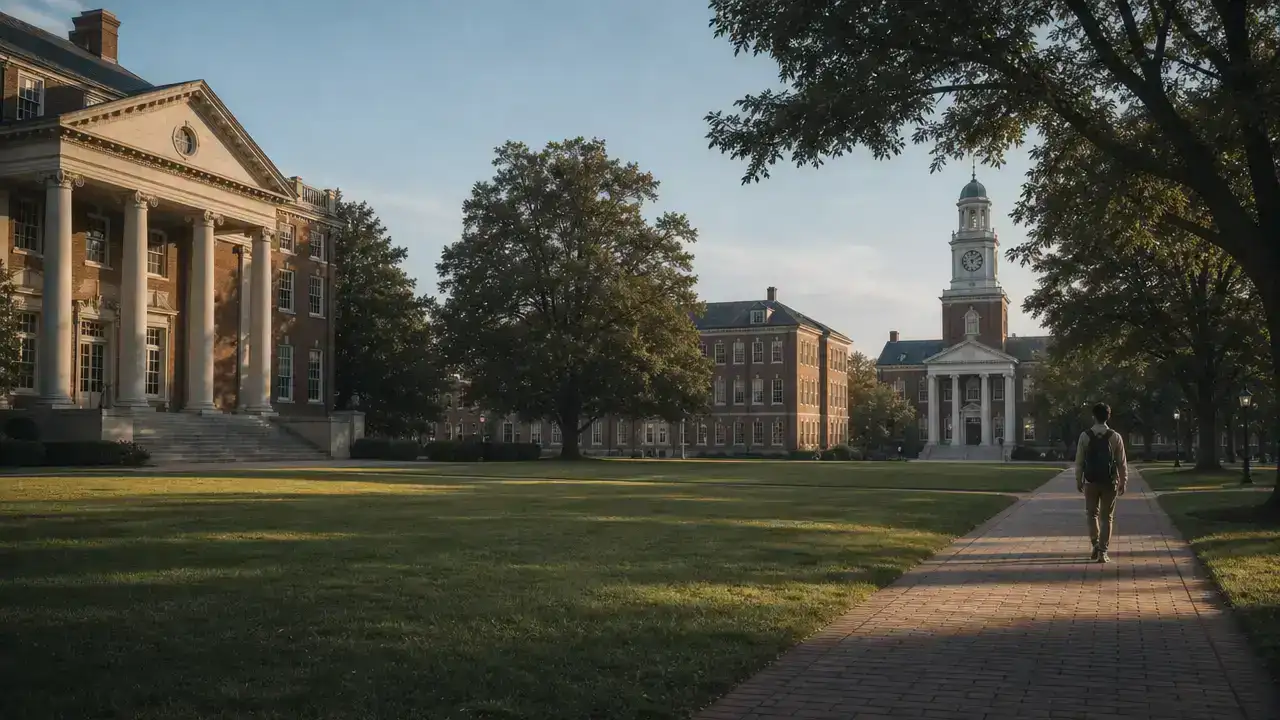
Study in the USA: Get Admitted to the Right University or College
You can study in the United States if a school approved for international students accepts you, you meet its English level, and you can show the funds on your I-20. There is no government minimum, so we check your budget against the school’s own estimate. AIA applies for you and charges no fee for admission.
The key facts at a glance
- Study levels
- Foundation or pathway, community college (associate or diploma), bachelor, master and doctorate, at schools approved for F-1 students (SEVP-certified)
- English
- Each school sets its own score. Four-year schools often ask TOEFL iBT 80 to 100 or IELTS 6.5 to 7.0.
- Money to show
- No government minimum. The school sets the amount on your I-20, and you show proof at the visa interview.
- Visa cost
- USD 185 visa application fee plus the USD 350 SEVIS I-901 fee (October 2026)
- Work in term
- On campus, up to 20 hours a week. Off campus only after your first academic year and in limited cases.
- After you graduate
- Optional Practical Training: 12 months of work at each degree level, plus 24 more months for STEM degrees
- Start dates
- Most schools start in August or September, with a second intake in January
- AIA fee for admission
- None
- Last updated
- October 2026
Why do students choose the USA?
Students choose the United States because the choice of schools is huge, you can work while you study, and graduates can work for 12 months or more after each degree. There is no government minimum for money, so each school sets the amount on your I-20 (DHS Study in the States, October 2026). You can work on campus up to 20 hours a week, and Optional Practical Training gives 12 months of work after each level of study, with 24 more months for STEM degrees (USCIS, January 2026).
Three reasons come up most often:
- A big choice of schools: community colleges, state universities and private universities all take international students, as long as the school is approved for F-1 students.
- Work during and after study: on-campus jobs in term, practical training linked to your course, and OPT after you finish.
- Ways in when your marks or English score are just short: pathway programs and community colleges can lead to a four-year degree.
Can I get admitted? What do I need for each study level?
To be admitted, you need the right education for the level, English at the level the school asks for, and a school that is approved to enrol F-1 students. Each school sets its own entry requirements, so the program page has the last word. Use the table as a starting point.
| Study level | Education usually needed | English score | What to know |
|---|---|---|---|
| Foundation or pathway | Secondary school | Set by the program, often lower than a degree | A pathway program leads to a degree at a partner school when you pass. |
| Community college (associate or diploma) | Secondary school | Many schools accept a placement test or a lower score | Often the lowest cost. Many students transfer to a four-year school after two years. |
| Bachelor | Finished secondary school with good results | Often TOEFL iBT 80 to 100 or IELTS 6.5 to 7.0 | Many schools also look at essays and activities. Some ask for SAT or ACT scores, so check each school. |
| Master | A bachelor degree | Often TOEFL iBT 80 to 100 or IELTS 6.5 to 7.0 | Many programs ask for a statement of purpose and references. Some ask for GRE or GMAT scores. |
| Doctorate | A master degree or a very strong bachelor degree | The program decides, often higher | Many doctoral programs offer funding. The program tells you what it covers. |
These are typical ranges, not rules. The school and the program set the real requirement.
Popular program types
Business
Bachelor or master. Many schools offer both, so your marks and English score decide the fit.
Engineering and computer science
Bachelor or master. Strong maths marks help, and many of these degrees count as STEM for OPT.
Science and mathematics
Bachelor or master. Check whether the program is on the STEM list if you plan to use the extra OPT months.
Arts and humanities
Bachelor or master. Check each program for portfolio or essay steps.
Health sciences and medicine
Competitive and often costly. Check each program for extra entry steps.
Community college, then transfer
A lower-cost start when your marks or budget are tight. You finish at a four-year school.
Tuition varies a lot by school and program. We show your exact first-year cost when we match you.
What English level do I need to study in the USA?
The United States has no national English score. Each school sets its own, and four-year universities often ask for TOEFL iBT 80 to 100 or IELTS 6.5 to 7.0. Community colleges and pathway programs often accept less, and some schools take other tests such as Duolingo, so check your program page.
| Where English matters | What it means |
|---|---|
| The school | Sets its own score for each program. Some programs ask for more than the school minimum. |
| Accepted tests | TOEFL iBT and IELTS are accepted almost everywhere. Some schools also take Duolingo or their own placement test. |
| Conditional admission | Some schools admit you now and ask you to finish an English program before your degree starts. |
| The visa interview | You answer in English at the interview, so practise speaking before you go. |
Test scores usually expire after 2 years. Check the date on your result before you apply.
How much money do I need to show?
The United States sets no government minimum for money. The school collects proof of funds before it issues your I-20, and the I-20 shows the school’s own estimate of your costs for the first year (DHS Study in the States, October 2026). You also pay the USD 185 visa application fee (State Department) and the USD 350 SEVIS I-901 fee (ICE).
| What you must cover | Amount (October 2026) |
|---|---|
| Government minimum for funds | None. The school sets the amount. |
| The school’s cost estimate on your I-20 | Tuition, books, living costs and travel for your study period. It can be stricter than other schools. |
| Visa application fee | USD 185, paid to the State Department |
| SEVIS I-901 fee | USD 350, paid to ICE before the visa interview |
| Health insurance | Most schools require it, and the price depends on the school plan |
| Proof you can pay | Bank statements, sponsor documents, scholarship letters or an employer letter, brought to the interview |
Example only: a first-year fee of USD 35,000 plus about USD 15,000 for living costs and USD 2,500 for health insurance means you show about USD 52,500, plus the USD 535 in visa and SEVIS fees.
What proof works: funds held by you or a sponsor, shown with bank statements and a sponsor letter. Scholarship or aid letters count too. Large or unexplained deposits get questions, so keep a clear paper trail.
Typical first-year tuition (our estimates, October 2026):
- Community college (associate or diploma): USD 9,000 to 20,000
- Foundation or pathway: USD 12,000 to 25,000
- Bachelor: USD 25,000 to 60,000 or more
- Master: USD 20,000 to 55,000
- Living costs: about USD 1,000 to 2,500 a month, and more in cities such as New York
For context, U.S. government data puts average in-state tuition and fees at public four-year schools near USD 9,800 and at private nonprofit schools near USD 40,700 (NCES, 2022-23). International students usually pay out-of-state or higher rates at public schools. These are our estimates, not official figures, and your I-20 is the real test.
Can I work while I study and after I graduate?
Yes, with limits. You can work on campus up to 20 hours a week while school is in session, and you need school approval and a Social Security number (DHS Study in the States, October 2026). Off-campus work is not allowed in your first year, and after that it is limited to cases such as serious economic hardship. Do not plan to pay your costs from work, because you must show your money before you come.
Curricular Practical Training (CPT) is work that is part of your program. You generally need one full academic year first, and 12 months or more of full-time CPT cancels your OPT.
After you finish, Optional Practical Training (OPT) gives you 12 months of work at each degree level. A STEM degree can add 24 months if your employer is in E-Verify and signs a training plan (Form I-983). You apply up to 90 days before your program ends and no later than 60 days after (Study in the States, August 2026, and USCIS, January 2026). OPT is not a path to permanent residence, and staying longer needs a separate work visa, which AIA does not help with.
When can I start studying in the USA?
Most schools start in August or September, with a second intake in January, and some also start in summer. You choose a school and program, apply, accept the offer, show your funds and receive your I-20. Then you pay the SEVIS fee, apply for your visa and travel (DHS Study in the States, October 2026).
| Step | What to know |
|---|---|
| 1. Choose an approved school | The school must be SEVP-certified to enrol F-1 students. You can check this on the official school search. |
| 2. Apply for admission | AIA applies for you through the school or a third party admission platform, at no fee to you. |
| 3. Accept your offer | You confirm by paying a deposit if the school asks. A conditional offer means you still have conditions to meet. |
| 4. Show your funds and get your I-20 | The school checks your funds first and then issues the Form I-20. |
| 5. Pay the SEVIS fee and apply for the visa | Pay the USD 350 SEVIS fee, complete the DS-160 form, pay the USD 185 visa fee and attend the interview. |
Deadlines differ by school and program. Fall deadlines are often months before the start, so ask early.
How does admission work with AIA?
We find programs that fit your marks, English score and budget, apply for you, and follow each application until you have an offer. There is no fee for this. You only pay what the institution charges, such as an application fee or a tuition deposit.
Step 1: Check your admission chances
Answer seven short steps. You see where you are strong and what to fix first.
Step 2: Send your documents
If you look admissible, we ask for your passport, transcripts and English score through a private link, and send you a short agreement to sign.
Step 3: We apply for you
We submit your applications, follow each task and tell you when an offer arrives. A conditional offer is not final enrolment, so we show you what you still need to meet.

Why students choose Amir Ismail & Associates
Since 1991, AIA has guided 25,000+ clients from offices in Toronto, Dubai and Karachi. We help you find programs that fit your marks, English and budget, and we apply for you at no fee. Schools make the decisions, and your visa stays a separate step that you handle yourself or through a regulated adviser.
Honest admission check
We tell you when a plan does not fit, before you spend money.
Programs that fit you
We match your marks, English and budget, not a template.
Free for you
Our admission help costs you nothing. You pay only the school’s own fees.
Clear on who does what
AIA supports your admission. You handle the visa yourself or through a regulated adviser.
A real application
We prepare your documents and submit your applications for you.
Since 1991
35+ years in immigration and 25,000+ clients guided.
What about the U.S. student visa?
Your F-1 student visa is a separate application with the U.S. government. AIA supports your admission, and you submit the visa application yourself or through a licensed adviser in the United States.
The steps are: the school issues your I-20, you pay the SEVIS I-901 fee (USD 350), you complete the DS-160 form and pay the visa fee (USD 185), and you attend a visa interview. The State Department asks F, M and J applicants to set their social media accounts to public (State Department, June 2025). Visas can be issued well before your program starts, but you can enter the United States no more than 30 days before it (Study in the States). Read the full list on the official page: State Department, Student Visa.
Frequently asked questions
What marks do I need to study in the United States?
Each school sets its own entry requirements, so the program page decides. Bachelor programs ask for finished secondary school with good results, and master programs ask for a bachelor degree. Community colleges and pathway programs are a way in when your marks are just short.
What English score do I need for the United States?
Each school sets its own score. Four-year universities often ask for TOEFL iBT 80 to 100 or IELTS 6.5 to 7.0, and community colleges and pathway programs often accept less. Check the program page for the exact score.
How much money do I need to study in the United States?
There is no government minimum. The school collects proof of funds before it issues your I-20, and the I-20 shows its cost estimate for the first year (DHS Study in the States, October 2026). You also pay the USD 185 visa fee and the USD 350 SEVIS fee.
Can I work while studying in the United States?
Yes, on campus up to 20 hours a week while school is in session. Off-campus work is not allowed in your first year, and after that it is limited to cases such as economic hardship. Curricular Practical Training can be part of your program after one full academic year (DHS Study in the States, October 2026).
Can I stay and work after I graduate?
Yes, with Optional Practical Training. You get 12 months of work at each degree level, and a STEM degree can add 24 more months with an E-Verify employer and a training plan (USCIS, January 2026). OPT does not lead to permanent residence, and staying longer needs a separate work visa.
Can I bring my partner or children to the United States?
Your spouse and your unmarried children under 21 can join you on F-2 status. They cannot work, and children can attend school. Your school adds their costs to your I-20, so plan for more money (DHS Study in the States and USCIS).
Is the U.S. student rule about how long I can stay changing?
A rule to replace duration of status with fixed admission periods was published in July 2026. A federal court paused it on 14 September 2026, so the earlier rules still apply while the case continues. Ask your school’s international student office for the current rule before you plan (October 2026).
Does AIA charge for admission help?
No. Our admission help is free, and the platforms we use are free for you. You only pay the school’s own fees, such as an application fee or a deposit.
Does AIA help with the U.S. student visa?
No. AIA supports your admission. The student visa is a separate application you submit to the government yourself or through a licensed adviser in the United States.
See where you stand
Two minutes. Seven short steps. No fee. We tell you honestly if you are ready to apply or what to fix first.
More study destinations
Study in the UK
Admission check and country guide.
Study in Australia
Admission check and country guide.
Study in Ireland
Admission check and country guide.
Study in Germany
Admission check and country guide.
Study in Canada
Study permit and visa guides.
All study destinations
Compare the countries side by side.
Last updated: 16 October 2026
