No, 1867 is not a legal cut-off, so you can still pursue citizenship by descent before 1867. The Canadian Citizenship Act, current to September 21, 2026 on the Justice Laws Website, sets no statutory earliest birth year for an ancestor. What matters is where your ancestor was born or lived, their status, and whether each generation can be proved.
A lot of Americans stop at the first family record they find. Great-great-grandpa was born in Quebec in 1852, Canada “did not exist yet,” so they assume the trail is dead. Here is what the law actually says, and the one question it leaves open.
Is there a cut-off year for citizenship by descent before 1867?
No cut-off year for citizenship by descent before 1867 is written into the law. The Act describes who is a citizen by place of birth, by date, and by a parent’s status. It never excludes an ancestor born before Confederation on July 1, 1867 (the day Canada became a country), and Bill C-3, in force since December 15, 2025, also added no birth-year floor.
The 1867 myth mixes up two different dates:
-
July 1, 1867 (Confederation): Created the Dominion of Canada. People born here were still British subjects.
-
January 1, 1947 (Canadian Citizenship Act): The 1946 Act took effect and created Canadian citizenship as its own legal status.
-
Ancestors who died before 1947: Subsection 3(1.3) of today’s Act asks whether that person would have been a citizen if the 1946 rules had applied just before their death. Being born before or after 1867 does not change that test.
So an ancestor born in 1890 and one born in 1850 face the same basic question. Neither was ever a “Canadian citizen” during their early life, because the status did not exist. The law looks at what their status would have been under the 1946 rules.
Am I a Canadian citizen by descent?
Trace your family line one generation at a time. Each link is tested against the law in force when that person was born, so you see exactly where your chain holds and where it breaks. About three minutes, and no account needed.
Check my family lineWhat does the Citizenship Act say about ancestors who died before 1947?
Subsection 3(1.3) of the Citizenship Act covers a parent who died before January 1, 1947. It asks whether that parent would have been a citizen if the 1946 Act had come into force immediately before their death. The test is pinned to the date of death, so it has no earliest year built into it.
Paragraph 3(1)(q) is the provision that subsection works with. It covers a person born outside Canada before January 1, 1947 to a parent who became a citizen on that day. You can read both provisions on the Citizenship Act page of the Justice Laws Website.
Bill C-3 then added subsection 3(1.5). It says a person is still a citizen if their parent, or their parent and grandparent, died before the 2025 law took effect but would have been citizens because of it. Death in an older generation does not break the chain by itself.
Does a birth in Quebec, Ontario or the Maritimes before 1867 count as a birth in Canada?
This is the honest grey area. The Act says “Canada” in the pre-1947 provisions means Canada as it existed just before Newfoundland and Labrador joined on April 1, 1949. It does not say how to treat a birth in the Province of Canada, Nova Scotia or New Brunswick before 1867.
One possible reading is that a birth in Canada East or Canada West counts, because those areas became Quebec and Ontario. We think that reading is fair, but we have not found a court decision or a published rule from Immigration, Refugees and Citizenship Canada (IRCC) that settles it. Until one exists, the officer looks at the facts of each file.
That is why we treat a pre-1867 ancestor as a real claim, not a closed door. It is also why the paperwork has to be tight. You want the officer looking at clear evidence, not filling gaps.
How does Bill C-3 change citizenship by descent before 1867 claims?
Bill C-3 took effect on December 15, 2025. According to IRCC, a person born outside Canada to a Canadian parent before that date is now automatically a citizen in most cases. IRCC says the change removed the old first-generation limit in some situations. That limit had cut off many grandchildren and great-grandchildren born abroad.
For an old family line, that matters a lot. Before Bill C-3, even a strong 1850s ancestor often could not pass status down more than one generation born abroad. Now, for people born before December 15, 2025, each American-born generation can carry it, as long as nobody in the line lost status in a way the law still counts.
A child born abroad on or after December 15, 2025 faces one more test. IRCC says the Canadian parent, who was also born abroad, must have spent at least 1,095 days in Canada before the child was born.
IRCC explains the change on its Bill C-3 rules page. It also says you must apply for a citizenship certificate to find out for sure.
What records do Americans need for an ancestor born before 1867?
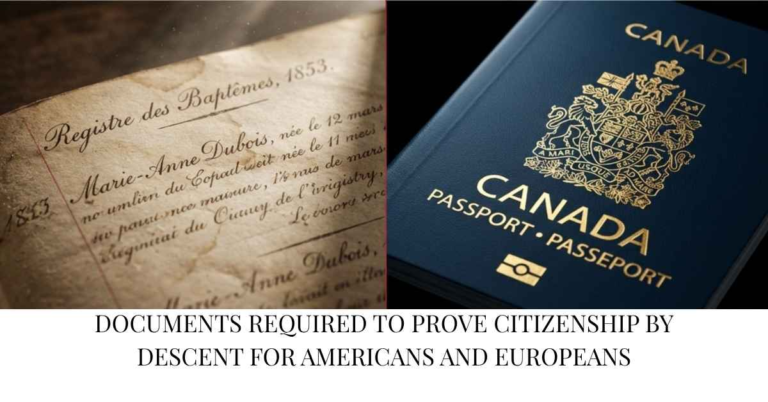
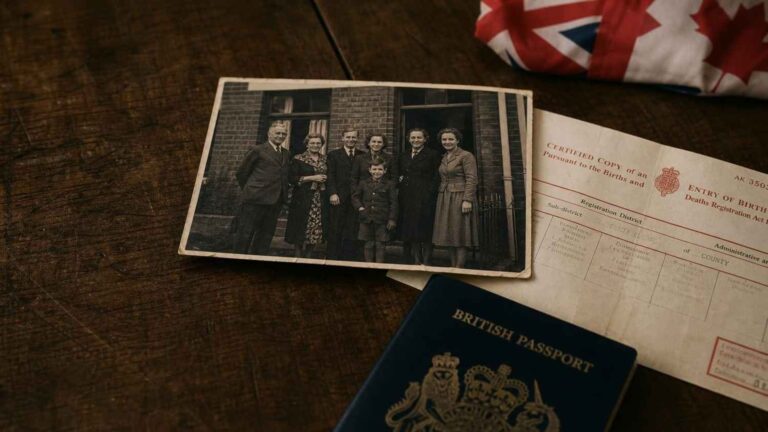
You need proof of every link, from the ancestor to you. That means a birth or baptism record for the ancestor, then a birth record for each generation after, plus records that join the names. For a pre-1867 Quebec ancestor, the birth proof is usually a Catholic or Protestant parish register entry.
On the American side, each generation’s birth certificate comes from the state vital records office where they were born. Marriage records and death records help when names change or spellings drift across a census, a baptism and a certificate.
We cover the Quebec side in our guide to Quebec records for citizenship by descent. Our complete document guide for Bill C-3 walks through the full chain.
Where do pre-1867 claims usually go wrong?
Most weak files fail on proof, not on the year. A parish entry with a different spelling, a missing link between two generations, or an ancestor who moved to the United States and naturalized there can all raise questions. Each one needs its own record or explanation, set out clearly.
Naturalization is the one people miss. If an ancestor became an American citizen, the date matters, because the old rules on losing British subject status and Canadian citizenship changed over time. Check the date against the law in force then, not today.
The other mistake is guessing at eligibility before ordering records. Our eligibility checklist for Americans shows the order we use: map the line, find the weak link, then pay for documents.
Frequently asked questions
Can I claim Canadian citizenship through an ancestor born before 1867?
Yes, possibly. The Citizenship Act sets no earliest birth year. Bill C-3, in force since December 15, 2025, removed the first-generation limit in some situations. No court we know of has settled whether a birth before Confederation counts as a birth in Canada, so the records for each generation have to be strong.
Did my ancestor need to be alive in 1947?
No, your ancestor did not need to be alive in 1947. Under subsection 3(1.3) of the Citizenship Act, a parent who died before January 1, 1947 is judged as if the 1946 Act had come into force just before their death. Subsection 3(1.5), added by Bill C-3, also covers a parent, or a parent and grandparent, who died before the 2025 changes.
How do I find out for sure if I am a citizen?
Apply for a citizenship certificate, also called proof of citizenship. IRCC says this is how you find out for sure. An officer reviews your family line and documents, then issues a certificate if you qualify. You can use that certificate to apply for a Canadian passport.
Not sure your family line holds up? Start with the citizenship by descent service page, see the official IRCC website, or Book Your Strategy Consultation with our team.