Can You Apply for a Super Visa While Your PGP Application Is Pending?
Yes. You can apply for a Super Visa while your Parents and Grandparents Program (PGP) sponsorship is pending. IRCC lists it as one of two choices on its Super Visa eligibility page, apply for a Super Visa while you wait for a decision, or withdraw the sponsorship at any time and apply. Apply while you wait, and your sponsorship file stays where it is. (IRCC, July 6, 2026).
Here are IRCC’s own words:
“If you’ve already submitted a sponsorship application, you can apply for a super visa while you wait for a decision or withdraw your sponsorship application at any time and apply for a super visa.”
Read it twice. Nothing in that sentence forces you to pick the second choice. Applying while you wait comes first on the list.
So the real question is not can I? It is should I keep my PGP file alive? We answer that in the Keep, Bridge or Withdraw section below.
You may be watching a PGP file sit in the queue while a parent gets older. That is a heavy thing to carry. The wait for permanent residence can feel endless, and you want your family here now. This guide shows what IRCC says and how to decide.
Key Takeaways
- Yes, you can hold both. IRCC says you can apply for a Super Visa while your PGP sponsorship waits for a decision (IRCC, July 6, 2026).
- You do not have to withdraw. Withdrawing ends your PGP file, and IRCC is receiving no new PGP applications (MI 89).
- Your parent must be outside Canada to apply. You also need enough income, $100,000 in medical insurance and a medical exam.
- A Super Visa can mean up to 5 years per stay. The visa allows multiple entries for up to 10 years, capped by biometrics.
- We cannot confirm one thing. IRCC’s pages do not say how an officer weighs a pending PGP file. Ask an RCIC before you file.
What does IRCC actually say about applying while you wait?
IRCC gives you exactly two options, and both appear on the Super Visa eligibility page. You can apply for a Super Visa while you wait for a decision, or you can withdraw your sponsorship application at any time and apply. (IRCC, July 6, 2026)
IRCC uses the phrase “at any time” for withdrawal. That means you face no deadline to decide. You can file the Super Visa first and make the call on your PGP file later. This wording was current on IRCC’s page when we last checked in September 2026.
Does a Super Visa affect a pending PGP application?
IRCC does not say that a Super Visa harms a pending PGP application. Its eligibility page lists applying for a Super Visa as a choice you can make while you wait. We cannot confirm from IRCC’s published pages how an officer weighs a pending PGP file inside a Super Visa decision. (IRCC, July 6, 2026)
Here is what IRCC does publish. Its Super Visa operational manual counts people the host already sponsored when it works out family size, but only where the undertaking is still in effect. An undertaking starts on the day the sponsored person becomes a permanent resident (IRCC operational manual, modified August 25, 2026).
That wording covers approved sponsorships. We found no IRCC text that speaks to a pending PGP file directly. Treat the family size question as unconfirmed, and ask an RCIC before you file.
Is the Parents and Grandparents Program Open for New Applications in 2026?
No. Under Ministerial Instructions 89 (MI 89), effective January 1, 2026, IRCC no longer receives new permanent resident applications from parents and grandparents of a sponsor until further instructions are issued. IRCC’s July 15, 2026 notice repeats the pause and gives no reopening date. (IRCC, MI 89; IRCC notice, July 15, 2026)
That leaves families in two groups. If your file was part of the 2025 intake, IRCC can take up to 10,000 of those applications into processing in 2026. If you never filed, you cannot start a PGP application right now.
If you never filed, our guide to what the PGP suspension means and your alternatives covers other options, including visitor visas.
What is MI 89 and how many PGP applications is IRCC processing?
MI 89 is the set of Ministerial Instructions that tells IRCC how to handle PGP applications in the 2026 calendar year. It lets IRCC accept into processing up to 10,000 applications received as part of the 2025 intake in 2026, and it stops new applications from January 1, 2026. (IRCC, MI 89, modified December 29, 2025)
The instructions say the stop lasts “until further instructions are issued.” The page gives no end date. So no one can tell you when new applications will open, and you should not plan around a guess.
What did IRCC say in its July 15, 2026 notice?
IRCC said it will keep processing existing applications and plans to approve up to 15,000 people for permanent residence through the PGP in 2026. It also said it will not receive new interest to sponsor forms or invite potential sponsors to apply until further notice. (IRCC, July 15, 2026)
The notice links that number to the 2026 to 2028 Immigration Levels Plan. It also says IRCC made the Super Visa more accessible through changes to the income and health insurance requirements. In plain terms, IRCC names the Super Visa as the way parents and grandparents can still visit.
You will see two numbers, and they count different things.
| Source | What it counts | Number |
|---|---|---|
| MI 89, effective January 1, 2026 | Applications from the 2025 intake taken into processing in 2026 | Up to 10,000 |
| IRCC notice, July 15, 2026 | People approved for permanent residence through the PGP in 2026 | Up to 15,000 |
One counts applications. The other counts people. The IRCC pages we read do not explain how the two connect, so do not read 15,000 as a count of new spots.
For a plain-language breakdown of the July 15 announcement, including what it means for each type of file, read our Parents and Grandparents Program pause 2026 update.
Should You Keep, Bridge or Withdraw Your PGP File?
Keep your PGP file if permanent residence is still the goal, and add a Super Visa as a bridge if your parent needs to be here sooner. Withdraw only if your family has decided permanent residence is no longer the plan. (IRCC, July 6, 2026)
The stakes are real because IRCC is receiving no new PGP applications (MI 89). A withdrawn file cannot be replaced now. IRCC does not use the words Keep, Bridge or Withdraw. They are ours, and they turn IRCC’s two options into three plain choices.
- Keep means you leave the PGP file alone and wait for IRCC’s decision.
- Bridge means you keep the PGP file and also apply for a Super Visa.
- Withdraw means you withdraw the PGP file and apply for a Super Visa only.
Start at the top of the chart and follow your answers.
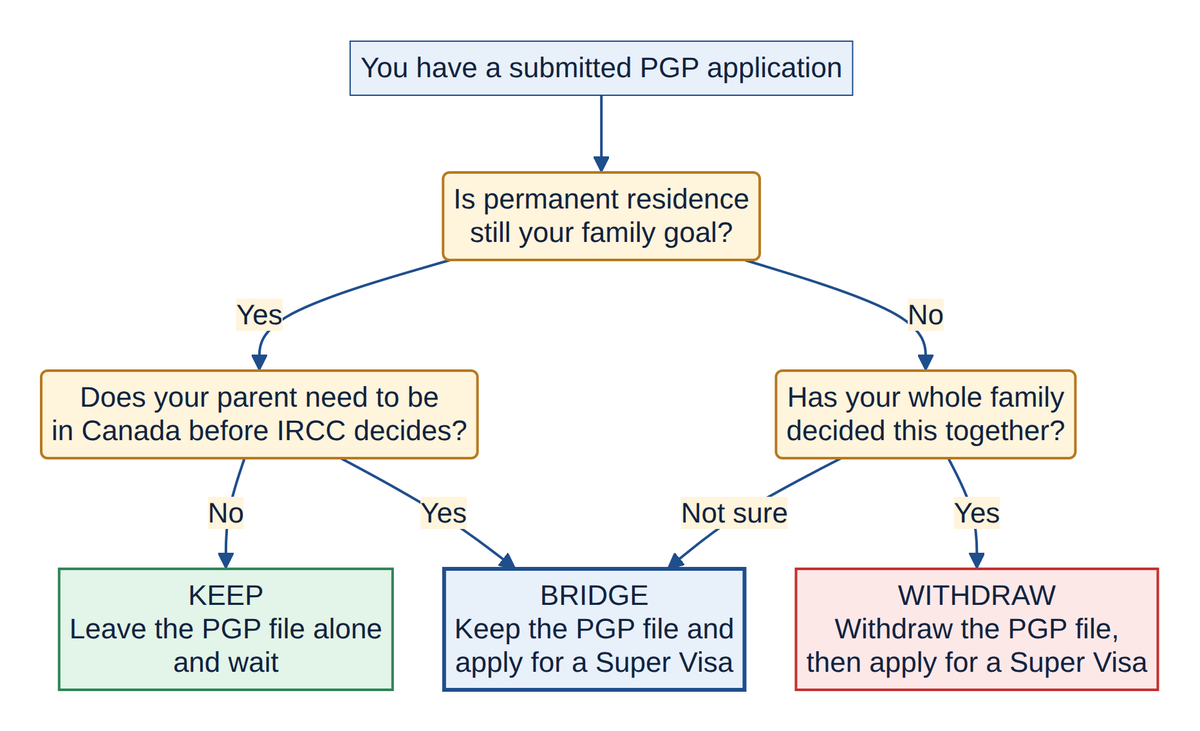
If you are unsure, follow the Bridge path. It is the one choice that keeps your PGP file and gets you a Super Visa. Here is how the two programs compare.
| Criteria | Super Visa | Pending PGP file |
|---|---|---|
| Status it gives | Visitor status, with stays of up to 5 years at a time and multiple entries for up to 10 years | Permanent residence, if approved |
| Can you start it now? | Yes, if you meet the rules | No. IRCC receives no new PGP applications |
| Your choice while you wait | Apply for it while you wait for a decision | Keep it, or withdraw it at any time |
Source for the table: IRCC, July 6, 2026; IRCC, MI 89.
Not sure which path fits your family? Book Your Strategy Assessment with Amir Ismail, RCIC #R412319.
What happens if you withdraw your PGP application?
Withdrawing ends your PGP sponsorship application. IRCC is not receiving new PGP applications in 2026, so you cannot file a replacement right now. We found no IRCC rule that bars a later application, but IRCC has given no reopening date. (IRCC, MI 89; IRCC notice, July 15, 2026)
You give up the application you already filed. If a new intake opens later, you would start from the beginning. IRCC has not said what that process would look like, so we cannot tell you what it will require.
When does withdrawing your PGP application make sense?
Withdrawing makes sense only when your family has decided that permanent residence through the PGP is no longer the plan. IRCC lets you withdraw at any time, and applying for a Super Visa does not require it. (IRCC, July 6, 2026)
Say a parent decides they would rather live in their home country and only visit. That is a real reason to withdraw. Wanting to “simplify” things is not.
Never withdraw as a shortcut. The simple rule: never close a door you cannot reopen.
What Does Your Parent Need for a Super Visa in 2026?
Your parent needs a qualifying host, enough host income, private medical insurance from an approved insurer, an immigration medical exam, and an application filed from outside Canada. IRCC lists these on its Super Visa eligibility and forms pages. (IRCC, July 6, 2026)
The host also writes and signs a letter of invitation. IRCC asks for proof of the medical exam from an approved panel physician, plus proof of your relationship, such as a birth certificate or another official document. Let’s take the big pieces one at a time.
Who can be the host?
The host must be the applicant’s biological or adopted child or grandchild, and must be able to prove it. The host must also be a Canadian citizen, permanent resident or registered Indian, at least 18 years old, and living in Canada. (IRCC, July 6, 2026)
That is you, if you are the son or daughter hosting a parent. Income is the requirement with the most math, so it gets the most space below.
What income do you need for a Super Visa in 2026?
The host must meet IRCC’s minimum necessary income (MNI) for the family size. Meet the full amount in either of the 2 tax years before you apply, or reach at least 75% in the year before and let your parents’ income cover the rest. (IRCC, July 6, 2026; IRCC notice, March 20, 2026)
A co-signer’s income can be added under either option. Here is IRCC’s table.
| Family size | Minimum necessary income (CAD) |
|---|---|
| 1 | $30,526 |
| 2 | $38,002 |
| 3 | $46,720 |
| 4 | $56,724 |
| 5 | $64,336 |
| 6 | $72,560 |
| 7 | $80,784 |
| Each extra person | Add $8,224 |
Source: IRCC, table updated July 29, 2025. IRCC updates this table, so check the current figure before you file.
Here is the 75% option in numbers, using a family of 4. $56,724 x 0.75 = $42,543. If you and a co-signer reach $42,543, your parents’ income must cover the other $14,181 ($56,724 minus $42,543). This is an example, not advice for your file.
Your parent must prove they will keep earning income while in Canada, and the document must show the currency.
IRCC’s family size count is not just your household. It also counts previously approved Super Visa holders whose visas are still valid, and people you sponsored earlier whose undertaking is still in effect (IRCC operational manual). For the full walkthrough, read our Super Visa income requirements guide.
What medical insurance is required?
The policy must give at least $100,000 in emergency coverage and stay valid for at least 1 year from the date of entry. It must come from a Canadian insurer or a foreign insurer that OSFI has authorized, and you can pay in full or in instalments with a deposit. (IRCC, July 30, 2026)
IRCC says the policy must cover health care, hospitalization and repatriation. It must name the insurer and be valid for each entry to Canada. A quote is not accepted. You need proof of an actual policy when you apply.
Can my parent apply from inside Canada?
No. A parent or grandparent must be outside Canada when they submit a Super Visa application. IRCC lists this in the applicant requirements on its eligibility page and repeats it on the apply page. (IRCC, July 6, 2026)
If your parent is in Canada right now, do not assume there is a way around this. The IRCC pages we read give no exception. Talk to an RCIC before you plan travel.
How Long Can a Super Visa Parent Stay in Canada?
A Super Visa lets a parent stay in Canada for up to 5 years at a time, with multiple entries for up to 10 years. The 5-year stay applies to applications made on or after June 22, 2023, and IRCC cannot issue a visa valid longer than the person’s biometrics. (IRCC, July 6, 2026; IRCC, August 28, 2026)
That is real time together. Birthdays, recoveries, grandchildren growing up. Two limits matter, and both come from IRCC: the biometrics cap on validity and the officer’s decision at the border.
How long is a Super Visa valid, and how long can my parent stay each visit?
The visa can be valid for up to 10 years with multiple entries, and each stay can last up to 5 years. IRCC also says a border officer decides how long your parent can stay each time they enter Canada. (IRCC, July 6, 2026; IRCC Help Centre)
Check the date the officer writes in the passport, or the “valid until” date on a visitor record. IRCC says that if the officer grants entry, your parent can stay 5 years even without a passport stamp.
IRCC also says: “We can’t issue you a super visa that’s valid for a period longer than your biometrics.” So 10 years is the ceiling, not a promise (IRCC, August 28, 2026).
Can a Super Visa holder extend their stay?
IRCC says that before your status in Canada expires, you must either leave Canada or apply to extend your stay. IRCC’s visitor record page asks you to apply at least 30 days before your current status expires. (IRCC, July 6, 2026; IRCC, January 9, 2026)
IRCC adds that it is your responsibility to keep valid visitor status. The visitor record page does not name Super Visa holders, so we cannot confirm from it exactly how it applies to them. If a stay is running out, ask an RCIC well before the 30-day mark.
How to Apply for a Super Visa While Your PGP File Is Pending (Step by Step)
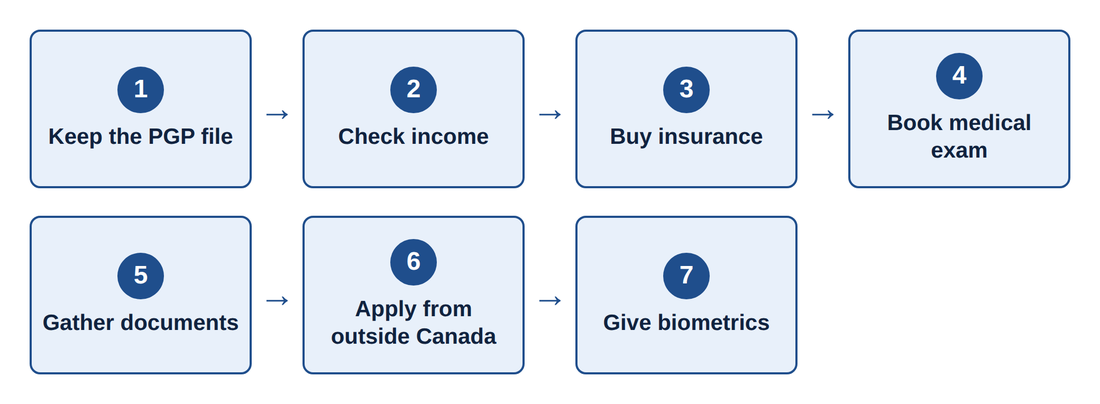
Follow seven steps, and leave your PGP file untouched. IRCC’s apply page has your parent sign in, answer a questionnaire, upload documents, pay fees, submit, then give biometrics. (IRCC, August 28, 2026)
Steps 1 to 5 are prep work. Steps 6 and 7 are the filing itself.
Step 1: Decide to keep your PGP file. Use the Keep, Bridge or Withdraw chart above. Do not withdraw unless your family has decided permanent residence is no longer the plan.
Step 2: Check your income against IRCC’s table. Find your family size in the minimum necessary income table. Then see whether you meet the full amount in either of the 2 tax years before you apply, or 75% in the year before.
Step 3: Buy a qualifying medical insurance policy. It needs at least $100,000 in emergency coverage and 1 year of validity from the date of entry. IRCC does not accept a quote, so you need a real policy.
Step 4: Book your parent’s immigration medical exam. IRCC asks for proof that your parent had a medical exam with an approved panel physician.
Step 5: Gather your documents. IRCC’s list includes the following.
- A signed letter of invitation with proof that you meet the minimum necessary income, and a list of family members with their names and dates of birth
- Proof of your status as a citizen, permanent resident or registered Indian
- Proof of relationship, such as your birth certificate or baptismal certificate, or another official document naming your parent
- Proof of the medical insurance policy and the medical exam
- Certified translations of any document not in English or French
Step 6: Apply while your parent is outside Canada. Your parent signs in to an IRCC account and answers the questionnaire, choosing “Visitor visa or super visa” and “To visit my children or grandchildren for more than 6 months.”
Then upload the documents from your checklist. Pay the $100 Super Visa fee and the $85 biometrics fee, if it applies, and submit.
Step 7: Give biometrics when IRCC asks. Wait for the biometrics instruction letter (BIL) after you apply, then follow it.
If an RCIC represents you, IRCC lists the Use of a Representative form (IMM 5476) among its forms. (IRCC, July 30, 2026)
Ready to file and want a second set of eyes? Book Your Strategy Assessment with Amir Ismail, RCIC #R412319.
Frequently Asked Questions About the Super Visa and a Pending PGP File
Can I apply for a Super Visa if my parents’ PGP application is already submitted?
Yes. IRCC says that if you have already submitted a sponsorship application, you can apply for a Super Visa while you wait for a decision. (IRCC, July 6, 2026)
Should I withdraw my PGP application to get a Super Visa?
No, not unless your family has decided permanent residence is no longer the plan. IRCC lets you withdraw at any time, but a Super Visa does not require it. IRCC is receiving no new PGP applications, so you could not replace a withdrawn file now. (IRCC, July 6, 2026; MI 89)
Will a Super Visa hurt my pending PGP application?
IRCC does not say that it will. We also cannot confirm from IRCC’s published pages how an officer weighs a pending PGP file inside a Super Visa decision. Ask an RCIC before you file. (IRCC, July 6, 2026)
Is the PGP taking new applications in 2026?
No. Under MI 89, effective January 1, 2026, IRCC receives no new PGP applications until further instructions are issued. IRCC’s July 15, 2026 notice says it will not receive new interest to sponsor forms until further notice. (IRCC, MI 89; IRCC, July 15, 2026)
How much income do I need to host my parents on a Super Visa?
It depends on your family size. For a family of 4, IRCC’s table shows $56,724, and the 75% option means reaching at least $42,543 with your parents’ income covering the rest. (IRCC, table updated July 29, 2025; IRCC notice, March 20, 2026)
Can my parents apply for a Super Visa while they are in Canada?
No. A parent or grandparent must be outside Canada when they submit a Super Visa application. (IRCC, July 6, 2026)
How long can a parent stay in Canada on a Super Visa?
A parent can stay up to 5 years at a time, and the visa allows multiple entries for up to 10 years. IRCC cannot issue a visa valid longer than the person’s biometrics. (IRCC, July 6, 2026; IRCC, August 28, 2026)
Talk to an RCIC Before You Choose
Every family is different. Income, family size, your parent’s health and your timing all shape the right move. For personalized guidance on applying for a Super Visa while your PGP file is pending, Book Your Strategy Assessment with Amir Ismail, RCIC #R412319.
Want to see how we handle these cases? Visit our Parent and Grandparent Super Visa page.
About the author
Amir Ismail, RCIC #R412319, is the founder of Amir Ismail & Associates, a regulated Canadian immigration consulting firm (CICC and CAPIC member) with over 35 years of practice and offices in Toronto, Dubai and Karachi.
Sources
- IRCC: Super Visa, who can apply
- IRCC: How to apply for a Super Visa
- IRCC: Super Visa forms and documents
- IRCC: Proof of financial support
- IRCC: How long you can stay in Canada
- IRCC: Visitor record eligibility
- IRCC: Ministerial Instructions 89
- IRCC notice, July 15, 2026: PGP intake paused
- IRCC notice, March 20, 2026: Super Visa income changes
- IRCC operational manual: Super Visa
- IRCC Help Centre: length of stay