Not sure you qualify? Take our Canadian citizenship eligibility quiz first.
Did your grandmother marry a Canadian soldier during WWII? Or was your parent born on a Canadian Forces base abroad?
The truth is… you may already be Canadian by descent and not even know it.
Under the new Bill C‑3 rules, many War Bride descendants and children of Canadian Forces members now qualify for Canadian citizenship by descent, even if they have never lived in Canada. Americans born before December 15, 2025, with a Canadian parent or grandparent in these groups may now be citizens automatically. No Canadian residence required.
This is one of the most emotionally powerful citizenship stories in Canadian immigration.
For decades, old rules punished women for marrying abroad, penalized families for living outside Canada, and left military children with a paper that meant nothing at the border.
Bill C‑3 changed that.
This guide explains what changed, who now qualifies, and what you need to prove it.
Key takeaways for War Bride & military families
- The law changed: IRCC says Bill C-3 (in force December 15, 2025) removed the first-generation limit in some situations. In most cases, a person born outside Canada to a Canadian parent before that date is now automatically a citizen.
- War Bride grandchildren: If your grandparent was a Canadian soldier who married a War Bride, you may now be a citizen automatically, even if your parent never applied.
- Military bases abroad: A DND 419 is not proof of citizenship (IRCC; National Defence). Children born on Canadian bases abroad may be citizens through their parents, and for births before December 15, 2025 no physical presence in Canada is required.
- No residency required: Americans and others who qualify under this retroactive restoration do not need to move to Canada to get their citizenship certificate.
Why did Bill C‑3 reopen the door for War Bride and military families?
Bill C‑3 removed the rule that blocked many grandchildren and great‑grandchildren of Canadians born abroad from claiming citizenship by descent.
If you were born before December 15, 2025, IRCC does not cap how far back your Canadian ancestor can be, as long as you can prove each generation. One properly documented Canadian in your family line can be enough.
For years, Canada had a rule that said only the first generation born abroad could pass on citizenship. This rule blocked many War Bride grandchildren and military children from claiming the status they should have had from birth.
In December 2023 the Ontario Superior Court of Justice declared the first-generation limit, as it was then, unconstitutional for many people in Bjorkquist v. Canada (2023 ONSC 7152). The federal government announced in January 2024 that it would not appeal, and Parliament passed Bill C-3, which took effect on December 15, 2025.
For War Bride families and military families, this matters enormously. The 2009 limit specifically cut off grandchildren of Canadian soldiers who had married and had children abroad during or after World War II. It also caught the adult children of Canadian Forces members born on overseas bases in the 1960s and 1970s. Bill C-3 retroactively restores citizenship to most of them.
For a full breakdown of what Bill C-3 changed and who qualifies broadly, see our overview of Canadian citizenship by descent and Bill C-3.
What is a Canadian War Bride and why does her grandchild have a claim?
A Canadian War Bride was usually a woman from Britain or Europe who married a Canadian soldier during or right after WWII and later came to Canada.
Many of their children were Canadian from birth, even if the paperwork was never done. That means their grandchildren today may already be Canadian by descent, but they need documents to prove the chain.
Between 1942 and 1948, nearly 44,000 war brides, mostly from Britain and Europe, came to Canada with about 22,000 children, according to the Canadian Museum of Immigration at Pier 21. Most arrived through Pier 21 in Halifax. Order in Council P.C. 1945-858 facilitated the entry of military dependents and gave them Canadian domicile, but the Federal Court of Appeal held in Taylor v. Canada, 2007 FCA 349 that it could not in and of itself confer Canadian citizenship.
IRCC’s proof of citizenship guidance says that for people registered between January 1, 1947 and February 14, 1977, a Certificate of Registration of Birth Abroad is accepted as proof of citizenship. Many War Bride families never obtained formal proof of citizenship for children born abroad.
Decades later, that gap in documentation became the wall that blocked their grandchildren from claiming the citizenship their grandfather’s military service earned.
Here is the typical scenario that affects thousands of American families today. A Canadian man, born in Nova Scotia, marries a British woman in England in 1944 while serving with the Canadian Armed Forces. Their daughter is born in England in 1946. The family later moves to the United States under the US War Brides Act. That daughter grows up in America, has children, and never pursues her Canadian status. Now her adult child, born in the 1970s or 1980s in the US, wants to know: “Am I Canadian?”
Under the 2009 first-generation limit, that grandchild was blocked. Under Bill C-3, if they were born before December 15, 2025 and their mother was a Canadian citizen at the time of their birth, they are now recognized as Canadian by operation of law.
The critical legal mechanism is the 2009 retroactive restoration. French-Canadians and other Canadians who emigrated and naturalized in the United States before 1977 had their citizenship stripped under the old 1947 Act. The 2009 amendments retroactively restored that citizenship. This means a War Bride’s child who never formally documented her Canadian status may still count as a Canadian citizen in the lineage chain, because the law now treats her as having always been one.
For more on how this restoration works for Americans specifically, see our guide on Canadian citizenship by descent for Americans.
Am I a Canadian citizen by descent?
Trace your family line one generation at a time. Each link is tested against the law in force when that person was born, so you see exactly where your chain holds and where it breaks. About three minutes, and no account needed.
Check my family lineWhat is a DND 419 and why is it not proof of citizenship?
A DND 419 is a birth document issued by the Department of National Defence for children born on Canadian Forces bases abroad.
It only records the birth. It does not prove Canadian citizenship. To prove citizenship, you still need a Citizenship Certificate from IRCC based on your parent’s Canadian status.
IRCC says it does not accept DND 419 birth certificates as proof of Canadian citizenship, and National Defence says DND 419s, which may have been issued to children born at military bases outside Canada between 1963 and 1979, are not accepted as proof of citizenship. If you were born at a military base outside Canada and need proof of citizenship, you must apply to IRCC for a citizenship certificate, and proof of your parent’s service abroad at the time of your birth may be required (National Defence, military records page).
This has caused real harm to real people. There are documented cases of men and women in their 50s and 60s who spent their entire lives believing their DND 419 was their proof of Canadian identity, only to be told at a health card office or passport counter that the document means nothing for status purposes. The CBC has covered cases where individuals discovered this problem decades after the birth.
The good news is that most DND 419 holders do qualify for Canadian citizenship through the regular descent rules. If both parents were Canadian citizens at the time of birth, as is common among Canadian Forces families, the child born on the overseas base was a Canadian citizen from birth. The DND 419 is simply not the document that proves it. What proves it is a Citizenship Certificate issued by IRCC, applied for with the right supporting documents.
The DND 419 can still be submitted as supporting evidence alongside a military service file from Library and Archives Canada. It helps establish the facts of the birth and the posting. But it cannot substitute for the formal citizenship certificate.
How do War Bride descendants build their document chain for citizenship by descent?
War Bride descendants need to construct a vertical, linear document chain from themselves back to the qualifying Canadian ancestor, generation by consecutive generation. Every link needs documents from the original authority that prove parentage and Canadian citizenship. A gap in the chain, or a name mismatch without explanation, may lead IRCC to ask for more information, and IRCC says an incomplete application may be returned.
Required Documents for War Bride Descendants
Applicant Documents:
- Birth certificate displaying the name of your Canadian parent (IRCC, CIT 0014)
- Current government-issued photo ID
Parental Documents (For each link in the chain):
- Birth certificate showing the parent-child relationship
- Marriage certificate, where names differ between records (IRCC asks for a letter of explanation for documents that need clarification)
- Death certificate (if deceased and required to establish the generational link)
For the Canadian anchor (typically the grandfather who served):
- Canadian birth certificate or Canadian naturalization certificate
- Military service records confirming overseas deployment and the dates of service
- Marriage certificate showing the marriage to the War Bride, including location and date
War Bride-specific supporting documents:
- Immigration records showing the War Bride and child’s arrival in Canada (Library and Archives Canada holds passenger lists; for lists after 1935, follow LAC’s instructions for requesting them)
- Registration of Birth Abroad certificate, if one was ever obtained
- Any documentation of the War Bride’s landing and entry under the relevant Orders in Council
- US War Brides Act immigration records, if the family later moved to the United States
The strongest single document in many of these applications is the grandfather’s Canadian birth certificate combined with his military marriage record. Together, they establish both his Canadian status and the legal relationship to the War Bride and their children.
A complete document checklist for citizenship by descent applications is available in our guide on Canadian citizenship by descent documents and Bill C-3.
How do children of Canadian Forces members apply with a DND 419?
Children born on Canadian Forces bases abroad, and their own children, apply for a citizenship certificate through IRCC using Form CIT 0001, the same form used for all citizenship by descent applications. The DND 419 is included as supporting evidence but is never the primary basis of the claim. The actual citizenship claim rests on the parent’s status.
The document package for a DND 419 holder typically includes:
For the applicant:
- DND 419 as supporting evidence of birth abroad
- Any local civil birth registration from the host country, if one exists
- Current government-issued photo ID
For the Canadian parent:
- Canadian birth certificate or citizenship certificate
- If the parent was also born abroad (second-generation military), their own citizenship proof must be established first, using the same process
Proof of military service:
- Military service file from Library and Archives Canada confirming the parent’s posting abroad at the time of the birth
- This record establishes that the overseas birth was connected to Canadian military service, which may be relevant to specific exemptions under the Citizenship Act
For grandchildren of DND 419 holders (second-generation military families): This is where the process runs in sequence. If your mother was born on a Canadian base and has a DND 419 but never obtained a citizenship certificate, she must apply first and establish her own citizenship before you can apply as her child. Once her certificate is issued confirming she was a citizen at the time of your birth, you submit your own application.
There is a meaningful benefit for current and future military families worth noting here. Under Bill C-3, children born on or after December 15, 2025, to a Canadian parent who was also born abroad would normally need that parent to show 1,095 days of physical presence in Canada. However, if the Canadian parent was serving abroad with the Canadian Armed Forces, the federal public administration, or a provincial public service at the time of the child’s birth, that physical presence requirement is entirely waived. Military service abroad is treated as an ongoing connection to Canada, and the Substantial Connection test does not apply.
What are the biggest challenges in War Bride and DND 419 citizenship applications?
The most common problem is the missing Registration of Birth Abroad. Before 1977, children born outside Canada to Canadian parents needed to be formally registered with the Canadian government to lock in their citizenship. Many War Bride families and military families never completed this registration, because no one told them they had to. Decades later, their descendants discover the gap in the paperwork and have to rebuild the evidentiary trail from scratch.
Name changes and anglicization are the second major challenge. War Bride families were often from Britain or Europe, and names were sometimes shortened, anglicized, or changed entirely after immigration to Canada or the United States. IRCC expects documents to link consistently across generations. When a name on a UK birth certificate does not obviously match a name on a US marriage certificate from the 1960s, the applicant needs additional documentation explaining the discrepancy.
Out-of-wedlock births under the old rules created a third category of difficulty. Under the 1947 Citizenship Act, Canadian citizenship passed through the father in a legitimate marriage, not through the mother, and certainly not to children born outside of marriage. This discriminatory structure was eventually corrected by later amendments and retroactively, but applications involving births outside marriage before 1977 may still require additional legal analysis.
The Lost Canadians problem extends into this community. Many War Bride descendants and military children fall squarely into the “Lost Canadian” category: individuals who legally are or were Canadian but lost or never fully obtained their status due to old technicalities. Bill C-3 resolved most of these cases for people born before December 15, 2025, but the documentary burden of proving eligibility still falls entirely on the applicant.
For a deeper look at the Lost Canadians history and how Bill C-3 addressed it, see our article on Lost Canadians and citizenship by descent.
How long does proof of citizenship take in 2026 and what does it cost?
IRCC’s processing times tool showed about 35 months for proof of citizenship in data updated November 17, 2026, with about 139,200 files in the queue. War Bride chains spanning three or more generations, and DND 419 cases that need military records from Library and Archives Canada, take longer to prepare before you can file.
The application fee for a citizenship certificate is CAD $75 per person. That is the IRCC fee only. The real cost is in the documents: certified copies of birth, marriage, and death certificates from multiple provinces and countries, military service records, Library and Archives Canada fees, and potential translation costs for European documents in the case of War Bride families. Most applicants in these two categories spend CAD $400 to $1,200 or more on documentation before submitting to IRCC.
Library and Archives Canada holds Second World War service files and passenger lists. If a service member survived the war, National Defence says you need an Access to Information request through LAC for the service file. Most citizenship and naturalization records, which can include Registration of Birth Abroad records, are held by IRCC, and IRCC offers a search of citizenship records (LAC, citizenship and naturalization records).
IRCC does offer urgent processing for citizenship certificates where a specific urgent need can be demonstrated. Full details on eligibility criteria and the process for requesting expedited review are covered in our guide on urgent processing for Canadian citizenship certificates.
One procedural note: IRCC’s guide says you may not hold more than one valid certificate of citizenship, and that you must return any original certificates you have with a replacement application.
Full processing time data for citizenship and other IRCC streams is tracked in our current guide on proof of Canadian citizenship processing times in 2026.
Not sure you qualify?
Take our Canadian citizenship eligibility quiz in about two minutes, read the Canadian citizenship guide, then Book Your Strategy Consultation with Amir Ismail, RCIC #R412319, to confirm your path.
Frequently asked questions: War Brides, DND 419, and Bill C‑3
My grandmother was a War Bride from Britain. She married my Canadian grandfather during WWII. Am I Canadian?
Possibly, yes. If your grandfather was born in Canada or was a Canadian citizen, and your parent was born to both of them before December 15, 2025, you may now automatically qualify under Bill C-3. The key questions are whether your parent’s Canadian citizenship can be established through the lineage chain, and whether you have the documents to prove every generational link. A precise legal assessment of your specific family history is the best starting point.
I have a DND 419 from when I was born on a Canadian base in Germany in 1971. Is that enough to get a passport?
No, a DND 419 is not accepted as proof of Canadian citizenship for a passport. It only records a birth abroad. To get a Canadian passport, you must first apply for a formal Citizenship Certificate through IRCC (Form CIT 0001) using your parents’ citizenship records and military service files.
My mother was born on a Canadian base abroad in 1975 and has only a DND 419. I was born in the US in 1998. Can I get Canadian citizenship?
Yes, you likely qualify for Canadian citizenship by descent if you were born before December 15, 2025. IRCC says that in most cases a person born outside Canada to a Canadian parent before December 15, 2025 is automatically a citizen, so you can claim through your Canadian grandfather if you can document each generation.
My grandfather naturalized as a US citizen in the 1950s after coming back from the war. Does that break the citizenship chain for our family?
Not under the current law. The 2009 amendments restored Canadian citizenship to people who lost it for reasons other than renunciation or revocation, which includes acquiring another nationality (Citizenship Act, s. 3(1)(f)). IRCC asks for proof of other nationalities acquired before February 15, 1977, and a US naturalization certificate is an example. You will also need documents proving each generation.
Is there a difference between how War Bride descendants and DND 419 holders approach the application?
The underlying application is the same: Form CIT 0001 for a citizenship certificate. The difference is in the supporting documents. War Bride descendants focus on the grandfather’s Canadian status, military marriage records, immigration arrival records and any Registration of Birth Abroad. DND 419 holders focus on the parents’ proof of Canadian citizenship and military service records that confirm the overseas posting. Both groups need documents from the original authority that prove parentage and citizenship for each generation.
What if my family’s records were lost, destroyed, or never created?
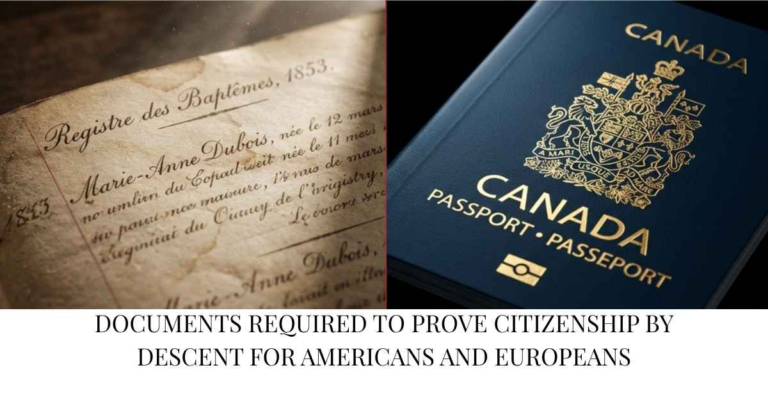
IRCC’s guide lists other documents that can show parentage and citizenship when a birth certificate or record is missing: a hospital record of birth, a record from a physician or midwife who witnessed the birth, a baptismal certificate or record, census records and a boat manifest, issued by the original authority. If you cannot provide official documents from the original authority, you must explain in writing why you cannot and show proof that you tried to get them. Library and Archives Canada holds military service files, passenger lists and census records that applicants often do not know to look for.
Your next step: get a clear answer before you spend money and time
War Bride and military family cases reward preparation. The document chain is long, the records are scattered across countries, and IRCC does not forgive gaps it cannot explain.
Get the strategy right before you spend months and hundreds of dollars chasing the wrong records.
I’ve spent more than three decades working on Canadian citizenship cases like these. I know how to read a family history, find the legal “anchor” in the chain, and build a file that can stand up to IRCC scrutiny on the first pass.
Book Your Strategy Consultation to map your eligibility, list every document you need, and get a clear plan before you apply.
Amir Ismail is a Regulated Canadian Immigration Consultant (RCIC #R412319), licensed since 1991. Amir Ismail and Associates has assisted over 25,000 clients across Canada, the UAE, and Pakistan and is a 2026 Canadian Choice Award recipient.
Read More Citizenship By Descent Resources By Amir Ismail

Levels Plan Citizenship by Descent: Is There a Quota for Americans?
No, there is no quota or cap for Canadian citizenship by descent. The 2027 to…

Manchester, New Hampshire Families: Canadian Citizenship by Descent Records
If your family is from Manchester, New Hampshire and has French-Canadian roots, you may already…

Citizenship by Descent or by Grant: Which Route Are You On?
Minnesota Families With French-Canadian Roots: Canadian Citizenship by Descent
If your family is from Little Canada, Saint Paul or elsewhere in Minnesota and has…
How IRCC Assesses Citizenship by Descent: What an Officer Checks in Your Family Tree
IRCC assesses Canadian citizenship by descent by checking your family tree one official record at…