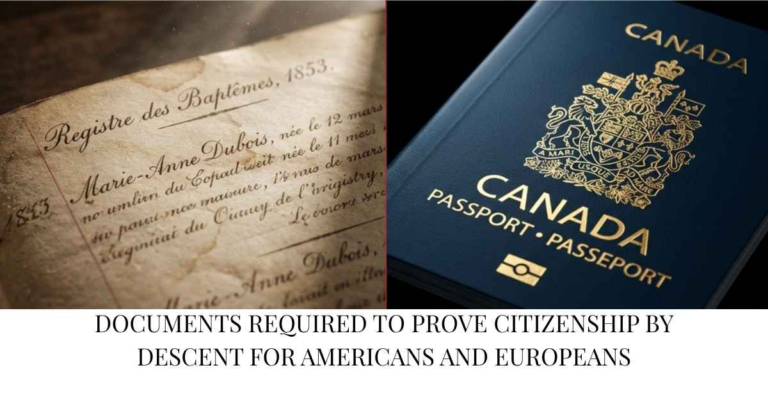

If a Canadian parent had citizenship when you were born abroad, you are on the descent route and you may already be a citizen. If not, you can only become one by grant, which starts with being a permanent resident with 1,095 days in Canada in the last 5 years (Immigration, Refugees and Citizenship Canada (IRCC), April 2026). The two routes use different applications, so picking the wrong one wastes months.
Maybe you just learned your grandmother was born in Winnipeg. Or maybe you have lived in Canada for years and wonder if that counts. Both feel like the same question, but the answer sends you down two very different roads.
Want a quick read on your family line before you go further? Try our free tool, Am I a Canadian citizen by descent?, then come back here.
What You Will Find On This Page
Key Takeaways
- Descent is about your birth. If you were born outside Canada to a Canadian parent, you may already be a citizen, and a certificate proves it (IRCC, February 2026).
- Grant is about your life in Canada. You must be a permanent resident and have been in Canada for at least 1,095 days in the last 5 years (IRCC, April 2026).
- Marriage, a refugee claim or years as a permanent resident do not make you a citizen on their own. IRCC says so on the same page (IRCC, February 2026).
- The certificate costs $75 per person. Descent claims go through that application (IRCC, June 2026).
- Two different 1,095 rules exist. One is for adults applying by grant. The other is for the Canadian parent of a child born abroad on or after December 15, 2025.
What is the difference between citizenship by descent and by grant?
Citizenship by descent means you already hold citizenship because of a Canadian parent, and you apply to prove it. Citizenship by grant means you are not a citizen yet and you apply to become one. IRCC puts it plainly: if you are not a Canadian citizen, you may still be eligible to apply for a grant (IRCC, February 2026).
The word “descent” is not a separate status in the IRCC guides. It is how many people describe being a citizen through a parent or an older ancestor. The legal question is simple: were you a citizen the moment you were born, or not?
| Question | Descent (you may already be a citizen) | Grant (you apply to become one) |
|---|---|---|
| Who it fits | People born outside Canada to a Canadian parent, and some older family lines | Permanent residents who have lived in Canada long enough |
| What you prove | A chain of records from you back to a Canadian citizen | Permanent resident status, time in Canada and the other adult requirements |
| Main application | Citizenship certificate (proof of citizenship) | Application for Canadian citizenship |
| Test, language proof and oath | You are proving a status you already hold, not becoming a citizen | Required for adults aged 18 to 54 (test and language), plus the oath |
If you apply by grant and are 18 to 54, you must pass the citizenship test and prove your English or French. Every approved adult takes the oath (IRCC, April 2026). A certificate does not need any of these, because you are proving citizenship you already have.
How do you tell which route you are on?
Start with where and when you were born, and who your parents were on that day. IRCC says you are likely a citizen if you were born in Canada, and likely a citizen if you were born outside Canada before December 15, 2025 to a parent who was a Canadian citizen when you were born (IRCC, February 2026). If neither fits, look at your life in Canada next.
Work through these steps in order and stop at the first one that fits you.
- Born in Canada: you are likely a citizen, and your provincial or territorial birth certificate is valid proof (IRCC, February 2026). Children of foreign diplomats posted in Canada are an exception.
- Born abroad before December 15, 2025: ask whether your parent was a Canadian citizen on the day you were born. If yes, you are likely a citizen and you are on the descent route.
- Born abroad on or after December 15, 2025: your Canadian parent must have been a citizen when you were born, and a parent who was also born outside Canada must have spent at least 1,095 days in Canada before your birth.
- Adopted abroad by a Canadian parent: you are not automatically a citizen. You or your parent can apply once the adoption is complete (IRCC, February 2026).
- None of that fits: check whether you are a permanent resident with 1,095 days in Canada in the last 5 years. If yes, you may be able to apply by grant.
- Still cannot tell: use our eligibility quiz before you spend money on records.
These steps are a starting point, not a ruling. Special cases, such as a parent who gained citizenship later because of changes to the Citizenship Act, can change the answer (IRCC, February 2026). Our page on citizenship by descent goes deeper.
Who has to apply by grant, not by descent?
You apply by grant when no Canadian parent passed citizenship to you. IRCC lists three situations that do not make you a citizen on their own: marrying a Canadian citizen, having a refugee claim accepted, and living in Canada for many years as a permanent resident (IRCC, February 2026). In each case you can still apply for a grant if you meet the adult requirements.
Spouses are a common worry. IRCC says you do not automatically become a citizen when you marry a Canadian, and you must meet the same requirements as any adult (IRCC, April 2026). Our post on what descent does and does not do for a spouse explains what that means for you.
A parent who became a citizen after you were born is a tricky case. IRCC says you are not automatically a citizen in that situation, but it also says changes to the Citizenship Act may have given citizenship to people whose parent became a citizen because of those changes, even after the birth (IRCC, February 2026). Read our guide to Section 8 lost Canadians if your family story fits.
Adopted children are in between. Adoption abroad by a Canadian does not create citizenship by itself, so those families usually apply after the adoption. We cover that in Canadian citizenship for an adopted child abroad.
Why does the number 1,095 show up in both routes?
Because Canada uses 1,095 days, which is 3 years, in two different rules that readers often mix up. For a grant, an adult must have been a permanent resident and physically in Canada for at least 1,095 days in the last 5 years (IRCC, April 2026). For descent, a child born abroad on or after December 15, 2025 to a Canadian parent who was also born abroad needs that parent to have spent at least 1,095 days in Canada before the birth (IRCC, February 2026).
| Grant rule | Descent rule for births abroad on or after December 15, 2025 | |
|---|---|---|
| Whose days count | Yours, as the applicant | Your Canadian parent’s |
| When they are counted | In the last 5 years before you apply | Before the child was born |
| Where the days are spent | In Canada. Days as a permanent resident count in full. Days before that, as a temporary resident or protected person, count as half days, up to 365 days. | In Canada |
| Applies to | Adults applying for a grant | A child born abroad to a parent who was also born abroad |
If your child was born abroad before that date, the second rule does not apply. Our post on Bill C-3 and second-generation children sets out who is covered.
The parent rule is in section 3(3) of the Citizenship Act. Bill C-3, An Act to amend the Citizenship Act, added it on December 15, 2025.
Which application do you send for each route?
On the descent route you apply for a citizenship certificate, and on the grant route you apply for citizenship. IRCC says you can apply for a certificate if you do not have proof of your citizenship, lost your documents, or are not sure you are a citizen and want IRCC to check (IRCC, February 2026). The certificate costs $75 (IRCC, June 2026). An adult grant costs $653, which includes the right of citizenship fee.
If IRCC confirms you are a citizen, it issues the certificate, and you can then apply for a Canadian passport. IRCC advises anyone who thinks they may be a citizen to get proof and a passport before they travel, to avoid delays at the border (IRCC, February 2026). A certificate is not a travel document, so you still need a valid passport to travel (IRCC, June 2026).
Our proof of citizenship page and our citizenship by naturalization page show each path in more detail, and our post-certificate guide covers the next step.
All dates and rules in this post come from Immigration, Refugees and Citizenship Canada (IRCC) pages read in November 2026: Check if you may be a citizen, citizenship eligibility, certificate process, and the fee list. IRCC updates its pages, so check the current version before you apply.
Frequently asked questions
What is the difference between citizenship by descent and citizenship by grant?
Descent means you are already a citizen through a parent. Grant means you apply to become one. Descent applies when a Canadian parent passed citizenship to you at birth, and you apply for a certificate to prove it. Grant applies when you are not yet a citizen and apply to become one. IRCC treats them as separate routes (IRCC, February 2026).
Can I apply by grant if I think I might already be a citizen by descent?
No, apply for a citizenship certificate first. IRCC says to do this if you are not sure you are a citizen and want IRCC to check. If you are a citizen, you do not need the grant process. Use our descent checker first so you know which way to lean.
Does marrying a Canadian make me a citizen?
No. IRCC says you do not automatically become a citizen when you marry a Canadian, and you must meet the same requirements as other adults who apply by grant (IRCC, April 2026).
How many days in Canada do I need to apply for citizenship by grant?
You need at least 1,095 days in Canada in the last 5 years. You must be a permanent resident. Each day you were in Canada as a temporary resident or protected person in those 5 years counts as half a day, up to 365 days. You may also need to have filed taxes for at least 3 of those years (IRCC, April 2026).
Do I need to pass the citizenship test for a certificate?
No, the citizenship test is only for the grant route. IRCC lists the citizenship test and the language proof as requirements for adults aged 18 to 54 who apply by grant (IRCC, April 2026). A certificate application proves citizenship you already hold, so it is a different process.
How much does a citizenship certificate cost?
The fee is $75. (IRCC, June 2026). Records, copies and any translations are extra. Fees can change, so confirm the current amount on the IRCC page before you pay.
If you are not sure which route fits your family, and you want a clear plan before you spend money on records, Book a Strategy Consultation.
Amir Ismail is a Regulated Canadian Immigration Consultant (RCIC #R412319) who has been associated with the immigration consulting industry since 1991.